Little Inventions, Big Applications: Commercializing Patents
Lavai Yang / photos Hsueh Chi-kuang / tr. by Scott Williams
October 2011


Taiwanese are great inventors and win prizes every year at major international invention expos like those held in Nuremberg and Pittsburgh. According to the Global Competitiveness Report 2011-2012 published by the World Economic Forum, Taiwan ranks first in the world in the number of patents per capita (355.57 US patents per 1 million people) and innovation is certainly a driving force in the new economy.
To encourage industry to put this asset to use, the government has since last year integrated resources to aid individuals, corporations and academia in commercializing inventions. The goal is to convert Taiwan from a manufacturing powerhouse into a "Republic of Creation."
Taiwan's representatives at the world's seven major invention expos have done very well in recent years. At the long-running events in Nuremberg and Geneva, for example, Taiwan has won consecutive top prizes for teams. Last year, 82 of the 98 entries Taiwan submitted for competition at the Nuremberg expo won awards. That's a remarkable 84% of submissions, and far above the 35% average for all nations. At this year's Geneva expo, a record 96% of Taiwanese entries won prizes.
But, setting aside the honor these awards bring our nation, how are we to turn our inventions into products that improve our national productivity and competitiveness and further our economic development? This question has been an important strategic consideration underlying the government's efforts to bring innovation and industry together.
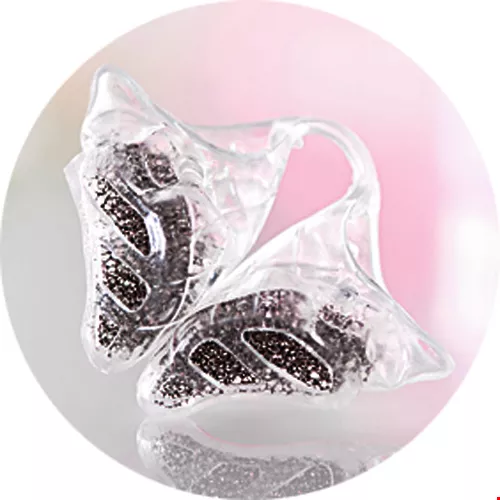
KiAYA holds numerous patents on its nostril filters, which are made of a porous, biocompatible thermoplastic rubber filter material.
The government will invest a total of NT$11.8 billion in the six-year program (2010-2015), funded by the Ministry of Economic Affairs, the National Science Council, and Council of Agriculture. Its objective is to create a successful model for commercialization that will spur the transfer and licensing of more than 5,000 patented technologies, catapulting Taiwan into the ranks of the world's leaders in patent transactions.
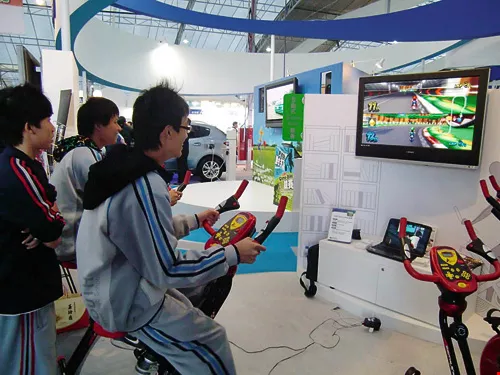
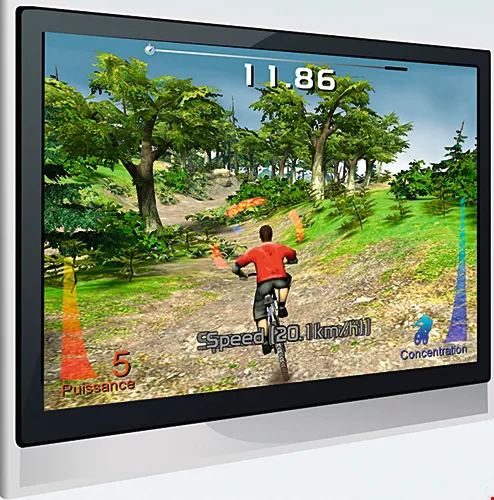
When connected to the Internet, this exercise bike developed by the Cycling and Health Industry Research and Development Center allows riders to game together.
Taiwan has been referred to as a "smart island," but the differing resources of individuals, industry, and research institutions mean they face different challenges in commercializing innovations. For individuals, who usually lack capital, technology, and a firm grasp of potential markets, commercialization is a high-risk proposition.
The "invisible mask" that won a bronze medal at the 2005 Taipei International Invention Show and Technomart (TIIST) was nothing more than a concept at the time of the show. The idea had its genesis with inventor Wang Shunqing's desire to help his severely asthmatic son. He was intensely focused on the problem of building a device that would filter airborne allergens such as dust and dust mites.
During the SARS outbreak of 2003, Taiwan's supply of N95 respirator masks and surgical masks failed to keep up with demand. Moreover, wearing them interfered with breathing. Wang thought that a mask that was "invisible" when worn over the nose and mouth would be less stifling, less of an impediment to breathing, and less prone to getting dirty.
But his lack of capital made moving the idea from blackboard to prototype a serious challenge. Every step of the process, from designing and developing a mold to testing the safety of the mask and filter materials to clinical trials and product revisions, required serious money. Applying for patents in Taiwan, the US, and mainland China was also very expensive.
"If I'd realized that it would take five or six years and millions of dollars to get from patenting the invention to commercialization," says Wang, "I might never have started the process."
In 2010, assistance from Chen Shiang Intellectual Property (CSIPO), a consultancy that works with the Industrial Development Bureau's Taiwan Technology Marketplace (TWTM), enabled Wang to sell his six nostril-filter-related patents to KiAYA & Co.
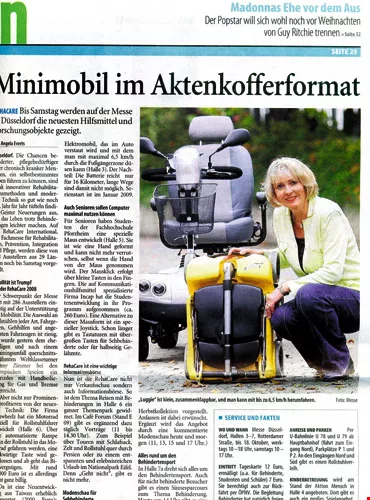
The small, foldable Luggie, the world's lightest scooter, has been the subject of much media attention in Europe.
KiAYA is a small textiles firm that has been expanding into biotechnology. After obtaining Wang's patents, the company spent NT$25 million on R&D aimed at commercializing them. It took KiAYA six months of trials to find an appropriate material: a biocompatible thermoplastic rubber (TPR) similar to those used in artificial cardiac catheters. It then worked with a Japanese company to develop a porous filter material arranged in six alternating layers that lets the wearer breathe freely while filtering 99.9% of airborne pollutants and allergens.
Max Ho, KiAYA's director, says that the company experienced a number of manufacturing problems at the outset. They had to completely reconfigure the composition of the biocompatible TPR and the manufacturing process they were using to make it after they realized that the material felt entirely different in the nose than it did in the hand. The changes made the "nasal mask" more comfortable to wear. But they had to be careful when utilizing the new process. If they didn't properly mix the raw materials for the TPR and then heated it too much, they were likely to produce nothing but burnt pellets of charcoal.
Even though KiAYA's parent company supported it with equipment and assistance developing the molds, their factory's one machine initially produced only 20-some of the "invisible masks" that met quality-control standards per day. The company simply could not recoup its production costs at those quantities. After six months of experimentation, innumerable tweaks, custom manufacturing low-temperature equipment and other parts, and discarding more than 3,000 failed products, the company finally went into mass production.
In April of this year, KiAYA began selling the product online and through drugstore chains under the Healthnaso brand. The product comes in three sizes tailored to Asian nostrils and is priced at NT$250-300 per filter. Consumer response has been positive because, unlike traditional surgical masks, the filters don't absorb nasal mucus or obstruct breathing. They can also be sterilized and reused for up to two weeks.
"The government has helped us a lot with marketing," says Ho. "Technology transfers, invention exhibitions, new product press announcements and press conferences have all increased the product's exposure."
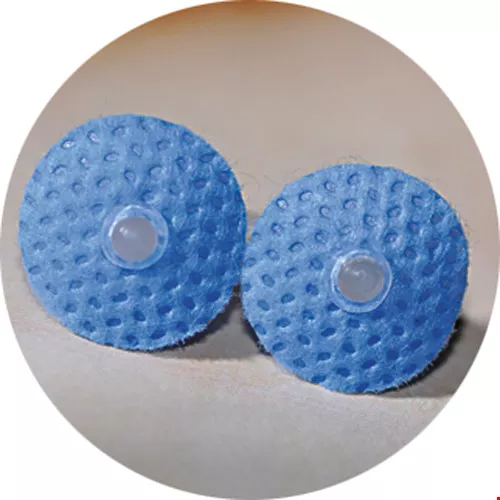
Similar products from Japan and Korea utilize a disk of non-woven fabric bound by a ring, but still have problems with impeding the wearer's breathing.
One key strategy of the commercialization promotion program is to bring together experts from research institutions, academia, and the technology services industry to create a consulting center capable of selecting invention patents with market potential.
What kind of patented technologies have the potential to be developed into products?
Zhou Zhengyi, president of CSIPO, says that the first thing to look at is the quality of the patent. In the case of the invisible mask, what was the scope of the patent claims? Was it simply an air filter? Could it also be used to deliver medications or aromatherapies? Did it have other functions? Patents are valid only in the territory in which they are issued. Because applying for patents in multiple countries is very expensive, you need to study the market before filing to make sure an application is worth the cost.
You also have to look at how long the patent protections will remain in effect. Taiwan issues three kinds of patents. An invention patent offers the broadest protections, but is difficult to get. It requires overcoming a variety of hurdles and examinations and takes two to three years to be approved, but once granted remains in effect for as long as 20 years. A utility model patent covers a new form, structure, or function for a product and has a term of 10 years, while a design patent has a term of 12 years.
If a patent has only two or three years of validity remaining, product development could very well consume all of it. Given that production, marketing and distribution take still more time, commercialization generally isn't recommended in this situation.
Next up, you have to look at the competitiveness of similar patents. For example, what similar licensed products and competitor firms exist? You need to take the sales figures and popularity of these similar products into account.
Finally, you have to look at substitutability. How likely is it that another technology will replace that of this patent?
Whereas large corporations can develop or import new technologies themselves, and can respond to infringement suits by obtaining patents through transfers, small and medium-sized enterprises are in the same boat as individuals: they lack capital and the means to test and assess key production technologies.
For example, Sun Yu Windows won a TIIST silver medal and a Nuremberg gold medal in 2009 for an airtight window track that allows panes to slide on a horizontal track but close in alignment with one another. The windows are attractive, watertight, and soundproof. But the company was a traditional manufacturer of aluminum window frames with just 25 employees. It wanted to expand, but didn't know how to plan its operations.
After an evaluation by TWTM's consulting center last year, the center used the resources of the MOEA's SME Instant Technical Assistance Program to apply for a "soundproof green building material" label for Sun Yu's product. Once the product had been tested for toxicity and for soundproofing effectiveness, the company was able to raise its price.
Another company, Kaohsiung's Free-rider Corp., has developed the world's lightest electric mobility scooter, the 23.5 kilogram Luggie. Only 45.5 centimeters in width, the Luggie can be driven straight onto an airplane, or folded up into a traveling case and checked. It also fits easily in the trunk of a car, and is a Taiwan Excellence gold-medal winner.
Established in 1995, Freerider manufactures wheelchairs, carts, and scooters for medical applications. The heart of its lightweight scooter patent is the design of the mechanism that allows the vehicle's frame, handlebars, and seat to fold and unfold. There are numerous ways to fold the scooter, but with just a moment's practice folding it becomes second nature. The scooter also has four small auxiliary wheels that allow it to be wheeled around like a piece of luggage when folded.
"The Luggie's light weight has not compromised its quality," says Freerider president Fan Ju-yu, who suffers from mobility issues of her own. "The seat and seatback are ergonomically designed, and the vehicle itself is foldable. The elderly and the physically impaired can drive it straight onto a bus, subway car, or airplane by themselves without any problems."
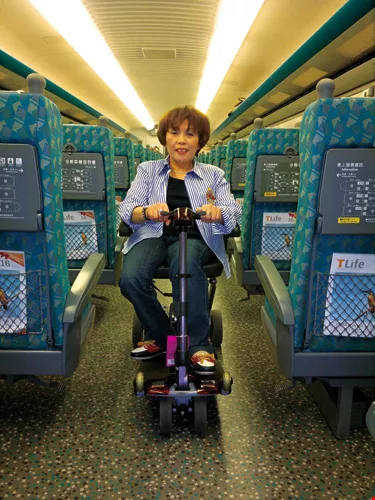
Just 45.5 centimeters in width, the Luggie can be driven onto a high-speed rail car with room to spare. The photo shows Freerider president Fan Ju-yu.
But making the scooter light required breakthroughs involving the motor, the differential, and the battery. Freerider consulted with the Material and Chemical Research Laboratories of the Industrial Technology Research Institute (ITRI) on lithium-ion batteries, and applied to the Industrial Development Bureau of the MOEA for new product development funds.
With technical assistance from ITRI, Freerider replaced the 15-plus-kilogram lead-acid battery typically used on scooters with a 2.5-kg cassette-style lithium-ion battery. It also swapped out the steel vehicle frame for an aluminum one. Together, these changes cut the scooter's weight by two-thirds, from 60-70 kg to just 23.5 kg.
The entire process, from creating molds and revising them to building a prototype and, last March, going into mass production, took more than two years. Over the course of that period, Freerider invested roughly NT$40 million on top of NT$10 million in government assistance. The scooter has since undergone further refinement, passing through second and third generations that feature an integrated battery, an adjustable rear bumper, and a carrying capacity that has increased from 113 kg to 120 kg.
The Luggie sells for about NT$70,000. Though this is about 20% more than the typical motorcycle in Taiwan, the scooter has become very popular among seniors in the US and Europe. Exports this year are expected to exceed 10,000 units, with Disney's US theme parks and Singapore's zoo among the buyers. A Japanese firm even made inquiries about selling the Luggie in the Japanese market under a Japanese brand, but Freerider rejected the offer.
"The government supported the product's development," explains Fan. "We can't take taxpayer money, then let some other nation enjoy the fruits of it."
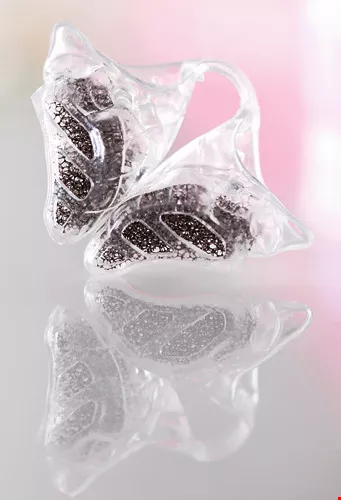
Surgical masks obstruct the nose and mouth, and tend to get stuffy, dirty, and soaked with nasal mucus as a result. In contrast, the "invisible mask" created by a Taiwanese inventor slips invisibly into the wearer's nostrils and doesn't impede breathing. It can also be sterilized and reused multiple times.
Even research institutions packed with experts have trouble figuring out how to set up technology transfers.
Take the Cycling and Health Industry Research and Development Center (CHIRDC), for example. Even having developed a multimedia health cycle that could be used with games, and holding six patents in multiple nations for technologies including joystick controls, handlebar joysticks, and turning sensors, the center didn't know how to go about marketing its research.
In 2008, CHIRDC's Sinew Consulting Group arranged to show the prototype at cycling and exercise equipment exhibitions, garnering interest from international brands based in the US, Canada, and New Zealand. After spending more than two years attempting to transfer its patents, CHIRDC finally licensed the technology to exercise equipment maker X-Bike.
According to company president Chen Yingquan, the early prototype originally supported only the Playstation 2 game console. But since no one was producing PS2 games anymore and the console itself was on the verge of obsolescence, X-Bike updated numerous circuit boards and programs to turn it into a product that supported multiple gaming platforms.
The GameBike, as it is now known, is intended for home use and sells for about NT$10,000. The bike has standard exercise bike functionality: it displays speed, distance, time, total mileage, and calories burned. But it can also be connected to a wireless adapter, gaming keypad, 360° controller, and balance sensors to allow the user to exercise and game with friends anywhere in the world.
X-Bike has also continued to work with National Formosa University to develop new gaming software that bike buyers can download at no additional cost, increasing the product's value to consumers.

Surgical masks obstruct the nose and mouth, and tend to get stuffy, dirty, and soaked with nasal mucus as a result. In contrast, the "invisible mask" created by a Taiwanese inventor slips invisibly into the wearer's nostrils and doesn't impede breathing. It can also be sterilized and reused multiple times.
The program to commercialize patents got underway just last year. As of the second quarter of 2011, some 643 patents had undergone the consulting and evaluation process. Another 1,355 had been licensed or transferred, 281 of which had been promoted by the MOEA, 1,060 by the NSC, and 14 by the COA. Meanwhile, technology transfers sparked NT$3.59 billion in private investment, generating some NT$26.9 billion in economic activity.
The road from invention to commercialization to profits is a long one. "Many people's expectations of R&D and innovations are simply too high. They think that having a patent equates to having a market. But the fact is that obtaining a patent and turning that patent into a product are two very different things." Inventor Wang Shunqing says that experience shows us that the keys are capital and time spent on R&D.
Given that, policies directing resources into this arena can provide assistance at the margins, but inventors still have to overcome the major hurdles themselves. That's just how commercialization works.
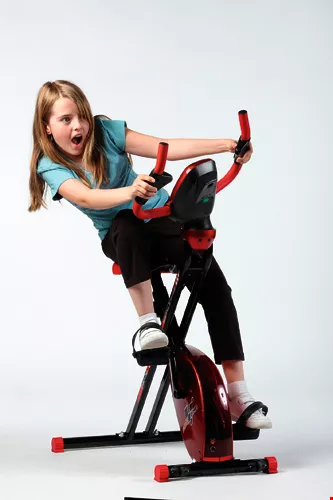
The Game Bike's patented handlebar and turn sensor allow riders to control the cycle on the monitor with the movements of their bodies.

@List.jpg?w=522&h=410&mode=crop&format=webp&quality=80)

@List.jpg?w=522&h=410&mode=crop&format=webp&quality=80)


