Propagating Buddhism in Its Birthplace
Fo Guang Shan’s Samanera School
Soon Thean Bee / tr. by Jonathan Barnard
April 2013


Whereas the world’s 700 million Buddhists account for about 11% of the global population, in India, where Buddhism was founded more than 2000 years ago, Buddhists make up only about 1% of the population.
Master Hsing Yun, founder of the Fo Guang Shan Buddhist order and its affiliated Buddha’s Light International Association, has made it his life’s ambition to rejuvenate Buddhism, and he has determined that the only hope of accomplishing that goal is through Buddhist education. Reviving Buddhism in India requires the training of local monks, so that the mission of propagating Buddhism there can be passed on to Indians themselves.
In April of 2010, Fo Guang Shan’s Educational and Cultural Centre in New Delhi established the Samanera School and has thus helped to build wonderful bridges between Taiwan and India.
In the suburbs of Delhi, grand residences may exist across a street from shantytowns whose residents are struggling to survive. On the pot-holed streets one can sometimes see women in rags holding their infants and begging money from the occupants of Lamborghini sports cars.
But in comparison to crowded, chaotic Delhi, the Fo Guang Shan Educational and Cultural Centre’s Samanera School in New Delhi seems like a paradise on earth. Set back on lush green lawns is an elegant two-story white structure, surrounded by gardens full of bright lotuses and chrysanthemums. It’s a wonderful and tranquil place of natural beauty.
At the right time of day, you may see round-eyed, strong-nosed, dark-skinned samaneras (student monks) practicing martial arts on the spacious lawns. When they catch sight of visitors, they always graciously put their hands together in greeting.
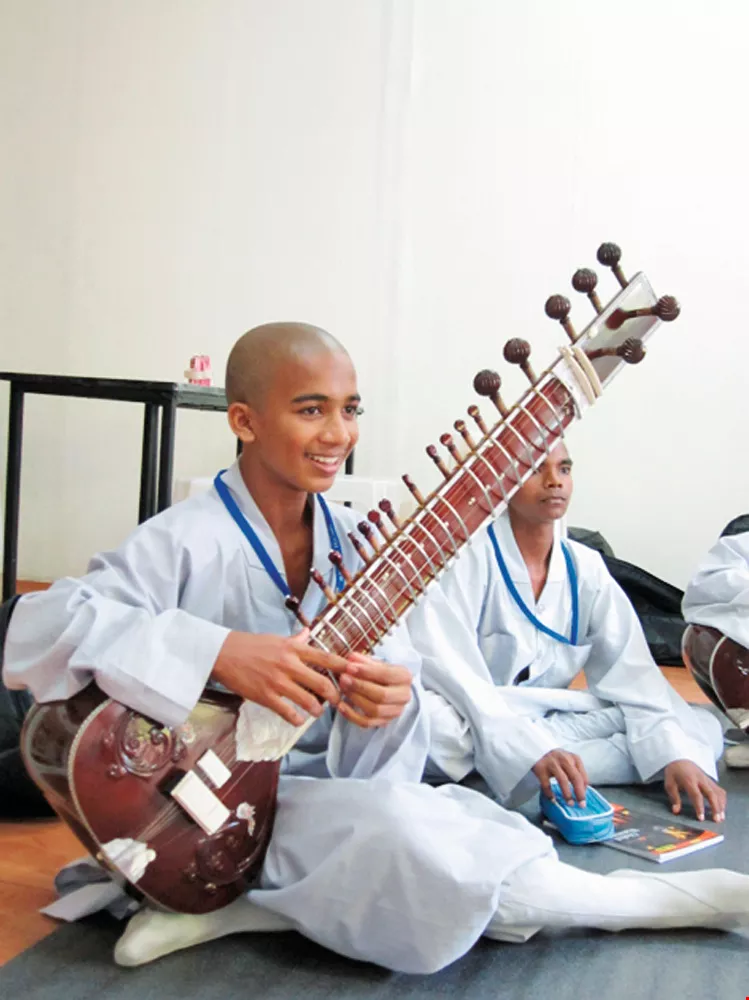
Samanera’s varied curriculum, which includes music, martial arts, and calligraphy, prepares students well for spreading the good word of Buddhism.
In order to cultivate a new generation of Buddhist monks in India, the school, under the leadership of Master Hui Xian, who is director of the FGS Educational and Cultural Centre (ECC) in New Delhi, began to enroll young boys, ages 9–13, three years ago.
When Hui Xian, now aged 38, who is from Malaysia, took his vows as a Buddhist monk in 1998 under a tree at the site where the Buddha found enlightenment, he had a sudden realization that he wanted one day to help lead a revival of Buddhism in India.
In 2008, he came to India and discovered tremendous difficulties in propagating Buddhism there. India has almost no Chinese at all and few Buddhists of any ethnic origin. What’s more, most Indians only speak Indian languages. The circumstances made the experience he had gained disseminating Buddhism in Taiwan and Malaysia virtually unusable. Because there are so few Buddhists in India, coming across one is a bit like finding a needle in a haystack. But Hui Xian was undeterred by traveling great distances, and many times he visited largely Buddhist villages in the north of India, where he announced his intention to recruit students of outstanding moral character who were interested in becoming monks. Three years ago Hui Xian came to tribal villages of the Sakya people, the same clan that produced the Buddha (Sakyamuni). He discovered that the villagers were living in abject poverty. Families shared their hovels with livestock. Living conditions were downright awful.
On many occasions the ECC sponsored free medical clinics in the villages, which both provided assistance to the people there and served as a conduit to recruit students. These efforts yielded 56 enrollments. But quite a few could not adjust to life at the school and left. Currently there are 15 students, who have varied reasons for becoming Buddhist monks.
Cheng Pu (his name-in-religion), age 15, came to the school two years ago after he read The Story of Buddha and realized that he and the Buddha were relatives. It sparked an interest in Buddhism.
“I come from the same clan as the Buddha, so propagating Buddhism is my duty. There is so much knowledge to learn here; I have got to work hard every day, including by helping out in the kitchen, because all of this knowledge will help me to enrich Buddhism in India.”
Cheng Pu, who has an even-keeled personality, couldn’t help but feel homesick in his early days at the campus. Now he has adjusted to his life there, even though he can only see his parents twice a year and speak to them on the phone every other month.
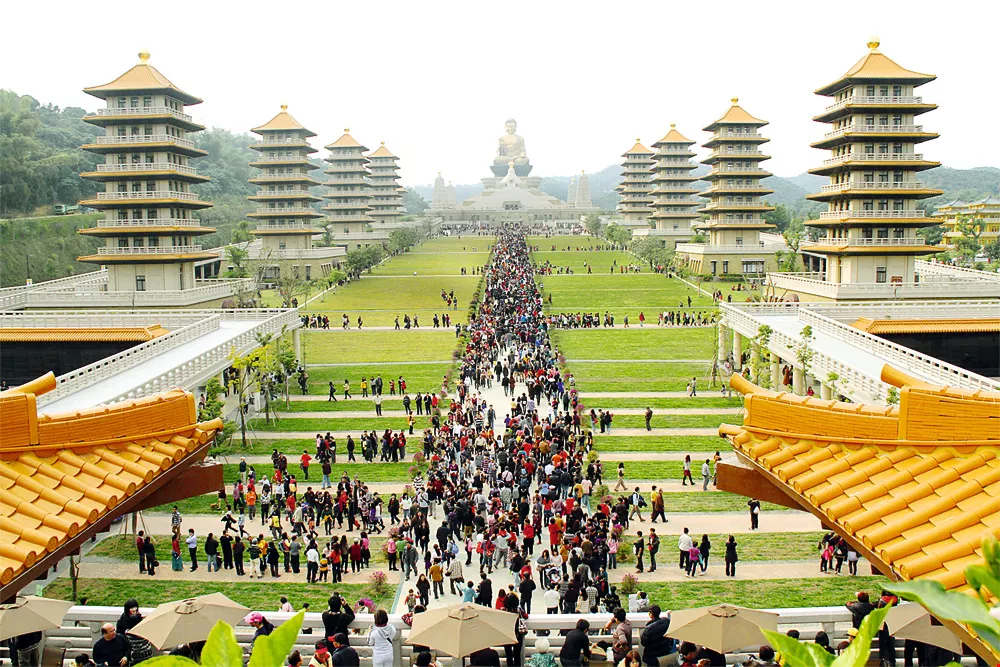
Today the monks and students at Fo Guang Shan’s Samanera School are striving to disseminate knowledge of the sutras and understanding of Buddhism in the land of its birth: India. The photo shows the FGS Buddha Memorial Center in Kaohsiung.
“‘One minute of well practiced stage performance requires 10 years of diligent practice.’ Only with long and assiduous practice can monks develop mastery.” Hui Xian explains that in order to develop the “right stuff” in his charges, he must subject them to rigorous training.
Every morning the students must practice chanting the sutras. Then they must go to practice martial arts on the lawn. After breakfast, they must individually perform their assigned chores. When the bell rings for morning study, they reenter the space where they ate and use what had been their dining tables as desks.
The curriculum at the school is extremely diverse and includes learning Buddhist theory and how to strike the “singing bell” and “wooden fish” (ritual percussion instruments) during Buddhist rites. It also includes Chinese, English, Hindi, Pali, math, science, art, yoga, martial arts, Indian music and so forth.
In order to improve their Chinese and English skills, they are, for example, quizzed on fruits and vegetables even while eating.
Master Hui Xian says that after a few years these young novices will go to Fo Guang Shan in Taiwan to study. They will certainly need a strong foundation in Chinese, and if they don’t have sufficiently deep understandings of math and science, they will not be able to integrate Buddhist doctrines with the realities of secular life. That deficiency would impede their attempts to spread Buddhist teachings. Consequently, the school is very demanding.
With regard to the pace of learning required by the school’s curriculum, 14-year-old Cheng Fa (name-in-religion) has his own unique take on things.
Witty, lively and quick to laugh, he looks a little like Ikkyu, the monk in the Japanese cartoon of the same name. He is a diligent student, and as soon as he hits a concept or vocabulary word that he doesn’t understand, he makes certain to ask questions until he gains a thorough understanding that he can commit to memory.
For instance, a volunteer teacher mentioned that the great Zen Buddhist master Hui Neng once said that he had decided to become a Buddhist monk after he heard someone reciting The Diamond Sutra: “To use one’s mind spontaneously and naturally, without being constrained by preconceived notions arising from the senses.” Cheng Fa immediately copied down the characters and softly began to recite them to himself.
What’s more, two hours and 40 minutes every week are allotted to watching television or a movie, with the idea that the novices will get a feel for popular culture, so that they won’t be at a loss when dealing with lay people.
“Can you imagine? When only a short time every week is given over to watching movies or reading books of your own choosing, a single book from the Harry Potter series can take two and a half months to finish,” says Cheng Fa, scratching his head.
Cheng Fa, who is mischievous on occasion, then shifts to a serious tone and says that Buddhist teachings are a door to happiness for the people. There are so many people in India who are destitute: If they all get an opportunity to hear Buddhist teachings, they can leave their misery behind to have happy futures.
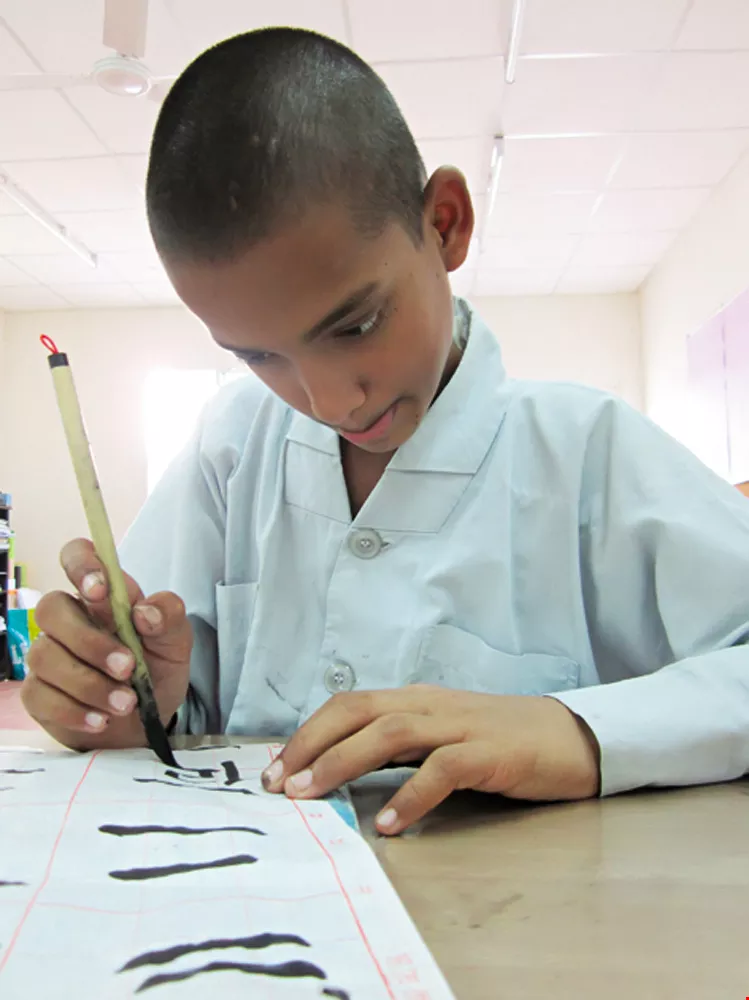
Samanera’s varied curriculum, which includes music, martial arts, and calligraphy, prepares students well for spreading the good word of Buddhism.
Master Hui Xian frequently cites phrases from the sutras that emphasize that so long as you are willing to put in the hard work and time, anyone can become a Buddha, but it’s impossible to say how long it might take.
The young novices of Samanera are well behaved and have great attitudes about learning. Nevertheless, like most teachers, from time to time Hui Xian can’t help but chide his students.
For instance, he notes that Indian children have no concept of time. For years, he would grumble about them coming to the classroom late. But it would go in one ear and out the other. Eventually, in order to get them to understand that when the class bell rings, they should immediately enter the classroom, he had to punish them.
Education is a long-term endeavor, and propagating Buddhist doctrines requires a lifetime of dedication. Some 2500 years ago Sakyamuni, so as to help people gain enlightenment, spent 49 years with his disciples, traveling far and wide on both sides of the Ganges to spread the good news of Buddhism.
Master Hui Xian explains that it wasn’t until he took his leadership position at the school that he truly understood Master Hsing Yun’s call for his followers to be selfless: “So long as you become useful, I’m willing to sacrifice myself for you.” For Hui Xian, it is gratifying that after three years of establishing firm roots, the school is beginning to achieve some results, and the teachers and students are getting on track. The Samanera school will continue to prepare its charges for advanced study at Buddhist seminaries or universities, while spreading knowledge of Buddhism.
“We expect that when this group of young students complete their training in Taiwan and return to India as novice monks, they will once again spread the wonderful teachings of Sakyamuni far and wide on both sides of the Ganges!”
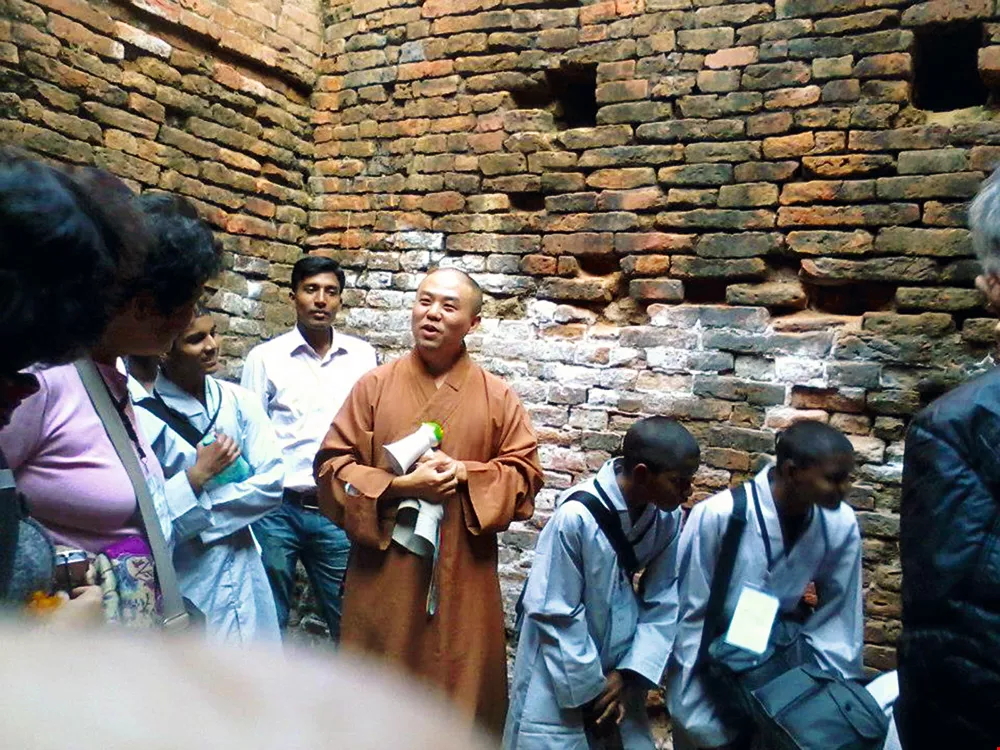
Never complaining about the hardship involved, Master Hui Xian, who hails from Malaysia, has visited numerous isolated Indian villages in conjunction with efforts to offer free medical services and recruit a new generation of Buddhist monks in India.
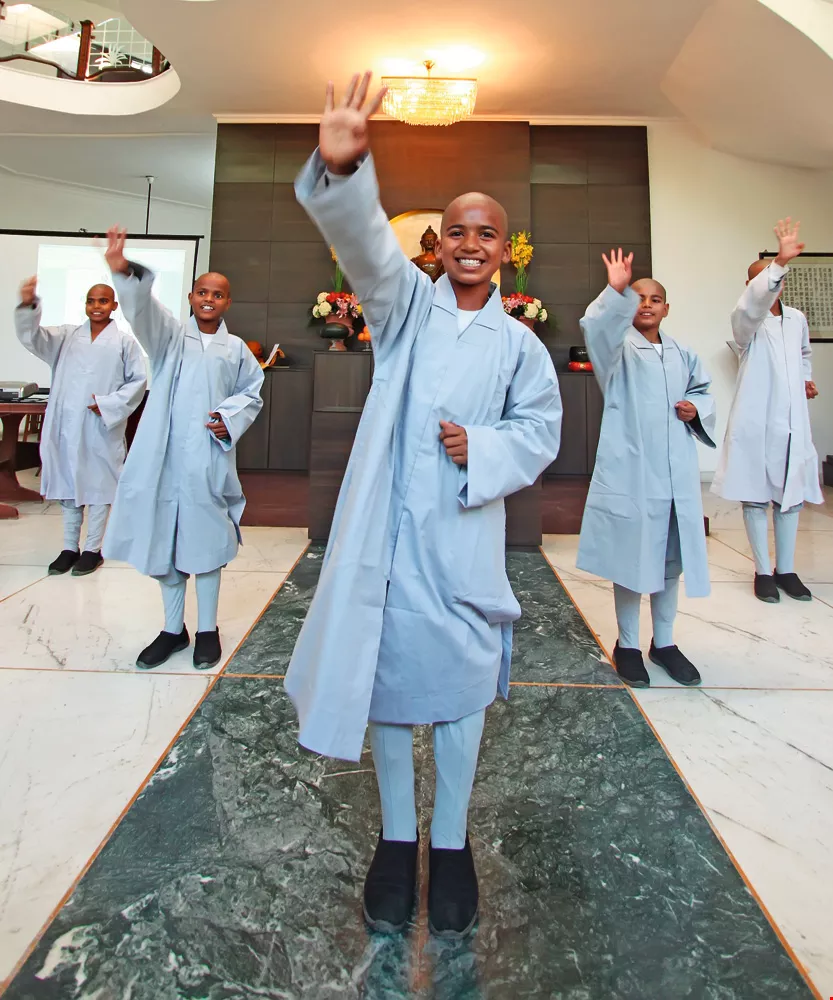
Aiming to revive Buddhism in India, Fo Guang Shan has established the Samanera School. In the photo students, their heads newly shaven, take part in a ceremony at the school.

@List.jpg?w=522&h=410&mode=crop&format=webp&quality=80)
@List.jpg?w=522&h=410&mode=crop&format=webp&quality=80)


