Lisa Lu--The Empress Dowager of Chinese Film and Theater
Teng Sue-feng / tr. by Jonathan Barnard
October 1994


Lisa Lu plays her parts so well that people are always convinced she's the best person for the role--whether it be the Empress Dowager Tzu Hsi, that matron who presided over the fall of the Ching Dynasty, or the gentle Mrs. Chien, who frets over her lost youth in Pai Hsien-yung's Wandering in the Garden, Waking from a Dream. Where does Lu's charm lie? And how does an overseas Chinese make a name for herself in Western theater?
From the start writer Pai Hsien-yung believed that Lisa Lu was the best choice. More than 10 years ago Pai put together a creative team for a stage adaptation of his novel Wandering in the Garden, Waking from a Dream (from his "People of Taipei" series), and Lu was the first person he could think of to play the main character Lan Tien-yu (Mrs. Chien). Formerly a Kunchu Opera singer who performed on the banks of the Chinhuai River, Lan marries a general and finds herself living in the lap of luxury. But only shortly after marrying, her husband dies, and she is left to pass her days alone. Her fortunes couldn't have changed more dramatically.
Upon making a sudden move to Taipei, she meets old friends ensconced in lives of pomp and circumstance. In contrast, she still wears a dark green Hangzhou silk chipao she brought from Shanghai. Under the light it looks well the worse for wear.
Through Mrs. Chien's intuitive understanding and observations, the changes of the era coupled with the feelings and experience of the individual make for a powerful drama, and Lu commands her viewers' attention: in every move she makes we see the end of the old era and the coming of the new.
In 1982 each of the play's 12 performances at the Sun Yat-sen Memorial Hall would win the admiration of the 3000 people watching. It had Taiwan theater circles abuzz.
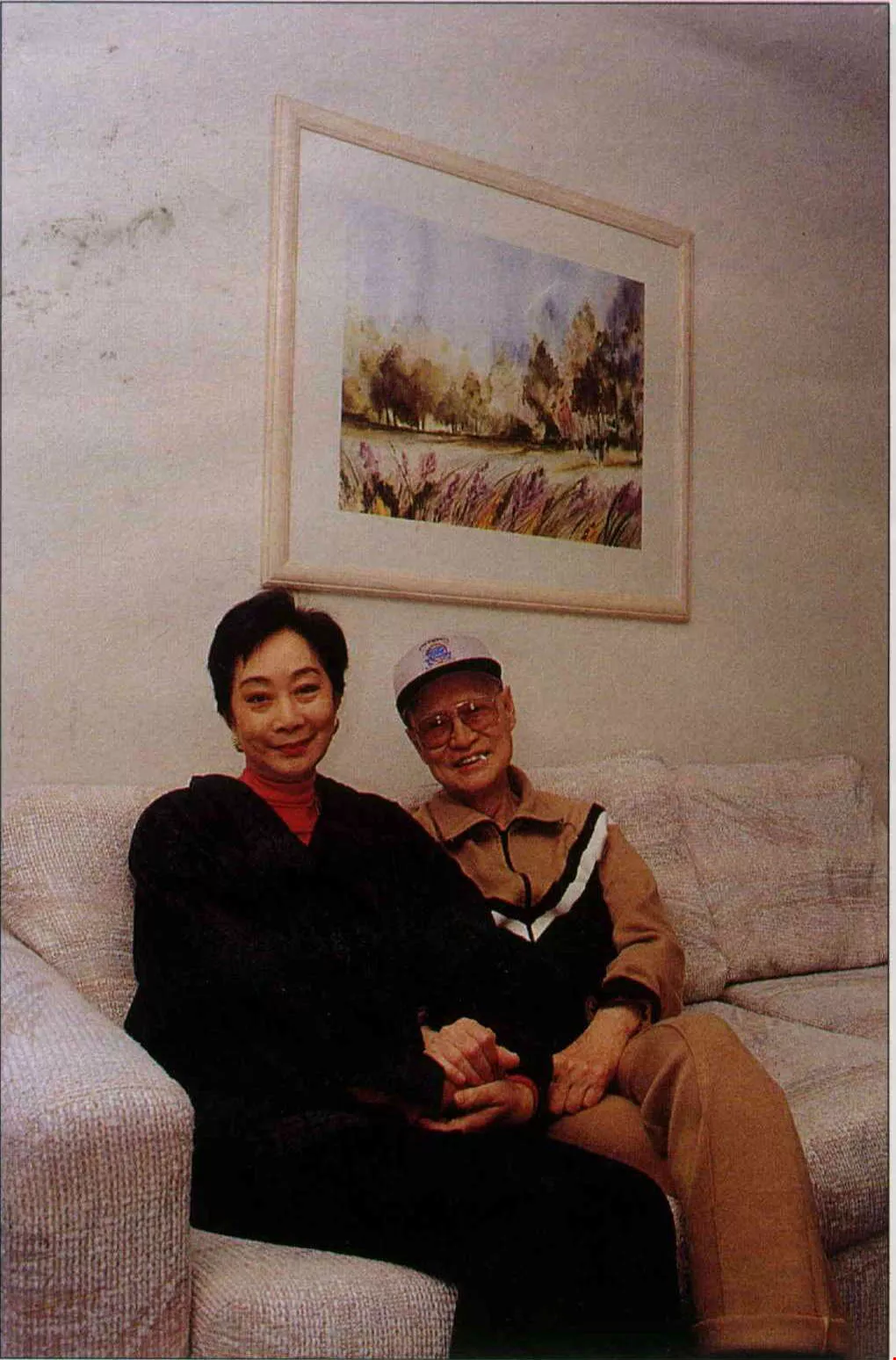
Married for nearly 50 years, Lu and her husband are still each other's constant companions. When Lu went to San Francisco and Boston for performances of Woman Warrior, her husband went with her.(photo by Cheng Yuan-ching)
An actress of true talents
Those who have read the novel know where it's special. Pai employs a stream of consciousness, skipping back and forth in time through Mrs. Chien's recollections. The script uses monologues--some ten over the course of the play--to reveal Mrs. Chien's inner thoughts. These soliloquies pose a tremendous challenge to the skills of any actress.
"There are a few long monologues in there. While she was performing them the 3000 members of the audience were dead silent. Not a soul dared to even clear his throat. You can see how firmly the audience was in her grasp," Pai wrote afterwards in a collection of critical essays about Wandering in the Garden. "The lights were off except for a spotlight on her, and she had the audience where she wanted them: under her spell--entranced by her voice and riveted to every movement of her face and hands."
In looking for a leading lady, they wanted not only a talented actress but also someone who could sing Kunchu opera, and it was imperative to find "a traditional Chinese beauty." Lisa Lu "was the only one we could think of that fit the bill," Pai says.
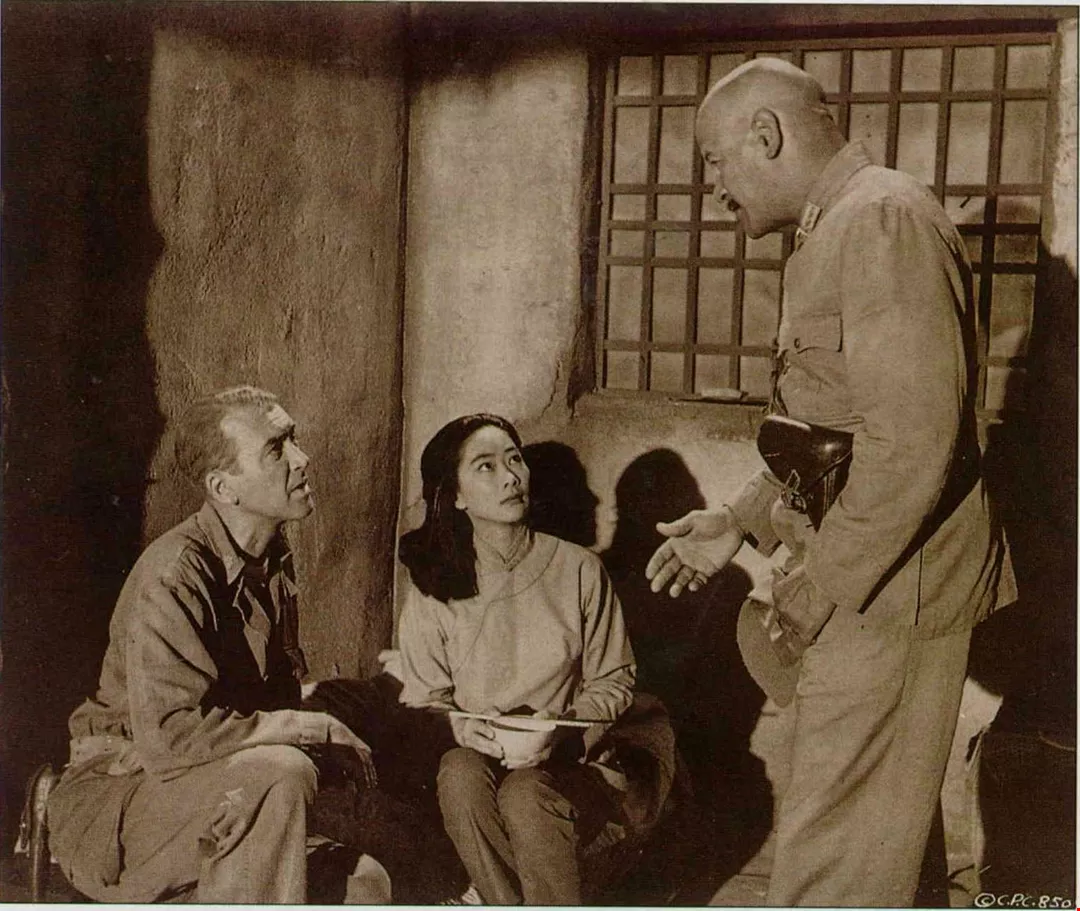
Not long after Lisa Lu first appeared on the silver screen, she had the chance to co-star with James Stewart in The Mountain Road. (courtesy of Huang Jen)
A classical Chinese beauty
Up on the silver screen Lu has a quiet and refined classical Chinese appearance, with a trace of melancholy about her. Back in the 1970s she won a Golden Horse for playing the lonely and dignified widow Mrs. Tung in The Arch.
Adapted from a story in Lin Yu-tang's Chinese Legends, The Arch is set in a remote village in southwest China, where a 34-year-old widow lives, dutifully supporting her mother-in-law and raising her only daughter--as workers build a traditional arch attesting to the widow's faithful and self-sacrificing behavior. One autumn a group of soldiers come to help the villagers harvest the rice, and it is arranged for their leader, Lieutenant Yang, to stay in the Tungs' study. His arrival turns the sedate household topsy-turvy.
On the one hand, there's the young officer's admiration for Mrs. Tung, and on the other, the daughter's affections for him. Around these relationships, the plot thickens. Mrs. Tung is pulled between Lieutenant Yang and his attempts at seduction and the arch symbolizing her virtue. In the end the latter wins out, and the Lieutenant takes away the daughter as his bride. As the arch is finished, Mrs. Tung has lost everything. Her mother-in-law has died, and her daughter and Lieutenant Yang have married and moved away. Even her manservant Chang can't stand her loneliness and pain (nor his own feelings for her) and leaves in low spirits. Standing in front of that arch, a heroine she may be--but it's of the tragic kind.
Critics who saw the film at three special screenings in Taipei for the film and arts community praised it, but it's a pity Taiwan's film fans never got a chance to see it. The movie theater owners thought the public wouldn't watch a black-and-white film.
In contrast to its reception at home, The Arch was warmly greeted abroad.
Director Tang Shu-hsuan, a 28-year-old overseas Chinese, entered the film, her first, in the San Francisco and Cannes film festivals. In Paris it was listed as one of the year's 15 best international films.
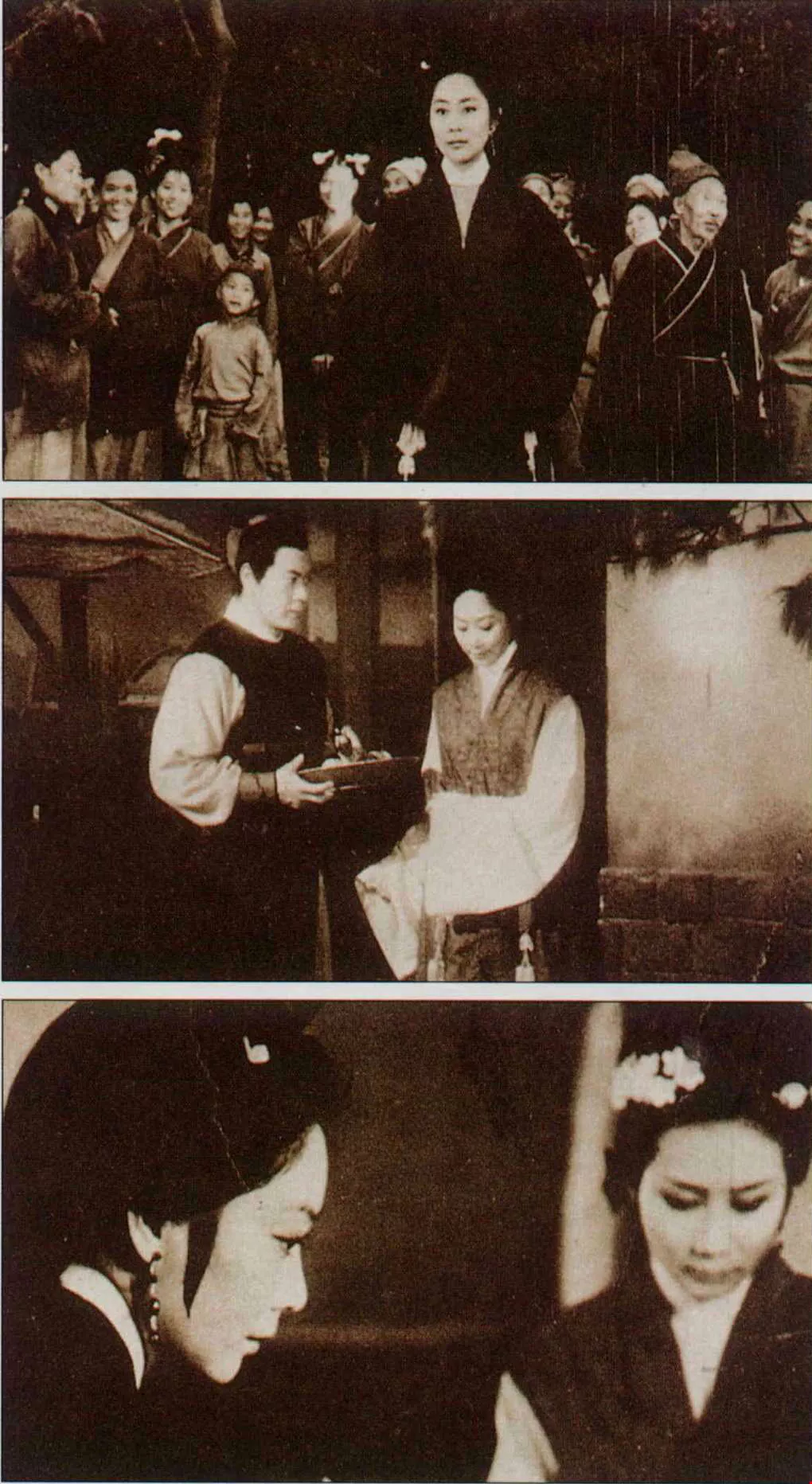
Lisa Lu won a Golden Horse for her performance in The Arch. Western viewers who saw the film in Paris and San Fransisco were given a glimpse of her classical Chinese beauty. (courtesy of Huang Jen)
Combining East and West
On stage or on screen, the well-dressed Lisa Lu has a style all her own. Off them, her charming smile and soft-spoken manner brings to mind the elegant and gentle Chinese beauties of years past.
The late film critic Tan Han-chang described Lu as "like a lady in an ancient painting, but with the sincerity and intimacy that people in paintings lack."
Huang Yi-kung, a director at Taiwan Television who directed Lu in the stage version of Wandering in the Garden, describes her as "an interesting combination. Her family background gave her a deep understanding of Chinese theater, and in America she received professional training in Western theater. In her person you can really see the convergence of East and West, the modern with the classical." Her command of Shanghainese, Cantonese, Mandarin and English also sets her apart, Huang stresses. Few performers can move so easily between the film worlds of Taiwan, the mainland, Hong Kong and the West.
Though her acting talent may trace back to her family, her path to stardom as an actress was a circuitous one.
Lisa Lu's mother was the famous Peking Opera starlet Li Kuei-fen, and for nine years mother and daughter lived in the French concession of Shanghai, in the apartment of Mei Lan-fang, the era's greatest male player of female leads. At a very young age, Lisa took the Meis as her godparents, and through the course of her childhood, the opportunities for personal instruction were many. She took to the stage for the first time when she was just 14.
Although Lisa studied opera with her mother and godfather, her mother discouraged her from seeking a career in the field, emphasizing that in addition to strict training, Peking opera singers also needed natural talent--a sonorous voice, refined features and a strong and vigorous figure.
"It's too bad my voice wasn't strong enough," Lu recalls. Her mother also thought she was too gentle of disposition for such a career. But since her math was good, why not study business?
After high school and college, her mother took her from war-ravaged Shanghai to Hawaii in 1947, where she majored in financial management and met Huang Hsi-lin, an ROC foreign affairs official posted on the island. Meeting in the Western, unarranged manner, the two quickly fell for each other and married soon after.
When the mainland was lost to the communists, they lost all they had in China and had to start all over again. To help support her family, Lu held down three jobs: She worked in the library of a newspaper during the day, went to a Chinese school to teach Chinese in the afternoon, and translated international news for a Chinese paper at night.
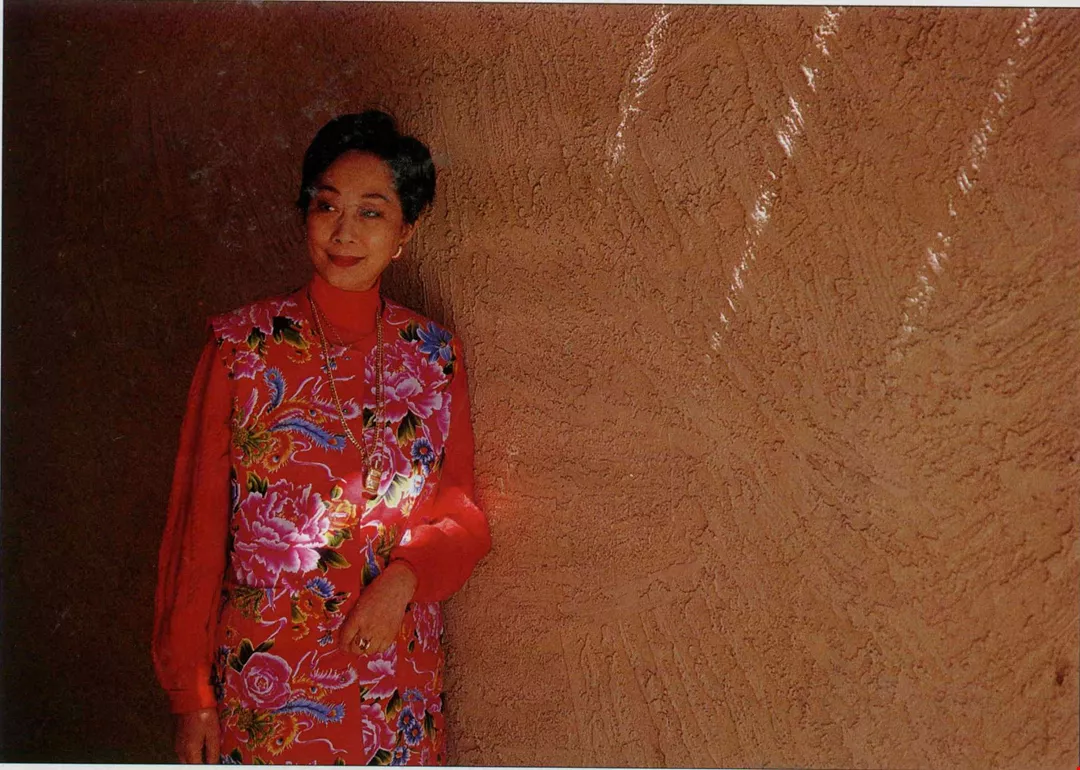
Lu's temporary lodgings in San Francisco while she was appearing in Woman Warrior. She lives in Hollywood, the movie capital, but her acting career has taken her east and west, and to the three realms of Chinese film and theater: Taiwan, Mainland China and Hong Kong. (photo by Cheng Yuan-ching)
A constant desire to act
After giving birth to three children one after another, in 1956 Lisa Lu and her husband left Hawaii for better job prospects in California. Lisa hadn't forgotten her dream of being an actress.
"I kept believing I could act." With her husband' s encouragement, she entered a program at the Pasadena Playhouse, graduating in 1958.
As a member of a racial minority she had to struggle to find parts. She acted in many English-language plays, including Teahouse of the August Moon, The World of Suzie Wong and Flower Drum Song. But her face limited the characters she could play to Oriental women.
She also acted in more than ten movies and made more than 200 appearances on television. Before accepting Shaw Brothers' invitation to come to Hong Kong and shoot a series of movies set in traditional China, she had already acted with such first-rung Hollywood stars as James Stewart (in The Mountain Road) and Marlon Brando (in One-Eyed Jacks).
When she went to an audition for Li Chin-yang's Flower Drum Song, a casting director said, "We're looking for a Chinese, not someone like you. . ." Wanting delicate, tiny girls, "they felt I was too tall and lanky, that I didn't look Chinese," Lu says.
"It was hard for Chinese actresses to get parts and those that we did get all depicted stereotyped Chinese women. Even these were in scarce supply." The way she saw it, for Chinese and American actors alike, a good audition wouldn't mean you would get the part. You'd have to rely on that aura you projected, that special something extra. This was where Lu excelled.
"It was one of her strong points, but it also had its down side," Huang Yi-kung says. "Lisa Lu is like a piece of porcelain or jade; she gives people a feeling of purity and refinement," Huang analyzes. If you want her to play someone down and out—say a prostitute--it's not beyond her acting abilities," but her personal beauty will give the character an aura that makes it lose clarity."
Without suitable scripts, she went for a decade without appearing on stage, and it wasn't until Wandering in the Garden was performed in Taipei that her yearning to act was sated once again.
The obvious choice
Confined by the limited number of American scripts on Chinese topics, overseas Chinese still find the greatest room for expression on the Eastern stage. And Lisa Lu, with her innate classical charm, is particularly well suited for dramas set in China's past.
"When I play Mrs. Tung, they all say I'm just right. It's the same thing with Mrs. Chien--but in truth it's just a matter of my outward appearance being suitable," she says. As far as she's concerned, the greatest challenge is in playing a character completely different from herself.
And she's happiest talking about playing the unreasonable Empress Dowager Tzu Hsi of the end of the Ching dynasty.
Over the years, she's played the empress dowager in three movies, so the role is almost second nature by now. Early on there was Li Han-hsiang's Kingdom and City, then Bloodshed in Yingtai and finally Bernardo Bertolucci's The Last Emperor. Lu's performances have spanned the swath of the empress dowager's life from when she took power to old age.
"Originally Li Han-hsiang didn't want me; it was Shaw Yi-fu [one of the brothers for whom the studio is named] who had confidence I could do it. I may not look like the empress dowager, but I really enjoy the challenge of playing her. She's an historical personage, for whom there are lots of records. Her environment, her way of treating people and thinking were all so different from mine. To depict her, I've got to shed myself, whereas with Mrs. Tung and Mrs. Chien, I can still put a lot of myself into the characters, because at least some of the feelings are the same.
For Lu, the scene of doing calligraphy was the most satisfying moment of making Kingdom and City.
"I pick up the brush, dip it in the ink and on red paper write a 'shou' [longevity] and then a "hsiao" [filial piety]. I'm talking, writing and laughing at the same time, while my sideways glance is telling my son the emperor, 'You should understand what I'm thinking. A good son has to act in accordance with his parents' wishes. I want to celebrate my birthday, not go to war.' Yet out loud I'm still saying: 'O.K. You want to go and fight Japan, then go.' This double-faced hinting at her real meaning is just right for revealing her character."
For this rendition of the empress dowager, she picked up her second Golden Horse for best leading actress in 1975.
China in Western Eyes
The empress dowager wasn't as big a part in The Last Emperor as she was in Kingdom and City, but The Last Emperor was the first major Western film to deal with China and it had a bigger impact on the Western perception of that mysterious place. What did she learn from it?
"In the film, her bedroom walls were decorated with carvings of the eight immortals. While the empress dowager lies dying in the 'Dragon Bed' [which is usually reserved for the emperor], the eunuchs start pushing the bed around. I asked Bertolucci if he had ever been to the palace in Beijing. In the Chinese palace you wouldn't have found these kind of carvings, and the Dragon Bed would have been fixed and stable. There's no way they would have been pushing it about."
"Bertolucci said that he wasn't shooting a Chinese history or a documentary. This was his artistic creation, and art could not be interfered with."
Turning to the empress dowager's clothing and makeup, Lu said, "It's not because I don't like the way you've made me look so ugly. It's just that I must remind you that the empress dowager cared greatly about her appearance. She never would have allowed herself to look so bad." Lu was bothered that this movie was not sticking closely to the historical records.
Although disagreeing with Bertolucci's depiction of actual Chinese figures, in the end she did what the director asked, and Bertolucci praised her "for acting very well."
Huang Yi-kung holds that this reveals a working attitude that respects "the director as the ultimate interpreter of a film."
Chinese on stage
At the end of this last May, the American-Chinese writer Maxine Hong Kingston adapted her novel Woman Warrior for a production that premiered in San Francisco, and Lu went to both coasts with the show.
"At first it was difficult to act in this kind of play," Lu recalls. "Kingston is a second-generation Chinese American, and her mother's stories are all she knows about China. She was very young when she heard them. Later, using her memory and imagination, she wrote Woman Warrior and China Men.
In Kingston's version, Hua Mu-lan, a legendary ancient Chinese woman who disguised herself as a man to take her father's place in the army, has become a female hero fighting for equal rights and looking to seek revenge on behalf of her family. Her father has even tattooed characters on her back, so she'll never forget to "Seek revenge for the family."
"It's a little weird to write of ancient Chinese like this," Lu says. "But this play is a true reflection of the history of the struggles of overseas Chinese early on and is creating opportunities in the theater for Chinese. If you don't act in this sort of play, as a Chinese you won't have a chance of getting on the stage at all; so later I agreed to do it."
In Woman Warrior and Wayne Wang's The Joy Luck Club she played strong-willed Chinese women who ended up living in the New World and hoping their daughters would get what they wanted out of life.
But what kind of a mother is Lu in real life?
In the words of Huang Hsi-lin, her husband of nearly 50 years, "Though she really becomes the character she's playing, she never brings it home with her."
And Lu herself believes that none of the mothers she has played as an actress "is anything like the mother I am at home."
Before her own mother passed away, she lived in a traditional Chinese fashion with three generations under one roof. During the day, with both parents out working, the grandmother would care for the children. The way they educated their children was also distinctly Chinese: rules came before discussions about why things were the way they were.
Lu wanted her daughter to study the pipa when she was little. But staying at home and studying a boring instrument was not the daughter's idea of a good time. She envied the kids who could go out and play after school. Lu, however, believed that abilities must be cultivated from a young age.
When her daughter grew up, she was still studying music and composition. Now living in New York, she arranged the music for the New York production of M. Butterfly. "She thanks us for being so strict before," Lu says.
Though grown and moved from home, her other two children live nearby. The husband and wife spend their time at home watching movies and listening to music and Peking opera. "While she's still alive, you won't be able to pull her from Hollywood," Huang says. A truly fated match, the two married shortly after meeting. They get along like brother and sister or friends. Lisa has a gentle disposition, and the two seem to have never had any fights.
Away from the stereotypes
Having lived in America for more than 40 years, Lisa Lu says that Broadway and Hollywood's understanding of Chinese culture is still stuck in the "chop suey age."
Back when the couple first moved to California, they opened a Szechuan restaurant and hired a cook who prepared finely sliced shredded pork. When it was brought out to the table, the American customers would ask, "What's this? Is it leftovers?" They wanted big chunks of meat.
Back then, stateside Chinese restaurants didn't have cooks adept with the cleaver, and most Americans hadn't seen real Chinese food. Decades later, even Americans of non-Chinese extraction might be connoisseurs of Chinese cuisine.
An understanding of Chinese food or culture takes time. But the latter will come too, Lu says, because "China is rising."
[Picture Caption]
p.48
Elegant, with a touch of melancholy about her, Lisa Lu stands center stage, her body language giving form to an aging beauty's regrets and recollections.(Sinorama file photo)
p.51
Married for nearly 50 years, Lu and her husband are still each other's constant companions. When Lu went to San Francisco and Boston for performances of Woman Warrior, her husband went with her.(photo by Cheng Yuan-ching)
p.52
Not long after Lisa Lu first appeared on the silver screen, she had the chance to co-star with James Stewart in The Mountain Road. (courtesy of Huang Jen)
p.53
Lisa Lu won a Golden Horse for her performance in The Arch. Western viewers who saw the film in Paris and San Fransisco were given a glimpse of her classical Chinese beauty. (courtesy of Huang Jen)
p.54
Lu's temporary lodgings in San Francisco while she was appearing in Woman Warrior. She lives in Hollywood, the movie capital, but her acting career has taken her east and west, and to the three realms of Chinese film and theater: Taiwan, Mainland China and Hong Kong. (photo by Cheng Yuan-ching)

@List.jpg?w=522&h=410&mode=crop&format=webp&quality=80)
@List.jpg?w=522&h=410&mode=crop&format=webp&quality=80)


