The Royal Project Foundation of Thailand: 40 Years of Success
Lin Hsin-ching / photos courtesy of the Ministry of Foreign Affairs / tr. by Geoff Hegarty and Sophia Chen
December 2012
The Golden Triangle on the border of Thailand, Myanmar and Laos is surrounded by high mountains, a remote and difficult-to-access region which was once one of the world’s best-known sources of opium poppy.
In order to improve the livelihood of the poor local farmers, the Thai government launched the Royal Hill Tribe Assistance Project in 1969 (rechristened in 1993 as the Royal Project Foundation), encouraging farmers to turn to high-economic-value fruits and vegetables instead of poppies.
Nowadays, when people visit this mountainous area of northern Thailand, the fatally seductive poppies are nowhere to be seen, and the hills are covered by thriving food plants such as apple, pear and peach trees, and highland vegetables.
The project, which was led by the cousin of King Bhumibol Adulyadej, HSH Prince Bhisatej Rajani (now 91 years old) with the assistance of a team of Taiwanese agricultural experts, has successfully helped the local farmers move out of poverty.
In 2012, Prince Bhisatej Rajani was awarded the Friendship Medal of Diplomacy by the ROC Ministry of Foreign Affairs, the ROC’s highest honor for diplomatic work. In 1988, the project piloted by the prince was awarded the Philippines’ Ramon Magsaysay Award in the category of Peace and International Understanding, often regarded as Asia’s Nobel Prize.
Prince Rajani came to Taiwan to receive the award in early November, and said that he could not remember how many times he had visited Taiwan. But while the number of visits was almost beyond counting, the initial impression of his first stopover in Lishan, Taichung was still as fresh as if it had been yesterday.

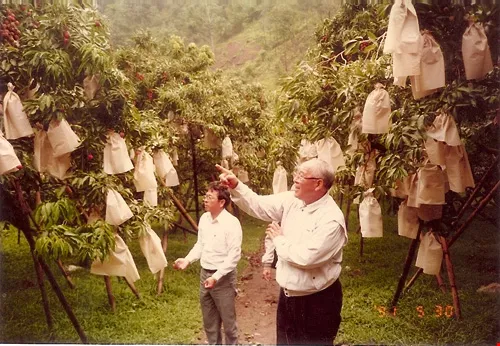
Sung Ching-yun (right), who now lives permanently in northern Thailand, is known to local farmers as “Papa Sung.” The photo shows him in the early days of the project, instructing the locals on how to care for fruit trees.
Prince Rajani’s connection with Taiwan began around 40 years ago.
A multiplicity of ethnic tribes including the Karen, Yao, Meo, Akha and Lisu inhabit the mountains of northern Thailand. In keeping with their traditional lifestyle of relying on nature for their living, they continued to practice slash-and-burn agriculture, but this practice inexorably diminished the area of arable land available for farming, and the tribal peoples became increasingly impoverished. Hence, they were eventually forced to cultivate opium poppies to sustain themselves, and by the late 1960s, annual opium production in northern Thailand was estimated at as much as 150 metric tons.
In 1968, in order to curb the escalating harm caused by opium and also help local farmers break out of poverty, the King invited foreign representatives to visit northern Thailand with the goal of making a joint effort to improve the situation. As a result of this initiative, the Royal Hill Tribe Assistance Project was launched in the following year, and countries including the UK, US, Japan and Korea donated several hundred temperate-zone fruit-tree seedlings, which were planted on the Dai Pui Farm near Chiang Mai Palace.
Unfortunately, the initial trial of fruit trees ended in failure, so in 1970, the King summoned the then ROC ambassador Shen Chang-huan and made a plea for assistance. To enhance diplomatic ties and friendship between the two countries, the ROC government airlifted several thousand seedlings for fruit and other types of trees along with vegetable seeds to plant in the Dai Pui and Angkhang farms in northern Thailand.

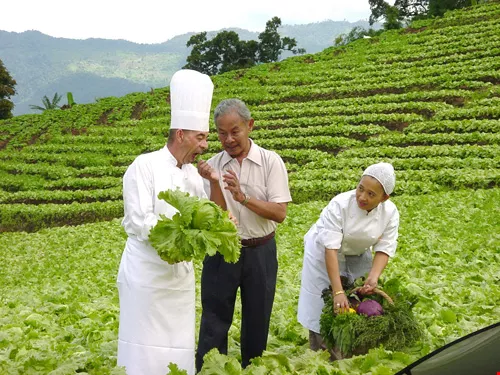
In February 2012, Prince Bhisatej Rajani invited foreign representatives to visit Angkhang Farm in northern Thailand. Here they are tasting organic lettuces.
In 1972, Prince Rajani led a delegation on a first visit to Taiwan. They visited agricultural research facilities, university agriculture departments, and mountain farms. The visitors were very impressed with the lush peach, pear, and apple trees growing abundantly in Lishan.
The prince tells a story of how Sung Ching-yun, then deputy director of Fushoushan Farm in Lishan, told him that when a team of retired ROC servicemen was planning to plant temperate-zone fruit trees in Lishan and Fushoushan, a US agricultural expert ridiculed the idea: “Taiwan is a subtropical country. How will it be possible to grow temperate-zone fruit?” However, Lishan is at an altitude of 2000 meters with over 1000 hours per annum at temperatures below 7 ºC. It is in fact a perfect location for growing temperate fruit.
“Because of the climatic similarities between the mountain areas of northern Thailand and Lishan, I believed that we had at least an equal opportunity for success,” says the prince.
In 1973, Sung was sent to northern Thailand to help the farmers grow fruit and vegetables, and soon he and the prince became close colleagues. Transport into the mountains was extremely poor. Without a helicopter, the route onto the mountain involved hiking for seven hours, with no exceptions for royalty.
The local people called Sung Ching-yun “Papa Sung” because of his remarkable contribution to their farms. Sung recalls that the first time they hiked into the Angkhang mountain area, the prince himself carried a heavy backpack. At night, they stayed in the homes of local villagers, making do in the usually overcrowded hut and sleeping on newspapers spread over the floor. Even in these conditions, the prince never asked for special treatment.
After 18 months, the Angkhang Farm produced its first harvest of peaches, and the other fruit trees were also thriving. It was clear that Taiwan’s successful Lishan experiment could really be duplicated in northern Thailand. Subsequently, the prince led the Thai people to work closely with Taiwan’s Agricultural Technical Mission, and together they managed to transform a virtual wasteland into a delightful environment full of aromatic and abundant fruit trees.
The Royal Project Foundation has been running for over four decades, with currently five research farms and 38 outreach stations in northern Thailand, bringing substantial benefits to as many as 37,561 farming households.
Their cooperative projects have expanded from growing temperate-zone fruit and vegetables to cultivating flowers, tea, mushrooms and strawberries, reforestation projects, the creation of tourist farms, and processing operations. With produce being sold on Thailand’s domestic market and exported to Singapore and Taiwan, farmers can make much more than they did from opium poppy cultivation in the past.
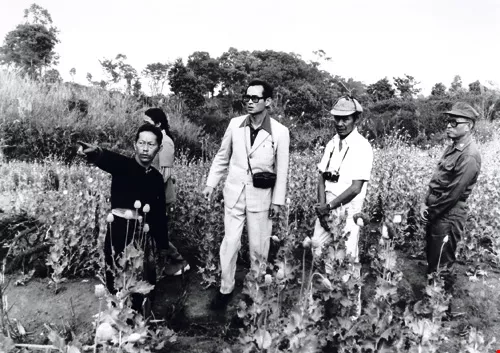
The Royal Project Foundation was launched by King Bhumibol Adulyadej (second from right). The photo shows him and Prince Bhisatej Rajani (right) inspecting opium poppy fields in 1969.

Not many people know that Prince Bhisatej Rajani, with all his expertise in agriculture, has in fact degrees in history and law and a master’s degree in economics from the University of Cambridge. Over the past several decades, he has gotten his hands dirty assisting the residents of the mountain areas in northern Thailand, mastering the skills of fruit and vegetable cultivation from the very basics.
“If I had originally trained as an agricultural professional, I could have just used my own expertise. But because I knew nothing about agriculture, I had to ask the experts, and as a result I learned a lot.” The prince attributes the remarkable successes of the project to the King, and humbly regards himself as merely one of the volunteers.
The prince has developed a deep friendship with Taiwan, and is proud and grateful for the agricultural cooperation between that country and his own: “Taiwan chose Thailand to become its partner, rather than Thailand choosing Taiwan.” With Taiwan’s assistance, the project has become famous as the only successful case of opium poppy eradication. The friendship between the two countries is being sustained through long-term cooperation in agriculture.