Spreading the Love—Taking Taiwanese Medicine to the World
Chang Chiung-fang / photos courtesy of Yang Zhenya / tr. by Geof Aberhart
November 2012


Taiwan’s high standard of medical care has become an important part of its diplomatic efforts internationally. As former foreign affairs minister Timothy Yang has said, “Providing medical assistance is a manifestation of Taiwan’s soft power.”
Health minister Chiu Wen-ta has also said, “Medical care is much like diplomacy, in that neither can be done just locked away behind closed doors, but rather should be taken outside to the people!”
For several years, Taiwan has been quietly providing medical and humanitarian support to its diplomatic allies, providing another option in the difficult work of developing foreign relations.
On a crisp, sunny autumn day in early October, Yang Ming University medical graduate Yang Zhenya and China Medical University dentistry graduate Lin Yuexian land in Taiwan after a 20-plus-hour flight from Taiwanese ally Burkina Faso via Paris and Hong Kong.
The pair volunteered to provide medical service in the allied African nation in substitution for their compulsory military service. “I figured if I had to do my service, I may as well do it in a way that had something to do with my major,” says Lin. “If it hadn’t have been for this ‘diplomatic service’ option, I probably would never have had the chance to visit Africa,” says Yang.
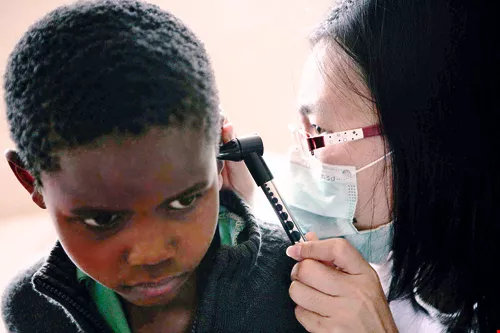
A doctor with the Taipei Medical University medical mission examines a child in Swaziland.
By some freak chance, the day before returning to Taiwan, Lin came down with malaria. Spending his flight suffering the side-effects of the medication—fever, tingling, nausea, and pain—made the trip back to Taiwan like a journey through hell. Nonetheless, Lin considers it a price worth paying for his 11 months providing medical care in Burkina Faso.
Taiwan re-established diplomatic relations with the African nation in 1994, and almost immediately dispatched a medical team to Friendship Hospital in the city of Koudougou, which had previously hosted a team from mainland China. The medical mission provides free consultations for the local people, along with some of the necessary medicines.
Yang, who worked as a GP, says that most of the patients he saw were women and children, with the women mostly suffering lower-back pain, degenerative arthritis, and prolapsed intervertebral discs, while the children most often had diarrhea or fevers. With the Taiwanese medical team not charging registration fees and getting good word of mouth, they quickly became a popular choice, with the clinic frequently thronging with people.
Dentist Lin, though part of the ROC team, worked under the jurisdiction of the hospital and therefore couldn’t provide free consultations like Yang. “There are no schools of dentistry there, so as well as providing normal dentistry, there was also demand for more specialist services. On top of that, Taiwan hadn’t sent a dentist to the place to help in a decade,” says Lin.
Serving in Africa wasn’t as torturous for these two brave souls as they’d expected: “Aside from the lack of entertainment making things a bit boring, it really wasn’t anything we couldn’t get used to,” says Yang.
“Africa was so different from what I expected,” says Lin. Rather than being the “dark continent,” Africa turned out to be a place of great vibrancy and color. “I was particularly blown away by the way the land went from brown to green when the seasons changed from dry to rainy,” Lin says.
As well as adapting to the environment, the two young men also had to adapt to the very different medical situation. “Medicine, public health policy, and politics are all closely tied,” says Lin, and with the Taiwanese medical team being outsiders, they had to be careful not to try and force their ideas and ways on their hosts.
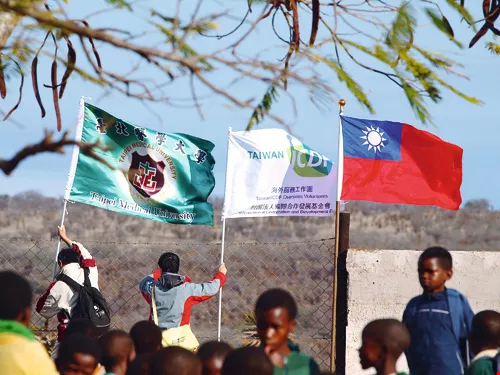
Love knows no borders, and through the medical projects headed up by the ICDF, Taiwan’s love is being realized in Africa in the form of strong support for her diplomatic allies.
During Yang and Lin’s service in Burkina Faso, President Ma Ying-Jeou made a trip codenamed “Project Benevolence and Friendship” to visit Taiwan’s African allies.
In the course of his visit, Ma made a special visit to Friendship Hospital in Koudougou, the capital of Burkina Faso’s Boulkiemdé Province. There, on seeing first hand the long lines outside medical team leader Huang Chi-lin’s clinic, he exclaimed, “So the legend is real!” expressing his deep admiration for Huang, who has volunteered his efforts there over the past 20 years.
Meanwhile, some 10,000 kilometers away from Taiwan, in Taiwanese ally Swaziland, another Taiwanese medical team is doing their part for the local community.
When the president traveled to Swaziland in mid-April, he also visited the intensive care unit and renal unit at Raleigh Fitkin Memorial Hospital, where the medical mission was serving.
The mission, dispatched through the International Cooperation and Development Fund (ICDF), plays an important role in keeping the diplomatic relationship between the two governments strong. “We can’t do anything that goes against our national interest,” says ICDF Humanitarian Assistance Department director Clifford Li. Such medical missions, though, have long been a source of tension between Taiwan and mainland China in their diplomatic efforts. Since beginning with a mission to Libya and continuing with missions to Burkina Faso, the Central African Republic, Liberia, and elsewhere, medical missions have become a necessary part of establishing diplomatic relations with anywhere the mainland has been.
And should such relations come to an end, those missions then become unsustainable, with Malawi being a classic example.
Malawi was once a diplomatic ally of the Republic of China, and to help provide medical assistance in a nation with some one million AIDS sufferers and 80,000 AIDS-related deaths each year, a Taiwanese medical mission established the Rainbow Clinic there. The clinic was quite a success, using fingerprint recognition systems and cellular phones to keep track of patients. But once Malawi severed relations with Taiwan, the ICDF could no longer provide support, and so in order to continue offering medical services in Malawi, the Pingtung Christian Hospital turned to organizations funded by the US Centers for Disease Control and Prevention for help.
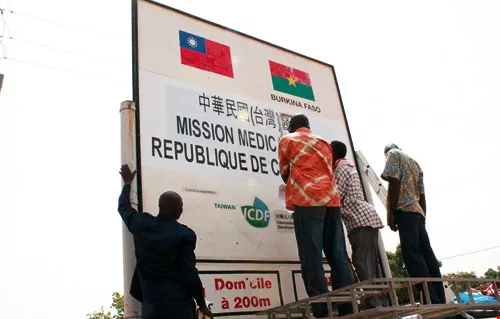
A sign declares the arrival of the Taiwanese medical mission to a town in Burkina Faso.
Helping those in need is a shared humanitarian effort across human society, and such international efforts have a long history. In its early days, Taiwan was one of the recipients of this help.
Marc Hsu, head of the Department of Health’s Bureau of International Cooperation, explains that in the 1950s, Taiwan received some US$100 million in foreign aid a year, accounting for 9% of GDP.
By the end of that decade, Taiwan had transformed from being one of the helped to helping others. In 1959 Taiwan sent its first agricultural mission abroad, to Vietnam, marking the start of Taiwan’s half-century of providing foreign aid. Timothy Yang, former chairman of the ICDF, remarked at the 2012 International Conference on International Development Cooperation and Taiwan Experience that as of 2010, Taiwan had provided a total of US$130 billion in foreign aid through agricultural, technological, vocational, and medical missions to diplomatic allies.
In his keynote speech, President Ma Ying-jeou added that through its own experience of receiving 15 years of foreign aid, Taiwan is well aware of the importance of such aid in helping countries transform themselves.
International assistance includes not only emergency aid in response to events such as natural disasters, but also long-term efforts to work toward food security, improve public health, and respond to climate change.
Such assistance covers a wide range of activities and isn’t something that can be handled by either money or offers of physical assistance alone.
Invited speaker and former president of the World Bank Robert Zoellick remarked that foreign aid should be tailored to each case and be done in cooperation with the local population, otherwise it has no chance of success.
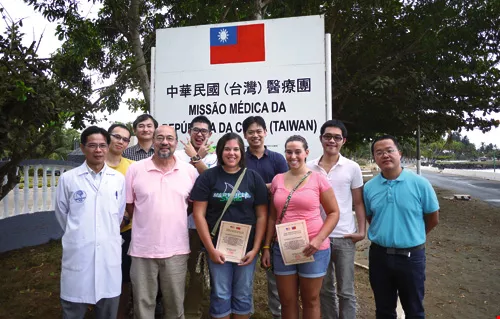
A team from Taipei Medical University Hospital is providing medical service in the allied nation of São Tomé and Príncipe.
Taiwanese foreign aid began with the provision of agricultural technology and techniques, later expanding into medical and educational aid.
Taiwan dispatched its first medical mission in 1962 to Libya, blazing a trail for future missions. Since then, medical missions have been sent to many countries, including Niger, Liberia, Guinea-Bissau, the Central African Republic, Burkina Faso, Chad, São Tomé and Príncipe, Malawi, and Swaziland.
Clifford Li remarks that in the early days, many of the missions were made up of military doctors seconded from the Ministry of National Defense, but as a result of military downsizing, they had to move their focus to calling for volunteer doctors. In recent years, such missions have been organized by individual hospitals in Taiwan, reaching out to hospitals in the host countries.
In 1979, National Taiwan University Hospital began taking part in joint missions with hospitals in Saudi Arabian cities like Hofuf, an experience which is a shared memory for many doctors still working at NTUH.
NTUH superintendent Chen Ming-fong explains that there were only a limited number of resident positions available at the hospital at the time, and it was an unwritten rule that anyone who wanted to get one of those positions had to spend a year serving in Saudi Arabia. As a result, several of the hospital’s most well-known and respected doctors, including Hsieh Yen-yao, Lin Fang-yuh, Hou Sheng-mou, Chang King-jen, and Yang Pan-chyr are former members of the Saudi mission.
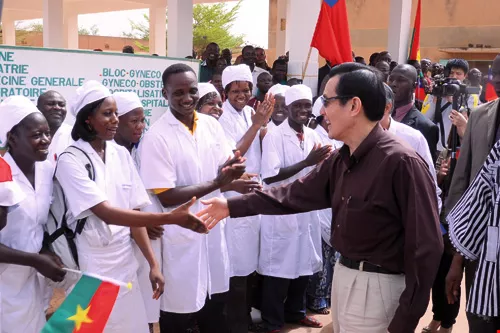
In April 2012, President Ma Ying-jeou visited the Koudougou Friendship Hospital in Burkina Faso, meeting the medical staff serving there. (photo by Huang Xuhong, Office of the President).
Medical aid can be broadly divided into two types: foreign and domestic. The former includes the normal medical missions, small clinical teams, the provision of secondhand medical equipment, and so on; the latter, meanwhile, involves having medical staff from allied nations come to Taiwan to train and patients from other countries come to Taiwan for treatment.
Taiwan’s medical aid ties in closely with the work of the Ministry of Foreign Affairs, the ICDF, and the Department of Health’s Bureau of International Cooperation (ICS).
At present, the ICDF has missions in Swaziland (administered by Taipei Medical University) and Burkina Faso (administered by the ICDF itself).
The ICS, meanwhile, has established “Taiwan Health Centers” in the Solomon Islands and the Marshall Islands.
The center in the Marshalls was established in 2007 and is focused mainly on providing care for mothers and infants and preventing diabetes.
“Public health is grassroots work,” says DOH Taipei Hospital superintendent Lin Shoei-loong, who took the reins at the Marshalls’ Taiwan Health Center (THC) in 2008. The Republic of the Marshall Islands was previously an American territory, and the population faces three particular medical problems, namely high rates of gout, high rates of diabetes, and high levels of blood lipids, along with highly saline soil which makes agriculture difficult. In recent years, the THC’s public health professionals have been teaching the locals how to grow more vegetables and eat less meat, helping cut off the republic’s medical problems at the root.
The THC in the Solomon Islands, meanwhile, has been focused on reducing infant mortality, improving family hygiene, preventing parasites, and controlling high blood pressure.
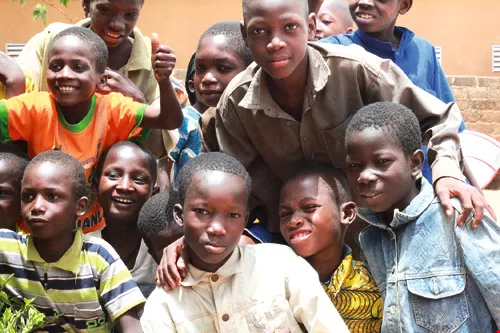
As well as being a means of exercising soft power, Taiwan’s medical aid efforts are also a chance for new medical practitioners to get a different kind of start to their careers. The photos show Yang Zhenya, in Burkina Faso for his alternative national service, with some of his patients.
In the past few years, with the twin problems of climate change and a poor global economy, an increasing number of countries have found themselves in need of assistance, but foreign aid money doesn’t just fall out of the sky.
Development counselor at the American Embassy in Tokyo Dr. Jay Singh has said that in recent years, due to the global financial downturn and the problems in the Eurozone, OECD members have had to revise the levels of foreign aid they provide, with only Australia and the United Kingdom raising theirs, while others, including Canada, Japan, and Norway, have enacted reductions.
ICS head Marc Hsu explains that in 2010 Taiwan offered US$380 million in foreign aid, on par with OECD members Italy and South Korea. This accounts for 0.093% of Taiwan’s gross national income, still far off the United Nations’ target level of 0.7% of GNI. ICDF secretary-general Tao Wen-lung says that Taiwan has substantial strength in the private sector, with many NGOs like the Tzu Chi Foundation, Dharma Drum Mountain, Fo Guang Shan, Taiwan Root Medical Peace Corps, and International Action and Cooperation Team involved in providing foreign aid and having more flexibility than governmental agencies in how they approach aid.
Taiwanese medical foreign aid work has faced pressure to transform and reorganize in recent years.
Tao Wen-lung explains that it has become increasingly hard to recruit medical staff for international work, the medical staff Taiwan does dispatch are often seen as replacements for local doctors, and the secondhand equipment that gets donated is often redundant or not what the host country needs, hence the need for reorganization.
While in the past there weren’t enough volunteers, in recent years medical missions have turned to young men looking for alternative national service to make up numbers.
Since the institution of alternative service in 2001, Taiwan has dispatched some 821 young men to complete their service in allied nations—in 2012, for example, 100 men signed on for alternative service for the Ministry of Foreign Affairs, with 13 volunteering for medical service. But with the imminent abolition of compulsory military service, the problem of insufficient manpower has once again reared its head.
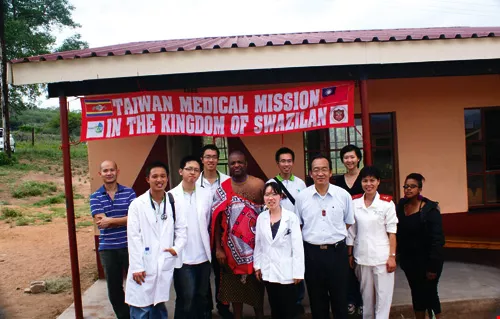
A Taiwanese medical mission stationed in Hhohho District, Swaziland.
Marc Hsu says that in the future, the DOH may establish a program for medical students to spend their summer vacations on medical missions to get experience and broaden their horizons. Students in their final year of study or doing their postgraduate year may also be able to do a year of residency overseas.
With so many cooks in the foreign aid kitchen, things were less efficient than they could have been. To address this problem, the International Medicine and Health Committee has been founded to take responsibility for coordinating and integrating resources, regular interagency discussions, and annual planning.
Clifford Li notes that medical missions stationed abroad will be reoriented toward public health projects, with short-term “Taiwan International Health Action” missions transforming into small medical teams aimed at providing clinical treatment in Taiwan’s six Pacific allies, in addition to Papua New Guinea and Fiji. These teams will engage in short-term, specialist projects to exchange techniques that are particularly tailored to the medical demands of the host nations with local doctors.
The aim of these changes, says Li, is to take the medical mission model from “giving a man a fish” to “teaching him how to fish”; for example, in the Marshalls, they will help local ophthalmologists to learn techniques for cataract surgery, and in Paraguay they will focus on teaching about the implantation of artificial joints.
From providing emergency assistance to working at the grassroots; from receiving assistance to providing it; Taiwan’s history of foreign aid, including medical aid, is a storied one, and throughout it has been focused on humanitarian concerns, while also playing an important diplomatic role. Thanks to these efforts, Taiwan has become a model for smaller nations wanting to play their part on the global stage.
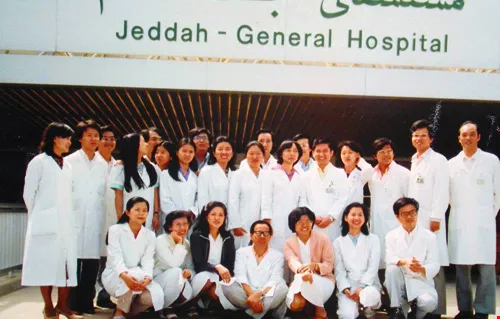
In order to shore up the relationship between Taiwan and Saudi Arabia at the time, Taiwan established the “ROC-Saudi Medical Mission,” which has in the years since become a part of the shared history of many of National Taiwan University Hospital’s medical staff.
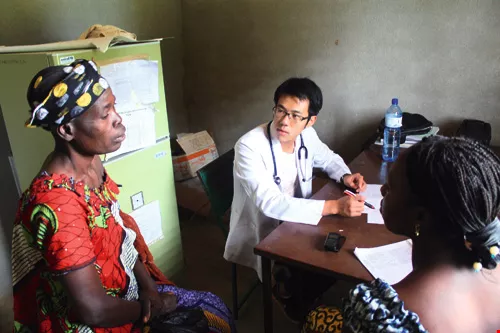
The Taiwanese medical mission in Burkina Faso provides free checkups and treatments. Most of the people who come here are women and children.
@List.jpg?w=522&h=410&mode=crop&format=webp&quality=80)

@List.jpg?w=522&h=410&mode=crop&format=webp&quality=80)


@List.jpg?w=522&h=410&mode=crop&format=webp&quality=80)

@List.jpg?w=522&h=410&mode=crop&format=webp&quality=80)
