

The air in mainland China appears so calm and serene. In truth, it is smoking with the fires of war. This "war smoke" comes from the shortwave signals of foreign lands, as far away as America and England, and as close at hand as Hong Kong and Taiwan. More than 20 different foreign stations are focussed on the same target-- mainland listeners.
Whenever their programs are broadcast, more than 10 million listeners stay glued to their radios. And what they most want to hear from foreign radio stations is the short hour of mainland domestic news.
Those who live in the free world probably find it hard to imagine the degree to which information is craved by those who cannot freely get it. One listener from Shenyang wrote a letter to Voice of America which said, "I'm over 70 years old. Every day my radio is set to pick up the Voice of America. It is the spiritual nourishment of my old age."
"When I was little, I would pluck up my courage and, hiding under the blankets, listen to the Voice of Free China. When I was a little older, I listened to the Voice of America and the BBC," says Yang Jianli, a mainland Chinese with a PhD from Harvard University.
Zhang Weiguo, formerly Beijing bureau chief for the Shanghai newspaper World Economic Herald, is now a visiting scholar at the University of California at Berkeley. He says that besides listening to shortwave radio on a regular basis, he would "sometimes compare the news from the BBC, Broadcasting Corporation of China, and the Voice of America." As an example, Zhang recalls that before the fall of the Soviet Union a professor from Tamkang University did live reports from Moscow for the Broadcasting Corporation of China. Neither the Voice of America nor the BBC achieved the same on-the-spot coverage.
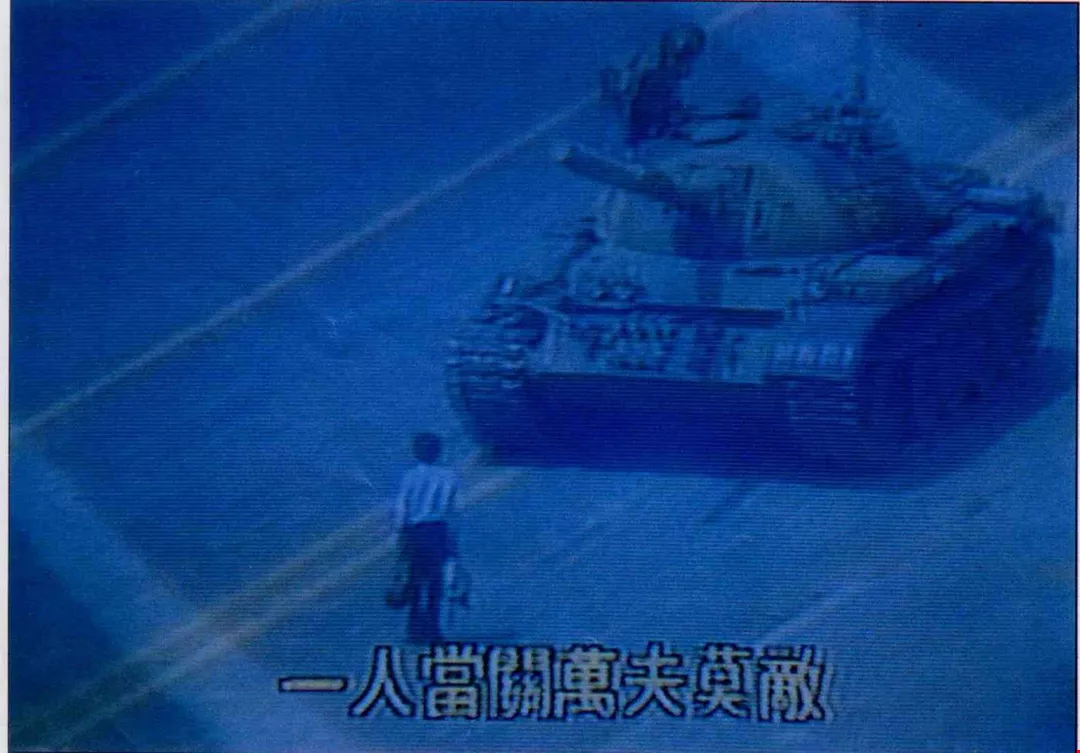
In 1989, television viewers throughout virtually the whole world saw this scene of an unarmed protester single handedly halting a tank. But because of the difficulty in gaining information, the citizens of mainland China were probably the only ones who were unclear as to what had happened. (photo taken from television footage)
The whole world in one radio
The Voice of America, the British Broadcasting Corporation (BBC) and the Chinese-language broadcasts of the Broadcasting Corporation of China's overseas division did not instantaneously rise to their current level of popularity. Their wide audiences were gained over more than ten years of broadcasting to the mainland.
In fact, shortwave stations from such countries as Germany, Australia, Japan, France, Canada, South Korea, Singapore and New Zealand all presently broadcast Chinese-language programs. Altogether more than 20 of these medium-or short-wave broadcasts inhabit the mainland airwaves, some supported by governments, others aided by private foundations.
Some people consider these radio shows to be propaganda tools, and they are not far off the mark. In years past, the psychological war over the airwaves was tainted heavily with a political color.
Jeffrey Lu, deputy managing editor of the Central Broadcasting System, notes that the station used to have a program called "Methods for Communication on the Air." This was the way the ROC's intelligence agencies contacted their undercover agents. The contents of the program were simply a series of numerical codes, broadcast ten minutes at a time, several times a day. It was not cut out until martial law was lifted in Taiwan in 1987.
The station had a very clear mission. Yet Lu stresses that many listeners believe their station is only trying to "insult the communist bandits." "Early on, all the stations in Taiwan referred to the Chinese communists as 'bandits,' but we never used the word when we broadcast all over mainland China. How could we have got any audience if we called them bandits?"
Broadcasts from Taiwan glorified the affluence of democratic society, while those from the mainland extolled the beautiful future prospects of their socialist system. The arguments went back and forth in a clangorous clamor.
Jeffrey Lu recalls that in the 1960s when he was still a student, he tuned in on programs from Beijing. One instance that left a deep impression upon him was when the mainland military shot down an American reconnaissance airplane along the border of Yunnan. The mainland government made a tremendous hullabaloo over the air: "If one American imperialist aircraft comes, we will shoot one down! If two come, we'll shoot them both! If the American imperialists dare to invade the territory of China, we will bury them in the vast ocean of the people's war!"
In time the broadcasts underwent a number of metamorphoses; the noisy and sanctimonious intonation disappeared. Today they strive to be personable and accurate.
After the profound changes in Eastern Europe and the former Soviet Union, the international broadcasts of the free world switched their emphasis to Mandarin. Of the 5.6 million people all over the globe, one quarter speak Mandarin, and the vast majority live in mainland China. The Mandarin broadcast market has an insuperable potential.
It appears that there is room for unbounded expectations, but news broadcasts are still plagued with great difficulty. The scope of Mandarin-language broadcasting rarely exceeds language education, international news and mainland domestic news. The rate for the latter is usually less than 30% of broadcast time. Having only an hour for domestic news can be a colossal headache for the program's production staff.
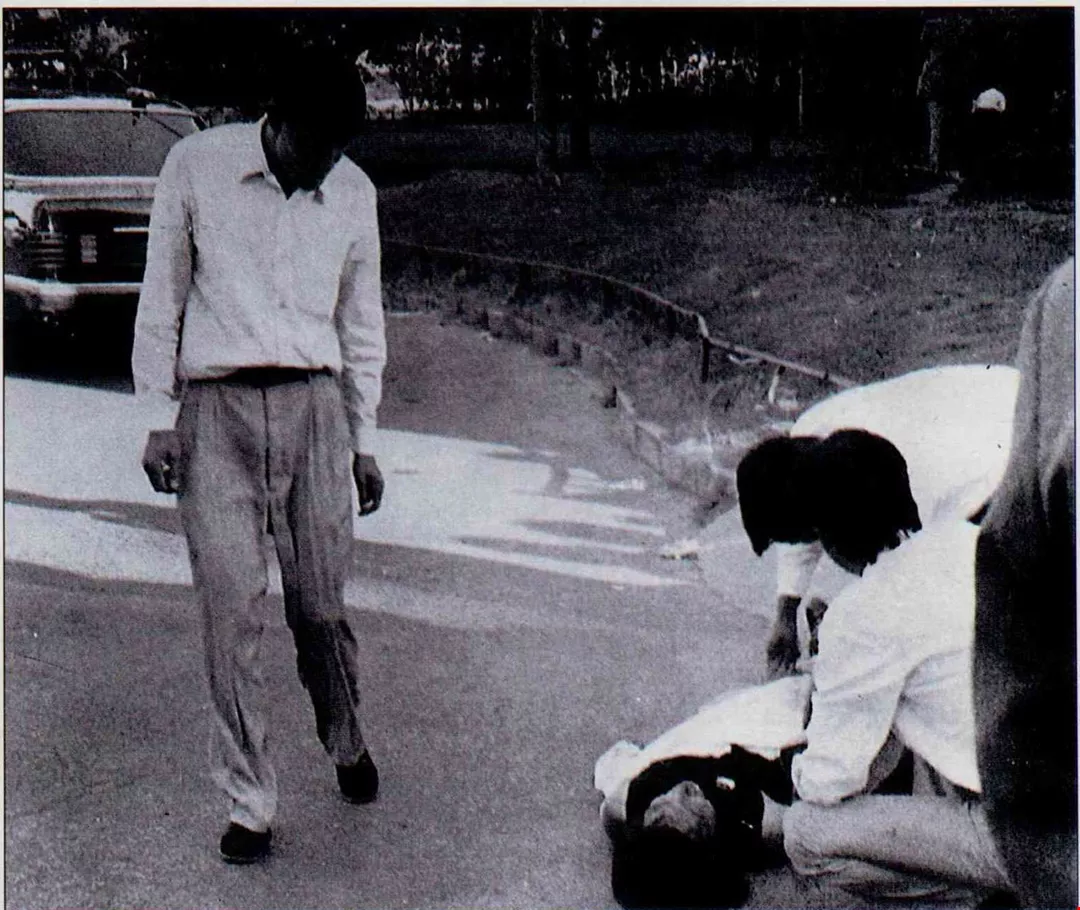
In September of last year, after foreign journalists rushed to report an incident of gunfire in Beijing, the mainland authorities had no option but to reveal the media. (photo courtesy of AP)
Playing down the news
What interests mainland listeners, starved for all kinds of free information, are the events taking place in their own backyard. And the "local news" is the most difficult to process.
Even if the local mainland newspapers and magazines work hard at their responsibility for providing the media with news updates, the barriers are often too great, because of the communist authorities' blockade of the news.
A recent example happened last September 20th when a gunfight broke out in Beijing's embassy district, resulting in more than 10 casualties. But the mainland's official news media did not extensively report on the incident. Even the Beijing Evening News devoted less than 100 words to the event.
Yet the event took place in an area of town where foreigners live, and it was only the second open exchange of gunfire in Beijing's streets in the last 45 years. So on that day, the newspapers sold out as soon as they hit the stands. Some people even resold the papers at a higher price.
Six hours after the incident, the official communist Xinhua News Agency released a report of a little over 100 words, which briefly explained the casualties but mentioned nothing about the age, identity or motive of the suspect. Because their national day celebrations were drawing near, the government instructed the various mainland news agencies to "play down the September 20 incident" and related news, lest it should have an effect on celebration activities.
Most people will recall that after the Tiananmen tragedy of June 4, 1989, in which mainland authorities forcibly suppressed the student democracy movement, television stations around the world ran footage of a mainland youth standing in front of a tank and forcing it to come to a halt. On one visit to Beijing, a university professor from Taiwan asked a friend there whatever happened to that young man who stopped the tank. Unexpectedly, her friend answered, "What guy who stopped a tank?"
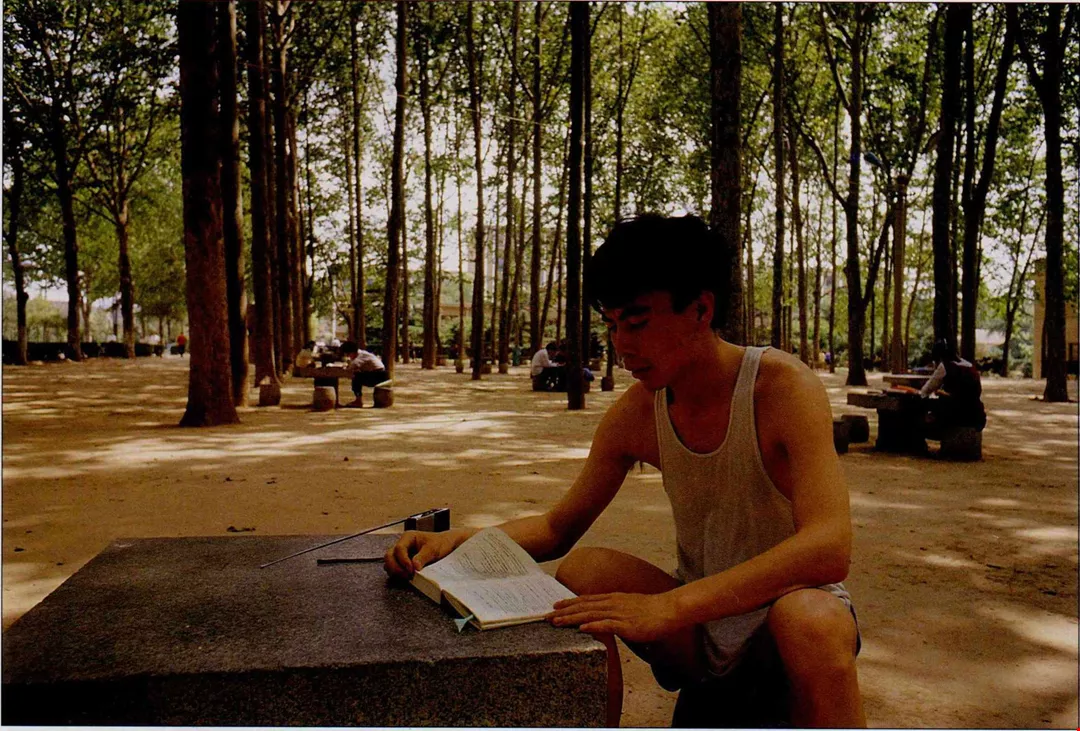
Listening to a broadcast under a tree, absorbing English, contemplating the news--it seems that the whole world is within one's grasp. (photo by Vincent Chang)
Viewing reporters as the enemy
Journalists may also suffer headaches due to mainland authorities' attitudes. Zhang Weiguo, who used to work as a reporter for Shanghai's World Economic Herald, frankly states that from June 4, 1989 up to the present day, mainland China has detained and imprisoned the most journalists in the whole world. It has set a world record in terms of depriving people of their freedom of speech.
In the period prior to the Tiananmen crackdown, the World Economic Herald held a seminar to commemorate the demise of Hu Yaobang. Attendees such as Yan Jiaqi and Chen Ziming sternly criticized the system in mainland China. That issue of the newspaper was confiscated, and later the entire publication was shut down. Three young journalists were exposed and criticized. Zhang Weiguo served a twenty-month imprisonment. "The mainland government felt I had made trouble for them, and I hadn't obeyed their instructions," he said.
"The Communist Party sees reporters as the enemy, especially reporters with a camera," says Todd Carrel, a former reporter stationed in Beijing for the American Broadcasting Company (ABC). On the third anniversary of the Tiananmen massacre, he tried to film the scenes of memorial activities in Tiananmen Square. He was attacked by ten secret policemen wielding steel pipes wrapped in cotton cloth and was detained for three hours. Two years later, his internal injuries have not yet healed. His spine and waist were damaged, rendering him unable to stand for long periods of time. After Carrel returned to America, he could no longer serve as a correspondent. Now he is doing research at the East-West Center in Hawaii.
Reporters from Japan, Germany and Canada encountered similar attacks during that time. The governments of these nations made serious protests. Mainland China's explanation was that they all were injured by unruly protestors.
Two years ago Hsi Yang, a reporter for Hong Kong's Ming Pao Daily News, was arrested while conducting an interview in Beijing. Afterwards, the mainland government gave him a heavy sentence of 12 years for "stealing national secrets."
Foreign reporters often have similar problems. If they are found to be violating regulations, they are automatically deported. But Hsi Yang was not such a case.
According to Hong Kong's The Nineties magazine, Hsi Yang had both gone to school and worked in Beijing, and he only lived in Hong Kong for two years. Judging from his background, he should have well understood mainland China's policies. Such a reaction from Beijing was meant to give a lesson to "traitors."
With the imminent approach of mainland China's 1997 reacquisition of Hong Kong, Beijing is increasingly ill-at-ease with the direction of Hong Kong's media. They want to take advantage of this chance to make sure that the Hong Kong media "behave themselves."
Thrust on this side, parry on that
The foreign media would love nothing better than to smash the stranglehold Beijing has on the news. But mainland China's powers-that-be are anything but slack in their combat preparations. Furthermore, they commonly denounce the "rumor mongering" committed by the foreign media.
In May of last year Beijing's State Council News Office convened the first national news workers seminar. According to Hong Kong's Cheng Ming magazine, during the seminar they singled out and strongly criticized both the BBC and the American wire services.
Li Tieyin, state councillor in charge of news media, charges, "Since China instituted its reforms and liberalization, the broadcast media in the United States, Western Europe and the territories of Taiwan and Hong Kong that are opposed to the Communist Party of China have not stopped their assault and slander for a single day, creating incidents and rumors."
One year ago President Clinton of the United States proposed conditions for extending China's Most Favored Nation (MFN) status, one being that the Beijing government stop jamming the Voice of America. The US State Department also stated that the Beijing government agreed to this stipulation.
But deed has not measured up to word. The Voice of America still receives responses from their listeners in mainland China that the signal is unclear. The Voice of America suspects that the mainland has never stopped jamming their broadcasts, despite the mainland's claims to the contrary.
No news to flog
Even the mainland news media experience difficulties generating solid material with which to apply their talents. How can Chinese-language stations located on distant foreign soil uncover news concerning the mainland? And how can they accurately and speedily send it out?
Generally speaking, the news sources that Chinese-language stations commonly access are official government news and Hong Kong periodicals, as well as the world's main wire services, such as the Associated Press (AP), Agence France-Presse (AFP) and Reuters.
The large number of democratic activists who have been exiled from mainland China since 1989 have also served as an information reservoir for reviews on Chinese affairs in Chinese-language broadcasting programs.
On last year's fifth anniversary of the Tiananmen Massacre, both the Voice of America and the Voice of Free China produced memorial features in which they interviewed exiled student leaders such as Wang Ming and Li Lu, as well as democratic activists Fang Lizhi, Wang Luowang and Liu Bingyan, to discuss the democratic future of China.
The Voice of America and the BBC both have special correspondents in Beijing, but the Beijing government stipulates that correspondent posts in Beijing must not be assumed by ethnic Chinese. Non-Chinese can be detected at a glance and are easier to "observe."
For long-term correspondents, difficulties lie in how they will develop relations with news sources and how they will protect these sources. "You can't simply go see whomever you want to see. That's very dangerous for them," says ABC's Todd Carrel. Many Chinese try to contact journalists, but even if the interviewees risk their lives revealing inside stories, the problems involved in conducting interviews in the mainland have always been, "What actually happened? How can one be sure of the accuracy of the news? What is the motive of those who supplied the news?"
Carrel says he worked in the mainland for seven years, but he still feels he has only seen a minute part of China.
In 1987, due to the fact that there were too many reporters entering Tibet and bringing news out with them, the PRC Ministry of Foreign Affairs enacted a "ten-day rule," which required reporters stationed in Beijing to inform the Ministry of Foreign Affairs ten days in advance before leaving the capital. Most remote areas still remain off-limits to foreigners.
Commonly rejected
Of course Chinese-language broadcasting stations are not satisfied with "only being able to report what Beijing puts in the newspapers." They still try their best to get first-hand news, but almost every station has been turned down when they request interviews with high-level Chinese leaders.
"Every time China's Minister of Foreign Affairs passes through the country, we go register at the Chinese Embassy. We are never granted an interview, but at least it's not because we didn't try to report on him, it's only because he didn't reply," says Wu Baozhang, who once was Xinhua News Agency's Paris correspondent and currently is the chief of language services, Chinese section, at France's La Radio Mondiale.
When the Golden Voyager loaded with Chinese refugees ran aground off New York, the Voice of China, sponsored by the Foundation for China in the 21st Century, discussed the issue of smuggled refugees in its programs. They tried several times to invite members from mainland China's consulate in San Francisco, to no avail.
Voice of America is conveniently located in Washington DC, but when they try to interview officials from the Chinese Embassy, they still get no reply eight times out of ten, says Peter Chen, Chief of External Affairs and Placement in the Voice of America's Chinese Branch. His impression is that he has hardly made any significant interviews with mainland officials.
Is Deng dead yet?
Even if news is hard to come by, their basic principles are "to report whatever the Beijing government's official media could not possibly report or would censor" and "to release any news they won't release." The focus of concern for issues in mainland China is human rights. On every anniversary of the Tiananmen incident, they produce special programs. On several occasions, they reported on the mainland democratic activist Wei Jingsheng while he was imprisoned and after his release.
Principles are easy enough to establish, but the problem remains how to verify the news that mainland China's official media refuses to release. The VOA's Peter Chen notes that in the past they have "run into misfortune." Around the time of Tiananmen, Hong Kong's news media reported that Li Peng was wounded in Tiananmen Square. This turned out to be sheer gossip.
One special correspondent from La Radio Mondiale heard news in Hong Kong that Deng Xiaoping died. Thinking that this was a big story, he immediately reported it back to Paris. It also turned out to be pure hearsay. "Later on, we openly apologized to our audience. And the listeners gave us good feedback; they said that the Chinese newspapers never corrected their mistakes," says Wu Baozhang.
News about Deng Xiaoping's critical illness is of course one common focus of media concern. Several times such reports were sent in from overseas, but in the past such rumors would fade if only mainland China's authorities denied them. Starting from May of last year, rumors have escalated. The mainland government and Deng Xiaoping's family have tried to brush away such speculation, but without success.
The media, with their sensitive antennas raised for new scoops, are beginning to get nervous. One English-language newspaper in Hong Kong is said to have already interviewed many commentators on Chinese affairs to analyze from various angles the future of China after Deng dies. Another foreign broadcasting station has already recorded a series of interviews.
"I won't report on Deng Xiaoping's death. The best way is to let Xinhua cover it," says Todd Carrel. Otherwise, how can one be sure of its validity?
It is indeed hard to come by internal news from mainland China. Facing this dilemma, some mainland scholars suggest tapping in on the supply of overseas Chinese. Since Tiananmen, a large number of people have remained overseas, and there are also between 40,000 and 50,000 overseas students. After gaining the right of residence in foreign countries, many of them frequently enter and exit mainland China. They are a ready-made database for "observing the climate on the mainland."
One China, four systems!
Today, when the two societies on either side of the Taiwan Strait are constantly in contact, the foreign broadcasting stations often choose controversial or major news events regarding cross-Strait relations, such as airplane hijackings or official bilateral talks.
Some reports indicate that early on the personnel working for the Voice of America's Chinese Department, such as radio announcers and translators, were all trained by Taiwan. But since the United States established formal diplomatic relations with the mainland in 1979, things have changed. Members coming from the mainland have been increasing, and they lack an understanding of today's Taiwan.
La Radio Mondiale is an exception, working relatively hard to strengthen its reporting on Taiwan. "France has an expert on Chinese issues who particularly said to me that we had to emphasize our Taiwan reports and that the outside world has too limited an understanding of what's happening there," states Wu Baozhang. They have already produced a series of interviews with Taiwan political figures such as Ma Ying-jeou, John H. Chang and Chiao Jen-ho, which have been aired one after another.
Mainland listeners have also expressed a desire for such programming, especially following the Koo-Wang Talks two years ago. Wu Baozhang guesses that mainland listeners wished that the mainland media could have covered the talks more thoroughly. But in disappointment they turned to foreign radio stations for information.
"We say that we broadcast toward China, but I've always felt that we've left out many areas in our broadcasting. How about Hong Kong? And how about Macao? China's situation is actually 'one China, four systems,'" says Wu.
Pop culture or politics?
The fact is that the audiences of Chinese-language broadcasts are themselves changing. As things continue to head in an apolitical direction, programs with a "soft tone" are increasingly popular.
And how, in such an atmosphere, should shortwave stations discuss political issues? Should they conform to the temperament of society and change to a more relaxed format?
Wu Guoguang, a student from mainland China who has earned a PhD in political science from Princeton University, explains, "Everyone in the mainland is busy making money. Who knows what thoughts are going on in most people's heads?" But even if this is the case, he does not recommend a faddish approach, because local stations will likely do a better job.
There is no obvious answer to this question. Programs which focus on popular trends are unquestionably well-received in the mainland. A good example is the Broadcasting Corporation of China's "Harmony Time," which interviews Taiwan's singing stars and introduces new songs.
"This shows that broadcast content is the same, whether targeting the mainland or Taiwan," says Ronald W.Y.Su, BCC's chief of the domestic languages section in the international department. He emphasizes that being relaxed doesn't necessarily preclude getting results.
For example, in 1982 mainland Chinese Wu Ronggen fled across the Strait by airplane to Taiwan. When asked who he would most like to meet, Wu Ronggen unexpectedly replied, "Deng Li-chun." At the time, when many mainland listeners turned on their shortwaves, they would have had no problem recognizing the melodious voice of pop singer Deng Li-chun, whom they called "Taiwan's Little Deng."
A radio in every hand
In the future shortwave broadcasting may be no competition for satellite TV, with its combined impact of both sound and image. But every time a major international incident occurs, the number of shortwave listeners increases. Surveys indicate that currently there are at least 600 million shortwave radio sets throughout the world, half of them in Asia and Africa.
Receiving international satellite programs requires expensive hardware, including a satellite dish, far beyond the financial reach of most private individuals. By contrast, a short-wave radio set only costs US$20. Everybody can easily own one.
The Beijing government has been constantly interfering with short-wave signals. But they also conduct door-to-door inspections for small satellite dishes; a personal shortwave radio set is not so easy to detect.
For shortwave broadcasting, this era falls in synch with the famous quote, "It was the best of times. It was the worst of times."
[Picture Caption]
p.100
After the Tiananmen Massacre, mainland dissidents living abroad have become one of the sources most frequently turned to by shortwave radio programs for information about Chinese affairs. Shown above (from right to left) are Su Xiaokang, Chen Kuide and Liu Binyan. (courtesy of Voice of China)
p.102
In 1989, television viewers throughout virtually the whole world saw this scene of an unarmed protester single handedly halting a tank. But because of the difficulty in gaining information, the citizens of mainland China were probably the only ones who were unclear as to what had happened. (photo taken from television footage)
p.103
In September of last year, after foreign journalists rushed to report an incident of gunfire in Beijing, the mainland authorities had no option but to reveal the media. (photo courtesy of AP)
p.104
Listening to a broadcast under a tree, absorbing English, contemplating the news--it seems that the whole world is within one's grasp. (photo by Vincent Chang)
@List.jpg?w=522&h=410&mode=crop&format=webp&quality=80)

@List.jpg?w=522&h=410&mode=crop&format=webp&quality=80)


@List.jpg?w=522&h=410&mode=crop&format=webp&quality=80)

@List.jpg?w=522&h=410&mode=crop&format=webp&quality=80)
