No Dream Too Small
Crowdfunding Comes to Taiwan
Liu Yingfeng / photos Jimmy Lin / tr. by Phil Newell
February 2013


Over the last two decades we have seen the rise of the Internet, the blossoming of blogging, and the meteoric success of social media like Facebook. What revolutionary new web model will emerge next?
“Crowdfunding” websites first began to appear in the United States in 2009. They bring together the resources of a broad range of Internet users, turning tiny amounts of capital into a major force to help people realize their dreams. In Taiwan, which has always been quick to pick up on Internet trends in the US, crowdfunding websites began appearing two years ago, and today this force that makes dreams come true is starting to have an impact.
“I would like to publish an illustrated book for children; I need NT$15,000.” “I want to produce wristwatches. I need NT$360,000 in capital.” If you put proposals like these in front of a banker or venture capitalist, you’ll likely get a very frigid reaction.
But today people who want to turn their dreams into reality no longer need to ask banks for loans or cajole friends and family to help them out. All they have to do is put their proposal on a fundraising website, where Internet users will be able to directly evaluate whether the idea is worth supporting or not, and, if so, the person making the proposal can then collect small amounts of capital from a broad circle of Internet users. This fundraising approach, known as “crowdfunding,” has been getting increasing attention in Taiwan over the last couple of years.
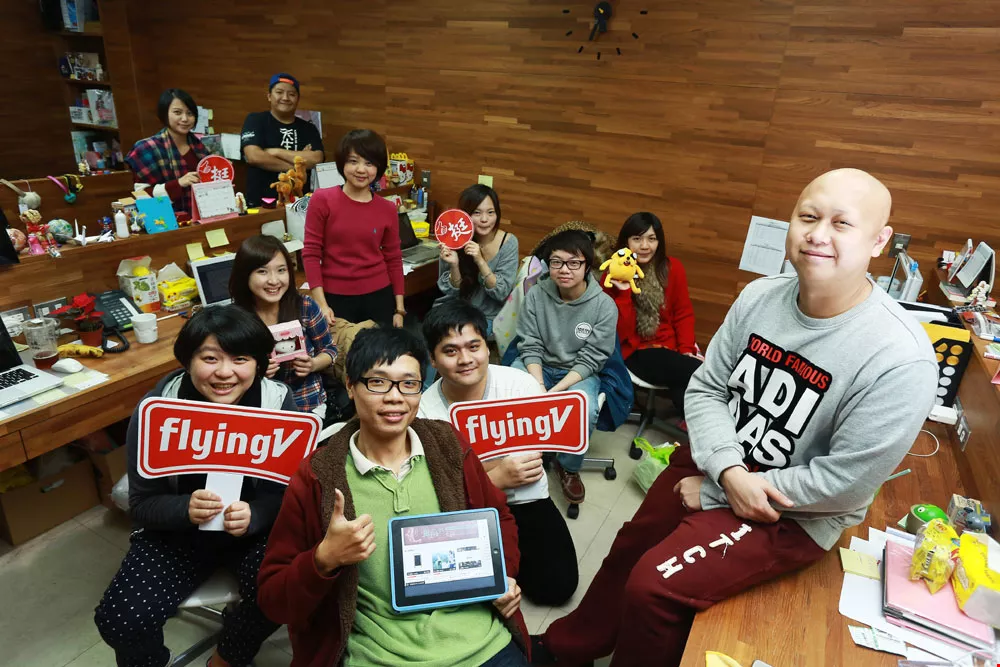
“Wretch” founder Light Lin (first at right) created the crowdfunding website FlyingV to break the traditional mold of capital sourcing, helping resource-poor creative types make their dreams come true.
This trend has been led by site “Kickstarter,” founded in 2009 and currently the largest crowdfunding site in the world.
The kick start for Kickstarter was the personal experience of its founder, Perry Chen, a 36-year-old Chinese-American. A jazz lover, he missed an opportunity to organize a performance at a jazz festival in New Orleans back in 2002 because he was unable to raise US$20,000 to fund his project. This unrealized dream became the impetus behind the birth of Kickstarter.
At the beginning, Chen’s aim was to raise money to help creative artists fund projects. Within less than a year, the site had taken off. Since its founding, it has listed over 80,000 projects, has had more than 2 million people join as members, and has raised nearly US$400 million, successfully funding 43.63% of the proposals.
Crowdfunding websites radically transform traditional models of both capital accumulation and consumer purchasing. Indeed, the Internet users who are the target of appeals for capital are, at one and the same time, the investors behind a given proposal and the future consumers of the product of that proposal. This innovation has drawn a vast amount of attention in a short time. In 2010 Time magazine called Kickstarter the best innovation of the year. Forbes has predicted an enormous explosion in crowdfunding websites this year, and estimates that the total amount raised could reach US$5 billion.

From something as simple as a children’s book to something as grand as performance art, concepts of any kind, no matter how idiosyncratic, just might find enough support among Internet users to become a reality.
The innovation of crowdfunding has made its way from the US to Taiwan, and Taiwan-style “kickstarters” have appeared one after another. In 2011, a group of scholars specializing in media and communications, including Chen Shun-hsiao of the Department of Journalism and Communications Studies at Fu Jen Catholic University and Hu Yuan-hui of the Department of Communications at National Chung Cheng University, founded “We Report,” following the model of applying crowdfunding to citizen journalism. In 2012, Light Lin, the originator of the blogging website Wretch, Quake Hsu, an architect who lived for several years in the UK, and Rio Peng, son-in-law of Taiwan Glass Group CEO Lin Po-Shih, all jumped in, each creating their own crowdfunding site.
After Wretch was acquired by Yahoo!Kimo in 2007, Lin became head of social blog products for the Asia-Pacific region. In 2011, having identified the potential of crowdfunding websites, he began his second phase as an Internet entrepreneur. As he is concurrently senior VP at Maxwell Capital, he understands very well the venture capital world and the criteria for evaluating the profitability of startup companies, so he knows that small-scale entrepreneurs with low-cap micro-projects are never going to get much attention.
Having founded his own firms, Lin knows how hard it is to find investors. He hopes to help micro-entrepreneurs who have dreams and ideas of their own, just like he had, to find a source of capital outside the traditional channels of bank loans and venture capital investment. “This is a new approach, whereby people who have few resources can assist one another to get a leg up,” he explains.
In the second half of 2011, Lin founded FlyingV, which formally went online in April of 2012. Currently FlyingV has nearly 10,000 registered members, has collected nearly 100 proposals, and has raised more than NT$7 million.
At the current stage, most of the proposals on FlyingV are notional, and as yet offer no tangible products. Light Lin hopes that in the future FlyingV will move beyond intangible concepts to actual product manufacturing that will take the original ideas to the next step. “It could be that proposals that get funded will all turn out to be just a flash in the pan, we don’t really know yet. But in any case, there can only be follow-up action and ideas if somebody takes the first step,” he says.
The promotion of crowdfunding has already begun to have an impact on entrepreneurship. For example, Eric Chiu, founder of the creative design website Ch+U Daily, who raised a record high NT$3.54 million on FlyingV, is now planning to mass-produce the watches from his initial proposal. Former rock-band front man Liao Zhiwen, whose initial proposal for “dining tables among the rice fields” (given a thumbs up by Wowprime Group chairman Steven Dai) succeeded in getting funded, has recently come up with a second proposal.
Another figure who wants to help others realize their dreams is Quake Hsu, who has founded the crowdfunding website “Zeczec.” Prior to creating Zeczec, Hsu, a city planner by profession, lived for several years in the UK. As part of his work, he often traveled to design exhibitions throughout Europe. He observed that in Europe, the environment for cultural and creative industries is quite mature. Designers are able to assess market trends by observing the purchasing patterns of large-scale retail outlets. This reduces the risks for going into mass production.
In Taiwan, on the other hand, there is no evaluation mechanism for designers to turn their creative ideas into commercial products, so designers have to absorb the risk that sales will be stagnant. As a result, it has not been easy to industrialize Taiwan’s creativity. Hsu adds that the absence of a sound environment for cultural and creative industries undermines the willingness of Taiwanese designers living overseas to return home.
How can a mature environment for cultural and creative industries be generated? The question kept coming back into Hsu’s mind. Then, at the end of 2010, he happened to hear that someone had successfully raised capital on Kickstarter to manufacture wristbands to mount iPod nanos. It seemed that he had finally found his answer. In 2012, Hsu gathered together five founders from the UK and Taiwan and they established Zeczec here in Taiwan.

Quake Hsu (right), who worked in the UK for several years, and his business partner Wayne Lin (left), returned to Taiwan to found the Zeczec crowdfunding website, offering a fundraising alternative to Taiwan’s cultural and creative community.
Crowdfunding has not only proved to be an innovation in raising capital, it has also transformed the traditional retail model by taking out the professional middleman. Zeczec project manager Wayne Lin explains that the traditional retail model is for a manufacturer to first produce a product, then release it onto the market, after which agents and buyers purchase it on behalf of retail outlets, who then put it on their shelves, until ultimately the consumer decides whether or not to buy the product. “Under this model,” he says, “clients identify with the product, not with the people who make it.”
But crowdfunding websites put the person with the initial concept right on the front line, closing the gap between the creator and individual buyers who ultimately judge whether or not to fund production. As Light Lin says, “In the past, customers dug into their pockets to buy a product. Today when they dig into their pockets, consumers are backing the idea itself. They are providing encouragement to innovators and personally identifying themselves with these creative people.”
To give a concrete example, in the past a band would be signed by a record company who would fund the production of their album, then retail it to consumers through record shops. But crowdfunding allows the fans of an unsigned band to pool money for the production of a new album or concert tour that they can then directly enjoy.
There is the possibility that any idea, no matter how trivial, can come to fruition through a crowdfunding website. But the filtering process, in which a certain amount of funding has to be raised within a certain time limit, can be ruthless. “This is not simply a survey of consumer opinions,” says Lin, “but a final decision actually made by the consumers who are the terminal point in the market.” The “investment” decision is at the same time a “consumption” decision—it is the market giving the proposal the thumbs up or thumbs down even before the production stage.
As T.H. Schee, formerly director of the Association of Digital Culture Taiwan and currently CEO at Fertta Communications, analyzes the situation, crowdfunding has changed the contractual notion of exchanging money for a product of equal value, a notion that is at the heart of traditional trading behavior. Instead, what people are buying through crowdfunding sites is an intangible concept or idea. In the past, consumers purchased the end product, but in the crowdfunding model those who provide capital are in fact “purchasing in advance,” and only later do they see the product actually take form.
Schee argues that the rise of crowdfunding websites is not just happenstance. With the emergence of the Internet in the 1990s, costs for individuals to publish their work plummeted, and everyone gained the power to tell others about their visions and dreams. These were the factors behind the blogging boom, but that was one-way communication only. In recent years, thanks to things like Facebook, it has become possible for strangers with common interests to connect. At the same time, the e-commerce environment has matured and people now routinely send money through the Internet for things they want. The upshot is that Internet users today are now willing to put up money to endorse ideas from people they don’t even know.
“This reflects the level of mutual trust between people in society,” he explains. It would be difficult for the crowdfunding model to operate in a community characterized by widespread deception and fraud.

Watches like this one are being produced by Eric Chiu, founder of the creative design website Ch+U Daily, thanks to money raised through crowdfunding.
A couple of potential problems have been mentioned in connection with these sites. First, there is no legal regime governing them. Second, it is difficult to be sure that those who get funding through them will really do what they promise.
Crowdfunding started without any legal foundation. In the US, last April President Barack Obama signed into law the Jumpstart Our Business Startups Act, one chapter of which deals with crowdfunding websites. This is seen as a very encouraging development by site operators.
Kickstarter founder Perry Chen emphasizes that crowdfunding websites are commercial operations, not charitable or public-interest fundraisers. Websites both overseas and in Taiwan typically take fees of 5–10% from any project that successfully meets its fundraising goals and require creators to deliver promised “rewards” to backers. In Taiwan, though a law has been passed that governs online solicitation of donations by charities, it does not apply to for-profit crowdfunding websites. As there is currently no other legal basis for crowdfunding, this creates some uncertainty about the future.
Schee remarks that when it comes to Internet innovations government agencies have normally maintained an attitude of letting the private sector develop first, then coming up with regulations later. At the current stage of crowdfunding in Taiwan, there are not that many proposals on these sites, and the amounts of money involved for any individual proposal—or even in total, for that matter—are small. Moreover, the current model avoids controversies over distribution of ownership shares. But if these websites continue to expand in scale, or if they initiate equity fundraising, problems will inevitably arise, and there will be a corresponding need for some legal basis to resolve them.
Just as people make down payments for apartments in buildings that have yet to be constructed, Internet users on crowdfunding websites buy only concepts or ideas that as yet have no material form. The problem then becomes, once the Internet users have paid up, whether the fundraiser will be able to implement the project as proposed. To minimize disputes, FlyingV not only signs contracts with people who put up proposals, it also regularly sends out inspectors to check on progress being made.
The evolution of crowdfunding websites has once again revolutionized the way the world sees the Internet. Now the micro-dreams of micro-entrepreneurs who lack capital may, if they can tell their stories in a persuasive way, have a greater possibility of becoming reality.

Liao Zhiwen (second from right) put his very original proposal for “dining tables among the rice fields” on the crowdfunding website FlyingV. The event even attracted Wowprime chairman Steven Dai (second from left).
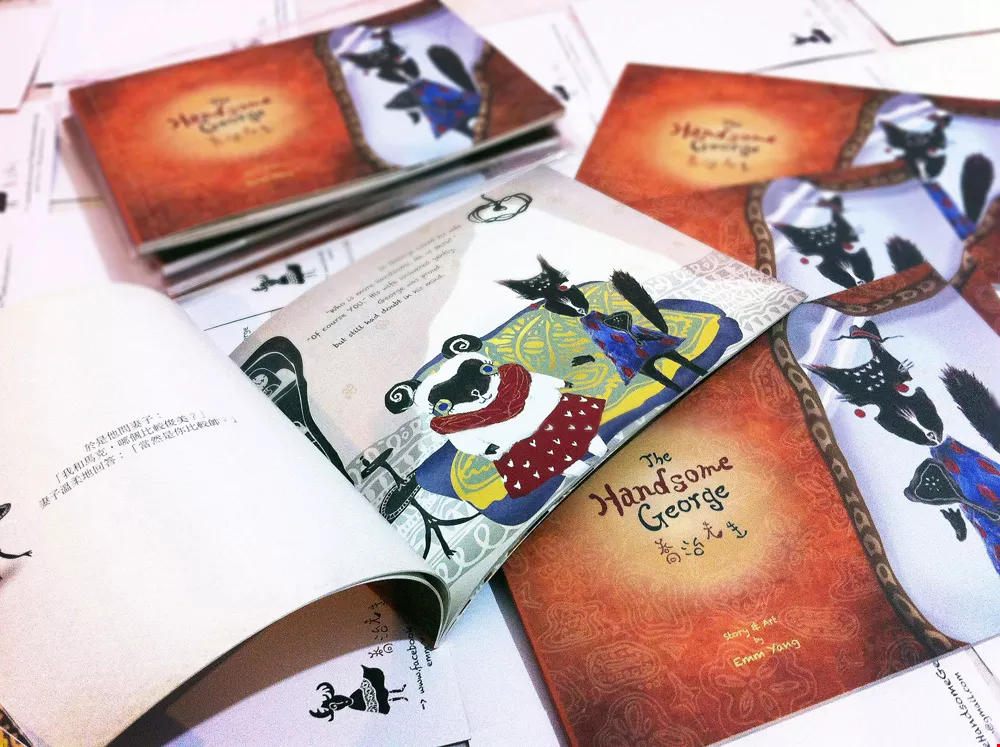
From something as simple as a children’s book to something as grand as performance art, concepts of any kind, no matter how idiosyncratic, just might find enough support among Internet users to become a reality.

@List.jpg?w=522&h=410&mode=crop&format=webp&quality=80)


