The Dream of Chinese Chambers?
Wang Jiafong / photos Vincent Chang / tr. by Christopher Hughes
August 1997


According to William Chambers, Controller of the Royal Architecture for King George III of England in the late eighteenth century, Chinese gardeners were not only botanists. They also had to be artists and philosophers-unlike in his own country where, he claimed, they "emerge from the melon grounds." Did such generous praise lead to fame for the Chinese garden, or was the result quite the opposite? Who exactly was this Chambers?
" . . . but I should hardly advise any of these Attempts in the Figure of Gardens among us; they are Adventures of too hard Achievements for any common hands; and tho` there may be more Honor if they succeed well, yet there is more Dishonor if they fail, and 'tis Twenty to One they will . . . "
In 1685 William Temple, the first person to introduce the beauty of Chinese gardens to England, reminded his readers that there was little chance of failure in the construction of a formal garden with its clearly defined lines. But as soon as you wanted to create the unfettered aesthetic, or "sharawadgi," of the Chinese garden, you would miss it by a very wide margin.

Claremont landscape garden in south London. It is said that when Chambers was beaten by Capability Brown in the competition for this contract, he began the literary onslaught against his rival. (photo courtesy of NTPL\Lan Shaw)
Leaving the melon ground?
The ideal of the natural landscape garden completely supplanted the formal style in the last half of the eighteenth century. The gardener Lancelot Brown seems to have made this "improvement" to the face of the English garden almost single-handedly.
If Brown had been born today he would definitely be a minimalist. It is said that his main contribution was to cut down the large trees that shaded the grand avenues for the nouveaux riches, level the dwellings that had stood between them, smooth off the hill tops to make them into gentle slopes, and turn the rectangular lakes and canals into irregular expanses of water and small streams. Then he would make a snaking path on the expanse of grass and let loose a flock of sheep of just the right number.
Open any guidebook to English gardens and it is very rare to see an eighteenth-century example that has not suffered "improvement" at the hands of Brown. That he was widely welcomed, though, is evident both in his nick-name, "Capability Brown" and his household familiarity. Of course there will always be those who wish to differ. Richard Cambridge, an essayist of the same period as Brown, lamented that every night he would pray that God would let him die first, so that he could see what Heaven looked like before Brown had "improved" it.
The most vigorous attacks on Brown's natural garden, though, were made by William Chambers. Chambers could see how the formal garden was a travesty of nature. Yet the style of Brown, by which it was being replaced, blindly followed nature and lacked any sense of taste. It was, in fact, hard to distinguish from the wilderness. Consisting of a few trees planted on a large grassy slope with a winding narrow path, people were spending a lot of money to produce not much more than an extravagant meadow. To top all this, you had to take the long route through the large expanse that could be taken in at a glance, by following a winding path.
When Chambers talked of English gardeners as "emerging from the melon grounds," he was undoubtedly making a sarcastic aside at Brown, the untutored professional who had indeed started out in the kitchen garden. The problem is that although Brown may not have been a philosopher or painter, he obviously knew how to win contracts. Many later critics thus think that Chambers' criticism is not much more than the churlishness of a bitter rival.
Yet it was to stop the English garden approaching the completely wild that, almost a century after Temple had introduced sharawadgi to England, Chambers looked again to the Chinese garden for support. Compared to the second-hand knowledge which created Temple's Chinese riddle, though, Chambers could rely on the fact that he himself had actually been to China, and that seeing is believing.
At the age of sixteen Chambers entered the Swiss East India Company and docked at Guangzhou (Canton) twice. After he left the Company he went to Paris and Rome to study architecture, then settled in London in 1757. Two years later he published Designs of Chinese Buildings, Furniture, Dresses, Machines and Utensils. In that same year he was invited to become tutor to the Prince of Wales. When the Prince became King George III, Chambers was naturally employed as his architect. His designs include the palace of Somerset House and important architecture in the Royal Botanical Gardens at Kew. It is due to the fame of Kew that he was knighted by the King of Sweden in 1771. The following year he published his controversial Dissertation on Oriental Gardening.
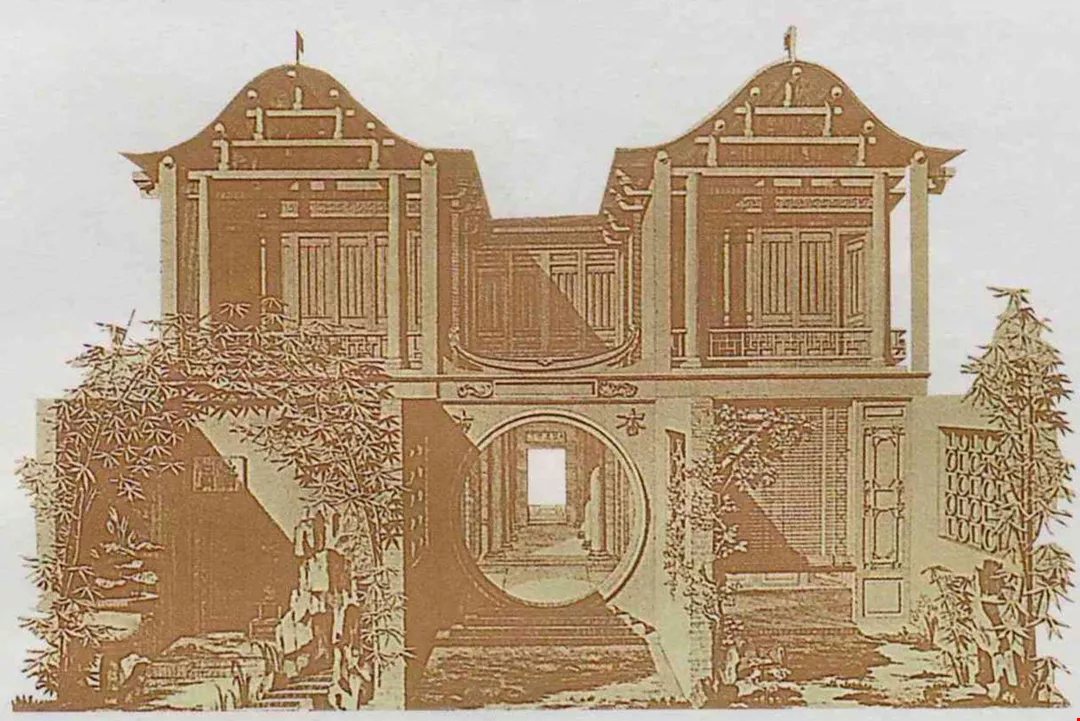
The sketch made by Chambers of a Chinese merchant's house at Canton (photo by Fu Chao-ching).
Horrid, pleasing and enchanted
It was in a chapter on gardening in the Designs that Chambers first vigorously promoted the thinking behind Chinese gardens. He used this to criticize the European formal garden, yet he also attacked the natural style.
Chambers pointed out that the scenes in a Chinese garden actually changed as you walked through it and with the moods of the different times of the day and the seasons. The variety of vistas was also suitable for a range of different activities, such as banqueting, reading, sleeping and meditating. Again, this was far from the English natural garden, which he saw as being fit for a "bachelor's dinner party" and wholly unable to arouse the interest of the walker.
How then were the surroundings of the Chinese garden to be achieved? Chambers proposed the use of three elements: the "pleasing," the "horrid" and the "enchanted." The "enchanted" involved the use of things such as rumbling underground torrents, complicated echoes and wind effects, and strange birds and animals. Effects of "horror" were produced by caverns and cataracts, blasted trees and ruined buildings. Having been through these gloomy scenes, the walker would return to the colorful scenes of the "enchanted" consisting of a great variety of buildings, rocks, grottoes, boats and water mills.
Chambers' later book, the Dissertation, was really an extension of the chapter on gardening in his earlier work, only with even greater exaggeration. Among the examples given for the three elements, those for "enchantment" included "beauteous Tartarian damsels, in loose transparent robes, that flutter in the air" and pavilions containing the "fairest and most accomplished concubines." There were also menageries and structures built for boxing, wrestling and cock-fighting in the garden.
When Chambers talked about the "horrid" scenes, he was even more dramatic. "Bats, owls and every bird of prey flutter in the grove; wolves, tigers and jackals howl in the forests; half famished animals wander upon the plains; gibbets, crosses, wheels, and the whole apparatus of torture are seen from the roads . . . " Dragons, monsters, thunder and electric shocks, artificial rain showers, sudden gusts of wind, and erupting volcanoes were all supposed to be elements of the Chinese garden.
Under the name of the royal architect and dedicating his book to the king, Chambers described the China he had seen in such a way as to present it as a land of wailing ghosts and spirits. How were people supposed to react?

A view of another typical coastal merchant dwelling, the Lin Family Garden at Panchiao, Taiwan.
Praise for others
Those who loved their country sniffed that, apart from its politics (which were at that time seen as something of a model for the West), perhaps China was actually lagging behind Britain. Moreover, the attempt by Chambers to introduce these tasteless Chinese gardens was in fact something rather unpatriotic.
Some people came to the opinion that, although Chambers' descriptions were moving and his book was certainly entertaining, it was hard to believe. Rather than being useful for reference, it was more of a source of entertainment. Somebody even produced a wildly exaggerated satire on his work under the title "An Heroic Epistle to Sir William Chambers, Knight," which ran into fourteen editions.
Chambers responded with a new edition of the Dissertation. This contained the names of a number of Chinese plants and even went so far as to include a testament by a Chinese visitor, in an attempt to strengthen his authority. This visiting artist from Guangzhou was said to have worn nine whiskers, four long finger nails, and to have had "three wives, two of whom he caressed very much; the third but seldom, for she was a virago, and had large feet . . . " He criticized the English in the preface to the book for clearing out their gardens so thoroughly and pointed out that ninety-nine people out of a hundred thought that such simple gardens needed improvement through the addition of variegated and stimulating features.
Unfortunately, the theories and recommendations of the Chinese did not give him the chance to "greatly improve" the natural garden, although his name became widely known in Europe. In 1775 a French treatise pointed out that Chambers' introduction of the thinking behind the layout of the Chinese garden had brought about great advances in Britain and France.
In 1779 a German professor of art wrote in his book that this different style from afar had marked the first time that the highly cultured Europeans had come to understand the true significance of garden art. The Chinese had led the British, and the British had stimulated others. By the end of the eighteenth century, the follies of the jardin Anglo-Chinois had become quite an eye-opener.

A golden bull provides a "horrid" effect in the Victorian garden of Biddulph.
Credibility crisis
In England, however, promotion of the Chinese garden had only led to a credibility crisis for the royal architect.
Ultimately, just how much of what Chambers wrote about this subject can be believed?
According to his own description, the illustrations in his books are sketches from his time in Guangzhou. He claims that the information about Chinese gardens is partly from what he saw for himself there, and partly based on what he was taught by Chinese artists.
Chambers also accepts that within this material there are the views of travelers down the ages. His readers, however, usually take a different view. Most of them think that his work on Chinese gardens is merely used to attack Brown. A contemporary reference work on famous English people lists his work as a "ridiculous book."
" . . . A skillful blend of borrowings, imaginative infilling, and-perhaps-Chambers' own experiences at Canton and its vicinity," points out Patrick Conner, a London art dealer who has carried out in-depth research into oriental architecture in the West. Most of Chambers' ideas about Chinese gardens are borrowed from the description of the Yuan Mingyuan (or Summer Palace) at Peking by the French priest Attiret, while his knowledge of Chinese plants comes from the General History of China by Du Halde. As for the "horrid" elements in his gardens, these come from the idea of the sublime that can be found in the writings of the British philosopher, Edmund Burke. What, then, do the Chinese say?
In the 1930s, to find out how much Chambers relied on Attiret, the Chinese scholar Chen Shou-yi made a careful comparison of the two authors. He concluded that the strange scenes described by Chambers, which were way beyond comparison with any of the trifles to be found in Europe at that time, must be from the Yuan Mingyuan. Yet at that time it was not easy even for those close to the Emperor to see such things. So how could Chambers do so in far-off Guangzhou? However, Chen also thinks that Chambers definitely did not copy everything from his predecessors. Having been to China himself and talked with Chinese gardeners, he cannot simply be considered to be an idle gossip. Unfortunately, though, he raised what the Chinese gardeners had said much too high, making people suspect that his whole book was a figment of the imagination.
Good medicine, bitter taste?
Chen Shou-yi was an expert on the history of communications between East and West. When Ho Chen-tsu, a late professor of architecture at Chengkung University who wrote a work on Chinese gardens in the 1960s, visited England and looked around with the eye of an architect, he concluded that Chambers "really understood Chinese gardens and architecture." As for his views on gardens, Chambers' work was the "medicine that saved English gardens from the wilderness." Yet he adds, "Unfortunately good medicine has a bitter taste and unavoidably invites scorn."
It can be said that the attack on Chambers was also partly due to political factors. At that time in England, the literati who attacked French styles and advocated the natural garden were, on the whole, opponents of the concentration of power in the aristocracy and monarchy. It is not surprising that when the master architect at the side of the King made an attack on the natural English garden he unavoidably drew attention. His use of the distant to criticize the nearby only served to stir up those patriots who were zealously promoting a national style.
Chiu Po-shun, Associate Professor of Art at Tainan College of Art and a student of Ho Chen-tsu, has gone a step further in comparing materials on seventeenth- and eighteenth-century theories of Chinese gardens with the chapter on Chinese gardens in Chambers' Designs. He points out that, "It seems with every paragraph you can find similar theories in the Chinese materials." It might thus be possible to believe that Chambers really did study the basic knowledge of Chinese gardens while he was in China.
"As an architect, Chambers' understanding of Chinese gardens and architecture was naturally deeper than that of the missionaries and merchants who came before him, and it was also stronger than that of Attiret," is the opinion of mainland-Chinese scholar Chen Zhihua. Chen maintains that Chambers' knowledge of Chinese gardens surpassed the superficial observations about the untrammeled imitation of nature of the age of Temple. It touches on the principles of appropriateness to the environment, using scenery to stimulate the emotions, using winding paths to provide a variety of vistas, and generating poetic and artistic sentiments from nature.
Strange beasts
What, then, about the Western view that the Tartarean damsels, the thunder and lightning, and the wild beasts are all made up? When Chambers was in Guangzhou, points out Chen Zhihua, the idea of the southern garden was actually comparatively crude and toyed with a lot of dramatic effects. So what Chambers said may not be entirely without foundation.
For those who are more familiar with the literati gardens of southern China, or who have been influenced by the cultured spirit of the imperial gardens of the Qing dynasty, putting wild beasts and machines in with the pipa-playing and painting might indeed seem incredible and unexpected. However, it is said that in the parks of the ancient emperors and the back gardens of the rich merchants there really were gathered together all kinds of oddities such as "bull-tendon dog-bone trees, chicken-head duck-foot grass," and a "splendid bird-strange beast range." Everything had to be more than unusual.
Records also reveal that in the parks of Han dynasty palaces not only were there raised a great variety of deer, birds and other beasts, but "elephant hides" and "white deer hides" were also constructed for watching strange creatures from afar. There were even mechanical bronze dragons spouting water, wave machines, and drinking sages. There were yaks and "green rhinoceros" wandering about in the garden of Yuan Guanghan, a businessman at Maoling. Then there was the garden of the Tang-dynasty official, Li Deyu, which contained an enormous fish bone.
In the late Ming dynasty, it is said that the salt merchants of Yangzhou graced their great halls with mechanical nudes. The export porcelain of Guangzhou is adorned with grossly distorted depictions of the crucifixion and naked missionaries chasing peasant girls. Who knows, then, what clever tricks Chambers' rich business acquaintances in Guangzhou might have wanted to show off when trying to impress the Westerner?
Talking about ice to summer insects
"Of course, there could have been a problem of understanding when Chambers heard people making descriptions," says Chen Zhihua. In the gardens of southern China, for example, there were many works that used the shapes of rocks. The "Lion Garden" of Suzhou, for example, was named after its collection of stones shaped like lions in a variety of positions. The Da Guan garden of the Dream of the Red Chambers contained stones shaped like monsters and fierce beasts. As for what Chambers said about volcanoes and lightning, Chen thinks that this could have been derived from the fireworks in the Yuan Mingyuan. You cannot say that all of these things were just dreamt up out of nothing by Chambers.
For the young Chambers who had sailed the seas with the East India Company, the complex politicized and nationalistic dispute about gardens that he became embroiled in must have made about as much sense as talk of ice to a summer insect. In one letter to a Swedish friend he exclaimed bitterly that the English find it hard to imagine an island that is big enough to have forests that elephants can walk in. "Our gardeners, and I fear our Connoisseurs too, are such tame animals, that much sparring is necessary to keep them properly on their haunches," he lamented.
It was to China that the experienced and knowledgeable Chambers looked for support to complete his mission of the "great improvement" of the natural garden. He originally thought that the Chinese "lived far enough off to be out of the reach of critical abuse." He could never have imagined that some time after he had stepped on this particular land mine, he would actually get a measure of sympathy from them.
As with Temple, after fully admiring the beauty of the Chinese garden, Chambers concluded by warning his compatriots that it was a profound art that was not to be tried lightly.
Two centuries later, when you wander along the winding paths of the English landscape garden and suddenly come across the burnt-out shell of a building, then turn and are confronted by a reclining golden bull, you cannot avoid worrying: Is Chambers still arguing with Brown, alongside whom he lies in Westminster Abbey, about how to improve the scenery in Heaven?
@List.jpg?w=522&h=410&mode=crop&format=webp&quality=80)

@List.jpg?w=522&h=410&mode=crop&format=webp&quality=80)


@List.jpg?w=522&h=410&mode=crop&format=webp&quality=80)

@List.jpg?w=522&h=410&mode=crop&format=webp&quality=80)
