The Business of Storytelling
Taiwan’s Professional Speakers
Eric Lin / photos Chin Hung-hao / tr. by Scott Williams
August 2013


Taiwan’s rising entrepreneurial tide is lifting the boat of our professional speakers to new heights.
More than just communications experts, Taiwan’s speakers are also active “cross-pollinators.” They flit from audience to audience and from corporation to corporation, delivering talks that ease concerns and answer questions affecting every sector of the economy. In so doing, like honeybees, they collect and redistribute the “pollen” of various innovations, giving rise to wonderful new creative fruits.
Interestingly, these speakers are themselves entrepreneurs who work hard to develop their brands and increase their value in the hope of someday becoming a star in the corporate sphere.
How is Taiwan’s new enthusiasm for entrepreneurship changing the professional speaking business? How are speakers adapting to the times? How are they distinguishing themselves in what has become a crowded marketplace?
The Youth Career Development Association Headquarters (YCDAH) marked the start of classes for its second annual entrepreneurial guidance and consulting course in June 2013.
The course requires would-be students to meet certain criteria, and advertises that those who complete it are eligible to become entrepreneurial consultants or association speakers, and may receive recommendations to take part in government projects sponsored by the likes of the Small and Medium Enterprise Administration and the Council of Labor Affairs. Dozens of professional speakers signed up for the course, all hoping to propel themselves into the ranks of Taiwan’s top speakers.
According to the YDCAH, more than half of the 50 people who attended its first speaking course in 2012 were hoping to add corporate counseling and crossfertilization skills to their speaking talents as a means of creating their own market niches.

Robin Chen is a powerhouse who sometimes works from cafés. A wine club meeting on a Danshui riverboat (right) provides members with a chance to relax and socialize.
The YCDAH is one of the most important sources of professional development classes in Taiwan. Their courses are inexpensive, professional, and cover a lot of ground, making them the first choice for many entrepreneurs and white-collar workers. But in spite of already possessing an enormous database of speakers, the organization still stresses that there is “a dearth of qualified, professional consultants.” Clearly,` the current wave of entrepreneurship has created an enormous market for speakers.
The main reason is that the speaking industry, unlike more traditional industries, tends to boom when the economy is down.
When global inflation began rising in 2007, Taiwanese workers became anxious about the job market and responded by seeking to expand their job skills. That demand sparked growth in the speaking industry. When the 2008 financial crisis struck, Taiwan’s government responded by promoting entrepreneurship as a means of creating job opportunities, causing speakers focused on entrepreneurship to become very popular and turning the speaking profession into one of the brightest fields in an otherwise bleak economic environment.
Given that a good speaker can earn nearly NT$100,000 per month working just two days a week, and that a star speaker can earn upwards of NT$20,000 per 90-minute presentation, it’s no wonder people have flocked to the field.
That said, Taiwan’s speaking industry actually began to develop fairly early. Its first wave emerged in the 1990s. With Taiwan’s small and medium-sized enterprises transforming and our large firms internationalizing, a number of former high-level executives began drawing on their management experience and industry contacts to establish consulting firms that offered classes to corporations.
The government became involved in the aughts, establishing the entrepreneurship programs and incubation centers that kicked off the speaking industry’s second wave. The government’s involvement has meant that speakers no longer need to first establish a consulting firm. Instead, they can begin giving talks in Taiwan and mainland China with just a certification from the Youth Career Development Association or the Institute for Information Industry.

Charles Chiu’s class on reading people was well received at a university “negotiating camp.”
They have almost nothing in the way of startup costs, and their products are intangible: words or stories. As a result, their name cards tend to be plastered with a variety of titles, including “speaker,” “consultant,” and “business coach.”
As individual speaking businesses have “miniaturized,” the industry has grown and its content diversified. Meanwhile, the number of classes on entrepreneurship has risen and the hot topics have become how to talk about new trends and market demands, and how to establish a specialization.
The speaking industry’s third wave began rising in 2007. More tightly focused on forging distinct individual brands, offering unique courses, and delivering more advanced entrepreneurial knowledge and skills, speakers of this wave who hope to win an audience have to be idealistic and excel at stirring interest via their writing, social media, or other Web-based media. But they have to be careful that the adulation of their audiences doesn’t go to their heads.
With these changes, Taiwan’s speakers have finally moved beyond being mere storytellers to being professionals who integrate information, organize events, and maintain an active online presence. Audiences, meanwhile, have been most attracted to the industry’s entrepreneurial consulting, digital information, and communications subfields.
.jpg?w=1080&mode=crop&format=webp&quality=80)
Robin Chen is a powerhouse who sometimes works from cafés. A wine club meeting on a Danshui riverboat (right) provides members with a chance to relax and socialize.
C. C. Chang, a third-wave speaker born in 1963, was a journalist and editor for more than 10 years before becoming a speaker. In fact, he used to work for Career magazine, a source of in-depth reporting on issues in the job market. Not surprisingly, Chang’s courses tend to draw on his journalistic expertise.
“I changed careers at the age of 48,” says Chang. “But I laid the groundwork by publishing three books first. The books helped establish my brand by dealing with hot topics like micro-entrepreneurship, the service sector, consulting, and mainland China.”
Chang’s second book was an entrepreneurial guidebook published in 2008 that showcased his firm grasp of the micro-enterprise era. Offering a step-by-step guide to buying from mainland wholesalers, the book generated a lot of buzz and was viewed as a must-read by seemingly every online shopping and accessories entrepreneur in Taiwan. Scheduled to be rereleased in a revised edition later this year, the title has sold 18,000 copies to date.
Chang observes that entrepreneurs are becoming smarter. Nowadays, they take classes and work with professional consultants before founding a business, in an effort to minimize time spent on mundane matters like registering the business and acquiring goods from wholesalers, and maximize the time available for brand management.
As a result, Chang sees a lot of interest in his media communications course, which gives entrepreneurs more confidence in dealing with journalists by providing training in writing brand stories, generating storylines, writing press releases, and interacting with the media.
His presentations are packed with so much practical information that his audiences often have trouble taking notes quickly enough. “I don’t give them any time to nap,” he quips.
Chang is currently publishing books covering the content of his courses at the steady pace of one per year, as well as working as a counselor with the Taoyuan–Hsinchu–Miaoli Multi-Employment Promotion Program. He has also partnered with noted speakers Gino Chen and Lou Zhenghao to form the Taiwan Business Training Center, which has developed a new service-industry certification. The center plans to introduce this certification in Taiwan before extending it to the mainland Chinese market.

Charles Chiu and Grace Yang have been video blogging book reviews for a number of years, raising their own profiles while also providing a service helpful to the visually impaired.
Robin Chen, a digital technology speaker and teacher, has developed her own unique approach to the business: she uses her down time to organize events that meet her students’ need to unwind and socialize. In a move that has been enormously image enhancing, she also donates all proceeds from her events to charity.
Born in 1970, Chen is a graduate of Soochow University’s Department of International Business and worked as the executive assistant to the CEO of a major company and as a business planner for a golf course before getting into speaking. Before she began working for herself, she took all the classes she could to extend her skills and make herself more competitive in the job market.
Chen began moving in a new direction in 2004 by publishing a twice-monthly electronic newsletter offering her analysis of the job market and emerging digital trends. Emailed to the more than 3,000 people on her contacts list, the newsletter immediately generated an overwhelmingly positive response. Two years later, she quit her day job to become a speaker focused on digital technology.
Over the years, her topics have evolved with the tech sector. She tracks even the subtlest changes in the industry, updating her curriculum every time Microsoft iterates its Windows OS, or Facebook changes its policies.
Involved with the Scouts while in university, Chen served three terms as a scoutmaster in Taipei’s Shipai District after graduating. In addition to familiarizing her with event planning, the experience gave her practice with speaking in public and trained her to gauge audience reactions, smoothing her transition into speaking for a living. “When I was leading Scouts, I dealt with children being silly day in and day out. That training makes it easier for me to deal with the strange questions and weird situations that can crop up in classes.”
Chen has a great reputation. Offered more speaking engagements than she could handle in the wake of the 2008 financial crisis, she began rethinking her definition of success. She resolved to book no more than two talks per week no matter how much money she was offered, and decided to focus instead on their quality and on giving herself time to recharge her batteries.
That said, she has an interesting approach to recuperating: she organizes events for a variety of online interest-based “clubs.”
Seeking to live by the scouting credo of doing good deeds and serving others, Chen has created a number of clubs since 2006, including one to share tips and ideas on the digital life, one for wine tasting, one that presents lectures by authors, one that delivers talks on life experiences, and even a reading club. With club events scheduled nearly every week, she had organized a total of nearly 300 events attended by more than 6,000 people as of late June 2013.
“People today are so busy,” says Chen. “They need to spend some time unwinding and making new friends. I just provide a platform for that.” But she admits that the clubs she organizes are also a low-key means of raising her own profile. “You don’t need to say anything. People become familiar with your name and what kind of person you are, which naturally helps you stand out among Taiwan’s thousands of speakers.”
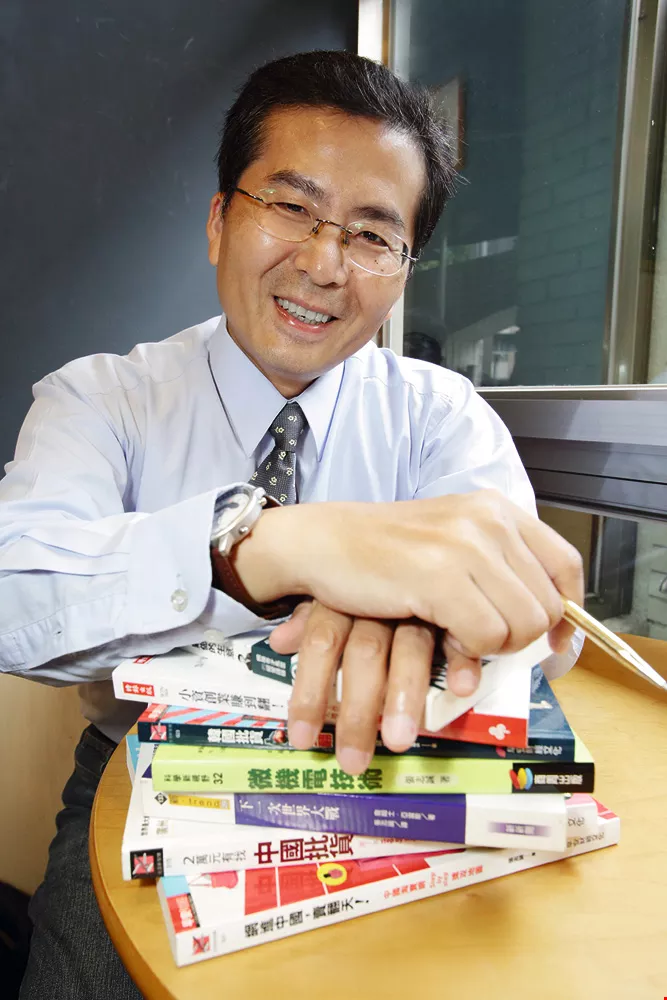
C. C. Chang is a former journalist who jumpstarted his speaking career by first publishing a few books.
In recent years, middle managers and salespeople have come to view communication skills as necessary to their jobs. Along the way, they’ve learned these skills are far less cut and dried than those related to management consulting or digital technology.
Charles Chiu and Grace Yang are a rarity in the speaking industry—a couple who are both speakers. Both hold master’s degrees in psychology and Yang is a licensed counselor.
They got into the speaking business with video-blogged book reviews. When Chiu and a friend established a Web business in 2005, he began recording his reactions to books and posting them online to familiarize himself with certain digital technologies. The next year, he went further by inviting authors and editors onto his show. Working at a pace of two shows per week, he has now reviewed nearly 600 titles and accumulated an extensive list of contacts.
Chiu’s reviews can get upwards of 3,000 views on YouTube. He’s now released an app that allows users to download the reviews as podcasts, and has begun working with Bat E-News and Windows E-News to provide access to his reviews to the visually impaired.
Chiu and Yang’s online reviews raised their profile and expanded their professional networks, enabling them to transition into the speaking business in 2008, where they initially focused on how to manage emotions and foster personal growth.
In 2011, they refined their niche, developing a psychological communication curriculum that teaches students how to use techniques drawn from psychology to read facial expressions and behavior. In a sign of their growing reputation, they were invited to present a class at the summer 2013 “negotiation camp” organized by Dr. Liu Bih-rong, one of Taiwan’s foremost authorities on negotiation.
During a typical class, one of the two will lecture from the stage while the other stands offstage taking photos of students’ faces. They then use a computer to project the students’ photos and analyze their expressions for that day’s audience. The technique, which facilitates a better understanding of psychological analysis, has been very well received by audiences.
For all the current enthusiasm for the speaking business, the profession does present certain moral quandaries. Speakers can become mired in the adulation of their audiences and lose their way. Chen says that speakers have to avoid thinking of themselves as “rock star” life coaches. “You have to remain passionate and idealistic to survive in the profession over the long haul.”
Given the growing competition in the job market, workers have little choice but to acquire new skills. When you set out to do so, be sure to choose a good teacher.


@List.JPG?w=522&h=410&mode=crop&format=webp&quality=80)


