Citizen Survival in the Media Jungle
Chang Shi-lun / photos Jimmy Lin / tr. by Christopher J. Findler
July 2006


The fierce competition that has characterized the media in recent years has been nothing short of dog-eat-dog. In order to grab a bigger piece of a very small pie, media organizations have resorted to every trick in the book in the fight for ratings and advertising profits.
In theory, competition should bring efficiency and progress, but in the case of Taiwan, the media is heading full throttle in the direction of sensationalism. Lack of depth and inflammatory content are the order of the day. Even in news pieces in which seeking the truth ought to be paramount, members of the press are obsessed with a formula consisting of speed, the bizarre, and sensationalism, that they feel is the only way to increase ratings.
Today, the people of Taiwan are no longer simply unhappy with local journalism--they are fast approaching downright indignation. Based on the concept of citizens' mass media rights, some are even beginning to advocate the idea that the media shouldn't be a choice cut of meat restricted to a select few; rather, it ought to be readily available for use by all citizens--a public forum in which all can participate.
Not content to be just lifeless numbers on ratings reports, they have launched a multi-pronged movement to counterbalance and criticize the mainstream commercial media. Despite the present lack of clout, they are pushing from a viewer perspective for step-by-step media reform.
During the spring of 2006, packs of TV station SNG vehicles and reporters camped out in front of a country residence in Taitung. This is the house of Lee Tai-an and Lee Shuang-chuan, major suspects in the South Link Railway rail tampering case. After the deadly derailment, journalists from Taiwan's various media agencies were staked out here day and night. Not long after the case took place, verbal traps laid by law enforcement agencies and the press "drove" Lee Shuang-chuan, suspected of being behind the tragic death of his wife, to suicide. Photographs of his body, dressed in a red shirt and black trousers and hanging from a tree, were unceremoniously shown on the front page of Taiwan's biggest-selling newspaper, Apple Daily.
Following Lee Shuang-chuan's demise, the press re-aimed its collective finger and pointed it at Lee Tai-an. For many days, papers reported every detail of life in the Lee household. Not one to be easily shaken, Lee did a superb job of "playing the media," going so far as to place a sign announcing the "Tai-an Rest Stop" in front of his house to poke fun at the media bivouacked there. He became buddy-buddy with journalists, even establishing a number of "interview rules" and "ordering" each member of the press to scrawl their name on a pillar of his house to commemorate their visit. If it ensured an interview with Lee, reporters were more than happy to be played for fools.
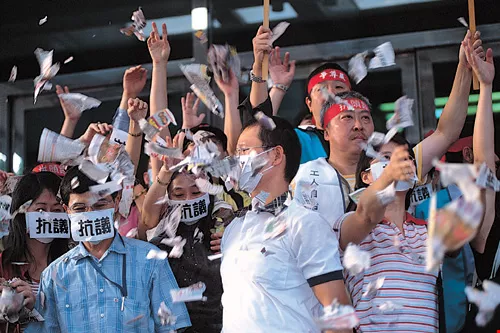
Taiwan's newspaper industry has been scraping the bottom economically speaking for several years and a number of old-name papers have bellied up. Employees demonstrated outside the China Times Evening News after it closed its doors without warning last November.
Meanwhile, in the Taipei headquarters at the other tip of the island, editors scrambled to edit films for hourly news programs. The rail-tampering case was noted for its bizarre nature and the prosecutor's office, after mistakenly divulging information several times, temporarily put on the brakes. The media then proceeded to portray Lee Tai-an and his 83-year-old war-veteran father, Lee Chu-pao, as anti-heroes, like characters in a detective flick, playing their hands close to their chests as they carefully considered their next move against law enforcement officials.
Faced with intense media competition, no news station wanted to be without this breaking news; some channels even handled it like a soap opera, spending 30 minutes or more of each hour-long news program reporting on Lee family tidbits totally unrelated to the case, and even preambling reports with "Episode XX of the Rail-Tampering Case." They went so far as to conjecture on the case and fabricate details without any evidence. SETTV anchor Chang Ya-chin admits these methods were questionable. But although she disliked treating the story this way, "The reality is that reports on the Lee family produce immediate spikes in ratings. If we didn't carry them, other stations would. In the end, we would lose out in the ratings war."
The South Link Railway case is a peephole into the world of Taiwan's media. Faced with pressure from competition as it has been in recent years, the media long ago cast aside all professional standards and ethical considerations in exchange for that almighty duet: ratings and circulation. The driving force behind this phenomenon is nothing less than the media's increasingly dismal future.
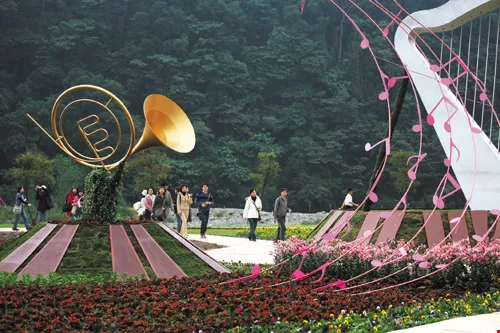
Faced with plummeting revenues, media groups have begun branching out into other businesses and carrying reports about them on their own pages. This is Ilan's Green Exposition, organized by the China Times.
In the newspaper market, for example, we note that in recent years the global print media have been mired in an economic slump. According to a Monthly Statistics of the Republic of China survey, newspaper circulation, still at 61 per 100 households in 1995, tumbled to 47 in 2000. That number fell to a mere 35 per 100 households in 2004. In the last year alone, four major papers, the China Times Express, Great News, Central Daily News, and Taiwan Daily News, have folded. Even the Min Sheng Daily, once the star of the United Daily News Group, is tottering on the brink.
In contrast to the economic struggles being experienced by the market's old players, the vitriolic, no-apologies-offered muckraking of Apple Daily, a Hong Kong tabloid which made its debut in Taiwan in May of 2003, and its "reader/consumer first" attitude in its treatment of the news, triggered a tempest in Taiwan. The images and gossip employed by Apple Daily, eschewing all things highbrow, have meted out a thrashing to the old papers that saw themselves as torchbearers for "quality" and "culture." The China Daily and United Daily Newspaper Syndicates were forced to lay off massive numbers of employees, and the Liberty Times overhauled its layout. Older papers turned up the fire under the blue-green ideological debate to distinguish themselves from Apple Daily and thereby attract readers.
With five network and seven cable news channels blaring 24/7 as they vie for a bigger piece of the market pie, what Taiwan lacks in physical size, it more than makes up for in electronic media. In order to fill up the long time slots that make up these news programs and beat out the other guys in ratings, they scramble over each other for controversial and conflict-filled stories or they focus on soft consumer information messages or human interest stories. TV stations are staunch advocates of sensationalism and tend to oversimplify complex subject matter into black-and-white issues of conflict and confrontation in order to haul in the widest range of viewers possible.
The central government's inevitable squabble, for example, over just how much various government bodies should get of the annual tax take is a complex issue with a number of facets, including the division of power between the central and local governments and the fairness of the tax system. But thanks to media, it has been reduced to a battle between politicians from different ends of the political spectrum. If the parties involved in a news issue just happen to be female, the media has a field day discussing their appearance. It dismisses the topic of their debate, regardless of its merit, as a "catfight."
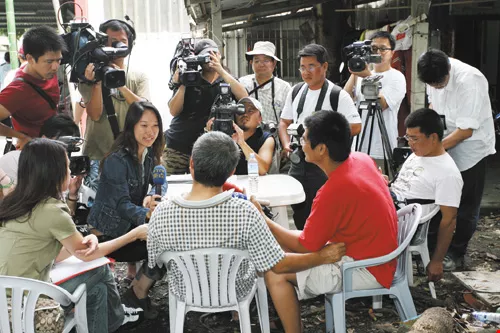
Lee Tai-an (seated, center), a suspect in the South Link Railway rail-tampering case, was surrounded by the media on a daily basis like a movie star.
When discussing the issue of out-of-control sensationalist reporting, many people point the finger of blame at the introduction of Hong-Kong-style tabloid journalism to Taiwan in the form of Next Magazine and Apple Daily. But rather than contending that they "led the local media astray," it might be more worth our while to investigate why Taiwan's media chooses the cheapest and most unimaginative devices available in the pursuit of profit and audience size.
Ratings are the bread and butter of commercial TV stations as they sell advertising time. Daily ratings surveys provided by the Taiwan branch of the US firm AC Nielsen are dense with figures, and fluctuations in ratings for every program on every channel every minute of the day are laid out in black and white. Every TV news station compares its ratings with those of every other news station for every news piece to determine what kind of news sells and what doesn't.
TV stations' obsession with ratings all but ensures that Taiwan's television news will be rife with exaggerated, sensational, and largely irrelevant news bites, because it seems that this is the only kind of information that can capture the gnat-like attention span of the Taiwanese audience. This situation is anathema to serious in-depth, analytical reporting. Even the miniscule number of international news pieces that actually manage to make it onto the screen tend to be human interest stories or reports about movie stars or sports; there is a distinct lack of comprehensive reporting of the real world around us.
The task of senior journalist and TVBS evening news producer Liu Shiu-fung is to arrange the evening's news content each day in the studio. A ratings grappler with years of experience under his belt, he harbors doubts about making numbers the ultimate standard. His reservations are magnified by the fact that although AC Nielsen ratings are "accurate to within about 1%," in Taiwan's small, scattered market, some programs are doing well if they get ratings of 1%, meaning that any such figures may well be within the margin of error.
Liu recalls managing a news program when the screen suddenly filled with snow because the TV station's satellite went on the blitz. Oddly enough, the ratings for the day still stood at 0.25%. Translated into real numbers, almost 50,000 people around Taiwan supposedly spent the day staring at blank screens. This shows just how absurd and bizarre the idea of ratings surveys can be.
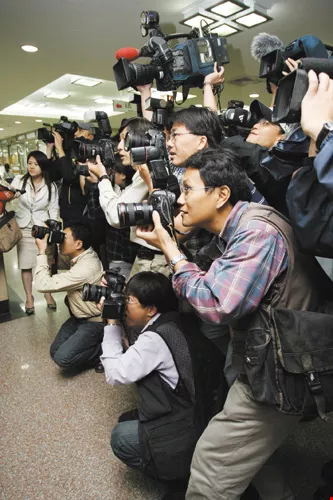
In the fierce melee that characterizes the competition between Taiwan's many media organizations, journalists are more warrior than reporter.
The news media's image has been seriously eroded by sensationalistic, lowbrow news content and selling its soul to advertisers has gutted it of moral values and credibility.
As the fourth power, independent of politics and commerce, the news media should theoretically keep their news departments separate from their advertising, marketing, and sales departments. This would enable journalists to make decisions on news perspectives based on professional judgment, without fear of outside interference. From the standpoint of audiences, news and advertising deliver two different types of message. Ads should not be dressed up as news, and to avoid influencing the fairness and objectivity of reports, journalists should not have any conflicts of interest with their information sources.
That's how it should operate in theory. But the "commercial"-ization of news has been part and parcel of Taiwan's media for a number of years. Today, with advertising profits down sharply, this practice, once considered "uncouth," is now brazenly touted as a policy of "media/industry cooperation." Journalists of major papers, who in the past were respected and could hold their heads up high, have been reduced to newsmongers who are required to dig up dirt and use their connections to sell advertising space and promotional features to the very people they are interviewing, and even demean themselves to promote sales of their papers. Each of these tasks has been written into their monthly performance evaluations. The print media can sell the headline news position to advertising agencies for over NT$100,000 a pop. A huge percentage of the news put out on TV is merely "product placement" paid for by event organizers. What's more, it's all too common to see the sales director take the helm in the news department.
To increase revenue, the media has not only flung open the gates to "media/industry cooperation," it has begun moonlighting in everything from retail, travel, and real estate to exhibitions and event management. It then turns around and churns out advertisements for these activities on its own pages, dealing a serious blow to the impartiality of its reporting.
It is often difficult for readers and viewers to distinguish between reports that contain news worthy of the name and bogus pieces purchased by advertisers and presented as anything from new achievements in industry and breakthroughs in medicine to introductions to restaurants and holiday events. The media is no longer a watchdog; rather, it has become the mouthpiece of advertisers. This is especially true of entertainment, retail, and cultural news and has resulted in a dearth of cogent and reliable reporting in these areas.
Formerly with the China Daily News, senior journalist Caroline Lin believes the core value of news reporting should be seeking the truth and that the policy of media/industry cooperation is tantamount to selling out the autonomy of the reporter. It's a no-brainer that over time, the public's confidence in the media will continue to plumb ever lower depths. If the media is to be compelled to mend its ways, clear-minded readers and viewers, and capable groups dedicated to policing the media, must join ranks to create a counterweight to the media's power.
All of this depends first and foremost on whether or not the people of Taiwan can wake up to their mass media rights as citizens.

As early as 1948, Article 19 of the United Nations' Universal Declaration on Human Rights asserted that "Everyone has the right to freedom of opinion and expression; this right includes freedom to hold opinions without interference and to seek, receive, and impart information and ideas through any media and regardless of frontiers." The media right referred to is accorded the status of an innate and inalienable basic human right on a par with the familiar rights to life, work, and property.
Journalism professor Feng Jien-san of National Chengchi University explains that the media rights laid out in the Universal Declaration on Human Rights are of two main types--individual and collective freedom of expression and dissemination, and the level of resources available to the mass media. In the past, under authoritarian rule and martial law, the public's focus was on safeguarding the media's freedoms of expression and news--rarely on the right of individual citizens to disseminate information. As a result, media organizations have become arrogant, morally degenerate tyrants in their own right.
It is actually common practice for conscientious citizens unhappy with the media's performance to employ any number of methods to uphold their media rights. Many citizens' groups in the West actively advocate that the media should not be controlled by big business, and that individuals shouldn't be just passive consumers of information, but should have the right to access and use the media. Some are working hard to promote "media quality education" in the hope of training private citizens to think independently, to prevent them being manipulated and brainwashed by information pumped out by the media. Others advocate a "TV-Turnoff" movement, setting aside periods of time during which they say no to the boob tube. This gives them an opportunity to take stock of their own lives and decide for themselves whether they rely too much on the media. Still other citizens of common mind, deeply aware of how seriously the media has encroached upon human rights, have joined forces to dialogue with or go toe-to-toe with the media.
In this battle, perhaps David will have to combat Goliath over and over again, but he will eventually chip away at his armor. As the citizens of Taiwan gradually become aware of their media rights, who knows--one day they could become a force to be reckoned with that will prompt an overhaul of Taiwan's media.
@List.jpg?w=522&h=410&mode=crop&format=webp&quality=80)

@List.jpg?w=522&h=410&mode=crop&format=webp&quality=80)


@List.jpg?w=522&h=410&mode=crop&format=webp&quality=80)

@List.jpg?w=522&h=410&mode=crop&format=webp&quality=80)
