

Last fall, newcomer Huang Chih-wei, a Taiwanese male model, walked away with first prize in the male section of the mainland's New Silk Road Model Competition. In Taiwan, that victory has stirred discussion on the role of ethnic Chinese in international fashion; international fashion-watchers, meanwhile, are now keeping an eye on China.
Models have long been in the vanguard of the fashion industry. When they strut down a runway, they not only show off the latest products, but also set the trends imitated by hip young celebrities. As the fashion market in mainland China heats up, Taiwanese models such as Chen Ssu-hsuen, Lin Kuei-chi and Huang Chih-wei are working all the major shows, not only playing a leading role in the mainland modeling scene, but also opening up new frontiers for Taiwan's fashion houses.
One could map out almost the entire development of the ethnic Chinese fashion world by tracking the movements of Hong Kong's Ivan Lam, general manager of Shanghai Elfland Consultants.
Lam began working for modeling agencies in 1984, and in his career since then, he has worked as a trainer of models, a stage director and a production manager, and has even founded a modeling school. Along the way, Lam also discovered several future stars of the Hong Kong fashion scene, including Christine Ng, Monica Chan, and Edmond Leung. In 1992, Lam got excited about Taiwan's potential and established Starlet International Modeling Agency in Taipei, where he began putting his Hong Kong experience to use in the Taiwanese market. In 1997, he merged his company with Taiwan's C&A Modeling Agency to create Elfland Productions. In 2001, Lam turned his attention to the vast opportunities in the China market.
In late 2002, Elfland's offices on Shanghai's Wujiang Road were filled with the crash and bang of carpenters at work on renovations needed to meet the demands of a growing business. Lam sits in front of a French window and, eyes alight, says, "This time, we're going to lead the pack!"
Like many other young men "going west" in search of their dreams, Lam boasts that he is an international trailblazer. From Hong Kong to Taipei to Shanghai, Lam has had no interest in remaining in mature or played-out fashion markets. Though the mainland market presents far greater challenges than he faced in Taiwan, Lam can't wait to dive in.
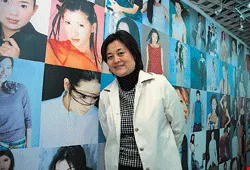
Wang Guihua, executive president of Beijing's New Silk Road Models, has been an eyewitness to the evolution of China's fashion market.
A hot new profession
In Hong Kong, Taiwan, and the mainland, Chinese societies are catching up with the international community and are supporting a growing fashion industry. And while Hong Kong and Taiwan are experiencing a lull, in China's major cities, fashion shows dedicated to the new lines of big-name fashion houses and to promoting the local industry are taking place year-round with hardly a break. The new capitalist class created by China's economic reforms is becoming ever more discriminating and its spending power is on the rise. To meet this class's growing demand for goods, the international fashion houses now always first put out coats costing upwards of RMB100,000 when they release their fall and winter collections to their Beijing shops.
Wang Guihua, executive president of the New Silk Road Model Agency, says that the 1990s marked a crucial turning point for the fashion industry in China. Before then, even what few models there were in China were not very professional. But Wang says that post-1990, changes in economic policy brought new information into China via the media and gave international brands a space in which to operate. "China's Ministry of Textiles also came to understand that the modeling profession played an important role in raising the standards of the textiles industry. It began authorizing the large modeling agencies, over which it had jurisdiction, to hold modeling competitions in great numbers, which improved the quality and increased the number of local models."
Today, the latest products from the world's top clothing, cell-phone, cosmetics, and jewelry companies are all available in China. This expanded market has turned the models that promote these products into hot commodities. These days, there is hardly a young person in China who doesn't feel the allure of a glamorous modeling career, and they see modeling competitions as a way into the field and as a means for newcomers to raise their profile.
But these events are extremely competitive. For example, of the nearly 10,000 contestants who took part in the 2002 New Silk Road Model Competition's 22 regional preliminaries, only 81 made it to the finals.
"Eight of every 10 models in China has gotten into the field by winning a competition. They are selected from among thousands, so their looks-their face, body, carriage-are beyond reproach," says Lam. He notes that in Taiwan, female models need only be 172 cm tall to work, but in the mainland the standard is 178-180 cm. Similarly, in Taiwan, male models average 183-185 cm in height versus 188 cm in the mainland.
"If you're looking for an attractive face, you've got it. If you're looking for a good body, you've got it," says Lam. "But China's fashion scene is five to ten years behind those in Taiwan and Hong Kong. No matter how good-looking these models are, their performance skills, their deportment, their fashion sense and their professionalism just don't compare to those of models from outside the mainland. A number of well-known designers still prefer to spend the extra money to bring in models from Hong Kong or Taiwan for their shows." He cites the example of Taiwanese designer Coco Fang, who in a recent visit to the mainland arranged to have Taiwanese models for her show to ensure that her products had the right feel on the runway.

Hong Kong's Ivan Lam, general manager of Shanghai Elfland Consulting, has been a trailblazer in international fashion, working to develop the Hong Kong, Taipei and Shanghai markets. Lam feels that the key to China's becoming a bastion of East Asian fashion is further liberalization.
Confidence and poise
When China first opened its doors to the world, models from Taiwan and Hong Kong were equally competitive. But Hong Kong models generally avoid staying in the mainland for extended periods, preferring instead to flit in and out like dragonflies on a pond. In contrast, Taiwanese models tend to be more willing to rough it and are more adaptable. Taiwanese models have frequently remained in Beijing and Shanghai for long periods, quickly making names for themselves there and doing much to raise standards for mainland models. Wang Guihua is full of praise for Chen Ssu-hsuen, who was the first Taiwanese model signed by his New Silk Road Model Agency. "Chen's professional skills, the demands she makes of herself and the respect she shows for the agency have provided Beijing's models with a 'model' they can learn from," says Wang. In addition, Chen has a "cat-like face" with a very modern feel reminiscent of Cameron Diaz. Although she is "only" 176 cm tall, that look and that professionalism have made her China's top model in just one year.
Chen remarks, "In a fashion show, the emphasis is on poise, and poise grows out of self-confidence." She says that for her, confidence has been something she has accrued from years of professional work, and which allows her to shine even among the many much taller models who also work Beijing's runways.
The smiling Chen goes on to say that Taiwan's models receive high marks around the world for their seriousness about their work. "People who make it as models in Taiwan are as tenacious as cockroaches." She notes that Taiwan's models train in performance, fashion and makeup; they are never late; and they bring their own accessories (socks, stockings, gloves, etc.). In short, they are skilled in all the "arts of war." In fact, it can be fun to watch the models arrive at fashion shows in Taiwan, because when they do, they come bearing not only their makeup kits, but also such a quantity of shoe boxes that they would need eight hands to carry them all.
When Chen first arrived in Beijing, she was treated with so much respect and consideration that she was thrown for a loop.
"Often, right before taking the stage, you'll hear someone say to the director in a coquettish voice, 'I don't have a thong. What shall I do?' Someone working on the show will then take care of the situation as if it were totally natural. In Taiwan, that kind of model would be given the boot."
Chen says that models are shown a great deal of respect in the China market. But the flip side to this coin is that with little discipline, young local models don't really have the opportunity to mature. China's agency system hasn't really matured either; so local models have to spend a lot of time handling public relations with their clients and their management. Those who make it do so not on the basis of their professional skills, but on the relationships they've built. Taiwanese models, on the other hand, have their agencies handle all the management issues, and instead focus their energies on keeping up to date on fashion and preparing for shows, an approach that has jolted the mainland's modeling scene.
Children of Taiwan
The success of Taiwanese models on the mainland stems not just from their professionalism, but also from a disposition fostered by the open society in which they grew up. Huang Chih-wei's victory in the New Silk Road Model Competition is a case in point.
At the time of last fall's competition, Huang was still a student at a technical college and had been modeling for less than one year. Although he was relatively tall at 191 cm, he wasn't very muscular. But from the moment he climbed on the runway, his disposition and deportment simply outclassed those of the competition.
Wang says, "Huang was both more vivacious and more dignified than his competitors from the mainland. When he dealt with the media, he did so with assurance and poise."
"It's probably a result of Taiwan's more open society," says Huang. "Its young people are more confident, more able to put fashion news to good use and find their own style." According to Huang, he was a star athlete in school and was therefore used to "being liked." Moreover, sports fostered a "winning attitude," and provided him with his first trip overseas. Huang took to travel like a fish to water: "I got to have fun and won a medal."
The business of fashion is much like the business of entertainment-both are "people industries" that emphasize shrewdness and a sense for the visual. In opening up the China market, Taiwan's modeling agencies benefit not only from their models and technical staffs, but also from a common language and culture, which gives them a distinct advantage over their American, European and Japanese competitors.
Many futures
Currently, all of the mainland's modeling agencies are state-run. Elfland, which is the first Taiwanese agency to move into the mainland market, is therefore taking a "soft" approach, putting aside agency work for now and instead focusing primarily on producing product shows.
According to Ivan Lam, "China's hardware-the stages, lights, sound systems, etc-is all world class, but their technical people aren't able to exploit its potential; Taiwan's technical people have become their main source of support." He goes on to state that Taiwan's models have had little difficulty making names for themselves in China in this early stage of its development, and their success has helped the modeling agencies ramp up their operations more rapidly than had been expected. Late last year, Elfland leveraged its modeling agency and training experience to acquire Shanghai's East Asian Modeling Agency's business license. The company now anticipates becoming the mainland's largest agency within five years.
Supported by the growing mainland market, the outlook for the modeling profession is bright, and Taiwanese models leaving the profession now have options besides film and television. Chen Ssu-hsuen, for example, hopes to become a professional fashion-show director.
Chen says, "Right now, furthering my career on the mainland involves understanding the environment so that in the future when I am directing shows, I can better meet the needs of the market." Chen's agile mind and knowledge of her field are serving her well in a profession where, contrary to expectations, success requires more than just a pretty face.

@List.jpg?w=522&h=410&mode=crop&format=webp&quality=80)

@List.jpg?w=522&h=410&mode=crop&format=webp&quality=80)


