

“I once imagined my children spreading my ashes on the Beishi Creek. I imagined them walking through the water like in the film A River Runs Through It, listening to the birds and cicadas in the forest, and it would be like I was there with them.” This is how world-traveling nature writer Liu Ka-shiang describes his love for this beautiful stretch of the Beishi Creek in Shuangxi.
The beauty of Shuangxi is in its stark, unbending vastness, its otherworldly independence.
Situated between New Taipei City’s Pingxi and Gongliao, Shuangxi is known as Taipei’s backyard. Shuangxi’s Taiping and Ganjiaocheng, then, are the backyard to the backyard. Usually, only hikers pass through these two peaceful, remote villages. In order to promote low-carbon tourism, the New Taipei City Government asked Liu Ka-shiang, who is familiar with the old pathways and the history of the mountain townships, to lead the way. They hope that these once-bustling villages will not be forgotten again, and that people will find inspiration in their enduring rustic spirit.
Twenty years ago, the poet Yang Mu described Shuangxi in these words: “The train approaches Shuangxi. The train goes through the unfamiliar stop. The train casts Shuangxi far, far behind. I have never gotten off at that stop, but my heart feels as if I have. Sometimes I imagine what a village hemmed in by mountains like that would be like, like this or like that.” Shuangxi itself is already remote, to say nothing of Shuangxi’s most remote village, Taiping.
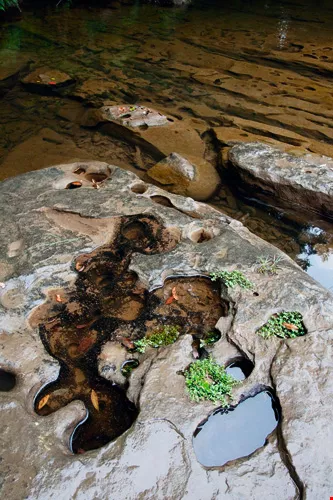
Erosion from the creek’s flowing water has cut holes into the rock in the shape of a bird.
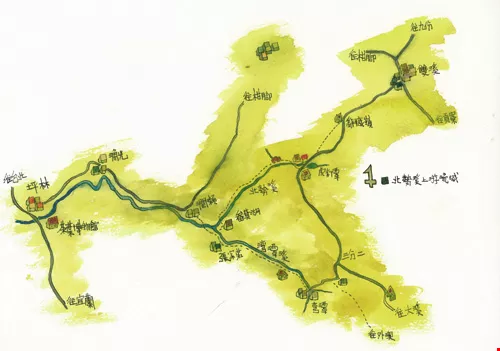
Open a map and you will see that Shuangxi runs from north to south, with the Shuangxi–Taiping Highway to the east and the Shuangxi–Ganjiaocheng Highway to the west. Taiping and Ganjiaocheng are right by these highways.
The first stop on this trip is Hubao Lake, which is around 30 minutes by car south of Shuangxi on the Shuangxi–Taiping Highway. Before the highway was constructed, it used to take eight or nine hours of hiking to get there. Dazhang Peak (also known as “Quitters’ Peak”), located between Shuangxi and Taiping, is the highest point of the local mountain range, and several mountain roads meet near there.
A plaque at the entrance to the Quitters’ Peak historic trail explains the origin of the name: In the early days after Taiwan’s return to Chinese rule in 1945, three teachers from Shuangxi headed out to teach at an elementary school in Taiping. It took them four hours to arrive at this spot, and they saw only towering mountains in front of them. Imagining the long journey still ahead, they decided to quit on the spot and head back.
Liu says that in the 1970s, before the roads were built, teachers that were assigned to teach out there felt as isolated as soldiers posted to outlying islands Kinmen and Matsu.
Now it takes just 10 minutes of driving for a visitor to reach Taiping from Quitters’ Peak over an asphalt road, and the hardship of the old journey is something you only read about in poems. Recently, because historic trails are becoming so popular, the Quitters’ Peak trail was retraced and cleared. Now, you can hike to the other side in less than an hour. The forest alongside the trail is lush, and there are natural fields on the way as well, making it a perfect spring or autumn trip.
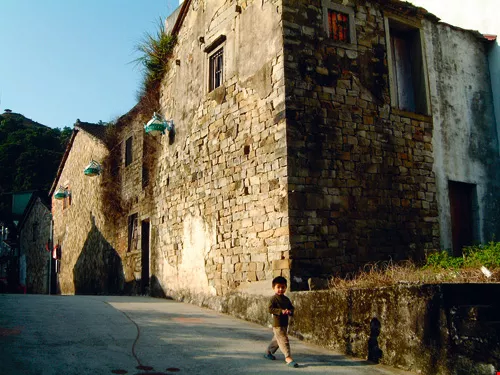
There are several beautiful villages scattered along Beishi Creek, such as Pinglin, Yuguang, Kuolai, and Taiping. Locals enjoy a peaceful lifestyle. Pictured here are stone facades on the old streets of Pinglin.
In front of an Earth God shrine at the head of the path to Hubao Lake, Liu Ka-shiang starts to explain how to examine such shrines.
When in old times people would begin farming a new area, they would first look for a stone or slab that would serve as a place to pray. There they would seek the local Earth God’s protection of their development of the land. That means that the history of the village begins with that of the local Earth God shrine.
The couplet at the doors of the shrine tell of the culture and the time of its founding. For example, “field of blessings” represents rice fields, and “Guangxu” refers to the Guangxu era (1875–1908) of the Qing Dynasty in which this shrine was built. It’s an invaluable insight into local history.
Earth God shrines in Shuangxi are all made of simple ashen sandstone, unpainted and unadorned. On the roof are a pair of horn-shaped protuberances, indicating that the structure was built in the era of Japanese rule. Since it is in such a remote location, it still maintains its original, simple facade.
The mountain valley farmland of Taiping was leveled out and developed by a Qing official, Huang Tingtai, who was in charge of Touwei in neighboring Yilan County. He discovered that the soil there was fertile but unused and, thinking it was going to waste, brought in farmers from Yilan. With a plentiful water supply and fertile soil, the area became a bustling village with terraced fields as early as 200 years ago. Poor families outside the village hoped to marry their daughters off to Taiping residents, and the bustling atmosphere also cultivated many amateur literary types who have left a large body of poetry.
With the changing times, many residents moved away and fields went fallow. Tang Yu, a senior historian who researched the search for gold in Taiwan, was tasked with writing a local history of Shuangxi and in 1977 passed through Sanfen’er, a town south of Taiping. There he wrote “On Seeing Fallow Fields on a Journey to Taiping”:
The crags of Oriole Peak, where the Beishi Creek starts / Ahead are the roaring falls of Hubao Lake / Lodging temporarily at Sanfen’er, / Sighing as I consider the fields that are left untilled.
The stark yet majestic view described in the poem remains the same 30 years on.
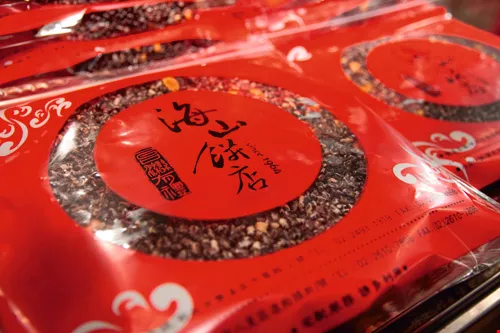
Shuangxi’s Haishan Cake Shop and terraced field farmers from neighboring Gongliao have cooperated to sell gift boxes of puffed-rice cakes made of local rice.
Hubao Lake, which is not far off the highway, is one of the deep lakes upstream on the Beishi Creek. The winding stream is clear and beautiful, and walking alongside it one feels a peaceful, quiet atmosphere.
When Liu first came here more than a decade ago, he had the urge to stand in the water with a fishing pole like Brad Pitt in A River Runs Through It. Here the creek bed is made up of sandstone and shale formations that have been eroded into fascinating designs by the flowing water.
Compared to other mountainous areas in Taiwan, where most rivers are steeply inclined, the upstream stretch of the Beishi Creek is mostly flat. That’s why early settlers could live by the waterside and have an idyllic life here.
Walking along the creek’s edge, Liu shows visitors the remnants of early settlements. For example, there are the light-yellow-flowered rose-apple trees growing alongside the water. Mountain farmers grew them for their fruit, which supplemented their vitamin intake. The fruit is similar to a wax apple, but is somewhat smaller.
There is also a variety of wild ginger lily that was used by early settlers as a spice. Shuangxi residents used to use it in dumplings, just as residents of Neiwan in Hsinchu County used it in their local take on rice dumplings (zongzi). There is also the bird’s-nest fern, which grows in the damp forest. When its leaves are too big to eat, locals use them to wrap rice cakes.

Kayaking is a great way to experience the beauty of Shuangxi. Currently, only group reservations are accepted. Pictured is Houfanzikeng Creek.
The second stop is Ganjiaocheng, also known as Changyuan Village, which is around 10 minutes away from Shuangxi on the Shuangxi–Ganjiaocheng Highway. This is Shuangxi’s most remote backyard. It is also a bright pearl in the dark mountains.
The nearby Shuangxi coal mines once attracted thousands to this place, and Ganlin Elementary once had 900 students at its peak. The mining industry declined, and now the school has only around 30 students.
The tiny village’s landmark Weihui Temple has 140 years of history. One side of the square in front of the temple has the only low covered arcade in northern Taiwan. When the market was bustling, the old shops here had every kind of good from outside, such as tea, rice, bamboo, and Chinese yams, and residents of nearby villages would come here to trade.
The liveliness of those days is a contrast to the easygoing quiet of today that makes it a getaway destination for harried city dwellers. Liu recommends that travelers visit Changyuan Village, nearby Mana Mountain Villa, and Waigan Village together as part of their trip to Ganjiaocheng. It’s best to come by train, get off at Shuangxi, and take the public bus to Waigan. From there you can walk across the bridge to experience the sensation of entering the small town.
Recently, this isolated village has come back to life thanks to community regeneration efforts, and the local grandmothers have started cooking dishes in the local style again for visitors’ benefit. Most memorable are the stewed bamboo shoots with pickled mustard greens, stir-fried tree fern shoots, and fishmint (Houttuynia cordata) tea. Liu, who’s been here many times to trace out the old pathways, once described Ganjiaocheng as a “faded mountain village.” Now he sees it as a sign of a revival in Shuangxi.
The 17th-century Japanese poet Matsuo Bashō and his disciples once made a five-month journey north from central Honshu by foot. On the way, he wrote his Narrow Road to the Interior. His path became a famed one among literary-minded travelers of later ages. Liu says that Narrow Road to the Interior is the ultimate in low-carbon travel. He hopes Shuangxi will become not a lively tourist destination like Jiufen but rather a “narrow road” of Taiwan’s own.
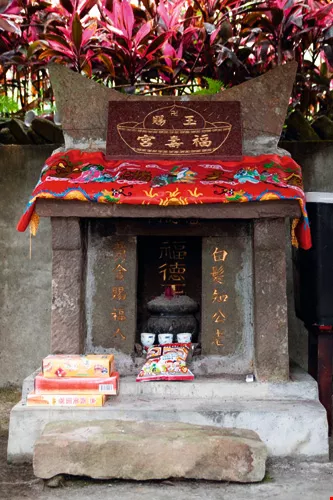
Shuangxi has more Earth God shrines than any other area of its size in Taiwan. Their facades still show traces of the simple Japanese styles from the colonial era.
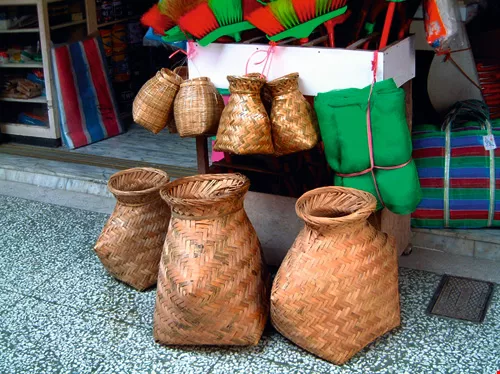
Residents of deep mountain villages often weave all sorts of containers out of bamboo and other natural materials.

@List.jpg?w=522&h=410&mode=crop&format=webp&quality=80)

@List.jpg?w=522&h=410&mode=crop&format=webp&quality=80)


