”
“Taiwan’s democracy is underappreciated by the international community.” —Eryk Michael Smith
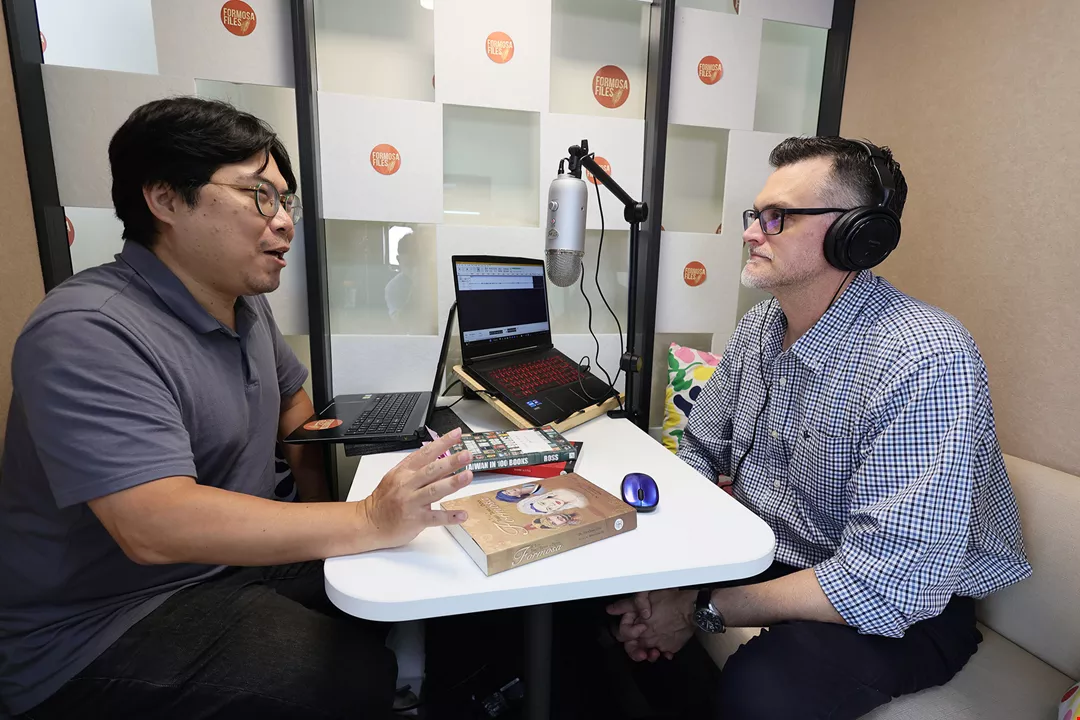
Eryk Michael Smith, an American journalist, has a long connection with Taiwan. In the 1980s he came to Taiwan with his parents, non-denominational Christian missionaries, and spent three or four years of his childhood in Taipei and Kaohsiung. In 1996, during Taiwan’s first direct presidential election, Smith was a young adult traveling back and forth between Japan and Taiwan. He was aware of the significance of the election at the time, though his deeper engagement with Taiwan politics and journalism came later, after he began working with local media in the mid-2000s.
Eryk Michael Smith
Founder and editor-in-chief of the Kaohsiung Times, an English-language newspaper based in Southern Taiwan, Smith has also worked as a stringer for Fox News Digital. His ability to work with Chinese-language sources helps him report on Taiwan with a local perspective, rather than relying only on English-language discussion.
He founded the Kaohsiung Times in 2025, motivated by a desire to push back against a Taipei-centered view of Taiwan. In our interview, he noted that Kaohsiung has a population of roughly 2.7 million, about the size of Chicago, yet far fewer people around the world know its name. Through international storytelling, he hopes to help readers see that Taiwan is much more than Taipei.
Smith enjoyed his time in Japan and also spent time in Hong Kong, but he says Taiwan was the place that seemed to fit. This gradual emotional connection led him to settle here long-term in 1997. After work connected to local media, including the China Post, International Community Radio Taiwan (ICRT), and Next Media, he moved with his Pingtung-born wife and their children to Kaohsiung in 2015. He says Taiwan is not his “second home,” but simply home: the place where he has spent more than half his life and where he feels rooted. “When the plane touches down at an airport here, there’s that feeling of, ‘Nice, I’m home,’” he says.
Here follows a synopsis of our interview with him.
Q&A:We asked Smith to talk about the special characteristics of Taiwan’s democracy and the importance of Taiwan’s first direct presidential election in 1996.
Regarding the 1996 election, Smith said that Taiwan’s first direct presidential election was important not only for Taiwan, but also for the broader Chinese-speaking world.
For Taiwan, 1996 was the first time people directly elected their president. It also mattered beyond Taiwan because it challenged the idea that Chinese-speaking societies are somehow unsuited to democracy,” he said.
He explained that Beijing often presents democracy as alien to Chinese culture, or argues that Chinese society requires emperors, strongmen, or tight political control. Taiwan’s experience offered a direct counterexample. The election did not simply produce a winner; it weakened the argument that democracy could not take root in a society shaped by Chinese language, history, and culture.He suggested that one of the most admirable things about Taiwan’s democracy is its high level of citizen participation. Some presidential elections have drawn turnout above 80%, while recent elections have remained high by the standards of many democracies. To observers from countries where turnout can be far lower, this level of participation is striking.A society of toleranceSmith argued that “there is sometimes too much focus on Taiwan versus China,” with Taiwan too often understood only through that framework. “If you look at Taiwanese society itself, you see something very impressive,” he said. “In a single extended family, you may have Hakka and Hoklo/Taiwanese backgrounds, Christians, Buddhists, Taoists, and people with different political views, from pan-blue to pan-green.”What impressed him, he said, was not the absence of political disagreement, but the ability of many families and communities to continue living together after sharp political contests. “After an election is over, people can sit down at the table together, have tea or beer or dinner, and not hate each other. The contest is done,” he said.Moreover, he said, direct elections became rooted as a norm with impressive speed. People still argue intensely, but the expectation that elections decide power has become part of everyday political life.


.JPG?w=1080&mode=crop&format=webp&quality=80)