Melding East and West: Chung Chieh’s Take on Preventive Medicine
Yang Ling-yuan / photos Hsueh Chi-kuang / tr. by Scott Williams
February 2012


Dr. Chung Chieh, a practitioner of both traditional Chinese and Western medicine, was on television recently talking about his “Qin-value detector.” Chung claims the device can evaluate the health of a patient’s five viscera in just a few minutes and that the “energy” fluctuations it measures confirm the existence of the qi system of traditional Chinese medicine (TCM). Does the device offer preventive medicine an additional diagnostic tool?
At a clinic in Taipei’s Beitou District, 75-year-old Dr. Chung Chieh has a patient afflicted with shoulder pain remove shoes, socks, and all metal items, then grasp a damp brass tube. Chung picks up a test probe and presses it against specific points on the patient’s hands and feet, observing the movement of a needle on his device. “This is testing your lymphatic system, which scores 100,” he tells his patient. “Now I’m checking your respiratory system, which also scores 100.”
As a nearby assistant records the scores, the device emits a piercing sound of varying intensity, as if the sound corresponds to the condition of the patient’s organs.

The measurements take just a few minutes. Once they’re complete, Chung spends a considerable amount of time explaining the significance of each score to his patient.
For example, one of the testing points on the index finger yields information on the health of the nervous system. If the scores for the right and left index fingers differ, it suggests a lack of coordination in the autonomic nervous system and the possibility of either neurasthenia or overstimulation.
“A score of 100 indicates that the autonomic nervous system is in balance,” explains Chung. “A score greater than 110 indicates an active organ. For example, the liver point usually measures 110 because the liver functions around the clock. A score of less than 90 indicates a hypoactive and potentially degenerating organ.” Chung tells his patient that unbalanced values can be indicative of chemical poisoning, allergies, or inflammation.
He adds that each finger and toe has two or three testing points that cluster near the joints. These points allow you to monitor the condition of the five viscera and six bowels, the circulation, the hormones, the joints, the skin, and even body fat.
On completing an examination with the Qin-value detector, Chung evaluates the results. For example, based on the connections TCM sees between the heart and small intestine, a heart imbalance coupled with a normal small intestine measurement suggests a cardiovascular issue. In such cases, Chung recommends changes to diet and lifestyle to treat the problem.
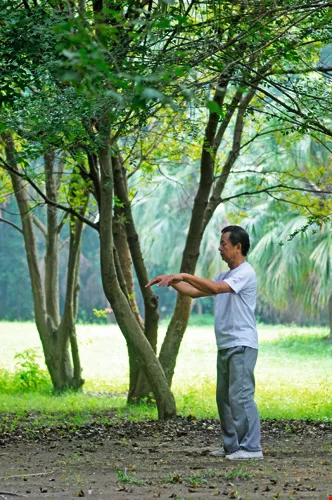
If you hope to enjoy good health and a long life, you have to take care of yourself. That means exercising and eating a balanced diet.
The seemingly inscrutable Qin-value detector is not a new invention.
Chung took Reinhold Voll’s electronic acupuncture as a model for his own work in 1982. After years of TCM study and practice, Chung developed his Qin-value detector, which utilizes a greater number of testing points and is better accommodated to Asian physiology.
Chung named the device the “Qin-value detector” to evoke the Qin Dynasty (source of the word “China”) and to suggest the qi of TCM.
Born in Indonesia, Chung graduated from the National Taiwan University College of Medicine and went to work in the cardiology and internal medicine division of Taipei Veterans General Hospital (TVGH) in 1963. He was introduced to the field of aviation medicine in 1969, when the Civil Aeronautics Administration asked him to help with the planning of its Aviation Medical Center. Concerned about the potential for side effects on flight personnel, Chung was very conservative in his use of medications at the center, and began moving towards more natural remedies. He also became interested in stimulating the body’s ability to heal itself, eventually obtaining a PhD in natural medicine from the US and studying acupuncture and moxibustion under Sun Peirong, a renowned doctor of TCM. These endeavors made Chung one of Taiwan’s few medical practitioners versed in both Western medicine and TCM.
Chung has used acupuncture and moxibustion to treat a number of prominent people, including former first lady Faina Chiang, a member of the US Congress, the wife of a South African ambassador, and choreographer Lin Hwai-min.
“Lin Hwai-min was on tour in Taiwan at the time, and had a problem at his very first stop,” recalls Chung. While onstage, Lin leapt, rotated his body, and planted his right foot first rather than both feet at the same time. This awkward landing tore a muscle in his calf and left him unable to stand. He was taken to the hospital, where his father called in Chung.
“When there’s an injury to muscle or tendon, you manipulate the yanglingquan acupuncture point [near the knee],” says Chung. “I used acupuncture and moxibustion at that point, which quickly enabled him to stand up.” Thrilled at the results of his treatment, Lin thanked Chung before traveling to the US to spend the following year recuperating.
Chung says that Western doctors’ amazement at mainland China’s success in using acupuncture and moxibustion as anesthetics and for the treatment of pain in the 1960s helped popularize the techniques worldwide in the 1970s. In the 1980s, research into the underlying mechanisms gradually spread from pathology labs to biochemical labs. Scientists eventually learned that acupuncture and moxibustion trigger the production of endocrines and endorphins, and bring about changes to other bodily fluids. Intensive physiological research into the techniques in this period led to the development of present-day energy medicine. Dr. Yoshio Nakatani’s ryodoraku, Voll’s electrodermal screening device, and Samuel Hahnemann’s homeopathy, all classic examples of energy medicine, also began to garner attention.

Dr. Chung Chieh has studied both modern medicine and TCM. Now semi-retired, he uses his “Qin-value detector” to promote preventive care.
In 1977, Chung became the director of the TVGH Acupuncture Department (now the Center for Traditional Medicine). Chung was anxious to have patients use his Qin-value detector, but lacked data from clinical trials and had yet to establish baseline values. He therefore established a partnership with the Family Medicine Department that allowed him to use the machine on patients receiving checkups at the hospital. After testing a sample of some 500 patients and comparing his results to those of their more traditional checkup, he arrived at his baseline values.
Even with clinical data in hand he had a hard time finding acceptance in the scientifically oriented field of Western medicine for a qi-based device that used an electrical current to measure biological energy at points around the body. Acceptance came instead from the “alternative medicine” community.
Rather than become discouraged, Chung has devoted the last few decades to integrating TCM into contemporary medicine and conducting further clinical studies on energy medicine.
His efforts have yielded disposable sterile acupuncture needles and flameless moxibustion devices, updates to his Qin-value detector (it is now in its fourth generation), and groundbreaking new techniques for the use of far infrared lasers to stimulate acupuncture points. “The qi of TCM exists,” he says. “We just have to find a means to further substantiate its existence.” Chung sees his device as providing the necessary proof.
TCM has been using the pulse, acupuncture, and moxibustion to manipulate the qi and bodily processes for thousands of years, but has been unable to provide concrete evidence for its theories. It wasn’t until Dr. Voll postulated that all living things have “energy” and radiate waves, and then provided quantifiable data by using resistors to observe changes in this biological energy, that the concept of “bodily energy” became more widely known.
“When stimulated with low-voltage DC current, the human body exhibits a defensive and adaptive response,” says Chung. He explains that his device works by running a low-voltage current through various test points on the body of a patient holding a conductive brass bar. The current causes electrically charged particles to travel down the meridians to the handle. When an organ linked to a meridian has a problem, it affects the strength of the current. Chung’s device measures the strength of this resistance.
“This illustrates the TCM concept of pain being indicative of poorly circulating qi,” says Chung. If you were to place food, vitamins, or micronutrients on the device’s conduction plate, the current would pick up the fluctuations in the food’s energy. These would correspond to those of the liver’s energy, and be reflected in changes in the value registered by the device. Beneficial foods make the measurement fall, indicating reduced stress on the liver.
Chung says that even though the electronic devices of Western medicine can identify sites of infection or disease with great accuracy, they are of little use in examining bodies in transition between health and sickness. He believes we can use the Qin-value detector to catch invisible problems in the qi of organs to catch potential illnesses early. That enables us to offer recommendations and help more people.

Energy medicine is similar in conception to the qi theory of TCM, which postulates that the state of a person’s health is apparent in their essence, qi, and spirit.
“There are three fundamental principles of healthcare,” argues Chung. “The highest is that health maintenance is preferable to disease treatment. The second is that timely treatment is preferable to heroic lifesaving measures. The third is the cultivation of your body’s ability to heal itself.” He explains that your body is in your hands. Increasing its ability to heal itself is a simple and effective way to keep it healthy.
Chung has also borrowed from kungfu legend Bruce Lee, a student of numerous styles of martial art. In a nod to Jeet Kune Do (“cutting” or “intercepting” style), Lee’s simplified Wing Chun style, Chung chose to call his acupuncture “intercepting” acupuncture.
No longer on the front lines of medical care, Chung now works with patients in need on a weekly basis, using his device to diagnose their problems and his “intercepting” acupuncture to alleviate them.
Most of his patients have been introduced to him by a friend or family member, and suffer from pain or chronic illness that mainstream medicine has been unable to treat effectively. He says that he is able to alleviate some patients’ pain with just one or two acupuncture treatments and guarantees to resolve their problems in three visits or refer them to another doctor.
Chung has devoted himself to popularizing energy medicine and hopes to use cell phones and software to bring his Qin-value detector and “intercepting” acupuncture to still more people.
He envisions a package containing a test probe or laser wand linked through a cellphone to an online service. The software would provide patients with information about their health and an image of the relevant acupuncture measurement and treatment points. It would be extremely simple for users, who would only need to follow a set of illustrated instructions.
“Providing everyone with the means to maintain their health eases the burden on the healthcare system,” says Chung. That, he argues, is what preventive medicine is all about.

Energy medicine is similar in conception to the qi theory of TCM, which postulates that the state of a person’s health is apparent in their essence, qi, and spirit.

@List.jpg?w=522&h=410&mode=crop&format=webp&quality=80)


