

Vito Lee/photos by Chuang Kung-ju/tr. by Geoff Hegarty and Sophia Chen
Chinese calligraphers have always respected and learned from the ancient masters. In fact, beginners learn by copying the works of masters from the Tang or Han Dynasties, and the poetry of the Tang and Song periods. But these models are extremely old—a thousand years before our own time—so how might we stimulate our children’s interest in calligraphy in a way that’s more relevant to today?
Born in Tainan, innovative calligrapher Chen Hsih-shien has created his own style of work—a calligraphy of images. Breaking away from the patterns of traditional calligraphy, Chen takes his students outdoors to observe nature, to notice the lines and rhythms of the natural world.
Accompanied by more than a dozen elementary school children, Chen mingles with the crowd near the Love River in Kaohsiung City enjoying a day off. This is an outdoor lesson for his calligraphy group—appreciating the works of nature that have been admired by artists since the dawn of time. Pausing in front of two tall coconut trees, he asks the children to observe how the trees differ.
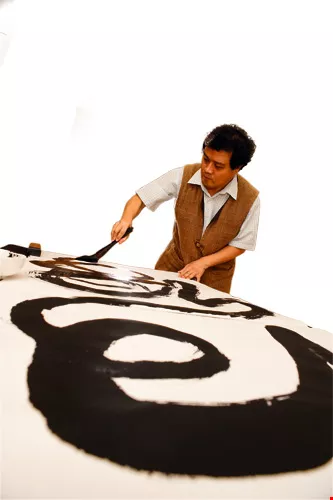
Chen Hsih-shien’s calligraphy breaks away from tradition, incorporating various writing styles and at the same time creating an unrestrained style all his own.
Back in the classroom, the children use brushes to draw the outlines of coconut trees. This is the first time that they have held a brush to draw, so everyone is using different techniques. Their brushes are dipped in the ink, and then carve out the forms of nature in sharp black lines. He tells them, “The trunk of a royal palm is larger than that of a betel nut tree. Brushstrokes include ti and dun: pressing and then moving the brush upward is called ti, and moving the brush downward is dun.” Chen explains the subtleties of these strokes.
Sometimes the children arrive in his class having just completed a 100 meters race at school. Then he asks them to use their brushes at the same speed as the race. To maintain the sense of speed, the brush cannot draw too much ink, and when it dries, you can see the effects of the tight lines flying across the page and diverging. Chen highlights the children’s own life experiences and makes them relevant to their study of calligraphy.
The speed with which a brush is handled and the grandeur of the strokes both have symbolic meanings. A slower speed indicates feelings of sadness and gloom, while rapid strokes indicate high spirits; the grander strokes reveal a rich emotion, while the more slender lines like reeds display loneliness. The brush can express the joys and sorrows of life.
Born in 1967 in Baihe, Tainan, Chen is a graduate of the Department of Chinese at Tunghai University. He became determined to make calligraphy his life early—at age 19. After military service, he renovated the family’s abandoned pigsty to create a studio, and became the famous local “pigsty calligrapher.” Back then he often stayed up through the night practicing brush writing 18 hours a day. The locals in Baihe all knew about the town’s “crazy man” who loved calligraphy.
Walking has always been his second love, especially as a source of insights for his creative work. The land inspires him. At the end of each period of practice, he ponders how to incorporate new horizons into traditional calligraphy. “I don’t believe it possible that one can create great work without embracing one’s land, one’s feelings and life experiences.”

Xinian (“Disquiet”): Chen’s grand strokes reveal rugged and vigorous emotions.
Traditional calligraphy can be divided into four styles of script: regular (kaishu), semi-cursive (xingshu), clerical (lishu), and cursive (caoshu). But Chen often employs different styles of brushwork. Sometimes he will use a giant stroke that almost obliterates the paper, creating the effect of a totally unrestrained line; sometimes he leaves aside the traditional black and employs different colors. Most importantly, his work is highly figurative, revealing directly what he feels about the words and the images they depict.
Since winning second prize at the Art Exhibition of Central Taiwan in 1992, Chen has held around 20 solo exhibitions, including overseas shows in Japan, Canada, France and Hungary. His book Works of Rigor, published in 2002, brings together more than 70 of his creative works from the past. Each work has its own story.
The two characters on the book’s cover—he (何) and qiu (求), which when read as a phrase imply that one should not demand too much—tell a story. The idea came from chats with his 100-year-old neighbor. The old man’s view of life—in which he remains unruffled by the world’s events—and the image of him supported by a walking stick inspired Chen’s creation. The two characters in the work create the image of a long arm, a walking stick, and an old man with a hunchback. The final stroke of the character he implies that the old man’s elongated arm is reaching for the stick. The four dots of qiu reveal the footsteps that the old man has created walking through the past century. The old man is walking forward slowly: his perspective on life is clear—he’s cool!
Art from lifeChen set up his Wangzhai Calligraphy Studio in Kaohsiung five years ago, and tends to spend a lot of his time developing teaching methods that will stimulate children’s interest.
“This is a new approach, starting from learning about the land. The concept is similar to that used in fine arts in which feelings for the environment are captured and converted into art. The characters you write also come from real life: if you live close to a hillside, then you employ the related vocabulary; if you are close to the beach, you might choose words that depict the lines of rocks along the seaside; always following the lines of the land.
Chinese calligraphy is a very ancient art. In the past, aesthetic values were determined by the elite, but today we needn’t get stuck in that same groove. We can and must open our minds to a new perspective on calligraphy—one that expresses real feelings; today’s feelings.
Chen believes that art is created from the relationship that exists between us, the creators of art, and nature. Sparrows jumping, eagles soaring, or even bamboo blown by the breeze—all demonstrate a different dynamic. Calligraphy cannot remain confined to and limited by the tradition. Calligraphic work should convey feeling—through brushstrokes and lines. It has the power to transform the cumulative emotions experienced in life, aesthetics, and art into stories portrayed in ink, with the hope that all different ages will be able to appreciate the beauty of this very ancient art.


