Ride the Jiji Line to Small-Town Taiwan
Lavai Yang / photos Hsueh Chi-kuang / tr. by Chris Nelson
September 2011


No matter how the world changes, a train ride will help you escape the doldrums of everyday life as views of the world speeding by outside the window make your mind wander while the train takes you to some rustic little burg. This is an important element of travel that the railroad offers beyond just getting from A to B. And you don't have to squeeze your way onto the Alishan Forest Railway. Instead, why not try the newly reopened Jiji Line for a fascinating new look at Taiwan?
"Toot! Toot! Toot!" The CK101 steam engine, a national treasure, emits three whistles as per railway tradition. People, train buffs among them, explode onto the platform of Jiji Station to witness the second reopening of the Jiji Line after the 921 Earthquake.
The antique CK101 and CK124 steam engines, each nearly a century old, arrive in an unprecedented fashion: one train pulling the other as they slowly make their way forward to inaugurate a new era as the Jiji Line is reborn.
The Jiji Line begins at Ershui Station in Changhua County, then follows the Zhuoshui River eastward, deep into Nantou County. It passes through Yuanquan, Zhuoshui, Longquan, Jiji and Shuili before reaching the terminus, Checheng. The 29.7-km route takes 50 minutes to complete, making it the longest of Taiwan's four passenger branch lines (Pingxi, Neiwan, Jiji and Shalun); it's also Nantou County's only railroad.
The Jiji Line was built in the Japanese era to transport sugarcane. Originally, a 762-millimeter-gauge light track was laid for "pint-size trains," but in 1919, Taiwan Power Company widened it to a 1067-mm-gauge track in order to ship materials to build a hydroelectric plant at Sun Moon Lake. Upon its opening in 1922, it became a branch line of the railway system.
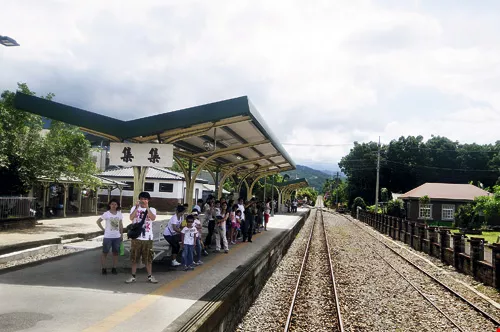
The slant-roofed shelters of Jiji Station's island platform are chock full of nostalgic feeling.
Afterwards, this railway entered its golden age, carrying rice, timber, bananas and other fruit, plus passengers who lived along the route. In the 1960s, it became the main line for timber from the Danda Forest Area, located around the upper reaches of the Zhuoshui River in the Central Mountain Range.
Back in the 1970s, logging ceased in the forest area as exports of rural goods became less profitable, and road transport gradually replaced rail after Provincial Highway 16 opened. This led to a decline in freight loads, and the Jiji Line began to lose money. In 1986, the Taiwan Railway Administration even considered closing the line entirely.
But in the 1990s, an advertising company filmed the old wooden station house at Jiji. With the subsequent interest in nostalgic railway travel, the stunning scenery along the line was rediscovered, and the little trains along the line were frequently filled to capacity under the weight of tourists. The classic miniature train station and quaint, rustic small-town scenery drew upwards of 1,000 visitors each weekend, strolling around and enjoying the countryside vistas, and seeking old-fashioned flavors like popsicles, plantains or a bowl of noodles.
The 921 Earthquake of 1999 caused serious damage to sections of the Jiji Line located on the Chelongpu and Shuangdong Faults, where landslides buried track in many places, tunnels cracked and rails were twisted. Notably, the roadbed near the No. 2 Zhuoshui Bridge in Mingjian Township was thrust up 3.5 meters, badly warping the track.
The stations at Zhuoshui, Shuili and Checheng were severely damaged, Longquan Station platform caved in, Jiji Station was thrust off kilter, and work sheds and warehouses collapsed. Over more than a year of reconstruction, the TRA spent hundreds of millions of NT dollars reinforcing the tunnels, reconditioning the tracks, rebuilding bridges, and repairing telecommunications equipment. Retaining walls and 3.6 km of roadbed were built, and landslide mitigation, reinforcement and restoration projects were completed; damaged station houses and platforms were rebuilt as well. The line was reopened on January 21, 2001.
Jiji Station was restored to its original appearance thanks to local and government cooperation. Built in 1933, the humble wooden station was later expanded to occupy 97 square meters. The unique style of the Formosan cypress wood structure, with its sloping roofs and European-style trusses, is a symbol of Jiji Township's history and a favorite subject for photography.
The Jiji Line's popularity surged after it became tourism oriented: its many tunnels, bridges and curves are a major draw. After passing through Jiji, the train enters the mountains. As you emerge from each tunnel, pitch blackness gives way to forests with mountainous backdrops. "Toot! Toot!" the train whistles as it rounds the corners, immersing the passenger in a leisurely, bucolic ambiance.
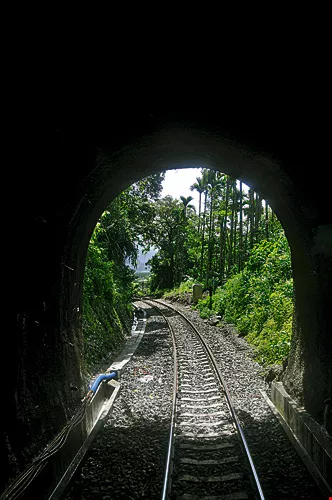
(above) When the train exits the tunnel, the greenness of the vegetation outside the window promptly fills the eyes. (below) When passing through the densely shaded Jiji Green Tunnel, you can smell the invigorating fragrance given off by the camphor trees.
But the repeated repair and reinforcement efforts to fix severe cracking and leakage in the tunnels following the 921 Earthquake ended up shrinking the clearance inside the tunnels, affecting the quality of the ride. The root of the problem was the age of the tunnel structures themselves.
There are seven tunnels along the line, and with the exception of the Zhongxing Tunnel, built in 1960, they are all very old (built in 1925). As such, they have suffered geological problems such as roof collapses and water saturation; indeed, Tunnel No. 1 has suffered over 10 roof collapses.
To prevent the tunnels from continued deterioration affecting the safety of the ride, the TRA spent NT$151.1 million on a complete renovation of all the old tunnels on the line, begun in April 2010. After initial assessments through tunnel clearance measurements, image scanning, ground penetrating radar and ultrasound tests, repair work began in earnest.
Yao Hui-hsiang, director of the TRA's Chiayi Construction Branch, explains that the tunnel structures, originally of brick and concrete, were changed to rebar- and steel-fiber-reinforced concrete for superior strength. Moreover, the cross-sectional structure of the new design conforms to the latest earthquake safety standards, making the tunnels much sounder.
The original bore of the tunnel was quite small, about 3.6 m wide and 4.1 m high, so there was insufficient clearance for trains other than the diesel passenger trains specially used on this line. Excavation of the tunnel walls increased the clearance by 10-20 centimeters, so in the future, Fuxing and Juguang-class trains will be able to pass through them; also, more cars can be added according to passenger demand, increasing capacity.
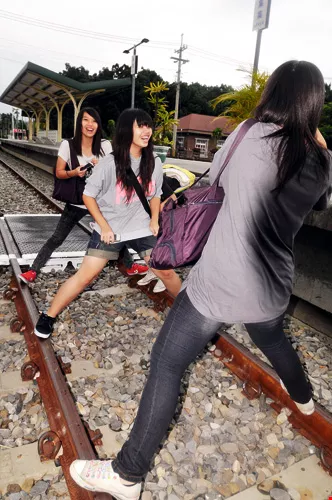
Since becoming a tourist line, the Jiji Line has become a popular railway holiday for students and youngsters.
The Jiji Line is a railroad with a unique history and quality. The scenery along the way is gorgeous, and each little station has its unique features. For instance, the quake badly mangled a section of track near Zhuoshui Station, and after the tracks were rerouted, a 200-m stretch of original track was preserved to create a memorial park and trail system, as a reminder of the biggest quake in a century.
After Mingjian Township, there's a 4.5-km stretch of road known as the "Green Tunnel": a narrow, shady road lined with camphor trees which are dense with branches and leaves. This Jiji Line runs right next to this stretch of road, making it a favorite place for railroad buffs to watch the little trains slowly chugging their way up the mountain. If you ride a bike here, you'll get to breathe the fresh, fragrant forest air of this shaded paradise.
Passing through the last tunnel and arriving at Checheng, the final stop, you find yourself surrounded by mountains and country hamlets: the beautiful views make it seem as if you've entered a secret garden. Checheng was once a chief timber distribution point for Nantou County; more recently the wooden station house was restored by the Sun Moon Lake National Scenic Area Administration and Taiwan's only outdoor railway museum was built here. There's also the Checheng Logging Exhibition Hall, the power plant, and the Checheng Chateau winery. It's the ideal vacation for small groups looking for a nostalgic and edifying journey by rail.
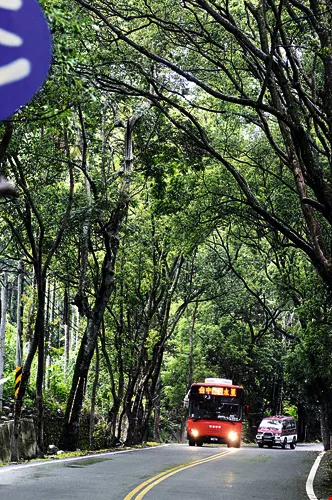
(above) When the train exits the tunnel, the greenness of the vegetation outside the window promptly fills the eyes. (below) When passing through the densely shaded Jiji Green Tunnel, you can smell the invigorating fragrance given off by the camphor trees.

@List.jpg?w=522&h=410&mode=crop&format=webp&quality=80)

@List.jpg?w=522&h=410&mode=crop&format=webp&quality=80)

@List.jpg?w=522&h=410&mode=crop&format=webp&quality=80)
@List.jpg?w=522&h=410&mode=crop&format=webp&quality=80)

