Bringing the Drifters Home—Sunrise Driftwood Workshop
Kobe Chen / photos Chin Hung-hao / tr. by Geoff Hegarty and Sophia Chen
September 2012


In 2009 Typhoon Morakot changed many people’s lives. Taimali Township in Taitung County was hit hard by rainstorms and landslides during the disaster, with several villages and large areas of agricultural land buried by landslides.
Mountain trees washed down the hillsides by the flood are like so many Taitung residents who, unable to remain on their own land, drifted away to find work elsewhere, often becoming almost nomadic. Sunrise Driftwood Workshop not only attempts to add value to pieces of wood, but also tries to restore the confidence of these human drifters.
Located in Taimali Township, facing the sea with the mountains as a backdrop, Duoliang train station was once known as the most beautiful station in Taiwan. But in 2006 it was shut down due to a lack of patronage. Today the disused station presents an impressive but desolate vista, reflecting accurately the bitter and contradictory feelings of the locals.
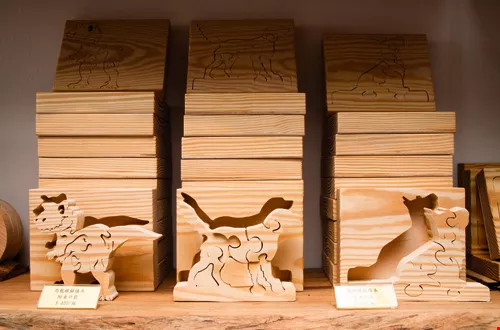
The building blocks in Principal Cheng’s hands are made from a variety of Taiwanese woods, and have become popular as teaching materials for elementary and secondary schools. With artistic sensibility, the Aboriginal people are able to portray the vivid charm of native animals.
While Taitung is set among scenic mountains and unpolluted rivers, economic development has always lagged because of the lack of convenient transportation. As a result, large numbers of people have moved out. The beautiful scenery and fertile lands remain, but the lifeblood of the traditional farming community and its culture have been lost.
Duoliang Elementary School used to be located above the station, but in 1999 it merged with another school. It now appears abandoned and looks even more desolate than the station, with empty classrooms, scattered textbooks, and students’ graffiti still on the blackboards. Overlooking the vast Pacific, one recalls the words of ancient poet Tao Yuanming: “Why can’t you come home to tend the fields and gardens overgrown with weeds?”
Cheng Han-wen, current president of the Original-Love Workshop Association, has been engaged in assisting Aboriginal communities for two decades. He has been monitoring the waning population in the area since even before Morakot.
Cheng, former principal of Taitung’s Xinxing Elementary School, noticed a serious problem with the children’s upbringing when he joined the community. With a lack of local job opportunities, most parents had to find work elsewhere, often leaving their children behind. As a result, nearly 70% of students were from single-parent families or were being looked after by grandparents.
“It’s easy for children to go astray without their parents’ guidance. At vulnerable moments, they need direction.” For the sake of the next generation’s future, Cheng became actively engaged in the community, using the resources of the school and the teachers to help the unemployed villagers learn woodcarving skills. The teachers helped to set up a website to sell their products, creating a small but adequate income for the community.
Creating employment opportunities, however, cannot happen overnight. Cheng put forward a philosophy for the children: “To enjoy my school, to love my home; to regard school as a second home.” Children received care at school that they missed out on at home, and benefited from the care of the teachers and tribal elders who tried to set examples for the children to follow.
In 2008, considering the huge cost and time involved in cleaning up fallen trees and branches after typhoons, the Forestry Bureau cooperated with Cheng to establish the Original-Love Woodworking Workshop. Tables and chairs produced by the workshop have won quite a reputation from a number of exhibitions, once selling a record 70-plus items in two days. Their efforts are aimed at reuniting families: it’s hoped that creating more local employment opportunities will encourage people to stay in their hometown.
In 2010, Cheng launched a joint venture with Tzeng Ching-hsien, then director of the Department of Life Sciences at National Tsing Hua University. Together they promoted a plan commissioned by the Forestry Bureau to transform several hundred thousand tons of driftwood into suitable materials for Taitung’s local community industries.
“We tried to rouse the people’s feelings for the land in an attempt to recreate links to past cultural experiences.” Cheng says that a number of valuable mountain trees such as Taiwan cypress (Chamaecyparis taiwanensis), Formosan cypress (C. formosensis), Taiwan incense-cedar (Calocedrus formosana), Formosan michelia (Michelia compressa) and Taiwan zelkova (Zelkova serrata) were washed down to the ocean after the typhoon. If this floating driftwood were left to rot or were burned, it would represent a waste and damage to the ecology.
The Council of Labor Affairs through their Fostering Employment Program provided counseling for management teams, training for foundation members, and subsidies. In 2010, Sunrise Driftwood Workshop, located in the disused Duoliang Elementary School, was established under this program with further assistance from other sources.
Duoliang Elementary is built along a hillside, with upper and lower rows of buildings. Four classrooms in the upper section have been opened up to form a complete production line with all kinds of woodworking equipment strategically placed. The lower row of buildings is used for a showroom and cafe with outdoor seating. Patrons can look out over the beauty of the Pacific Ocean while enjoying their coffee.
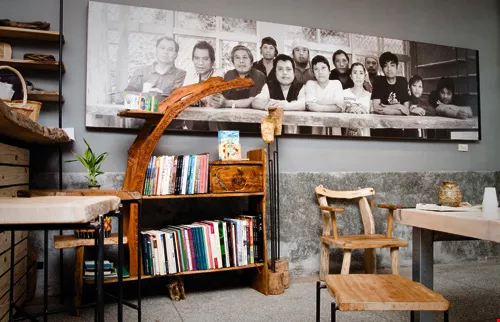
Through their woodcarving works, the family history of Aborigines can be passed on, at the same time as seeking new ways of making a living.
Above the abandoned station, using deserted school buildings and waste wood, these people are striving to achieve a goal.
“Outsiders often mistakenly believe that indigenous people are born woodworkers,” says Tzeng. Woodworking is a way of transforming natural materials in order to meet the needs of everyday living. But in modern society, many have forgotten these skills.
To help the Aboriginal workers to pick up woodcarving skills again, the workshop has adopted a system of traditional apprenticeships. Teaching is adjusted according to each apprentice’s strengths and weaknesses, making the system more flexible than the technical and vocational education system. The workshop has invited Huang Qingtai, a former principal of Kung-Tung Technical Senior High School who learned woodworking techniques in Germany and Switzerland, to give lessons. After hearing about the training program, many who had left their homes to work elsewhere were willing to return to their hometown to learn the new skills.
Tzeng’s team designed a set of building blocks, including square, conical, cylindrical and circular shapes, allowing the apprentices to learn the woodworking techniques of three-dimensional carving, fret sawing and woodturning. The blocks have become one of the major products of the workshop, and are especially well received by secondary and elementary school students. They’re made from a variety of Taiwanese woods, and can also serve as materials for teaching about nature.
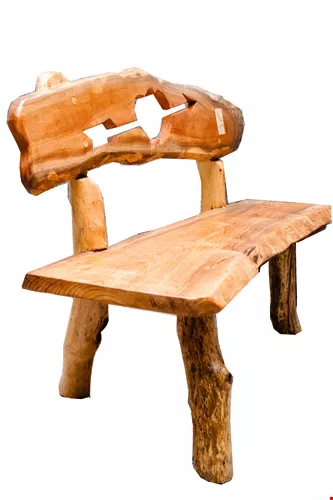
This rustic bench features a unique style which retains the distinctive textures and aroma of its driftwood origins.
The driftwood products, including artistic woodcarvings and furniture, are created in harmony with the shape and texture of the wood itself. Larger pieces of driftwood go into making dining tables, benches, and mirror frames; the smaller bits are often suitable as delicate combs, cutlery, and storage boxes.
“All things by their nature are good for something,” says Tzeng. Even low-quality driftwood can find a use. They bought seedlings of a variety of butterfly orchid native to Mt. Dawu from the nearby branch office of Taiwan Sugar Corporation, and made flowerpots for the orchids from waste wood. The villagers themselves planted the seedlings, and the orchids have become a form of natural installation art for the community.
In addition to the carved wood products, the workshop has cooperated with other, larger factories to introduce a standardized manufacturing process. Building blocks, folding stools and souvenirs are produced according to templates. With stable production and good market response, their products are currently distributed in Taipei and Kaohsiung through the Lovely Taiwan Foundation.
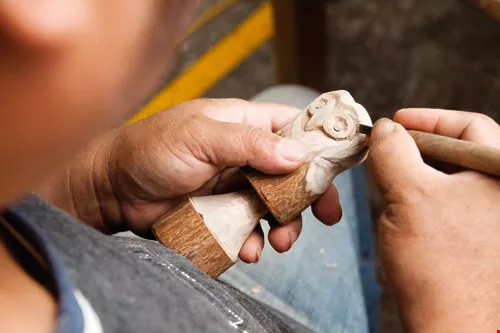
The building blocks in Principal Cheng’s hands are made from a variety of Taiwanese woods, and have become popular as teaching materials for elementary and secondary schools. With artistic sensibility, the Aboriginal people are able to portray the vivid charm of native animals.
Watching the gradual progress of apprentices, Cheng’s efforts to help the community over more than a decade have finally borne fruit. There are only about 20-odd apprentices in the workshop, but as long as they can help one person to stay in the community, it will relieve the lonely souls of two persons or even more, allowing for care of children and the elderly.
“We focus not on how much they can earn monthly, but on the sustainability of the family, and the passing on of family history,” says Cheng. The workshop doesn’t aim to create a large and successful business; merely to encourage people to stay in their hometown. Parents are the drivers of their children’s development, the remedy to poverty, so a family which has its core in place—the parents—brings hope to the children.
The workshop also wants to connect with the world, sharing their warmth. After Japan’s 2011 Tohoku earthquake and tsunami, the members of the workshop set up a reconstruction team to assist in Japan. Having themselves already undergone the pain of reconstruction, they were able to help the Japanese victims rebuild their homes, applying their carpentry skills in a very practical way.
This remote community is located on Mt. Dawu and along the Pacific coast. While Aborigines have always been friends with the mountains and the sea, the establishment of nature reserves on Mt. Dawu and designation of different stretches of the coast for tourism have made hunting and fishing impossible, forcing some of the villagers to leave their hometown.
The highways present a long journey to or from the township, and many simply give up rather than trying to get home. In addition to the physical distances involved, the lack of resources and opportunities at home can also create a psychological distance from their community.
People today need both the skills and the opportunity to survive in modern society. The Aboriginals don’t lack the ability, but they need to be allowed the opportunity to survive in their tribal community.
Aboriginal ancestors once said: “The flood will remember the way home; we should let it flow.” Will these human drifters ever find their road home?
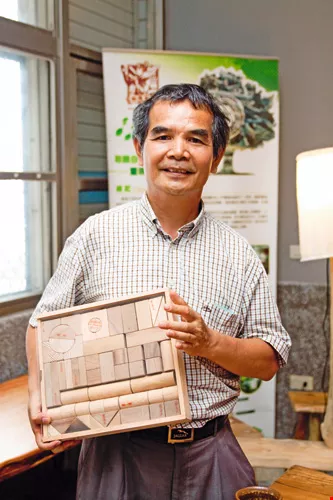
The building blocks in Principal Cheng’s hands are made from a variety of Taiwanese woods, and have become popular as teaching materials for elementary and secondary schools. With artistic sensibility, the Aboriginal people are able to portray the vivid charm of native animals.
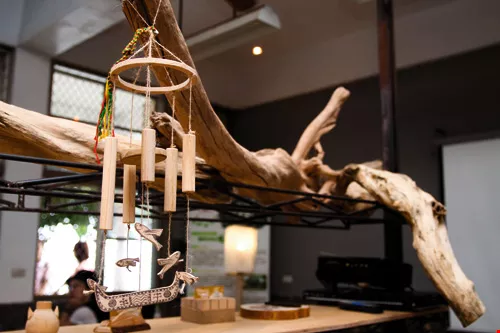
Taiwanese Aboriginal motifs like flying fish, canoes, and hundred-pacer snakes are used to decorate many of Sunrise Drifters’ woodworking products.

@List.jpg?w=522&h=410&mode=crop&format=webp&quality=80)


