Notes of a Baseball Fan
Wei Hung-chin / photos courtesy of Professional Baseball / tr. by Jonathan Barnard
January 1994


When the Giants of Japan came to Taiwan for exhibition games, fans went to any lengths to get the autographs of their idols. (photo by Hsueh Chi-Kuang)
Watching a major league game while sipping a Coke has long been one of America's favorite leisure activities. Whether or not professional baseball in Taiwan (now nearing its fifth season) will become an integral part of life here depends on how baseball culture takes root.
If you only have NT$250 to spend tonight, where are you going to go? Take my advice: Go see a professional baseball game.
If I ask you to spend all you've got to watch a ball game, there's got to be a good reason for it.
The league's reason: Pro baseball is a fresh and wholesome activity, and everyone should support it. (Sounds like an election slogan.)
The police's reason: "It's better for kids to go to the ballpark than break the law racing motor-bikes."
Teacher's reason: Sporting competitions have educational value. (How serious!)
Father's reason: NT$250 is really cheap.
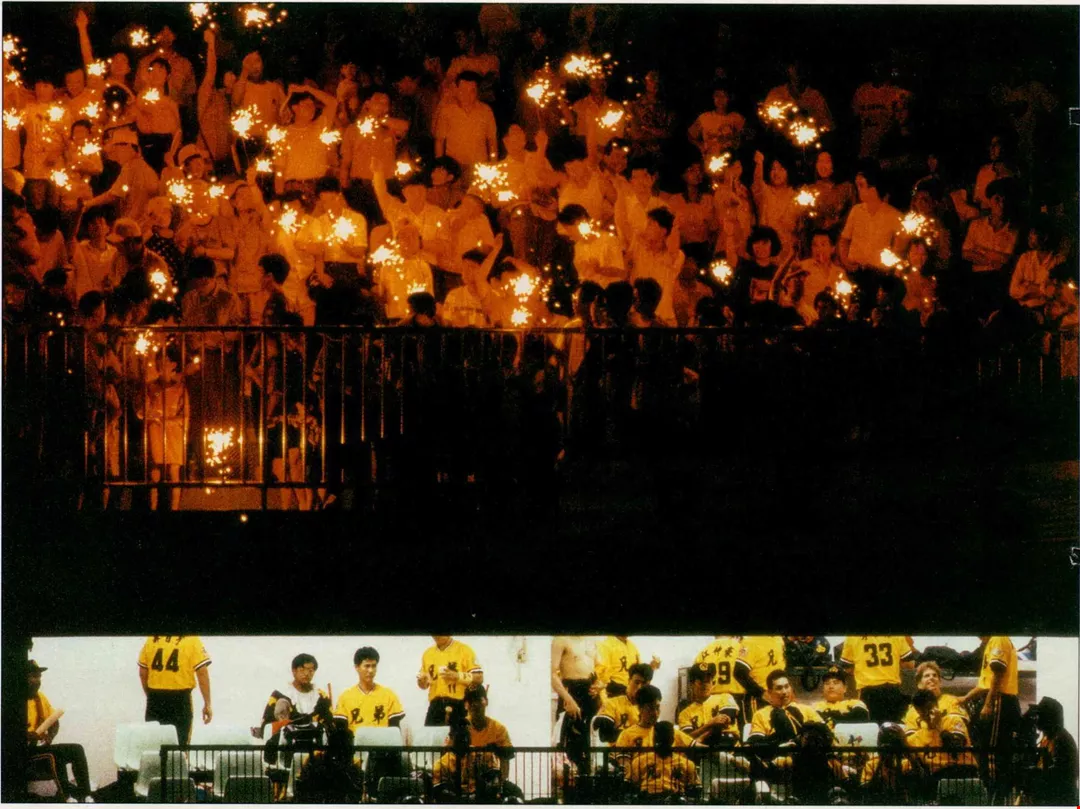
With the playing lights off, the players relax in the dugout while spectators kill time by lighting sparklers.
Five good reasons for going to the ball game
The truth is that all of the above are reasons of a sort, but father's is the easiest to verify objectively and the closest to the truth. Why is that? Read the following analysis:
Number one: Because with NT$250, you've got just enough to buy an infield ticket but not enough to go dancing or have a fancy meal.
Number two: If you choose to see a movie, NT$250 will, of course, be enough. But can you hoot and holler in a movie theater?
Number three: At the cinema--think about it--will the stars jump off the screen to say hello and sign autographs? At the ballpark, the stars will be standing right in front of you.
Number four: Watching a baseball game is really exciting. Now and again fans will set off firecrackers and throw them at the players, who will run in all directions. It's like target practice. Of course a slugfest is an even more impressive sight. Whether it's only the players exchanging blows or the spectators join in the melee too, it's sure to be well worth the price.
Number five: If you still won't go, here's a material incentive for you: At the game there will be a lottery drawing for a motorcycle! And perhaps you'll catch a foul ball or a home run. Just taking the ball home will be well worth the admission price. Who knows, maybe the autographs will be worth millions in a decade or two? Then you'd really make a pretty penny! With the five above reasons, watching pro baseball is a bargain! Let's take ourselves out to the ballpark. Today is the championship of some year between--let's say--the President Enterprises Lions and the Brother Hotel Elephants.
Play ball!
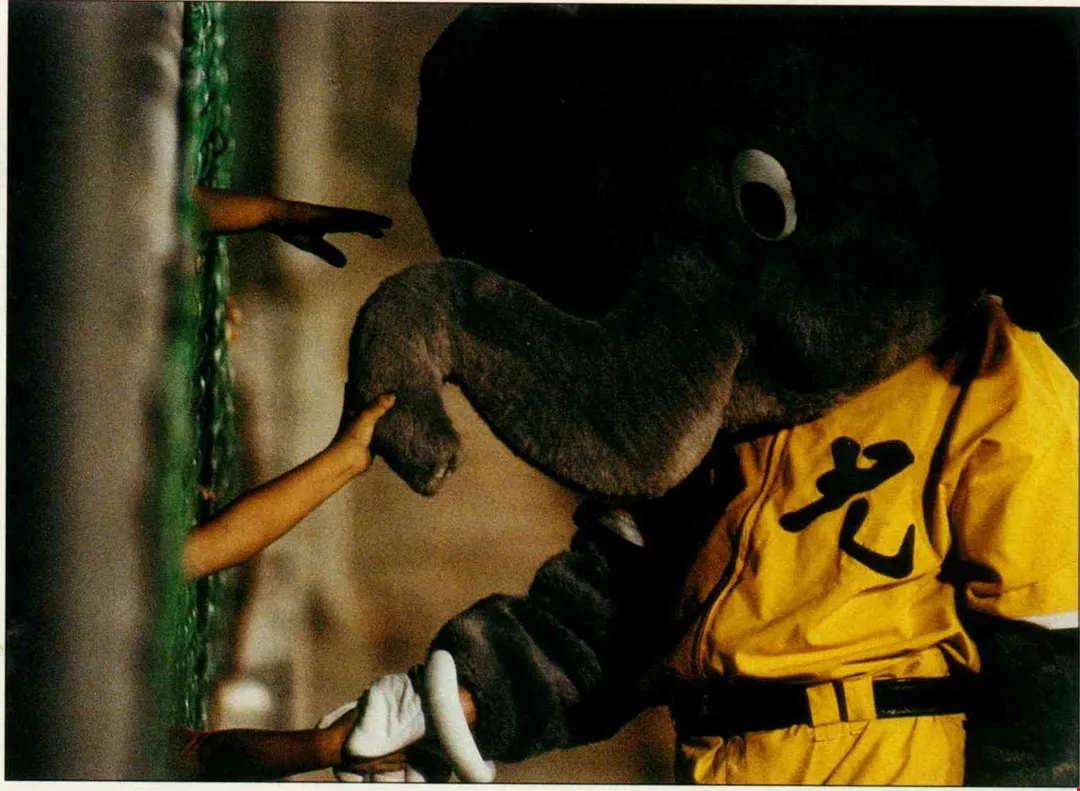
Since the Elephant is the Brother Hotel's team symbol, it is often called upon to play a comical role. Here the elephant is shaking hands with a fan, while another young spectator mischievously shakes its trunk.
Playing to win
Look at how handsome the Elephants' pitcher Chen Yi-hsin is! The Lions leadoff batter Cheng Pai-sheng takes the first pitch for a called strike.
On the next pitch he hits a sinking line drive into center field. Li Chu-ming charges hard but can't catch up to it. It drops in front of him for a single.
What's that? The ball was catchable; Chu should have dived for it. On satellite TV you've seen Koji Akiyama make that play for the Seibu Lions of the Japanese pro league.
Don't be stupid! That's Japan. Haven't you noticed that their fields are all smooth and lush. Diving on them is like laying out on a feather mattress. Look at the lumps and pits covering our field. Li Chu-ming isn't fighting a war. Why should he play kamikaze?
Oh! Build a new stadium. That's easy to say, but where's the land? Sure the six owners have got money, but they're still businessmen. They're not about to build a new stadium as some act of beneficence when they would make a lot more money building a department store.
Right! In Japan and America, the teams all have their own home ballpark, and in America they're provided by local governments. Renting the stadiums to the teams reduces the teams' costs, raises efficiency, and lets the teams fight in the name of their city.
Ouch! And the public seating is very uncomfortable. Give them a break! It's an old stadium.
What! You say that those people next to you are so noisy. Don't worry about them. Look at that guy in the sweatshirt forever pressing his air horn. Do you see him? He comes to just about every game, working himself into a frenzy upon arrival. He's supposed to be in the middle management of a major company. Every day he struggles with those above and below. His superiors reprimand him, his underlings ignore him, his wife is always playing mahjongg and Junior gets poor marks. He puts all his emotions into baseball, coming every day to blow off steam and find escape from his humdrum existence. Hey you, pay attention!
In the bottom half of the inning, it's Brother Hotel's first turn at the plate. With two people out, Li Chu-ming hits a single and Wang Kuang-hui steps to the plate. Wang's batting average of .328 is nothing to take lightly.
Look! He hits a long fly ball. Does it have the distance? Chiang Tai-chuan backpedals, leaping to make the catch against the wall. Chiang's fielding gets more spectacular the older he gets. But the brilliant play has not pleased everyone.
I could have told you this was going to happen--the Elephants fans are throwing things onto the field again. Keeping his poise, Chiang picks up the soda cans one at a time and takes a bow.
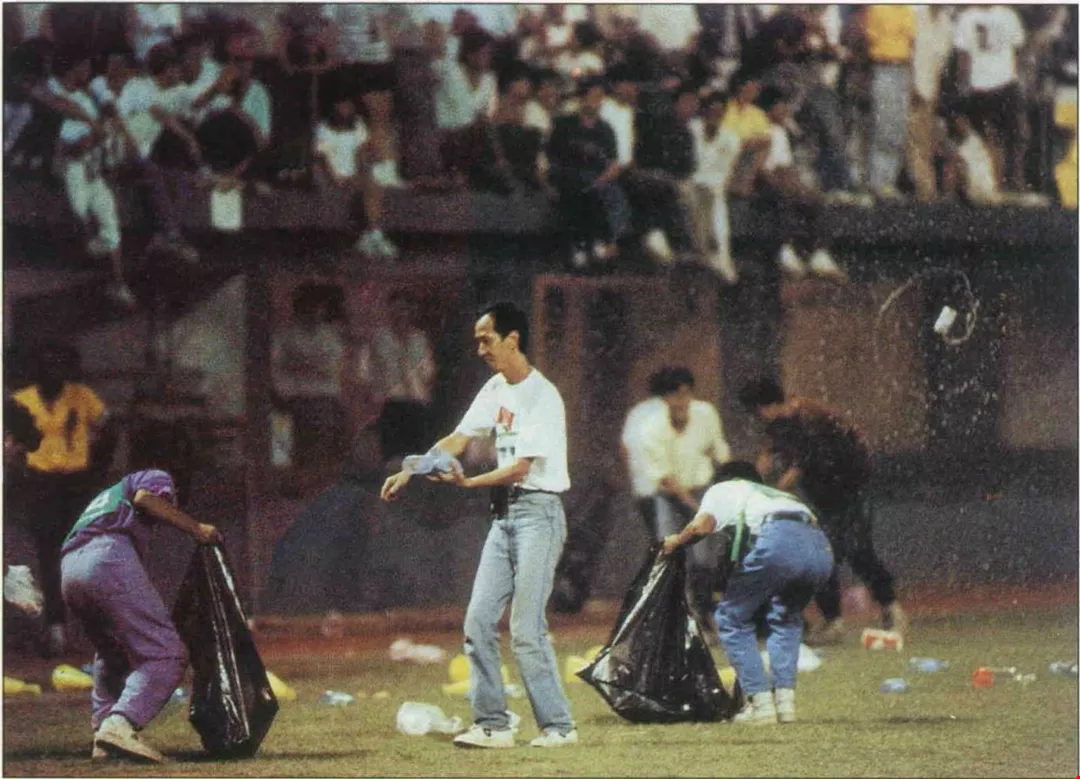
"You toss and I glean." When fans can't control their emotions, scenes like this are the result.
For love of the game (and money)
You know it's a minor miracle that Taiwan has professional baseball at all. People should stop being so picky. At first, in order to give amateur baseball players a future and reinvigorate amateur baseball, Hung Teng-sheng, the owner of Brother Hotel, thought of organizing a baseball league. He asked President Enterprises and Mercury to sponsor teams that would join the formerly amateur teams sponsored by Brother and Wei Chuan. With a four team league, pro baseball in Taiwan had its start.
When the league first formed, people had their doubts about how long it would last. Some predicted it would fail within three years for lack of fans and players.
Who would have known that attendance would grow during each of the first four seasons, that The China Times Eagles and the Jungo Bears would join the four original teams, and that other would-be owners would be angrily complaining about not being allowed to join?
No kidding. The Taiwanese are, as people say, "economic animals." When company bosses thought of baseball as a money-losing venture, they weren't interested. But Taiwanese have turned out to be much more interested in watching sporting events than anyone had anticipated, and professional baseball is on a hot streak. The first year attendance was 899,955, rising to l,600,500 by the fourth year. With an average ticket costing NT$ 150, total revenue reached more than NT$240 million.
True, after this hefty sum was divided, each ball club was still running about NT$50-70 million in the red. But it was clear to see that pro ball had potential. If the investors could stick it out for a couple of years, it wouldn't be difficult to attract twice as many fans with better ballparks. Add to that substantial advertising revenue, and a baseball franchise might just be the goose to lay the golden eggs.
And there's more! A baseball team helps the corporate image. Even if a company wants a buck any way it can make it, a ball club lets it talk in stately terms about "giving something back to society" and "advocating wholesome recreational activities." This makes a good impression on people, and so admirers of Liao Min-hsiung will read The China Times and fans of Huang Ping-yang will put Wei Chuan milk into their shopping carts. Making money and a good name, how could the franchise owners be anything but pleased?
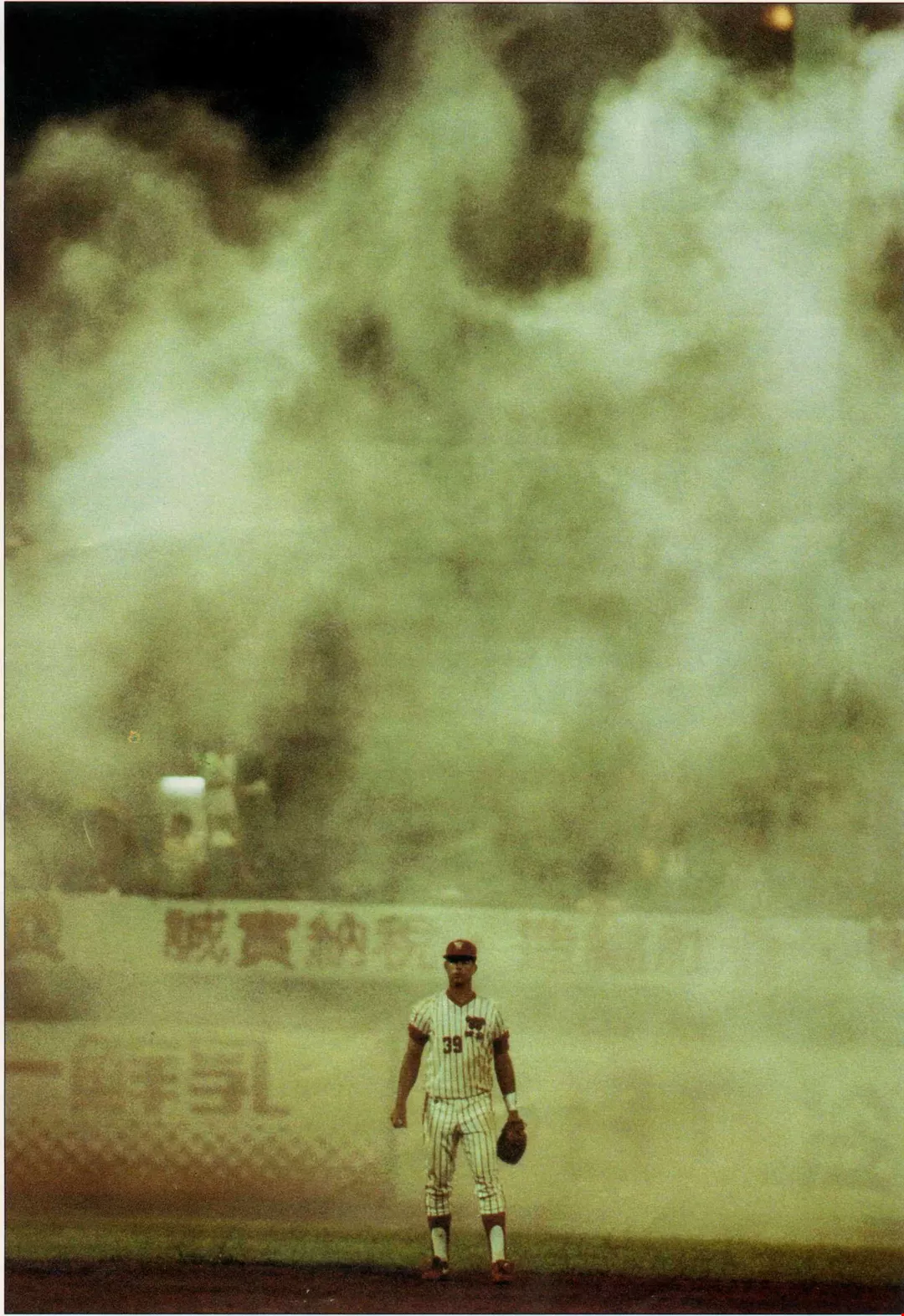
As the air rings with explosions, the ball field is shrouded in smoke. Lighting firecrackers off in the ballpark? Taiwan's baseball culture has a long way to go.
Cooperate to make money?
Of course? A prerequisite of making money is abiding by this ancient teaching: When you're working together, you're all in the same boat.
The only problem is that Taiwanese businessmen have a nasty habit: After someone has been a boss for a while, he doesn't like to take directions from anyone. The league should have had the power to oversee all matters large and small, but the franchise owners seemed to fear that the league officials understood the "game" of baseball but not the "business" of it. Leery of putting real professionals in charge, the team owners have acted as league bosses, and with six of them nothing can get done. For instance, one will say that it's only fair that Lu Ming-tsu is put in the selection draft, while another owner will complain that Lu had already reached an agreement with his club. . . . There are numerous examples of how the league has only been able to please one owner by angering another.
Fiddlesticks! Enough of this nonsense. Let's watch the ball game!
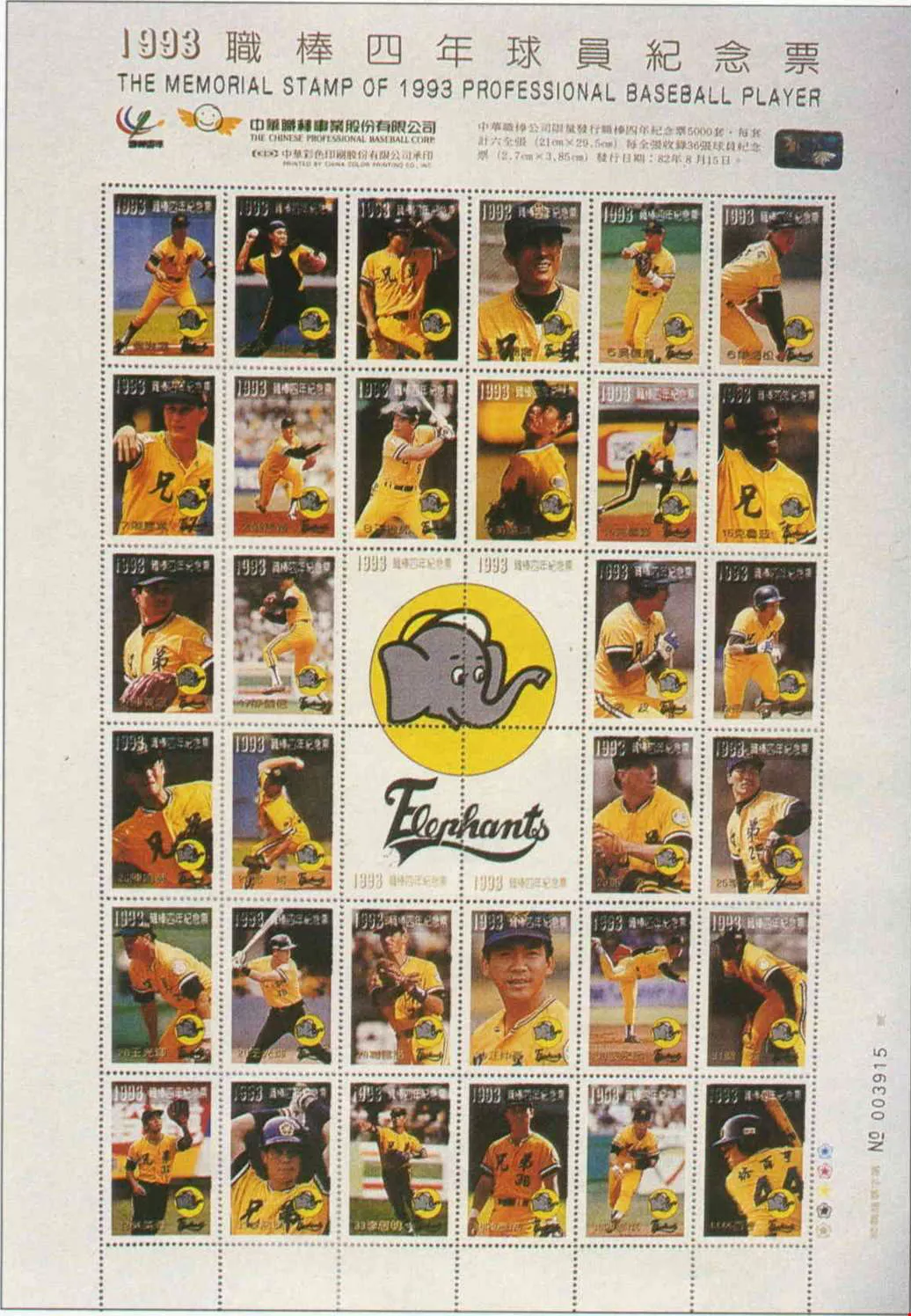
Commemorative stamps issued by the Chinese Baseball Association. As professional baseball grows, it spawns related businesses. (photo by Hsueh Chi-Kuang)
A well-played game!
The game is now in the bottom half of the sixth inning. In the top of the fourth, Sung Jung-tai, batting sixth in the Lions' lineup smashed a solo homer. Now President Enterprises is still ahead one-nothing, but the Elephants are at the plate.
The Lions' pitcher Hsieh Chang-heng is facing the first batter of the inning, the Elephants' Lin Yi-tseng, who hits a grounder that second baseman Lu Wen-sheng runs down. Lin, however, is just too quick. By the time first baseman Cheng Pai-sheng stretches for Lu's throw, Lin, a base stealing threat, has already made it safely.
In four years of professional baseball, Lin Yi-tseng has stolen 41 bases, eight more than second-place Angel Gonzalez for the Tigers. For an "old-timer" already in his thirties, Lin has performed remarkably.
Professional baseball is in fact a kind of theater, and there are rules governing player behavior. But the performances haven't been scripted or choreographed. If a player's showing earns him public approval and a leading role, the ensuing fame and fortune is not limited to the playing field. Haven't you seen the commercials that feature Chen Yi-hsin and Li Chu-ming? Huang Ping-yang has even recorded an album. It's gotten to the point where the wedding of pitcher Kuo Tai-yuan to the actress Chang Chiung-tzu has been called "the wedding of the age." Hence, you can say that there's a future in playing ball well.
But don't begrudge ballplayers' their double reward, for as soon as their athletic days are over, they're left with nothing. And the ever-present threat of injury makes their careers just that much more insecure. While it's anybody's guess when they'll get in a slump, it's for sure that when they can't play ball any more, the fans will forget them. The stars of today, making NT$200,000 a month, just have to be cut next year to be making nothing.
Haven't you heard? Chen Yi-hsin, for one, was pretty straightforward: "You ask me what I'm after? It's money." Maybe in a life of competition, you can only fully control things that you can see!
Where did all this doom and gloom come from? They're having a raucous time at the ballpark.
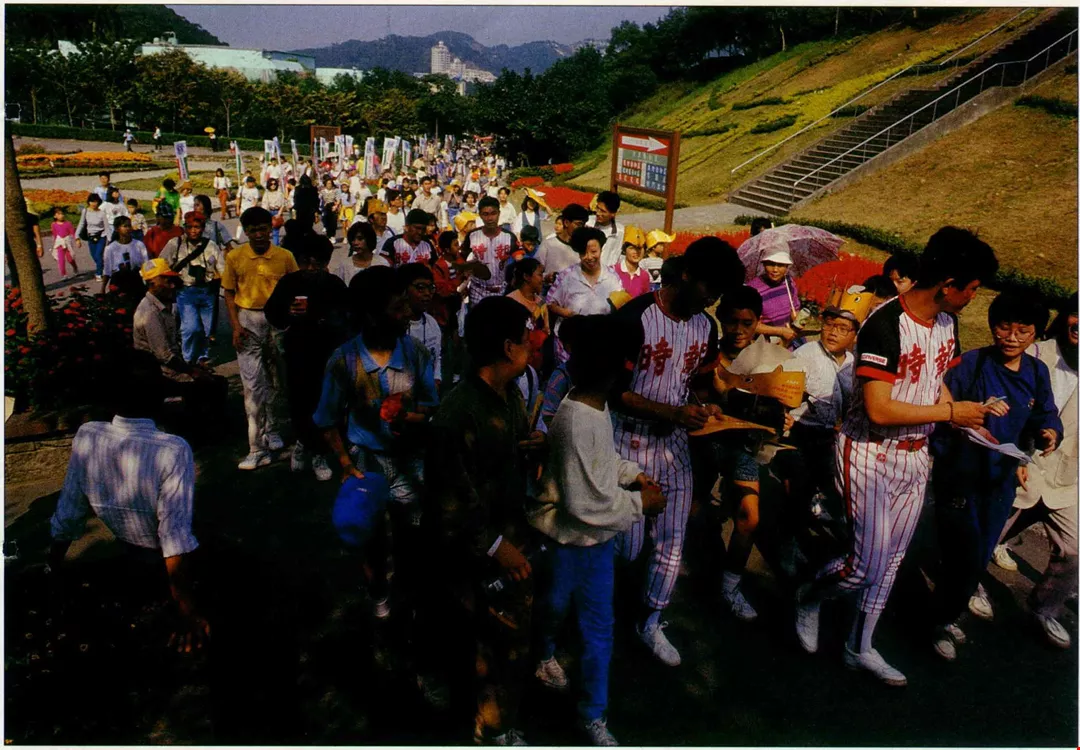
Baseball uniforms are not worn only on the playing field. In order to build their public images, the teams all make appearances at charitable functions. (photo by Vincent Chang)
TV doesn't like baseball?
When number two hitter Wu Fu-lien steps to the plate, Hsieh Chang-heng peers over at Lin Yi-tseng. Lin is crouched in a lead that is a step or two farther than most base runners will venture. He knows that the crowd has been waiting for him to get on to see him steal.
"Steal! Steal! Steal!" The Elephant fans chant in encouragement.
Hsieh can't take his mind off of Lin. Without throwing a single ball to the plate, he throws over to first and Lin scampers back safely. But as soon as Cheng Pai-sheng tosses the ball back to him, Lin takes the same long lead off the bag, indicating his felonious intent.
Hsieh finally takes his mind off of Lin and throws a pitch high and outside that Wu Fu-lien lays off. Lin, despite all of Hsieh's work to keep him close to first, charges off to second. Catcher Tseng Chih-chen has sharp eyes, and the ball barely enters his glove before he throws it to second. There, Juan Castillo the shortstop takes his position in front of the bag to catch the ball and tag the runner. A cloud of dust rises as Lin slides hard, and the umpire's arms extend in both directions -- "safe." The Elephants fans roar in approval.
It's over too quickly, isn't it? If only it was on TV. Then you could savor the replays again and again. But our television stations are all too full of themselves, and they've got to be buttered up to broadcast a ball game. In Japan and the United States, television pays for the rights to broadcast games, whereas our television stations ask the teams to pay for the privilege of being broadcast. Otherwise, they're not interested. How different the cultural climate is here!
But it's not clear whose loss it is. Some announcers can't even tell the difference between a "put out" and a "force out" and the camera frequently can't follow the path of the ball. They're stupid not to take advantage of an opportunity to advance their skills.
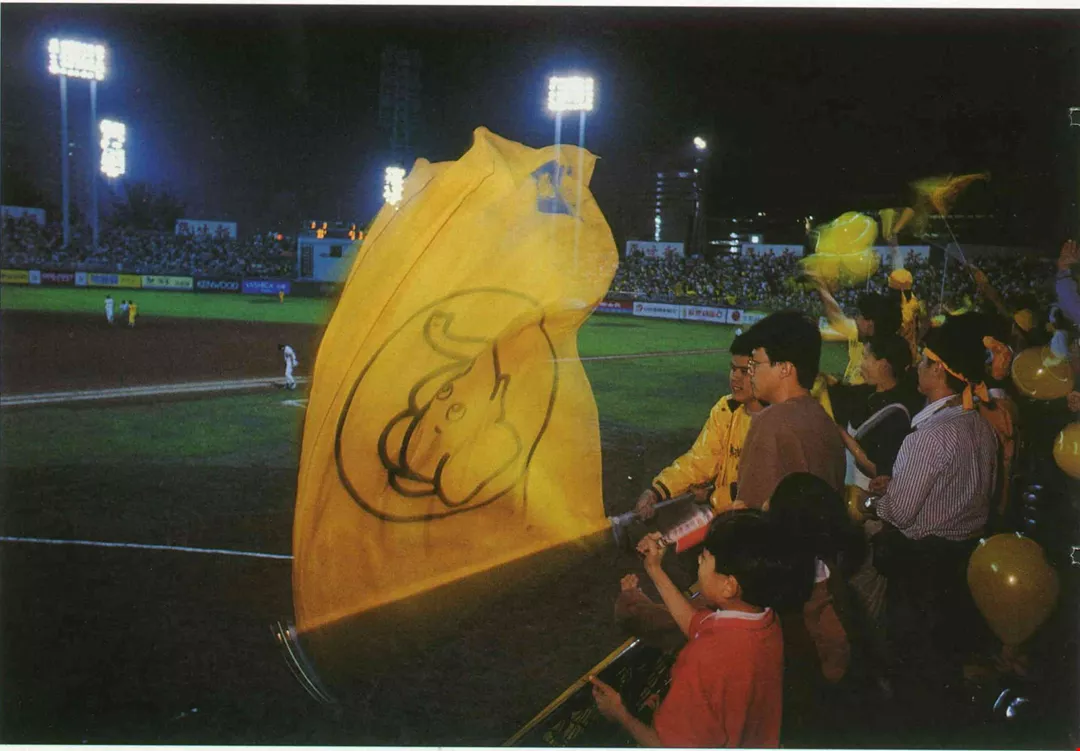
Besides passionately declaring their allegiances, why don't the fans in the stands coolly study all the strategy and skills that make up the game? (photo by Hsueh Chi-kuang)
Fatsos can still be pretty boys
It's the top of the eighth inning, and the Lions are at bat. In the bottom of the seventh the Elephants tied the score at one-all with back-to-back hits. Now slugger Lo Min-ching comes to the plate. A homer would put the Lions in front, and Lo certainly has startling power. "Lo Min-ching, I love you" a group of young girls chant shrilly, hoping that with one swing Lo will put his team in front.
Fans are fans, and so even the pot-bellied Lo can earn the love of the fairer sex. It may not be logical, but in school these young girls are warned against falling for boys by the dean of students, and when they come home, their parents tell them that their only suitable suitors are math and English. Their lives lack spice. Coming to the ballpark and getting starry-eyed about the players is good for their psychological health.
Nevertheless, fans can go a little overboard. Some are reputed to have collected more than one million baseball cards, and others know by heart the smallest of details about a player's life. While such interest may be flattering to the players, it makes you wonder if they haven't gone a bit too far. Our society is sorely lacking in things that people find captivating.
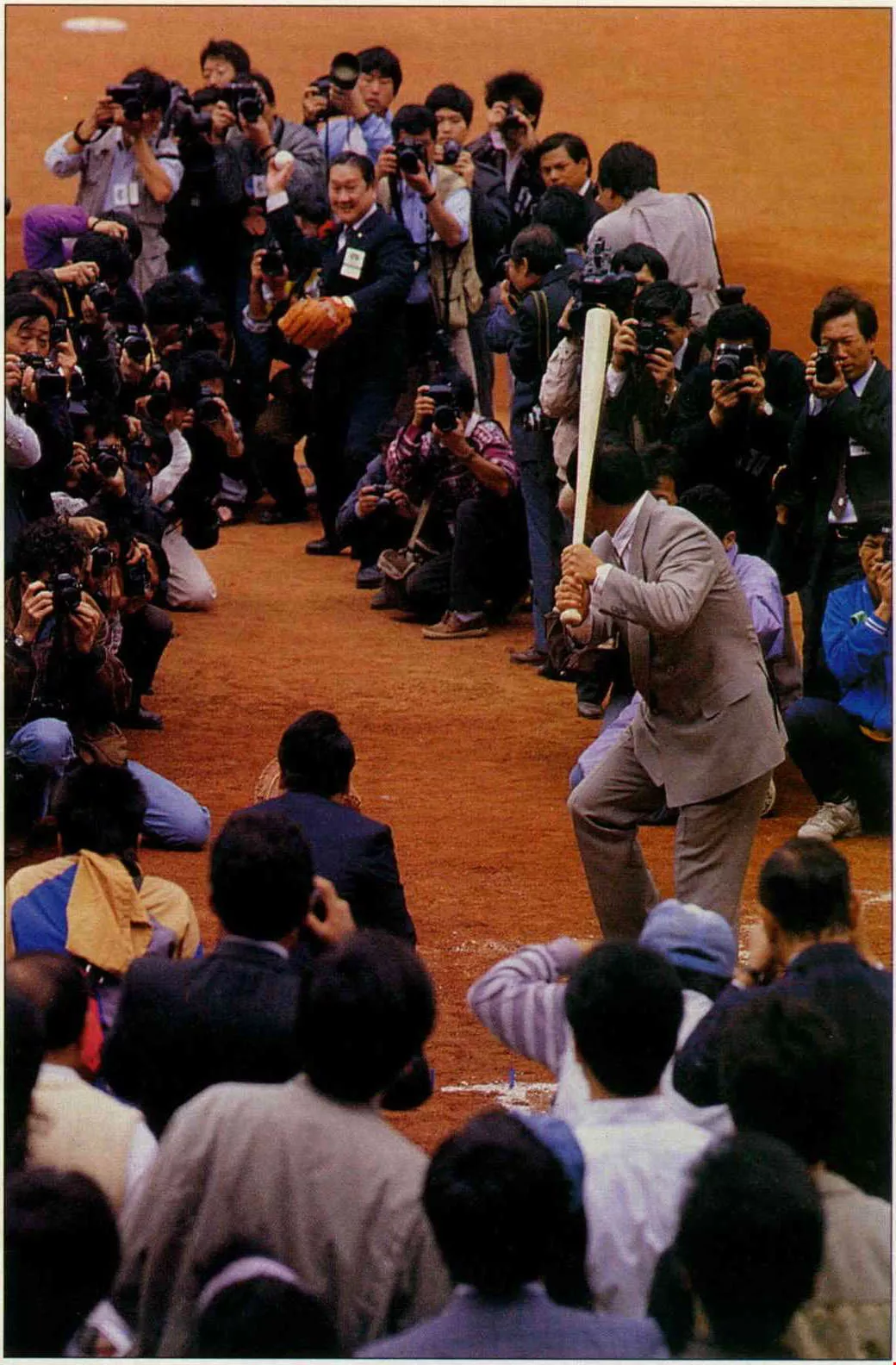
Photographers jockey for position as Wang Chen-chih steps to the plate for a ceremonial throwing of the first pitch. As professional baseball has prospered, the press has devoted page upon page to reporting on the sport.
Hey big spender!
How can someone be leaving now, when the game is so tense! Wait a minute, I know that guy. It's Chen Hung-yen, a former national team javelin thrower who is now associate professor of Physical Education at Fu Jen Catholic University. "Professor Chen, why are you leaving?" "I simply can't watch anymore!" "What's the matter? It's a good game!" "The game's good, but I can't stand the spectators. Look! I've been here for eight innings, and I've been entirely surrounded for nearly three hours. If I watch any more, I'll become a smoked chicken."
In baseball stadiums abroad, unlike in Taiwan, there are smoking and non-smoking sections. It's tough on the many children fans here, and pity the poor people who sweep up afterwards. But don't blame it on the league. In Taiwan there's no way to stop smoking even in indoor movie theaters. How can we expect to prohibit chain smokers from lighting up outdoors?
Alright then, good-bye Professor Chen! Let's continue watching. Lo Min-ching strikes out, and his female admirers "ah" together in disappointment. Now Frank Laureano steps to the plate and hits the first pitch into right field, where Wu Chun-ta takes a few steps toward the ball before holding up. Because the ball was hit near the line, the umpire signals that it is fair, and with Wu having hesitated before picking up the ball, Lin pulls up at second with an easy double.
Wait a second--there's an argument. The Elephants' manager Yamanai comes out of the dugout to protest! The Elephants think that the ball should have been called foul and Frank Laureano should go back to the batter's box. The umpire is explaining what happened.
Watching is not understanding!
The fans, however, don't have deep reservoirs of patience, and some are beginning to throw things out on the field. Others are tossing lighted fire-crackers into the air. The players run for cover, and play is suspended.
Our fans really don't have much of a sense of humor. No one knows what the manager and the umpire are arguing about anyway, but among themselves the fans take the approach that the quickest to action win. Chang Che-lang, a baseball critic of the highest caliber (whose real job is Chairman of the history department at National Chengchih University), once told me, "Don't take the disputes on field seriously." For the sake of adding to the drama of the games, he said, managers in America often protest the umpire's calls. The fans see two men pot belly to pot belly, shouting until they're red in the face. But if a tape were made of what they were disputing, you'd hear "How about a beer tonight?" "Alright." "Where?" "At that stupid bar." "Don't leave if I'm not there when you get there." "Sure thing."
The Urban Jungle
The conventions for watching pro ball here in Taiwan have yet to be fully established. While going to a ball game abroad has all the etiquette of going to the theater, here it's more like watching Taiwan opera on the street. No one knows what's going on anyway, so you might as well just act serious about everything, displaying the Chinese trait of refusing to admit defeat. Let's all yell and scream together.
An hour later the arguing has only grown more heated. We might as well slip away before we find ourselves in trouble. Who knows when the game will begin again, anyway. Let's go home. But it's like a jungle out there just as much as it is in here. Ordinary folks like us just can't escape it.
[Picture Caption]
p.8
A slow shutter speed and triple exposure capture the motion of Elephant Chen Hsien chang's delivery.
p.9
When the Giants of Japan came to Taiwan for exhibition games, fans went to any lengths to get the autographs of their idols. (photo by Hsueh Chi-Kuang)
p.10
With the playing lights off, the players relax in the dugout while spectators kill time by lighting sparklers.
p.11
Since the Elephant is the Brother Hotel's team symbol, it is often called upon to play a comical role. Here the elephant is shaking hands with a fan, while another young spectator mischievously shakes its trunk.
p.12
"You toss and I glean." When fans can't control their emotions, scenes like this are the result.
p.13
As the air rings with explosions, the ball field is shrouded in smoke. Lighting firecrackers off in the ballpark? Taiwan's baseball culture has a long way to go.
p.14
Commemorative stamps issued by the Chinese Baseball Association. As professional baseball grows, it spawns related businesses. (photo by Hsueh Chi-Kuang)
p.15
Baseball uniforms are not worn only on the playing field. In order to build their public images, the teams all make appearances at charitable functions. (photo by Vincent Chang)
p.16
Besides passionately declaring their allegiances, why don't the fans in the stands coolly study all the strategy and skills that make up the game? (photo by Hsueh Chi-kuang)
p.17
Photographers jockey for position as Wang Chen-chih steps to the plate for a ceremonial throwing of the first pitch. As professional baseball has prospered, the press has devoted page upon page to reporting on the sport.
@List.jpg?w=522&h=410&mode=crop&format=webp&quality=80)

@List.jpg?w=522&h=410&mode=crop&format=webp&quality=80)


@List.jpg?w=522&h=410&mode=crop&format=webp&quality=80)

@List.jpg?w=522&h=410&mode=crop&format=webp&quality=80)
