Seeking the Infinite in the Infinitesimal:Neuroscientist Chiang Ann-shyn
Lin Hsin-ching / photos Jimmy Lin / tr. by Josh Aguiar
May 2012


Suppose one queries, “Who among Taiwanese academics has the greatest potential to win a Nobel Prize?” Professor Chiang Ann-shyn, director of the Brain Research Center at National Tsing Hua University, is indubitably one name that cannot be omitted from the list.
Since 2007, Professor Chiang’s research team has been studying fruit fly brains literally the size of a pinhead and isolating the neural pathways responsible for conveying the sensations of smell and hearing, as well as identifying brain cells that play a key role in mid- and long-term memory storage. The magnitude of these findings was such that they garnered effusive praise from 1962 Nobel laureate James Watson, the “father of DNA,” for they carry broader implications about the workings of the human brain.
The setting is a 3D theater like you’ve never seen.
The projected image evokes the symmetrical beauty of an orchid petal or the motley refulgence of a swallowtail butterfly in mid-flight. Its true identity is something far less poetic: the brain of a fruit fly (Drosophila), whose actual size is that of a mere pinpoint.
Under the sweep of the camera lens, one Drosophila neuron after another, each merely three microns long (three thousandths of a millimeter), assumes a luminous onscreen presence so immediate that you feel you could reach out and touch it.
A voiceover narration elucidates the complex mechanics of the Drosophila brain in simple, straightforward language so accessible that in a relatively short time even those without scientific training can grasp how smells initially received by the organism’s antennal lobes are conveyed to the olfactory glomeruli and then navigate a dense network of neural pathways before arriving at the all-important corpora pedunculata or “mushroom bodies,” which form the “CPU” where the signals are processed and the decision to approach or disregard the odor’s source is ultimately made.
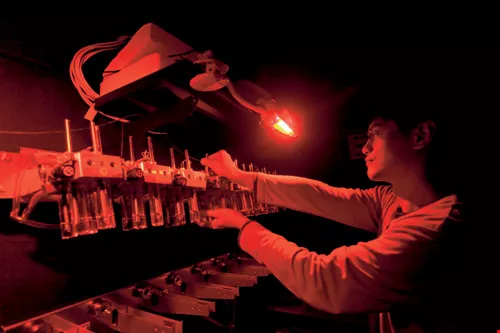
Drosophila can only form olfactory memory when they are free from visual distractions. In order to create optimal “study” conditions for the flies, the lab is illuminated using red-hued lights that the small organisms cannot see.
The “FlyCircuit,” a 3D virtual imaging system for Drosophila brain gene expression patterns developed by the Brain Research Center at the NTHU College of Life Science, is an unprecedented triumph in global bioimaging technology. Providing a resolution 10,000 times finer than nuclear magnetic resonance (NMR), it is able to display patterns at the molecular level, making it possible to discern even the minutest operations of individual Drosophila neurons.
“When 82-year-old Nobel laureate Dr. James Watson, one of the discoverers of the double-helix structure of DNA, saw this system two years ago, he was totally blown away!” says Brain Research Center director Chiang with self-evident satisfaction.
The 55-year-old Chiang is widely recognized as a global leader in the search to unravel the mysteries of the human brain. Though his laboratory has neither the size nor the funding of its counterparts in Europe and North America, he has nonetheless been able to deliver one scientific tour de force after the other. Chiang first came to international prominence with the article “A Map of Olfactory Representation in the Drosophila Mushroom Body,” published in 2007 in the highly regarded academic journal Cell, the first time the publication had ever spotlighted the research results of a Taiwanese scientist.
His research team subsequently discovered that the fly’s long and midterm memories were stored in separate locations of the brain, as well as identifying its auditory pathways. More recently, a four-person research team under his supervision, including Chen Chun-chao and three other PhD students, isolated two key dorsal-anterior-lateral (DAL) neurons responsible for storing long-term memories.
The findings of Chen’s team torpedoed the long-reigning belief that fruit flies’ long-term memory was stored in the mushroom bodies. The discovery was so arresting that the February 10, 2012 edition of the prestigious international academic periodical Science allotted a full eight pages of in-depth coverage.
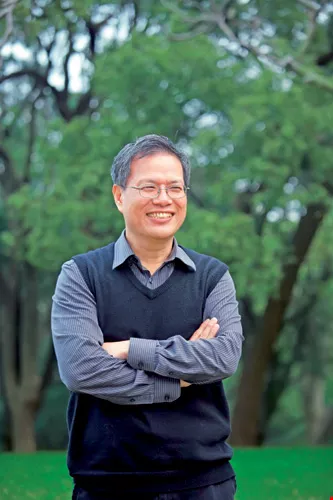
The urbane and witty Chiang Ann-shyn is a delightful conversationalist, quite unlike the frequent stereotype of scientists as cold, aloof men obsessed by their work.
Today Chiang is a highly respected leader in the neuroscience field, but unbeknown to many, he started his career as an expert on that most reviled of bugs, the cockroach.
In his college days at National Chung Hsing University’s Entomology Department, he profoundly disliked memorizing endless taxonomy lists, but was always invigorated by lab work. He still has vivid memories of the first time he witnessed the life cycle of Bacillus thuringiensis, a soil bacterium that also lives in the guts of caterpillars, under a microscope: “It was like intruding on an alien planet. It really was a world unlike anything I had ever experienced!”
Possessed by a fervent desire to fully comprehend biology’s obscurest secrets, he decided on an academic career that first took him to National Taiwan University for a master’s in plant pathology and then later across the sea to acquire a PhD in entomology at Rutgers University in the US, where he studied with the man known by the sobriquet “the cockroach genius,” Professor Coby Schal.
“In the courting rituals of forest cockroaches, the male will sing amorously to the female while waving his antennae about. It’s really fascinating, actually.” As he reflects on that phase of his youth spent probing scientific mysteries alongside his mentor, Chiang’s voice and demeanor brim with warmth and enthusiasm. His 1990 PhD dissertation “Developmental Regulation of Juvenile Hormone Biosynthesis in Female Cockroaches” was also recognized as the best dissertation that year by the Entomological Society of America.
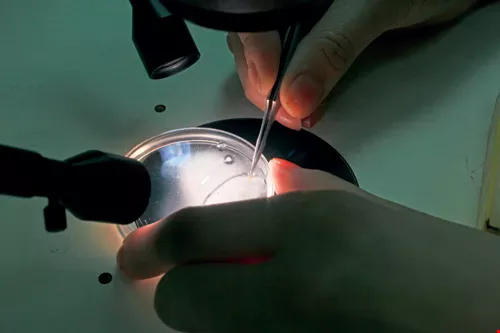
A microscope is needed to penetrate the pin-sized Drosophila brain.
His studies behind him, Chiang returned to Taiwan in 1992 to teach at NTHU. At a time when the scientific community had become obsessed with decoding the human genome, he was determined to approach the problem from a different angle.
The fire that was ignited the first time he viewed living tissue under a microscope was still burning hot, and his desire to learn and understand remained untarnished throughout.
Chiang sought answers in nature. “Jellyfish, body lice, and a number of fish and bugs have transparent bodies. I believed that there must be some way to render other organisms transparent so as to study their internal architecture without disrupting their cellular distribution.”
Armed with this simple belief, he began by painstakingly applying glycerin to tissue samples to make them partially transparent. Along the way he continually sought to make improvements by adjusting its chemical structure, and on one occasion even traveled to France to draw inspiration from a legendary traditional formula.
Like a wizard seeking the right ingredients for a potion, Chiang spent five years developing his own elixir, enduring one failure after another before achieving success with the remarkable clearing reagent, FocusClear.
“Take a sample of cockroach brain tissue a mere 600 microns in size and apply FocusClear and presto!—the whole thing becomes instantly transparent,” explains Chiang with an enigmatic grin. Viewed with a confocal laser scanning microscope, the cellular structure of the cockroach brain tissue, including the molecular and ionic solids, comes into sharp focus. It is a vast improvement over the old days, when achieving such a clear examination required painstakingly slicing each sample down to a just a few microns in thickness.
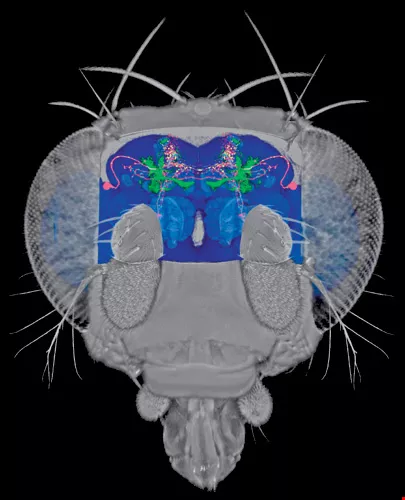
“FlyCircuit,” the 3D virtual imaging system developed by NTHU, fully reveals the otherworldly landscape of the Drosophila brain down to the minutest functions of individual neurons.
It is a curious thing indeed that a man whose initial focus was on insect neuroendocrinology has since delved into the workings of the human brain. In so doing he abandoned the cockroach in favor of the fruit fly.
It took some minor setbacks when Chiang first returned to Taiwan to teach to launch him on his current trajectory. At that time he, like all the other new professors, had one small lab, two graduate students and one postdoctoral researcher under his charge. Chiang still felt his own resume to be a bit thin at that point, nor did he feel comfortable guiding the research of a postdoc merely a few years his junior. As a result, he decided to give half of the NT$750,000 in government endowment to his postdoc to enable her to work more independently.
The postdoc’s area of expertise was in measuring calcium ion signaling, which required a piece of highly specialized equipment costing at least NT$1 million. They somehow scraped together the remaining funds, but when the machinery arrived, it was inoperative, and the source of the malfunction was so elusive that even the manufacturer’s expert was wringing his hands in despair. To add insult to injury, the postdoc, the only one with any understanding of the equipment, left abruptly. But Chiang apparently never learned the meaning of the word defeat, because he spent the next two years doggedly studying it until he located the problem: an improperly installed filter. Thus a piece of machinery that had hitherto only taken up space was ready to be usefully employed.
Now using the machine for his own purposes, Chiang discovered that cockroaches, like human beings, have NMDA receptors, which “mediate juvenile hormone biosynthesis,” and play a key role in the insects’ maturation and reproduction. The results of this study were published in the Proceedings of the National Academy of Sciences of the United States of America (PNAS) and were heralded as a breakthrough for the development of new types of agricultural and biological controls.
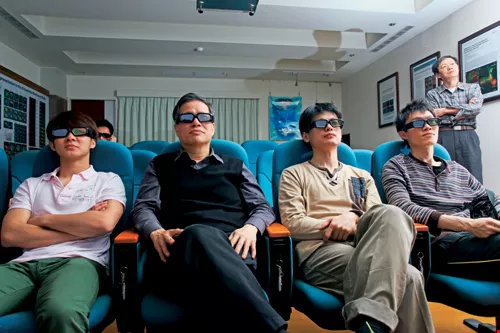
“FlyCircuit,” the 3D virtual imaging system developed by NTHU, fully reveals the otherworldly landscape of the Drosophila brain down to the minutest functions of individual neurons.
The obstacle was a detour that opened up new vistas.
“NMDA receptors can play a role in memory formation in human beings, but until this recent discovery, the scientific community was unaware not only of their presence but also of their functionality in insects. The follow-up therefore is: Do insects, like human beings, have memory?” he queries.
Wishing to plumb the depths of this mystery, he contacted his old PhD advisor, Coby Schal, whose recommendation facilitated a collaboration with geneticist Tim Tully, internationally recognized as one of the foremost authorities on Drosophila memory, at Cold Spring Harbor Laboratory in Long Island, New York.
But only two weeks after Chiang’s arrival came the terrorist attacks of September 11, 2001. Everyone was too devastated to work, and nobody was willing to pay any mind to some unassuming visiting Asian scholar.
Without much to occupy him, Chiang found himself meandering about the lab. One day, when he chanced upon a postdoctoral researcher coping with an extremely murky slide of a Drosophila mushroom body, he couldn’t resist coming to the rescue by unleashing his magic-formula FocusClear.
“In the blink of an eye, the slide snapped into sharp focus, and the fellow’s eyes nearly popped out of their sockets!” He chuckles as he recalls this watershed moment. A week later, the two collaborated on a paper that was published in Current Biology.
From that moment on, Chiang’s reputation took off. His laboratory teemed with people wanting to work with him. After returning to Taiwan a year later, he received countless invitations from Cold Spring Harbor. Between 2002 and 2006 he assisted no less than 10 top-deck international neuroscience experts with a series of important publications. His unselfish attitude led Tim Tully to praise him as someone who “really gives freely of himself” in cooperating with others.
“If you want to work with the best in the world, you have to share your abilities unstintingly and make yourself needed before others will be willing to open up to you,” says Chiang.
The credo “make yourself valuable” is what has positioned Chiang to be able to learn from the best and what has allowed his research group to rise to world-class status in such a short period. When his groundbreaking work on Drosophila olfactory representation appeared in Cell in 2007, all of the American scientists with whom he had worked went out of their way to give him the thumbs up and to tell him, “We’re so proud of you!”
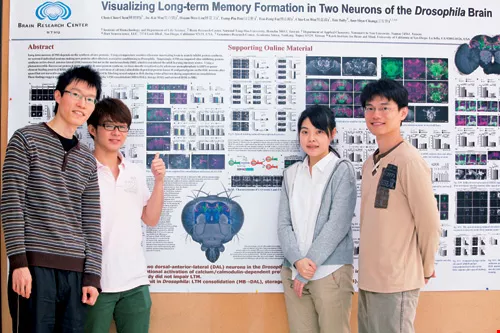
A team of NTHU PhD students comprising (left to right) Chen Chun-chao, Wu Jie-kai, Lin Hsuan-wen, and Pai Tsung-pin was responsible for discovering one of the locations of long-term memory in Drosophila. Their findings were published in the esteemed international journal, Science.
Over the past few years, the opus that has garnered the most admiration is his arduous and comprehensive mapping of the Drosophila neural circuitry.
He explains that although the flies only have 100,000 neurons, a mere drop in the bucket compared to the 100 billion in the human brain, the mechanisms of memory, learning, and signal exchange are fundamentally the same as our own. By exhaustively mapping out the neural circuitry of this relatively simple organism, it may be possible to glean a greater understanding of the human brain.
However, the completion of such a monumental project is no easy feat. The researchers must first use genetic markers to locate and then analyze each individual neuron before, in a process that resembles piecing together a puzzle, reassigning them back to their original location.
Thus far, they have decoded 20% of the Drosophila neurons, placing them far at the head of the pack internationally. Chiang cheerfully estimates that the work will reach completion within five years.
The infinite and the infinitesimalBehind every successful man, they say, is a great woman. Chiang’s wife Yang Meihui is a well-known former ballet dancer and a fount of undying support. If it weren’t for her abiding presence and constant reminders, it’s possible that his every meeting would run late while he became engrossed in discussion. It’s even likely that he would get lost while driving through Hsinchu, his mind preoccupied by his work.
“I even dissect fruit-fly brains faster than he does!” adds Yang gleefully.
His students describe him as “strict without being severe” and “in charge without resorting to anger.” Chiang himself believes that cultivating young talent is a task whose importance is second only to that of the scientific inquiry itself.
“If Taiwanese science is to have a place at the international table, there needs to be an abundance of qualified personnel who frequently publish in the upper-tier international publications like Science, Nature, Cell and the like. Only when this has been the case for 10 or 20 years will there be any real chance for Taiwanese to be considered for Nobel honors,” he opines.
Astronomy peers into the infinite, they say, while life science turns to the infinitesimal; yet each cell is a universe in itself. Dr. Chiang has looked into the brain of a fly and seen reflected in it a world of boundless marvels.
@List.jpg?w=522&h=410&mode=crop&format=webp&quality=80)

@List.jpg?w=522&h=410&mode=crop&format=webp&quality=80)


@List.jpg?w=522&h=410&mode=crop&format=webp&quality=80)

@List.jpg?w=522&h=410&mode=crop&format=webp&quality=80)
