Dancing with the Dragon--Hong Kong's Decade in China's Embrace
Vito Lee / photos Chuang Kung-ju / tr. by Scott Williams
July 2007


After a decade in China's arms, Hong Kong is gradually getting into step with its partner on the Asian stage.
By climbing aboard the juggernaut that is the rapidly growing Chinese economy, Hong Kong has escaped the dark memories of the East Asian Financial Crisis and the SARS epidemic. The territory now promises to rival New York and London as one of the world's three great financial centers.
The ten years since its return to China have shaken Hong Kong awake: The environment is becoming steadily worse. The focus on economic development has resulted in greater social inequity. The territory is struggling to integrate mainland Chinese residents into its society and is having to deal with the resulting frictions.... Post-return, the people of Hong Kong are demanding more and thinking about their place in the world. The territory's days as a colony are fading into memory, but what does it mean to be a Special Administrative Region? How long can Hong Kong keep its "special" status? What does it need to do to remain "special"?
Though handed over to China by the UK, moving from the control of one "exogenous" regime to another, the people of Hong Kong have never sought independence, and have seemed to have little awareness of their own subjectivity. Nonetheless, there are inklings that such a sentiment may be emerging. For example, the 2007 election for the chief executive of the Hong Kong Special Administrative Region (SAR), the third since the handover, included the first ever challenger to Beijing's nominee. But what China's takeover of Hong Kong, this city which has repeatedly stumbled and regained its footing, really means to Hong Kongers, takes some effort to discover.
To whom does Hong Kong belong? It's not a question the multi-ethnic gwailo (a Hong Kong term for Caucasian men) residents of the town of Stanley ever ask.
The town of Stanley sits on a peninsula thrust like a dagger out into the Pacific Ocean from the south side of Hong Kong Island. Once home to the first British garrison on the island, a mottled fort still tips the dagger 100 years later. But the town itself has long since given up its defensive posture and now stands with open arms. These days, it is an upscale residential district popular with Hong-Kong-based members of the international managerial class. Cantonese newspapers are a tough sell in this largely foreign enclave, where the most popular television stations broadcast in English, Spanish, French, German, and Hindi.
"You don't read the Cantonese papers or watch the Chinese channels unless you're really bored," says Marc in an English heavily seasoned with a southern French accent. The head of the mergers and acquisitions department in the Hong Kong office of France's Societe Generale, Marc has just been transferred here from Australia.
But boredom is something the gwailo managers that live here have little time for. Marc works out of an office in Central, but also travels to Malaysia, India and the major cities of China on a monthly basis for meetings. Working from the pricey environs of Stanley and Central, he and others like him keep their adrenaline pumping by playing and influencing investment markets in Asia and around the world by remote control.
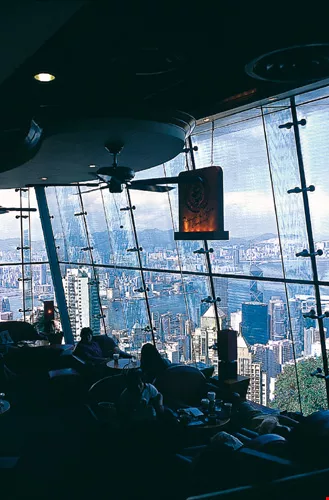
Shops and restaurants are everywhere in Asia's "global city," providing a never-ending feast for the eyes and the taste buds.
English laws...
"The SAR has been well run," says James, the Hong Kong-based CEO of an American environmental services company, explaining that the Chinese want to keep transnational corporations in Hong Kong. James, who came to Hong Kong to gain access to the China market, has his offices in Causeway Bay, but likes to get together with other Hong-Kong-based businesspeople at a bar where they can still smoke in Central's Lan Kwai Fong entertainment district.
"Or maybe I should say that the SAR hasn't done anything," he continues. "Their objective has been to maintain the pre-1997 environment. And, in this respect, they've achieved their aim."
Why fix something that isn't broken? The pragmatic people of Hong Kong continue to be as meticulous and efficient as ever. The Hong Kong SAR has had only two chief executives since its inception--shipping magnate Tung Chee Hwa and the recently reelected Donald Tsang, a former British colonial official--both native sons of the territory. By using locals to administer the territory and keeping things on a "business-as-usual" basis, China has eased Hong Kong people's concerns about the future of their home.
In addition, Beijing has been very cautious in its rollout of the "one country, two systems" experiment. Well aware that the eyes of the world are on them, they fear that even one slip will destroy the hard-won reputation of their prototype. Continuing to provide attentive service to foreign senior-management types is a basic tenet of the "the English made the laws, the Chinese follow them" system currently in place. Need a work visa and dependents visas? No problem. Hong Kong has the most efficient visa operation in Asia: visas require an average of just seven days to process. Meanwhile, taxes, an ever-present concern for transnational workers, are the lowest in Asia, with income tax at a single flat rate of only 15%. And, after ten years of Chinese rule, Hong Kong retains the freest economy in the world.
The principles of leaving the Hong Kong system intact for 50 years and having locals administer the SAR were laid out prior to the handover. "Though Beijing was used to controlling everything itself, it was supposed sit on the sidelines and watch," says Ivan Choy, a senior lecturer in the Department of Government and Public Administration at the Chinese University of Hong Kong whose research focuses on the administration of the SAR. But Beijing didn't keep its hands entirely off for very long at all.
Birthing pains
A seven-year period of economic recession and turbulence followed close on the heels of the People's Liberation Army soldiers who entered Hong Kong on 1 July 1997, presenting an immediate and serious challenge to the unprecedented "one country, two systems" experiment.
The first blow to the Hong Kong economy came in 1998 with the arrival of the East Asian Financial Crisis. The local bourse's Hang Seng Index responded to the crisis by plunging to just 6600 points, barely half the level of its 1998 peak. The 9/11 attack in the US and the bursting of the Internet bubble only added fuel to the fires. Even the real-estate market, long an index of the Hong Kong economy, collapsed, seriously eroding the assets of local residents.
The Asia-Pacific region was the nexus of the SARS epidemic, which struck China, Hong Kong and Taiwan simultaneously. With 1,755 cases and 299 deaths, Hong Kong was hardest hit. The territory's tourism industry, which accounts for 15% of its GDP, suffered badly and is thought to have lost as much as US$3 billion as a result of fallout from the disease. Unemployment soared to a record high of 8.7%.
Several consecutive years of economic sluggishness, the government's poor management of Hong Kong-China relations in 2003, and all the dissatisfactions that had accumulated since the handover finally pushed the public over the edge.
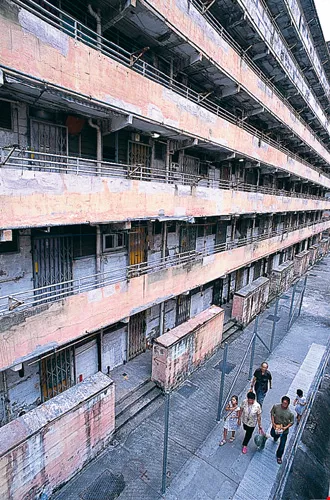
Scenes from outside of Central: Public housing estates awaiting demolition in Sham Shui Po; Looking down from Ngong Ping 360 cable car system, which opened last September, you can see the newly developed Tung Chung (below).
The 1 July demonstrations
In response to strong hints out of Beijing, the SAR government had begun efforts to amend Article 23 of the Basic Law in 2002. The government hoped to clarify the nature of crimes such as treason, separatism, sedition, subversion, and stealing national secrets to establish a basis for future law enforcement. Its actions ignited a firestorm of protest targeted particularly at the nebulous notion of "national security," which is too easily used to trump up charges.
"Article 23 was a wake-up call to the people of Hong Kong, who have long claimed to have 'liberty without democracy,'" says Dr. Tam Chi-keung, a well known Hong Kong political critic. "They realized that without democracy, their freedom could be taken away at any time." He explains that the media would tremble with fear at the thought of being accused of violating national security or revealing national secrets, and, if it were muzzled, Hong Kong's civil liberties would be at risk.
With the economy weak and Hong Kong's remaining freedoms in jeopardy, some 500,000 people out of a population of only 7 million took to the streets on the 1 July 2003 anniversary of the territory's handover to China. They carried signs calling for Tung Chee Hwa to step down, for the direct election of the SAR's chief executive, and for self-determination, venting their anger at the SAR government for several years of maladministration and for knuckling under to Beijing's efforts to expand its power in the territory. The media's images of the protest shook China's leaders and revealed the many problems with the one country, two systems model.
"The public was nominally demanding the recall of the chief executive," recalls Tam. "But their actual significance was that they were the first time that the people had stood up to talk back to Beijing."
Home Affairs Secretary Dr. Patrick Ho has been quoted as saying that the 1 July protests were "crucial," especially to Beijing, because they sent a clear signal that Beijing needed to rethink its Hong Kong policy.
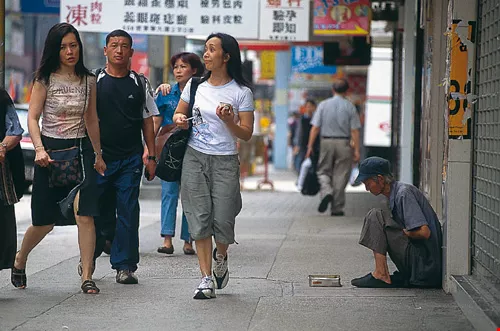
In Hong Kong, long a bastion of laissez-faire economic policies with few protections for workers, the income gap has soared along with the skyrocketing stock and property markets.
China's economic gift
Though the protests were humiliating for their principal target, Chief Executive Tung, Beijing did not permit him step down immediately. Regarded by the people of Hong Kong as an inept yes-man, he had to wait until the end of the following year before he was allowed to resign "for health reasons."
"The 1 July protests were naturally embarrassing for Beijing," says Choy. "They killed their plans for follow-on legislation to Article 23 of the Basic Law and took the wind out of the sails of their efforts to establish 'Big-Brother'-like powers. But Beijing felt that recalling Tung immediately would be too much like rewarding a child for a tantrum, that there would be endless demonstrations if they did so, making it difficult for the SAR government to get anything done."
"Though they couldn't give up political control, they could be generous on the economic front," continues Choy. "If they could just get the economy moving, the bulk of the public's disaffection would evaporate.
In an effort to spur growth in Hong Kong's economy, China rolled out the Closer Economic Partnership Arrangement (CEPA). The arrangement worked well once the global economy began recovering.
"What's CEPA? It's really just a free-trade zone," says Lin Chu-chia, a professor in the Department of Economics at National Chengchi University. He explains that when China and Taiwan acceded to the World Trade Organization (WTO) in 2001, they promised to reduce tariffs and open their markets over the course of five to 20 years. "By first opening up Hong Kong, Beijing could pour money into the territory while also softening the effects of a sudden large-scale liberalization on Chinese industries."
CEPA allows goods from Hong Kong to be imported into China duty free. It has also removed barriers to entry affecting Hong Kong's service industries, and covers 17 professions, the law and accountancy among them. CEPA has essentially offered Hong Kong businesses a free pass into the world's most attractive market. And they have taken advantage of the offer, pushing deep into every corner of the country and becoming the envy of the foreign firms that covet a share of the China market.
"Hong Kong's businesspeople excel at property development," says Lin. "When demand in the mainland's domestic market began to take off, they gained an enormous new playing field." According to Lin, Hong Kong businesses have been the drivers behind everything from infrastructure projects as big as airports and highways to smaller projects such as the Shanghai Xintiandi tourist mecca so familiar to Taiwanese. Hong Kong businesses are also tuned into what's going on in Beijing, giving them unparalleled knowledge of opportunities in the offing. "They know that Beijing is actively cozying up to and pampering Hong Kong," continues Lin. "It's a great time to ask for things and there's no reason for them not to be aggressive about asking for more. They've even asked that Beijing turn over all negotiation and arbitration services involving foreign nationals to Hong Kong businesses."
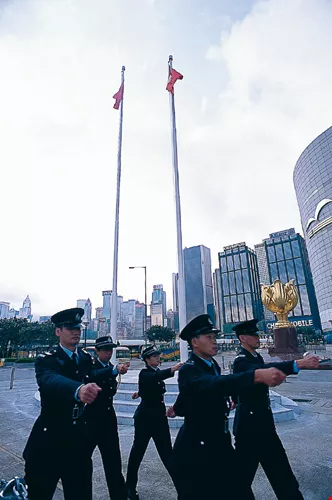
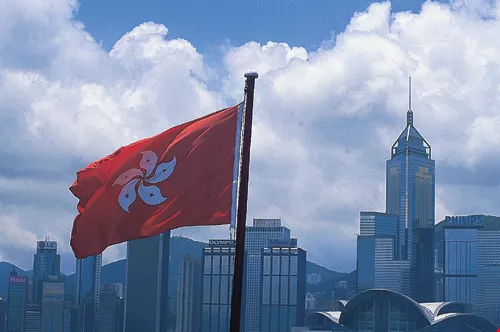
The flags of Hong Kong and China dance in the wind over Golden Bauhinia Square, symbolizing their ever more entwined futures.
Recovering a can-do attitude
Beijing provided the Hong Kong economy with another powerful stimulus not long after the 1 July march--it began permitting mainlanders to travel there for tourism without joining a tour group.
Known in Hong Kong as the "free travel" policy, it elicited both positive and negative reactions when it was first implemented. Doubters argued that while some mainlanders had serious money to spend, the new visitors allowed by the policy would bring higher crime rates and more undocumented workers. They also claimed that loud, poorly dressed mainland tourists would blemish the elegant and cultured ambiance of the territory.
Be that as it may, "free travel" from the cities in and around Guangdong has had a significant impact on the economy. Since 2004, the mainland has sent more than 10 million tourists a year to Hong Kong--about half of the territory's visitors--adding more than HK$20 billion to the economy.
With so many stimuli pouring in, Hong Kong's economy began rebounding in 2004 after seven tough years. The stock market soared and, by December 2006, the benchmark Hang Seng Index surpassed the 20,000-point level for the first time ever. These days, the Hong Kong stock market's market capitalization stands at US$1.6 trillion, having grown about 240% since 2003.
Having experienced hard times, Hong Kong is riding high again. The famous City Hall Chinese Restaurant is again packed with diners enjoying dim sum. Victoria Harbor sparkles as brightly as ever at night. Songs ring out every night in Lan Kwai Fong. The territory has reclaimed its "can do" spirit.
China's largesse has been instrumental in reviving Hong Kong's economy. "But Hong Kong's importance to present-day China should not be overlooked," says Lin Yuh-jiun, an associate fellow with the Chung-Hua Institution for Economic Research who studies Hong Kong's economy. Hong Kong businesspeople have established some 57,500 factories in the nearby Pearl River Delta. These factories, 70% of which have been established in the last decade, employ nearly 10 million people. "As China's largest source of foreign capital, Hong Kong has made a huge contribution to upgrading China's economy."
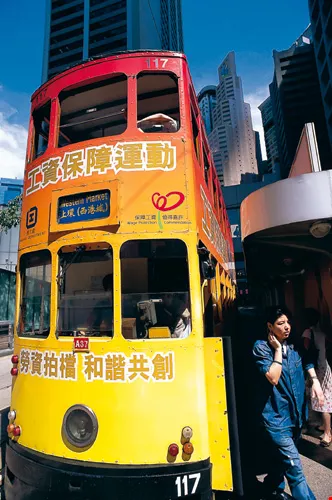
In Hong Kong, long a bastion of laissez-faire economic policies with few protections for workers, the income gap has soared along with the skyrocketing stock and property markets.
Politics and economics
In the ten years since the Union Jack was lowered in Hong Kong, the territory has been getting ever closer and ever more intimate with its new dance partner. Having transitioned from doubt to acceptance, the dancers have begun to step lively.
"The game turns on Hong Kong. If 'one country, two systems' succeeds there, it will have unparalleled propaganda value in Taiwan and in the rest of the world," says an observer familiar with the politics of Taiwan, Hong Kong and Macau. "Beijing can also use Hong Kong to counterbalance the influence of Shanghai."
Under China's current "vassal-state economy," local governments have a great deal of autonomy. The chief administrators of cities and provinces are appointed and removed based on their success in developing their economies and attracting new businesses. With China's rapid swing to the right and the focus everywhere turning to money, "Beijing sees Shanghai, where former president Jiang Zemin retains some power, as a major threat to its hegemony," continues this observer. "Consequently, when Hong Kong and Shanghai vie for position as financial centers, Beijing is more than happy to give Hong Kong a boost."
But how long will Hong Kong's wealthy and powerful new flame continue to dote on it? If Beijing's love wanes, where will Hong Kong find the energy to keep its economy moving? Recognizing what the score is, the people of Hong Kong are of two minds about the relationship.
"Take CEPA, for example. Hong Kong must realize that China will keep its promise to the WTO to gradually open its markets. That means that its pro-Hong-Kong bias will gradually fade," says Tam.
"More importantly, what are Hong Kong's defining characteristics?" asks Lin Yuh-jiun, who feels that relying on perks from China to push up revenues is risky. "If, for example, Taiwan and China were to restart negotiations and permit direct transportation links, Hong Kong would suffer the immediate loss of the more than 2 million visitors who transit through the territory every year."
"If you look at the big picture," says Tam, "Hong Kong's economic role has always been determined for it. From the days of British rule down to the present, it hasn't had the right to decide for itself." He notes that this is one of the principal characteristics of a colonial economy.
"Hong Kong would do well as a financial center, and it has what it takes," says Leung Man-tao, principal of Ngau Pang Sue Yuen (Cattle Depot College). "But in an ordinary society, if a city wanted to become a financial center, its citizens would be able to voice their opinions and discuss what sorts of structures needed to be put into place to address likely side effects, things like the expansion of the income gap, rising rents, and the squeezing out of businesses that depend upon reasonable rents."
"Sadly, Hong Kong hasn't yet been given the opportunity," says Leung. The excessive emphasis on Hong Kong's unique functions in the areas of finance, trade, transshipment, and tourism vis-a-vis the larger Chinese economy has sacrificed Hong Kong's economic independence and greatly sapped its economic health, and it has left out in the cold the many Hong Kong residents who are unable to make a place for themselves within this model.
Historically, colonialists have exploited their colonies' resources. "But Hong Kong provided Britain with no goods or materials," says political observer Nanfang Shuo. "Neither did Britain require Hong Kong to remit economic gains back to the UK. Instead, a different kind of economic benefit accrued to Hong Kong's British administration--it allowed many British-invested firms to put down deep roots in Hong Kong, such as the Swire Group (which controls Cathay Pacific Airways), and HSBC. Major corporations such as these grew strong in Hong Kong, creating jobs and contributing to the territory's prosperity."
On the eve of the tenth anniversary of Hong Kong's return, Lu Ping, a former head of the Hong Kong and Macau Affairs Office of the PRC State Council who was involved in the handover talks, recalled that the central government's pre-1997 attitude was that Hong Kong's stability depended on the capitalists. Placating these capitalists was therefore the overriding concern of their economic policy. "For both the British administration and the Chinese, the heart of the matter is that Hong Kong has always been controlled through its major businesses," says Leung Man-tao.
"With Asia's lowest taxes and its lack of worker protections, Hong Kong's 'can do' spirit fostered the myth that one needed only work hard to succeed," says Tam Chi-keung. According to Tam, the refugees from the mainland who came in those days probably weren't concerned about inequities; they simply wanted to take advantage of Hong Kong's 99 years of "borrowed time" to get wealthy. But would the people of Hong Kong be willing to accept the wealth inequities and overwhelmingly capitalist leanings of their society after their return to China, even given that the nominally socialist Chinese authorities had given the system their tacit approval?
"This is why democracy, the right to make your own decisions, is so important," says Leung Man-tao. "Hong Kong faces myriad environmental and social justice issues independent of questions of GDP, logistics or financial centers. We can't depend on Beijing to resolve them."
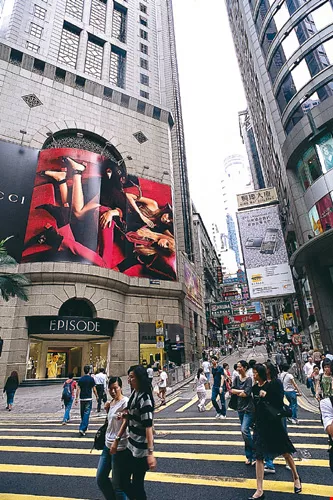
Shops and restaurants are everywhere in Asia's "global city," providing a never-ending feast for the eyes and the taste buds.
An M-shaped society
The view from Victoria Peak, which overlooks the impressive collection of skyscrapers flanking Victoria Harbor, has long been the pride of Hong Kong. But as the city's air quality has deteriorated, it's become hard to see the harbor even on a "clear" day.
Meanwhile, the territory's income gap has been expanding ever since the economy first took off in the 1970s. Hong Kong's Gini coefficient, already high in the 1970s, grew to 0.525 in 2001 and reached 0.56 in 2006. That figure is on a par with that of Uruguay and marks the territory as having one of the most unequal income distributions in the world.
Growth in income inequality indicates that the fruits of economic development are not being widely shared. Over the last ten years, Hong Kong's per-capita GDP has grown from US$27,055 to US$27,614. However, the number of Hong Kong residents earning less than HK$5,000 (US$650) per month has grown from 310,000 to 500,000 over the same period.
"Hong Kong is a paradise for the wealthy," says Leung, "and hell for the unsuccessful." Leung argues that people used to believe that if Li Ka Shing, a self-made billionaire and Asia's wealthiest man, could find riches in Hong Kong, they could too. But in recent times many have come to realize that wealth and poverty are often determined by social factors too powerful for individuals to overcome.
Hong Kong society may be stratified on the basis of income, but everyone suffers from degradation of the environment.
With property developers continually engaging in land reclamation projects to expand the city's concrete jungle, Hong Kong's population has grown by 700,000 since 1997 and currently stands at about 7 million. With Sha Tin, Tuen Mun and Tseung Kwan O already developed, Hong Kong has run out of places to locate the kind of new towns that can absorb hundreds of thousands of new residents. As urban buildings have grown ever taller and more densely packed, residential environments have become cramped, roads crowded, the air polluted, and firefighting difficult.
"When SARS struck, the people of Hong Kong became aware of some things they hadn't noticed before," says Lau Sai-leung, editor-in-chief of CUP magazine. Hong Kong's population had grown steadily after World War II, and public spaces had long accounted for less than 20% of urban land. Then the rapid growth of the last decade further reduced green space, worsening air quality and sowing the seeds of the SARS tragedy.
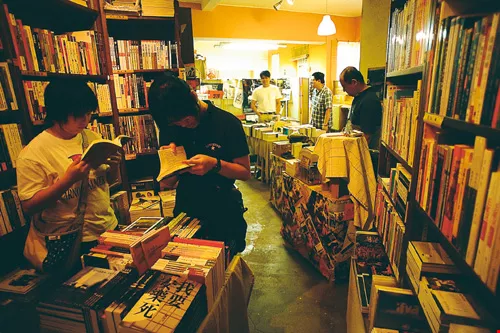
Causeway Bay's famous second-story Mackie Study bookstore mingles food and commerce on a tiny piece of pricey real estate.
Who am I?
While the celebrations were in full swing on the eve of the tenth anniversary of Hong Kong's return to China, the media busily dissected the Pearl of the Orient, analyzing its good and bad points and debating the mistakes and achievements of the preceding decade.
Those concerned with Hong Kong's future should give a survey published in April 2007 a very close look.
Among the questions the Public Opinion Program at the University of Hong Kong asked about Hong Kong people's identity was a very direct one--would residents have preferred to live as a pre-1997 colonial subject or as a post-1997 SAR citizen?
Of 1,007 residents who responded to the question, 41% chose the SAR, 22% expressed no preference, and 31% chose the colony. The figures indicate that more than half of Hong Kong's residents do not regard "SAR citizen" as their ideal identity, and that China's economic gift has not won over enough hearts and minds.
Moreover, while 275,000 of those who fled before 1997 have returned, more than 80% of people continue to hold passports from a second nation. For example, some 3.44 million have the British Nationality (Overseas) status that the British government offered to citizens of Hong Kong in the run-up to the 1997 handover, and about 1.5 million of these hold BNO passports.
"If you've got a passport and there's trouble, you can leave. It's no different post-1997 than pre. It just shows that the people of Hong Kong still haven't escaped their colonial mentality," says a critical Tam.

A Hong Kong of their own
Over the last ten years, have Hong Kong residents become Chinese just like those in the mainland? Or are they "SAR people," ambivalent about China? After 100 years caught between China and the West, the people of Hong Kong still identify themselves as different. Similarly, the mainlanders' deep-rooted impression of Hong Kong people as "unfriendly" and "unwilling to speak Mandarin" makes it hard for them to think of the latter as Chinese.
"You won't, for example, find mainlanders listing Hong Kong as one of China's top cities," says Leung Man-tao. Hong Kong is a unique region, especially in terms of its history. "It's so 'special' that the mainland has a hard time thinking of it as a Chinese city."
Back when Hong Kong was a jewel in the crown of the British empire, its glory reflected back on the queen. Today, as the prototype for the "one country, two systems" model of governance, its achievements are no less, but they burnish China's image. Over the years, Hong Kong has belonged to the world and to China. When will it belong to itself?
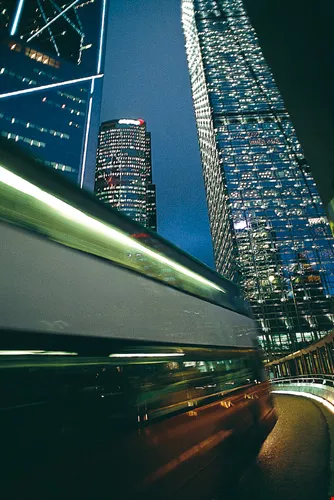
Shops and restaurants are everywhere in Asia's "global city," providing a never-ending feast for the eyes and the taste buds.
Learning to say no
All of the colonies taken since the Age of Discovery have now been granted their independence. All, that is, but Hong Kong. Instead, closed-door negotiations between Deng Xiaoping and Margaret Thatcher turned it into an experiment without historical precedent. Clearly, Hong Kong has a long way to go before it is truly "returned."
"Hong Kong's history is truly fascinating," says Choy. In spite of the fact that under British rule most of its citizenry were refugees from Communist China, that its educational system was run in English, and that its students studied world history in their schools, no one ever doubted their Chinese identity. As Jan Morris, author of Hong Kong: Epilogue to an Empire, has written: "Hong Kong has always been a Chinese city."
And yet, after returning to the embrace of the "mother country," the identity of Hong Kong's people has been thrown into doubt.
"A new awareness of everything from the disposition of economic roles to the course of colonial history has gotten Hong Kong thinking," says Hong Kong author Dung Kai-cheung, who has been awarded several literary prizes in Taiwan.
The growing cultural preservation movement of recent years is an outgrowth of this increased self-awareness. From the Kowloon Incident of 2003, the redevelopment proposal put forward by the residents of Lee Tung Street in Wan Chai in 2004, and the proposal to demolish Queen's Pier in 2005, to last year's decision to go ahead with the removal of the pier and expand the scope of land reclamation, activists seeking to preserve Hong Kong's historical culture have won some battles and lost others. But the mere fact that they have fought has attracted the attention of observers.
"When people demonstrated in Hong Kong in the past, it was generally in response to things that touched on them directly--salary or work issues," says Tam Chi-keung. "But these last few marches have been something new; they've been motivated by culture and awareness."
The upside of this is that having experienced the pains of 100 years of colonial status and of this first decade "under" China, the people of Hong Kong are finally starting to feel they've made it through the tough times and can begin to move forward. Possessed of this new peace of mind, they've begun exploring the question of how to make Hong Kong truly their own. After all, this beautiful island and peninsula should be something more than a place to earn money. It should, in fact, be a home filled with their memories of their own history and unique life experiences.
People in Hong Kong are hoping that this new Hong Kong, one that has its own culture, that treasures its freedoms and looks forward to a future democracy and greater autonomy, can gradually coming into being.
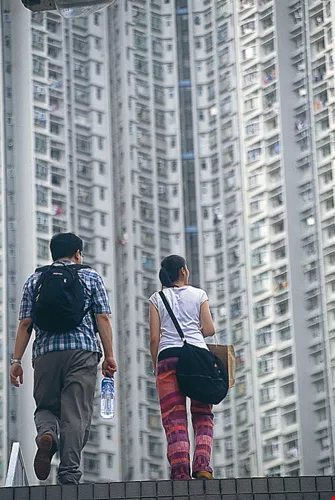
Scenes from outside of Central: Public housing estates awaiting demolition in Sham Shui Po; Looking down from Ngong Ping 360 cable car system, which opened last September, you can see the newly developed Tung Chung (below).
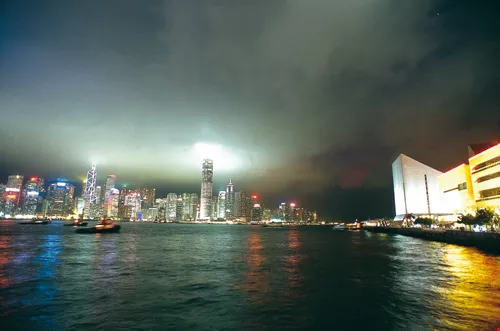
Having overcome SARS and the East Asian Financial Crisis, Hong Kong is riding high again. Over the last few years, its economy has sparkled like the lights on Victoria Harbor. But it is significant that in a poll of Hong Kong residents, only 41% of respondents declared themselves happy to be "SAR citizens."
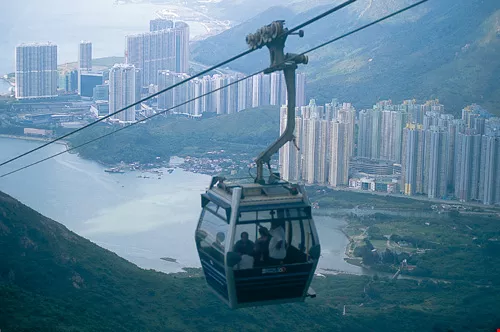
Scenes from outside of Central: Public housing estates awaiting demolition in Sham Shui Po; Looking down from Ngong Ping 360 cable car system, which opened last September, you can see the newly developed Tung Chung (below).
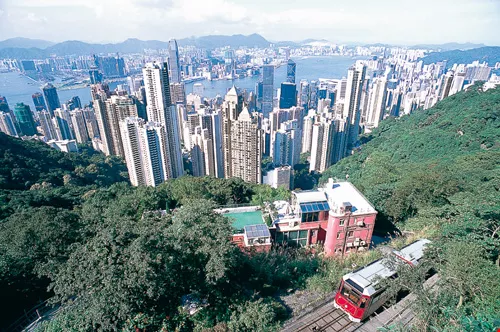
The skyscrapers arrayed beneath Victoria Peak are the pride of Hong Kong. They are also indicative of the rampant overdevelopment of this city, the most densely populated on Earth.
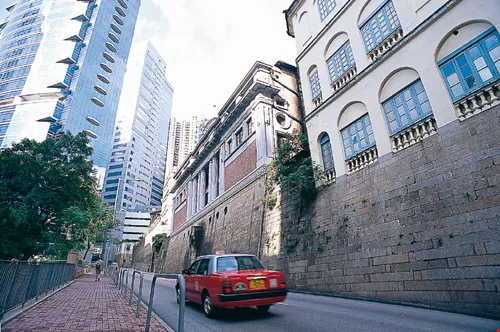
In a major victory for those trying to protect Hong Kong's collective memory, activists were able to preserve Victoria Prison (right), where Sun Yat-sen is rumored to have been jailed for a time.
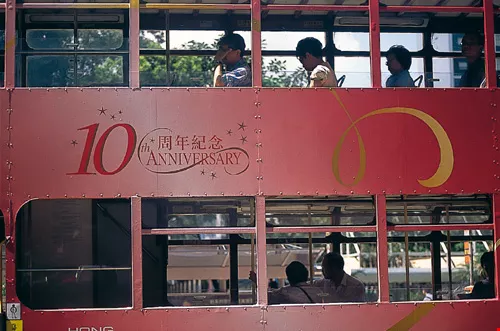
The posters everywhere add to the festive atmosphere on the eve of the tenth anniversary of Hong Kong's return to China.

@List.jpg?w=522&h=410&mode=crop&format=webp&quality=80)
@List.jpg?w=522&h=410&mode=crop&format=webp&quality=80)


