Black Bridge Sausages
Two Generations of Flavor
Kobe Chen / photos Chin Hung-hao / tr. by Geoff Hegarty and Sophia Chen
May 2013


It’s in the nature of things. Where there’s pork, there are usually sausages. And in fact the humble sausage is perhaps the one processed food that is known and loved in both Western and Eastern cultures.
In Europe, sausage-making can be traced back to 8th-century-BC Gaul. And sausages have long been identified with German popular cuisine, which boasts at least 1,500 different types and flavors of Wurst.
Back in Taiwan, the Black Bridge brand has become synonymous with the word “sausage.” And not only for local Taiwanese—they’re also a favorite of international tourists. So popular, in fact, are the Black Bridge products that in September 2012 the company established Taiwan’s first sausage museum, in Tainan. With 100,000 visitors in its brief existence to date, it has become a “must visit” in the region.
What are the particular charms of Black Bridge sausages? Let’s look into the history of the enterprise and see how the company’s founder and his son have worked for over a half century to create the unique Taiwanese flavor of their product.
Located in Tainan’s Anping Industrial Park, with an area of 1300 square meters, Black Bridge’s sausage museum is only the second sausage museum in the world (the other is in Germany).
Outside the main glass doors, an old pedicab stands quietly. An old-fashioned charcoal grill and a bowl with three dice sit on the tray of the cab. Here there is nostalgia for many: childhood memories of throwing dice to win a sausage, pausing by the roadside with one’s father for a little fun.
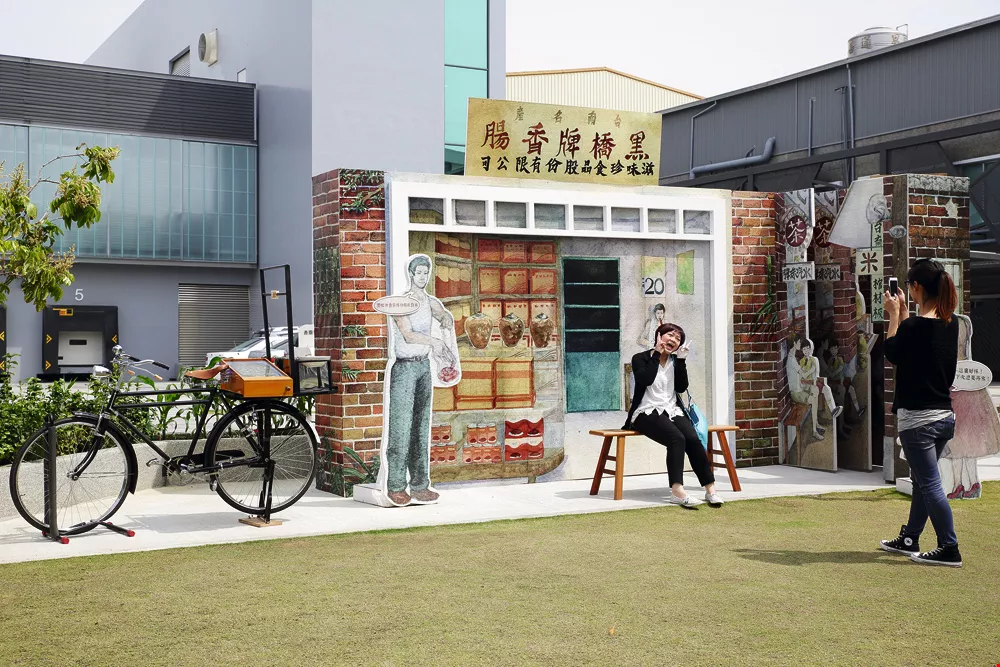
While Black Bridge has created a new look with its open factory, at the same time it retains a strong feeling of nostalgia, making a great subject for tourists’ photos.
Food is not only an essential of life—it is also an important part of the culture. The warmth of the Taiwanese community comes to life amidst the aroma of grilling sausages. So it was important to commemorate the late founder of Black Bridge, Chen Wenhui, and to promote the culture of sausages. Established more than half a century ago, Black Bridge spent NT$50 million building a sausage museum next door to its factory in the Anping Industrial Park, with the primary goal of encouraging people to learn more about the history of the sausage in Taiwanese culture.
Black Bridge’s first store is recreated in the history section of the museum. Then there is a replica of the founder Chen’s original kitchen, showing the kind of stoves and cookware used in the early days of the company. One can sense the hardships of the early times, making sausages by hand.
But the centerpiece of the museum must be the sausage culture exhibition, where visitors can see specialty sausages from around the world: German Weisswurst (white sausages) and frankfurters, and boudin noir (blood sausages) from France.
A sausage is usually made from minced ingredients (usually meat) with added salt and spices, all held within the classic sausage shape by an outer skin. Different combinations of fillings determine the flavor and texture: Taiwanese-style sausages, American hot dogs, and Italian salami all belong to the sausage family.
In terms of flavor and texture, while German sausages tend to be rather somewhat brittle to the bite, Cantonese-style sausages (lap chang) are known for their dry and savory taste. And each unique style has its supporters. Black Bridge’s general manager, 47-year-old Robert Chen, says that the genuine Taiwanese article features a firm texture in which you can see and taste the juicy pieces of real pork with sweet and savory seasoning, with the customary accompaniment of sliced raw garlic—that’s the standard Taiwanese sausage flavor!
With an annual revenue of over NT$1 billion, Black Bridge produces 100 million sausages a year, using more than 3000 metric tons of pork in the process. With a 56-year history behind it, Black Bridge has overcome many obstacles on its way to success over its lifetime.
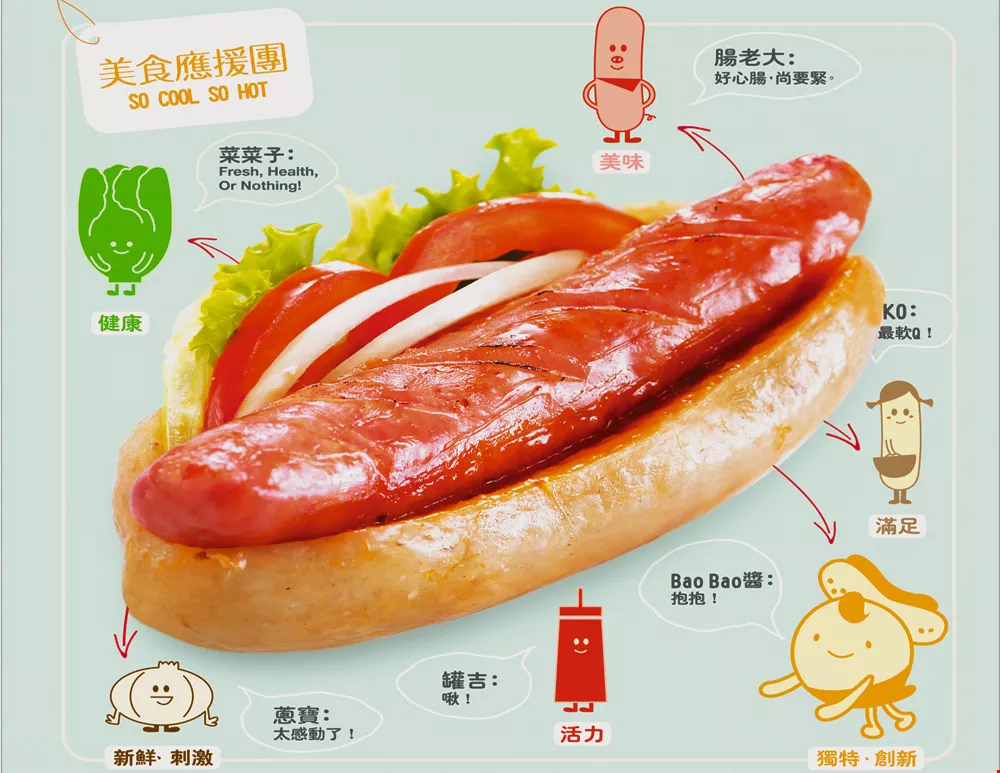
The Taiwan Hugdog, with its appealing flavor, has transformed the image of the greasy old pork sausage wrapped in a sticky rice roll, winning over the taste buds of a new generation.
Company founder Chen Wenhui came from a humble family background. After completing his military service, he began selling sausages from a stall near the Black Bridge over the Tainan Canal.
Meat was something of a luxury in the 1950s. As a method of preserving meat, butchers often minced leftover pork with added salt to make into sausages. But sausages weren’t considered serious food: they were often either too dry and hard, or overly greasy and salty—and not very tasty.
But Chen had different ideas. He would go to his local butcher early every morning to pick out the freshest pork hindquarters, and then add a little sugar and some Chinese medicinal herbs into a seasoning for his sausages. This new style of sausage, which retained pieces of juicy pork to create a nice firm texture, became an overnight sensation in his home city of Tainan.
In 1963, Chen opened his first outlet under the Black Bridge banner in Tainan’s bustling Sakariba market (now Hai’an Road), and the aromatic tale of Black Bridge has unfolded over the ensuing half century.
From the 1970s, when Taiwan’s economy really took off, Black Bridge gradually expanded, with new outlets launched in Kaohsiung and Taipei.
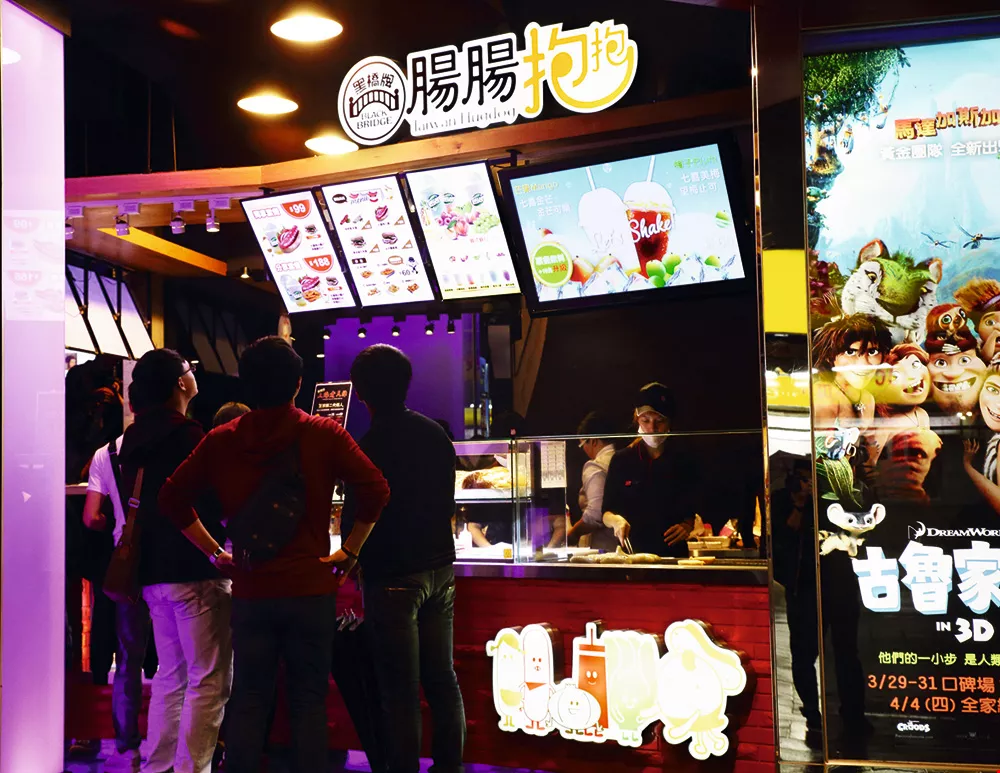
The Taiwan Hugdog, with its appealing flavor, has transformed the image of the greasy old pork sausage wrapped in a sticky rice roll, winning over the taste buds of a new generation.
During this period of rapid growth, Chen also started to think about issues of managerial succession and the long-term sustainability of the enterprise.
The founder’s son, Robert Chen, joined the family business at the grassroots level after completing his military service. He had to get up at four every morning to start work, going to the market to select the pork, making pork floss (a sort of light, fluffy dried pork product), and making sausages, as well as manning the storefront and keeping the books. Not only was the work arduous, but he also had to deal with his father’s very stringent ideas about how the business should be run.
“My father once actually threw me out of the factory,” recalls Chen. He was pan-drying pork floss, admittedly being a little lazy and not doing the work properly. His father saw what was happening and roared at him: “If you’re going to do the work, you must do it right. Otherwise get out!” The son was unceremoniously thrown out in front of all the other workers. Later, he mustered the courage to apologize to his father and ask for forgiveness.
Black Bridge sausages use only prime pork: the hindquarters of pigs of 110–120 centimeters in length, marinated for at least 12 hours. During the automated production process, the texture of the minced meat is carefully monitored so that the finished product approaches the quality of handmade sausages. The company’s strict pork selection criteria and the exclusive recipe distinguish Black Bridge sausages from other brands. Aficionados recognize the flavor at the first bite.
In 2009, at age 44, the younger Chen took over from his father as general manager, and with his ambition and vision has set out to revamp the old brand, while maintaining all the qualities that have made the company what it is.
With his grassroots experience in the company, Chen well understood the company’s old image and ways of operating—but he had plans for something new. In the 1990s, he had proposed dismantling the old strategy of running their own dedicated retail outlets. To better suit modern consumption styles, the company expanded its distribution channels into supermarkets, growing from 25 outlets to more than 2,000 distribution points. Black Bridge sausages are now even available at KTVs if anyone cares for a snack between songs.
He also noticed the popularity of ham, and the fact that hot dogs were as well-liked as Taiwanese-style sausages (particularly amongst the young), so he created the company’s second brand: Bolker STR, selling imported Western-style premium meat. The range targets the high end of the market—perfect for the Taipei 101 supermarket where the brand was launched—thus bringing greater diversity to the company’s product mix.
In 2010, Chen invited former Taiwanese entertainer Fong Fei-fei (known as the “Queen of Hats”) to become the face of the company. Fong had retired to Hong Kong years before, and in fact endorsing Black Bridge was the only advertising work she took on in the 20 years following her retirement, and also the last before she passed away in 2012.
Black Bridge launched a takeaway food business in 2012, introducing another new brand: the Taiwan Hugdog, a pork sausage served with lettuce and specially made sauce wrapped in either a larger sticky rice roll, or French bread like a submarine sandwich. The Hugdog outlet in the Ximending shopping district always attracts large queues as a favorite snack for moviegoers.
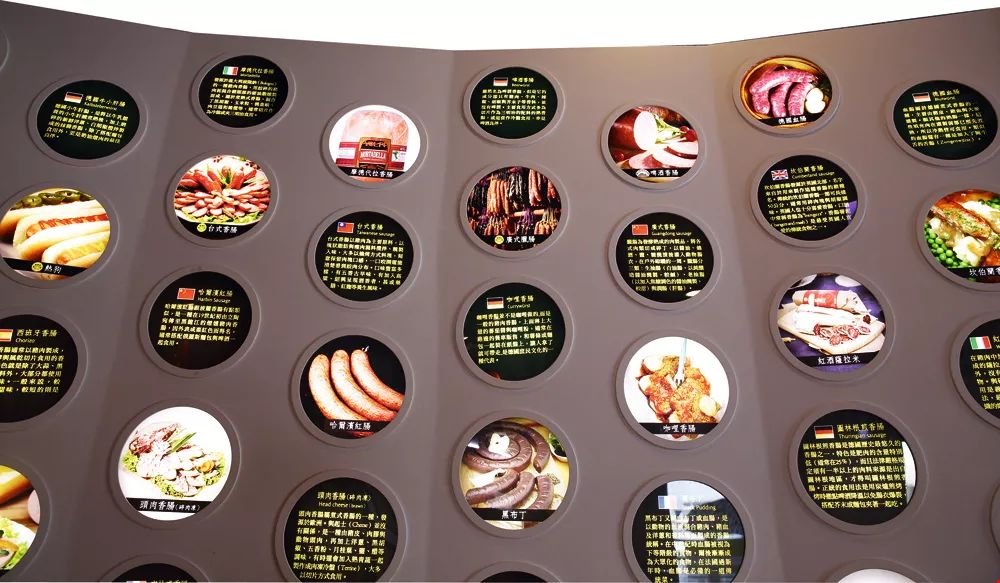
Black Bridge sausages (above) taste slightly sweet, with a unique Taiwanese flavor. The company’s sausage museum (below) introduces many varieties of sausage from around the world, really opening visitors’ eyes to the world of sausages.
But no matter how Black Bridge may change, the company always maintains its philosophy of sausages “with heart.”
Black Bridge insists on using CAS-certified domestic fresh pork. With their efficient supply chain to ensure freshness, minimal use of artificial additives, and no fillers or preservatives, the firm is able to maintain the original pork flavor.
The Black Bridge factory has gained the highest level of international food safety certification, including HACCP and ISO 22000. In recent years, food safety has become a major global concern, with recent incidents including diseased pigs, outbreaks of foot-and-mouth disease, and the use of the feed additive ractopamine in pork production—all of which has damaged consumer confidence in pork products.
“This series of crises has actually meant opportunities for us.” Surprisingly, Chen says that when the 1996 foot-and-mouth outbreak was under way in Taiwan, although initially the company’s performance was hit severely, it gradually stabilized and then gained significant growth in less than six months. This amazing performance demonstrated well the strength of the Black Bridge brand.
Chen explains that whenever there’s an outbreak of anything that threatens the safety of meat products, consumers tend to stick with major brands that they trust. As a consequence, the lower-quality manufacturers have gradually been eliminated, and naturally the performance of the major players has increased. There was a time when he didn’t understand why his father insisted on putting so much emphasis on good production processes—until the outbreak of foot-and-mouth disease. Then it all became clear.
Someone once said: “Laws are like sausages: it is better not to see them being made.” Sausage making is not always a pretty process. Most people would feel extremely queasy having to squash minced meat into a pig’s large intestine—not to mention the sometimes overpowering smell of many meat processing plants. Most people would want nothing to do with any of it!
But when tourists have the opportunity to visit Black Bridge’s open factory, they are surprised to see its highly modern atmosphere: all the workers wear caps, masks, and antibacterial overalls; the environment is bright, clean, and odor-free; and there are many strict quality-control procedures—the hygiene is as good as in any hi-tech environment.
Black Bridge’s open factory and the company-run museum demonstrate to visitors their devotion to their product. After gaining international food safety certification, Black Bridge’s next step is to expand its business internationally. The first overseas outlet is to be launched in Hong Kong in May, an initial step in bringing the unique flavor of Taiwan sausages to the world.
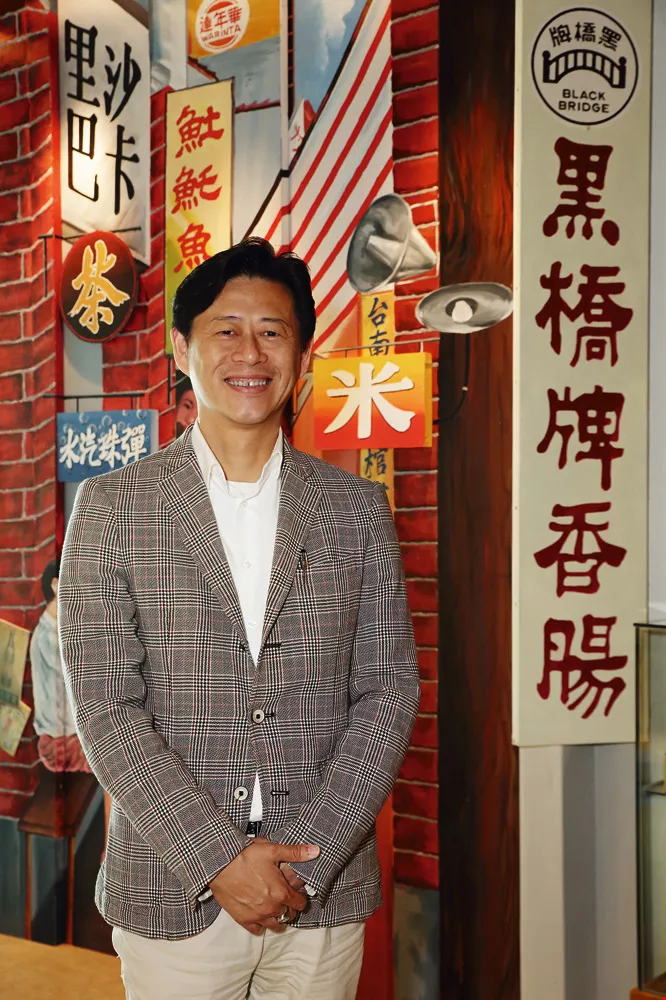
Black Bridge general manager Robert Chen is steering the 56-year-old brand through its transformation.

@List.jpg?w=522&h=410&mode=crop&format=webp&quality=80)

@List.jpg?w=522&h=410&mode=crop&format=webp&quality=80)


