Korean Drama FeverTaking a Cu(r)e from the Competition
Chang Chiung-fang / tr. by Geoff Hegarty and Sophia Chen
October 2011


South-Korean-produced TV dramas have become all the rage in Taiwan over the past decade. Local television broadcasts a large number of soap operas from Korea, which many say tends to reduce the work available for Taiwan's own production houses. Meanwhile, the public clearly enjoys the exotic nature of the Korean product, with fans sometimes learning the language or actually visiting the country. Some even become quite seriously addicted.
What makes Korean dramas so attractive, and how serious is their impact upon the homegrown industry?
In the early days of Korean imports, they were achieving TV audience ratings of around five to six percent, but this figure has been gradually falling. Even recent Korean dramas such as Secret Garden and You're Beautiful are rating below 1% on local networks. So is the novelty of Korean drama wearing off?
The fact is that the number of Korean dramas broadcast on Taiwan television is still prodigious. Lai Congbi, deputy general manager of the Planning Department at Gala Television (GTV), says that there are only about 50 idol dramas produced each year by the local industry, whereas in 2010 a total of 162 Korean productions were broadcast on local TV and the Multimedia on Demand digital channels of Chunghwa Telecom. And 120 were broadcast in the first half of 2011, an average of 20 per month.
And with the easy availability of Internet downloads, audiences no longer need to sit in front of a TV to watch programs at the time they're broadcast. They can see them online at any convenient time for free, with the added advantage of not having to sit through advertising. So it's probably truer to say that audience numbers are not falling; people now simply have a range of options for watching their favorite Korean dramas.
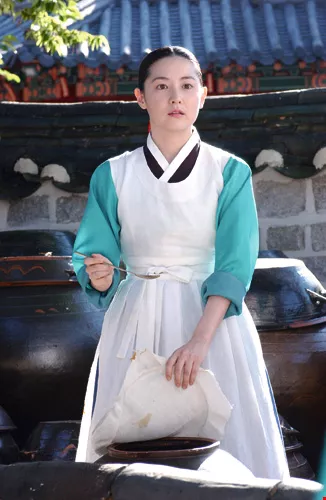
Lee Young Ae is leading actress in the Korean court drama Dae Jang Geum. After a successful initial run in Korea with massive ratings of around 50%, the show gained enormous popularity across Asia.
"Korean soaps have really changed some people's lives," complains a typical mother-in-law. She tells the story of her son's wife, who has become a "couch potato," sitting in front of her computer watching Korean dramas the whole day long on weekends or holidays, and neglecting her two toddlers. She hasn't tried to cure her addiction despite a number of discussions and understandings that she would do so. Even when her computer failed and produced only pictures without sound, she stayed put.
Wang Lanying, a single woman, loves the unrealistic plots of soap operas, and says that "the more fantastic are the romances, the more attractive they are." She once watched the Secret Garden online late into the wee hours every night over a period of several days. And even if she has already watched a program online, she will probably watch it again when it's shown on TV.
PopularityWhy is the Korean product so attractive?
"The plots of Korean dramas are full of possibilities, and the actors put a lot of depth into their performances," says Ms. Lin, who has experience writing screenplays for idol dramas. The stories can go anywhere, and that's an attractive quality.
"Life is Beautiful is my benchmark favorite drama," says Lin. Although seemingly little more than a marketing ploy for the holiday resort of Jeju Island, the audience accepts it as a genuine drama. "Screenwriter Kim Soo Hyun is really excellent." The 14 characters that Kim created for the drama all appear briefly in the first episode, and sometimes through just one spoken phrase, help the audience understand the personalities and relationships of the characters they will be getting to know as the drama progresses. And the plot is not too melodramatic.
Indeed, the screenplay is the secret soul of a successful TV series.
"Korean screenwriters enjoy a high profile," says a senior Taiwanese writer. They're paid better than the leading actors, and they even enjoy the right to decide who plays which role. One experienced Korean actor says that although he's been in the business for some 30 years, he still gets frightened of the screenwriter's eyes in script-reading sessions.
When Taiwan TV stations buy Korean dramas, they not only look at the cast, but more importantly they want to know who the screenwriters are. Fang Ko-jen, manager of the Planning Department at GTV, says that screenplays written by the Hong sisters are usually interesting and original, and are almost a guarantee of good ratings.
Kuan Chung-hsiang, associate professor in the Department of Communication, National Chung Cheng University, notes that Korean series use similar formulas to those from Taiwan: plots that rehash relationship issues such as those between mother-in-law and daughter-in-law, love affairs, and the spectacle of wealthy people fighting for power. However, compared to Taiwanese dramas, the Korean versions are usually more instinctive and closer to everyday life, and the characters much more diverse. "Taiwan's male actors are traditionally quite masculine on-screen, but Korean men are less so; some have even been known to cry on screen."
Television dramas all have unique local characteristics that reflect their place of origin, but Korean shows have won wider popularity by using universal themes such as love, the struggle for power and women's rights. The courtroom drama Dae Jang Geum, for example, though filled with many Korean judicial and medical terms unfamiliar to Taiwan audiences, was nonetheless widely accepted.
"The Korean emphasis on the day-to-day lives of ordinary people and their use of poignant discourse are lessons worth learning for Taiwan's screenwriters," says Sharon Mao, who adapted the screenplays of Meteor Garden and Devil Beside You from popular Japanese comics. Because these shows have been such successes, the network is constantly trying to persuade her to write a sequel to Devil Beside You, but Mao would prefer to concentrate on more original works, such as her Why Why Love and the forthcoming Ring Ring Bell. But Mao admits that in order to make the very tight deadlines, Taiwan's idol drama screenplays are often created by teams of several writers working together, so it's often difficult to distinguish one writer's personal style from others.
The peopleBut an interesting screenplay is only the beginning: a successful drama also needs good actors.
Vivian Chang, vice president of the Department of Marketing and Public Relations at Sanlih Entertainment Television (SET), points out that most film and television actors in Korea and Japan have some professional training under their belts. "Korean actors must undertake comprehensive theater training before they become professional, whereas in Taiwan, new performers are just thrown into the marketplace with the attitude of, 'well, let's see what happens now.'"
Ranked as the highest revenue earner of Taiwan's TV networks, SET has been actively producing TV drama since its inception. Local Taiwanese program Fiery Thunderbolt and the idol drama Fated to Love You, both produced by SET, have achieved record audience ratings at 15.72 and 9.3 respectively.
"SET produces all its TV dramas independently, and is well aware of the importance of training for its people," says Chang. In order to improve professional development, SET is cooperating with the television industry, government and academia to set up a training program to serve as a link between the academic world and the industry: a training ground for new talent. So far the studio has held three screenplay training programs, and eight selection panels for actors. Even if the personnel trained in their studios are later employed by other networks, it is still worth doing. "If we don't train people today, we won't have enough professionals for the future."
The impact of Korean dramas seems to have had more far-reaching effects on the local scene than might be imagined.

@List.jpg?w=522&h=410&mode=crop&format=webp&quality=80)

@List.jpg?w=522&h=410&mode=crop&format=webp&quality=80)


