NTUT: An Oasis in the Urban Jungle
Coral Lee / photos Hsueh Chi-kuang / tr. by Chris Nelson
January 2012


My mind is there, my body’s here; All the fish begin to dream.
They dream of sweetly rushing waters; They dream of the moon beneath the water.
My mind is there, my body’s here; All the trees begin to dream.
They dream of humming cicadas in the distance, they dream of birds; They dream of green mountains.
—Wu Huayang, NTUT
Babbling brooks, chirping birds and buzzing insects... in the middle of a traffic-snarled metropolis? Is it even possible? This dream has become reality at the National Taipei University of Technology, in the busy heart of Taipei!
As the pedestrian passes by the main gate of NTUT on Zhongxiao East Road Section 2, his hurried pace instinctively slows down. Scenes of monotonous concrete walls shift to a lush little wilderness. On Xinsheng South Road, just around the corner from Exit 4 of the Zhongxiao Xinsheng MRT station, pretty log benches aside a little creek accompany the luxuriant foliage, beckoning us to take a quick break, or stop and delight in the eight-story-high steel tree at NTUT’s side entrance, green-leafed plants poking out from within.
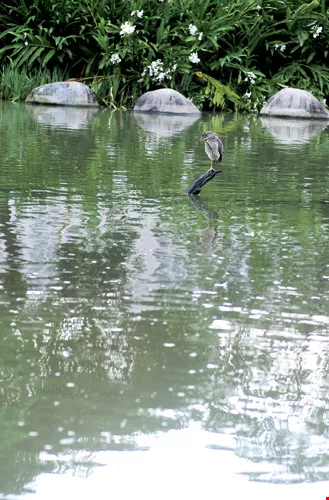
How can such a lush green natural ecosystem have been built on the 9.3-hectare campus of NTUT, sitting amid the urban jungle?
Tsai Jen-hui, dean of the College of Design, says that the eco-campus concept can be traced back 30 years. At that time, the school planted climbing vines on the walls of three buildings along Xinsheng South Road and purchased large quantities of stone to install ponds in the corners of the campus in order to beautify the place. Thereafter, more improvement plans came to the fore. The original concrete pavement in an empty lot in front of an L-shaped Japanese-built classroom building often collected water, but after being paved with red brick and sand, it no longer floods. Many years later, the ground is covered with moss, with stone tables to the side and shade overhead, giving it a leisurely old-time feel. Another shady space was repurposed by design students, and made into a fern garden.
At that time, the concept of sustainable environment was not fully understood in Taiwan, meaning that there were many ideas that had to be communicated.
For instance, the branches of a bishopwood tree were once allowed to slowly spread out behind a stretch of semi-open wall. But later, groundskeepers sawed the branches off, fearing students might hit their heads. Tsai did his utmost to save one obstructing bishopwood that the school was considering chopping down; however, several days later it was replaced with a “more beautiful” banyan tree, going completely against the original intent of preservation.
The subject of sustainability gradually came to the fore after 2000. Tsai filed applications to the Architecture and Building Research Institute, the Ministry of Education’s Sustainable Campus program, and the Construction and Planning Agency for funding, leading students in the completion of design plans for permeable pavement, rainwater storage, the Eco-Balcony, the Eco-Stream, the Green Building, and the Green Gate.
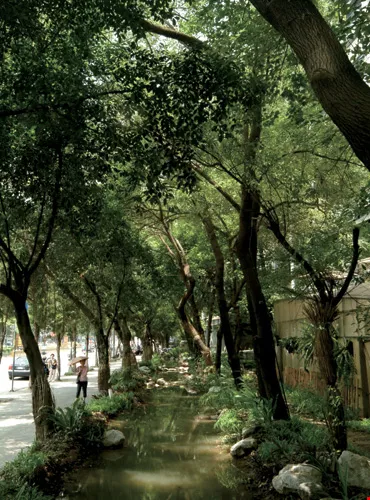
The stream flowing around the NTUT campus is a key element in creating a small ecosystem in an urban setting. It has taken several years for nature to take over, so that the water, soil, sunshine and plantings can reach an ecological balance.
Among these plans, the most representative and most difficult was the Eco-Stream encircling the campus.
“I spent four years convincing the university president,” says Tsai. To create a mini ecosystem in the city, there need to be streams for the flora and fauna to propagate naturally; also, for the eco-campus to connect with the community and city, it would be best to tear down the walls and replace them with a stream surrounding the campus.
Ground was broken in 2005 for the Zhongxiao East Road section of the stream. The next challenge was how to build a diverse environment so that a variety of plants and animals can live within it in a complex dynamic balance, achieving the ideal goal in which no human interference is needed for maintenance.
A healthy aquatic environment needs meanders, deep and shallow areas, slow and rapid flows, and nooks of different sizes; the land next to the water needs thick grass for insects to hide in. There also need to be undisturbed wild areas for animal life to lay eggs in. For other diverse factors such as sunshine, shade, wind direction and planting, there are numerous and complex factors to be taken into account. It’s comforting to know that since the stream’s completion in 2006, nature has taken control, achieving a certain dynamic balance.
At present the Eco-Stream encompasses half of the campus, stretching one kilometer. Its water source is rainwater, which comes from the permeable pavement on campus. Permeable bricks began to be installed seven or eight years ago, and now 90% of the surface of the campus is covered with permeable, breathable pavement. Rainwater soaks down and is collected underground, then seeps into an eco-reservoir next to the Green Building, from which it flows into the Eco-Stream. When a scorching sun is in the sky, underground water evaporates through cracks in the pavement, carrying away large amounts of heat, and thus lowering the temperature. Measurements show that in summer, the temperature difference between the surfaces of the permeable and impermeable pavements can be as great as seven or eight degrees Celcius.
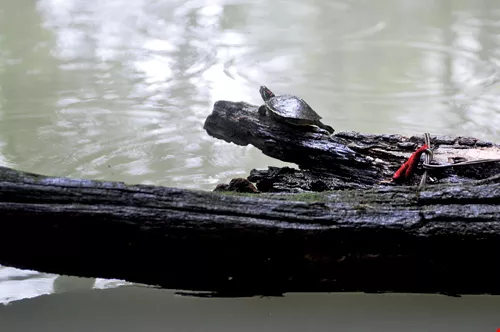
The roofs of the school buildings are hidden spaces that most people don’t even see. The Eco-Balcony, located on the roof of Design Hall, is lush with silvergrass and a variety of shrubs, offering a place for birds to use.
“Before humans arrived in this area, the land belonged to the birds. Now we just give them a portion of the rooftops,” says Tsai. As long as the water collection layer is done well, it can retain water. After planting several native plant species, we let nature run its course. If all the roofs of Taipei’s buildings could be redesigned into eco-balconies, an ecosystem once obstructed by city streets and buildings could be given once again to birds, butterflies and bugs, forming “stepping stones” that provide city birds with way-stations for roosting and breeding.
But the city is, after all, a space for human activity, so integrating residential spaces with nature and reducing the burden on the environment is a key issue for a sustainable city. NTUT’s Green Building is a project that architecture students took part in creating. This beautiful 132-square-meter, north-facing structure is built with insulating cavity walls and a 22.5º slanted roof so that the south wind, when blowing on the eaves, creates higher pressure above and lower pressure below. This means that air blows inside when the windows are open, providing natural air circulation. Beneath the high-framed house there’s also a wind corridor. The large glass windows at the front and back integrate the greenery outside the building with the interior, and with sufficient natural light entering, there’s practically no need to turn on the lights. The decorations are also mostly made of recycled glass and other materials.
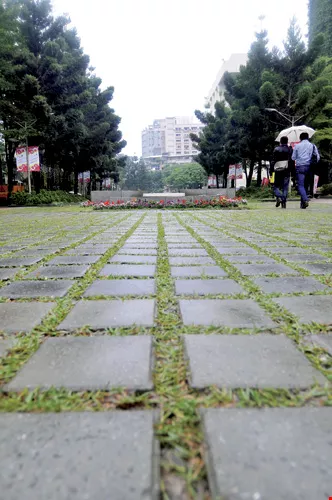
Permeable bricks in urban areas allow rainwater to seep into the soil, to sustain microorganisms. This also helps reduce the heat island effect. The bricks’ quality has improved so much in recent years that they can withstand large vehicles.
The Green Gate, winner of the Taipei Urban Landscape Award, has definitely become an NTUT landmark. The two colossal trees appear to be steel frames, but they’re actually built of fiberglass. Troughs in the gaps are filled with light soil, and there’s also a watering system, so the vines have a source of nutrients and water.
Tsai says given the great exposure of this area where the MRT exit and the school’s main entrance are, he hopes to link it to electronics mecca Guanghua Market one day, building it into Taipei’s answer to Tokyo’s Akihabara district.
The next step in the eco-campus project is to join up the main watercourse on the southeast side of the campus. Beneath Ningxin Park, to the east, is a branch of the Liugongzun, Old Taipei’s principal irrigation channel. Since it currently serves as an aqueduct for Taipei’s water runoff, leading into the sea, the water quality conforms to discharge standards.
He wants to “daylight” this 2-km branch of the Liugongzun, linking it to the school’s stream system so that it surrounds the campus, to bring canal water into the Eco-Stream, adding more vigor to the ecosystem.
Says Chiang Che-ming, professor of architecture at National Cheng Kung University and promoter of the Ministry of Education’s Sustainable Campus program, it has been quite difficult for NTUT to transform existing old school buildings into an eco-campus, because restoration is far harder than building from scratch. But since NTUT’s campus atmosphere can give people the chance to unconsciously experience the relationship between the self and the environment, it’s an ideal demo for teaching urban sustainability.
If you’re ever passing by Zhongxiao Xinsheng MRT station amid this prime area of Taipei real estate, why not stop for a spell and take a look around this small, pretty campus, and enjoy this magnificent bit of greenery in the midst of the concrete city?
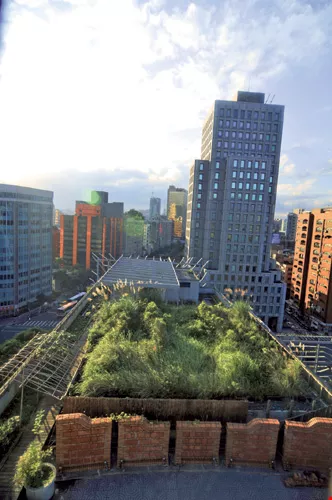
The Eco-Balcony concept reserves urban roof spaces for birds, butterflies and bugs. It’s hoped that more roofs of city buildings can developed in this way, becoming eco-stepping-stones.
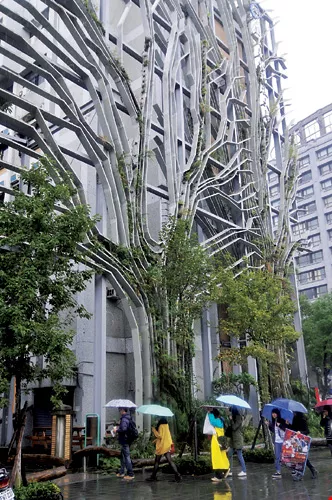
NTUT’s Green Gate, outside the MRT exit, is made of fiberglass. It contains light soil and a watering system; the plants peeking out of it add beauty to the street scene.

@List.jpg?w=522&h=410&mode=crop&format=webp&quality=80)

@List.jpg?w=522&h=410&mode=crop&format=webp&quality=80)

@List.jpg?w=522&h=410&mode=crop&format=webp&quality=80)
@List.jpg?w=522&h=410&mode=crop&format=webp&quality=80)

