

“If I’m not in a café, then I’m on my way to one.” So said Austrian poet Peter Altenberg, and his words echo deep in the heart of contemporary Taiwanese culture.
Taiwanese love coffee and they love running cafés. Taipei alone has an estimated 1000-plus places where a person can perk up, possibly making it one of the most coffee-shop-dense cities in the world. Flung throughout the streets and alleys, these places are a home away from home, a place to enjoy a latte and tiramisu while getting together with friends, reading, surfing the net, or just staring off into space.
Though some prominent individuals are incredulous to learn that many of Taiwan’s young people harbor no ambition greater than to run their own café, as author Lulu Han points out, “There may not be any money in running a coffee shop, but the motivation for such an enterprise isn’t money at all, but rather the pursuit of a lifestyle.” If a place like the Café Astoria nurtured folks like author Huang Chun-ming and poet Chou Meng-tieh back in the 1960s, then we can say that the café is a prism reflecting Taiwan’s creativity and its independent, democratic spirit.
Journalists visiting from mainland China have been struck by the singularity of Taiwanese café culture within the context of the Chinese world. Each establishment has its own unique identity, perhaps resultant of the customer demand, or then again perhaps a reflection of the personality of the respective proprietors. This teeming world of cafés is a kaleidoscope revealing Taiwan in all its multihued glory—just throw open the door and follow the fragrance into the heart of the unique cityscape.
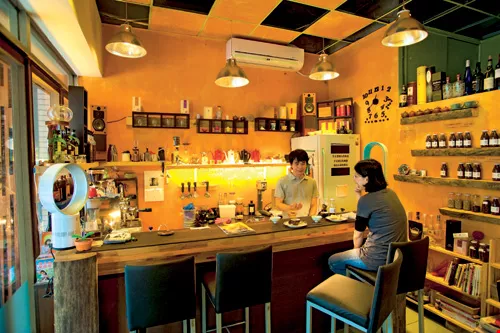
Taking charge of bean selection and roasting is a way to for an independent café to assert a unique identity. Here we see an establishment that specializes in light, acidic blends—Coffee Yeh in Fengyuan, Taichung County.
Established in 2000, Haaya’s Coffee is a pioneer in Taiwanese fine coffee. Owner Izuru Mikami, whose wife is Taiwanese, was previously in the food supply business, a background that enabled him to fully grasp the connection between quality raw beans and quality coffee. His search for the perfect beans involves flying out on scouting expeditions to coffee-growing regions in Africa, South America, and Indonesia. If a particular estate scores at least 80–85 out of 100 on a battery of taste and cupping tests for aroma, acidity, and flavor, and if its farming practices are consistent with the principles of sustainable development, then he attempts to secure a contract to import them to his operations in Taiwan.
“I can vouch for the quality of my coffee!” says Mikami, thumping his chest. His quest to brew superior coffee involved mastering all of the fundamentals from the ground up. In 2007, he became the first person in Taiwan to be accredited as a professional cupper by an international coffee sanctioning body.
Haaya’s Coffee has two Taipei locations, one in the business district on Dunhua North Road and the other in a residential neighborhood in Tianmu. In terms of décor, both stores are models of Japanese elegant simplicity, clean and well lit, with unfinished wood furniture and a traditional Washitsu room, which customers can only enter after removing footwear, adjacent to the bar. The coffee cups, made from fine bone china, further enhance the refined aura. As for the coffee itself, they roast their own beans to create three blends that range from dark and robust to light and acidic.
Coffee Only started out as a small place on Xing’an Street in 2003, but later moved to an alley off of Xinsheng South Road in the environs of Da’an Park. Proprietor and bean-roaster-in-chief Graham Liao has mid-length hair that is streaked with gray. He began his professional life in a very different setting, having earned his undergraduate degree in engineering from National Tsing Hua University and an MBA from an American university. But at age 35, determined to live his life without regrets, he left his job in the software industry to launch his own business.
“I’ll never forget the amazing sensation of eating black-coffee-flavored popsicle out of my older cousin’s freezer when I was nine years old!” says Liao, recounting the beginning of his lifelong affair with coffee. As a college student he was a frequent patron of Nan Mei Coffee in Ximending. He would also practice siphon-brewing coffee on his own, even staying up all night on one occasion after he brewed 16 cups in a row.
In the early stages of business, Coffee Only was strapped for cash. With only a trickle of customers, Liao and his business partners had plenty of time to perfect their roasting technique, the byproduct of which was over 100 kilograms of wasted beans. In 2005, they even shut their doors for three days as they toiled relentlessly to create the perfect blend to satisfy Liao’s demanding muse.
In terms of ambience, Coffee Only evokes a European warmth. Hanging lights spread soft yellow light on bead curtains, nut-brown wooden tables, and sofas. A menu thick from all the different options is highlighted by the so-called “V21,” a blending of seven highly distinctive estate beans that took 21 consecutive attempts to create, hence the name. The menu discloses the origins of each blend, provides information about its taste and texture, and as a bonus, appends the story of each concoction’s genesis.
That servers prepare the coffee for patrons at their table is a classy, respectful touch. All of the brewing equipment and the cups for tasting are brought out on a wooden tray. The server illuminates the particular qualities of the coffee requested, then allows the patrons to smell the freshly ground beans before adding hot water from a vessel with a small spout. The server elucidates each step of the procedure, and in the end, the experience becomes a performance from which none of the senses are excluded.
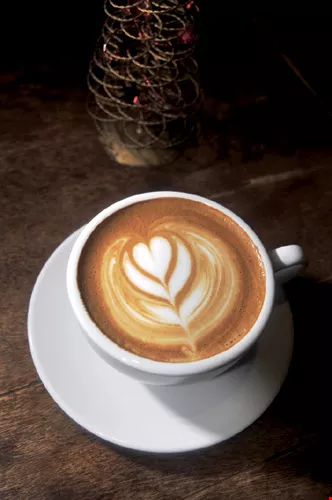
A past winner of the Taiwan Barista Championship, Zhang Zhonglun is a master at creating exquisite espresso foam art. For each cup that he brews he brings the same degree of concentration as during a competition.
Over by the Taipei Metro’s Liuzhangli Station in Taipei’s Xinyi District, PEG Coffee, founded in 2008, has racked up back-to-back awards at the “Meeting Taipei in Café” event: first prize in 2009, then a special commendation in 2010. Owner Li Zi worked as a bean roaster for six to seven years prior to opening his own place; coffee runs deep in his veins. A robust, athletic man, he once sustained an injury while playing basketball that required surgery. The store regulars all pleaded with him to take a few days off to recover, but the dedicated Li simply replied, “I can’t leave the store.”
Li assumes responsibility for all matters large and small, from choosing and roasting beans to manually brewing coffee for patrons and processing their payments. He typically roasts a batch of beans every two to three days, and the interior of the café is always suffused with the aroma. He’s always a bit disappointed when customers turn down the house specialty, a coffee featuring fruity overtones. Whenever customers express interest, he throws himself eagerly into explanations of both the estate origins and characteristics of each type of bean.
There are usually eight different estate coffees available, as well as Wujia coffee from the slopes of Mt. Ali in Taiwan. Priced between NT$120 and NT$180, web reviewers have praised them as “specialty single-bean coffees for ordinary folks.” The coffee comes served in thick porcelain beakers, which imparts a Zen-like quality to the proceedings. The store’s narrow, oblong dimensions don’t accommodate many seats, but there are individual table settings, a patio, and a bar. Throughout the place are Chopper Man figurines from the Japanese comic series One Piece, making for a festively distinctive interior.
In Fengyuan, Taichung City, Coffee Yeh has carved out a niche selling a mellow, lightly roasted brand of coffee that is “so light you can see the bottom of the cup.” Owner Yeh Shih-huang, who goes by the handle of “Xiao Yeh,” was a baker who had also managed franchises of the Japanese chains Manabe and Kohikan. Returning to his hometown in 2006, he set about opening a place that sold the light roasts that he himself fancied because they bring out the beans’ original flavor.
Away from his work roasting beans, brewing coffee, and baking cheesecake, he takes time out to serve as a coffee instructor at the Holistic Education School in Miaoli and at Hope Market in Taichung. Yeh enjoys sharing his every thought on the subject of coffee. From time to time, he offers “all you can drink” specials in which customers can drink more than 20 different kinds of beans that owner Yeh has roasted in small quantities. At under NT$250 the deal is so good, he might as well be giving it away.
One of his favorite tacks is to show customers the tremendous diversity of experience yielded by a single type of bean when presented at different temperatures and concentrations. The first batch of hand-brewed coffee is the purest presentation, and it offers a sweet tanginess with fruity overtones. Reusing the same grounds results in a thinner texture with lessened acidity. Rebrewing the grounds a third time yields a coffee with a taste similar to black tea. Finally, pouring some of the coffee from the first brewing into a wine goblet filled with ice makes for a deliciously mellow beverage whose taste approaches lemon-flavored black tea.
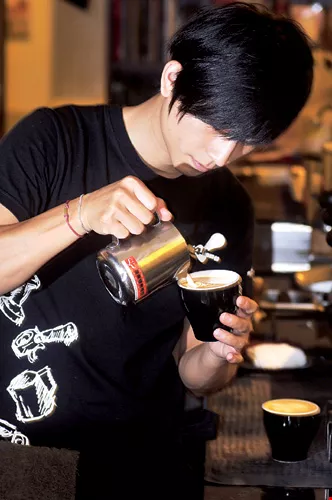
A past winner of the Taiwan Barista Championship, Zhang Zhonglun is a master at creating exquisite espresso foam art. For each cup that he brews he brings the same degree of concentration as during a competition.
The name Caffé 4Mano comes from four Italian words beginning with the letter “m” plus the word “mano”: miscela (blend), macinadosatore (bean grinder), macchina espresso (espresso machine), mano dell’operatore (the operator’s hand). The word mano itself means hand, and the broader implication is that of four experts working together, as Zhang Zhonglun began the café with three friends. Zhang himself has the distinction of being the winner of the 2009 Taiwan Barista Championship.
The store is ensconced in a narrow alley in Taipei’s Gongguan, in the same premises as the old Norwegian Wood Café, in its day a legendary landmark in the National Taiwan University landscape. Aside from some minor remodeling, 4Mano retains much of the original interior’s wooden chairs, tables, and bar. One wall is covered with a warm-hued portrait mural, while another beige wall is a gallery of black-and-white photography. A selection of Western music murmurs in the background, evoking the leisurely, cultured atmosphere of an Italian café.
A mere youngster of 30 years, Zhang originally studied graphic design, though owing to his tremendous enthusiasm for the subject, he has been active in the coffee business for more than 10 years. At 18, he began working at a café, and from such humble tasks as sweeping the floor and waiting tables he ascended to store manager by age 23. Up to that point, though, he had yet to comprehend the beauty of unsweetened coffee. His epiphany came at 24 when drinking a foamless caffè latte with no sugar added. Overwhelmed by the combination of aromatic coffee and the richness of the milk, he finally grasped the allure of Italian-style espresso.
In preparation for the competition, he practiced the 15-minute competition requirements 1000 times within the span of two months, and ended up winning the grand prize though he was a total underdog. These days when he opens his store, the first thing he does is fire up a cup of espresso which he then tastes in order to properly calibrate the flavor of his beans, because “espresso is the combination of more than 10 inextricable elements, from the beans themselves to the roasting and grinding; from water temperature to the amount of grounds used and the amount of pressure used to compress them. Even the external temperature and humidity can play a role in the outcome,” he explains.
4Mano’s espresso exudes a bright acidity, but the dark roast is full-bodied and intense. He offers a flavored coffee drink which pairs espresso with millet wine made by Aborigines in Sandimen Township, Pingtung County. The drink is served in a thick-bottomed, cone-shaped ceramic cup festooned with a mosaic of Paiwan motifs. Online connoisseurs have described the frothy texture reminiscent of black tea and the hint of alcohol as an “otherworldly combination.”
These coffee artists strive to extract primordial truths contained within fragrant beans, creating a coffee culture of variegated radiance for Taiwanese to savor. These little shops have the charm and character to complement any mood; they are the restful oases of modern life, the perch where the soul nests. Their tireless energy will continue to underwrite the creative evolution of Taiwanese coffee through successive generations.

@List.JPG?w=522&h=410&mode=crop&format=webp&quality=80)


