

The contemporary production model is that the parts for a product can be manufactured in different places, after which they are brought together using the fastest and cheapest means available and finally assembled. This new type of supply chain creates higher dependence than ever before on logistics—the timely transport and tracking of inventories.
Taiwan’s Free Economic Pilot Zones are aiming to create profit opportunities through “smart logistics” and the “store onsite, factory offsite” business model. If they succeed, they will not only drive growth in the relevant industries, they will energize surrounding local economies.
Because Taiwan’s current eight Free Economic Pilot Zones have different port conditions and locations, they are not all equally suited to logistics operations. At present the FEPZs most suited for developing this activity are the ones at Taipei Port and at Taoyuan International Airport.
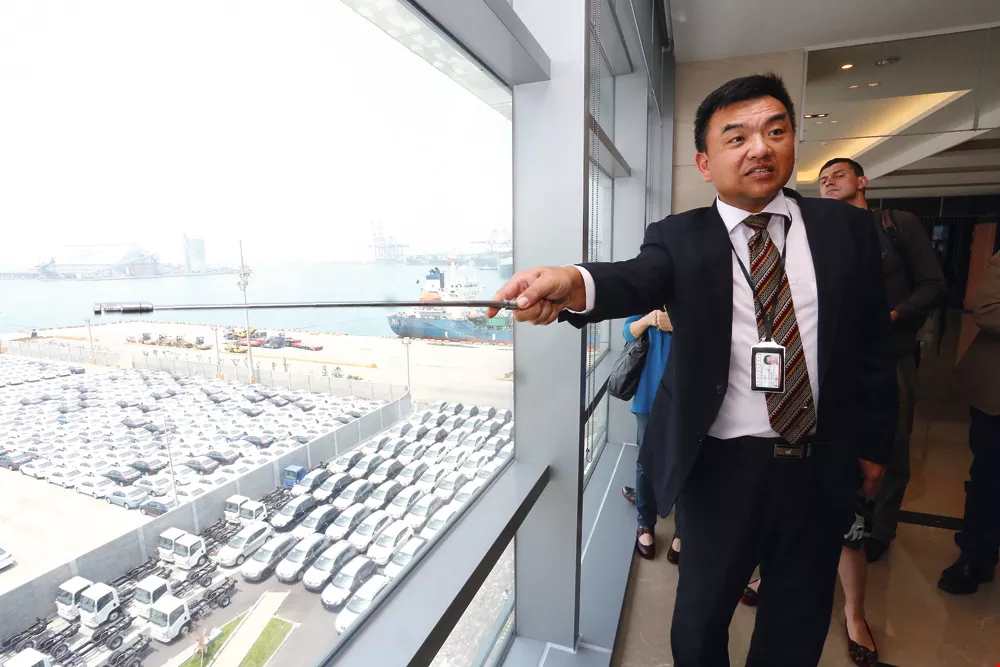
Tonglit Logistics president Alex Shih explains the company’s “store onsite, factory offsite” business model, which uses the Taipei Port FEPZ as the main base of operations.
The capital city of Taipei is booming with commerce, but few of its residents are much aware of the fact that not too far away (about 45 minutes by car) there is a major international harbor.
Against a backdrop of azure sky and aquamarine sea, the wharves of the container port are packed with automobiles every day. From above, the hundreds of cars and tractor-trailers look like little more than Matchbox cars stretching as far as the eye can see.
Taipei Port is located on the coast between Bali and Linkou, just south of the mouth of the Danshui River. Construction of a fully equipped modern port began in 1993, and operations began in 1999.
Most of the maritime traffic that comes into Taipei Port is long-distance container shipping. At present the two main lines of business are automobile logistics and participation in the supply chain for petroleum and petrochemicals. There are three companies operating in the FEPZ: Tonglit Logistics Company, Formosa Petrochemical Corporation, and Bom Ami Enterprise Company.
Of these, Tonglit, whose operation covers 18 hectares, is worthy of special note, for it is the prime existing example of the successful operation of the “store onsite, factory offsite” model.
Tonglit was the first firm to set up in the FEPZ. Their main business is shipping whole vehicles (both imports and exports) and handling logistics for car parts and accessories.
About 70% of the car parts used by Tonglit are made in Taiwan, and about 30% are imported from abroad. Using the “store onsite, factory offsite” model, they send the vehicle bodies and parts to subcontracting factories outside the FEPZ, who install the parts onto the cars. At the company’s factory inside the zone, meanwhile, they carry out customization, a high-value-added service. This involves installing special parts demanded by individual clients—parts that are not part of the standardized production line, such as head-up displays, parking (or reverse) sensors, and the like. The customized vehicles are then exported to the Middle East in a type of “end-to-end” service (from the maker at one end directly to the consumer at the other).
Tonglit president Alex Shih relates that Tonglit handles about 65% of the 100,000 to 110,000 vehicles imported into Taiwan each year. Impressive, but still small compared to the fact that they handle over 95% of exported vehicles!
Last year Tonglit brought 63,000 cars into Taiwan through Taipei Port, and shipped 80,000. They expect to handle between 67,000 and 70,000 incoming this year, while the number of outgoing vehicles should break the 100,000 barrier.
Shih notes that it is only 23 kilometers from Taipei Port to Taoyuan International Airport, Taiwan’s main aviation portal, so there is synergy between the maritime and air transport systems. In the future, Tonglit plans to get into marine rapid transport or maritime-to-air transport services.
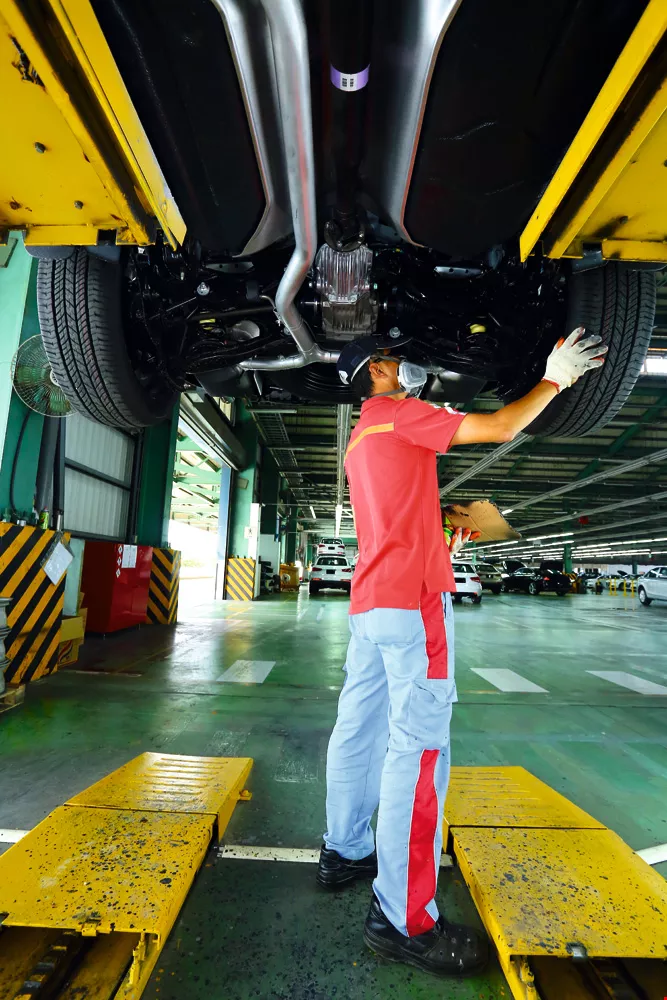
Tonglit Logistics specializes in importing and exporting vehicles and vehicle components. One of the services they offer is individual car customization, which they do right in the Taipei Port FEPZ.
Taoyuan International Airport (TIA) presents a picture of intense activity that is quite different from Taipei Port. The dedicated 600-meter road linking the airport to the FEPZ is like an umbilical cord channeling container after container of products from all over the world in and out.
The FEPZ at TIA is 35 hectares in size. The FEPZ is multi-functional, offering not only air shipment but also logistics value-added, transportation planning and tracking, and warehousing and inventory services. It is especially suited to playing host to firms in the fields of logistics, high-value-added parts and components, and IT-related industries. It is the most successful of the FEPZs to date. Last year, for example, the revenues of the airport’s free trade zone accounted for over NT$286 billion, or 34% of the revenues of the country’s seven free trade zones (at six seaports plus one airport).
The Taoyuan Airport Free Trade Zone is the only one to have been built under the BOT (build-operate-transfer) model. The job of building and running it belongs to the Far Glory Free Trade Zone Company. Paul Chen, assistant vice president in charge of the Business Management Planning Department, points out that at present the free trade zone enjoys various privileges like exemption from customs duties, commodity tax, and business tax. In the future it is hoped that clients who use the FEPZ to do value-added work will be able to go via mainland China into ASEAN, in order to enjoy exemption from customs duties and penetrate the mainland or Southeast Asian markets.
The Taoyuan FEPZ is divided into five zones: an air shipment hub; international logistics; a warehouse and office building; a value-added park; and a corporate operations center.
The air shipment hub, which occupies 12 hectares, is the general handling station for goods being imported into, exported from, or transshipped through the FEPZ. It can handle roughly 800,000 metric tons of goods per year (the throughput of the airport is about 1.5 million tons). The warehouse and office building, into which more than 60 companies have already moved, provides space where airlines and forwarders can handle goods on their own.
The 8500-square-meter value-added park is the world’s second largest, and Taiwan’s largest, air shipment logistics center, providing corporations with the opportunity to provide third-party logistics (3PL) here. Currently there are about 40 firms in the value-added park, including 13 multinationals and five Taiwan firms that are bringing capital back from abroad to invest here.
Paul Chen states that this sealed zone is the only place in Taiwan that achieves “1002” logistics efficiency: 100% of goods reach clients within two days of their placing an order. With the 600-meter dedicated road linking the FEPZ to the airport, it takes only four hours total for goods to be offloaded from planes, sent to the shipment hub for unpacking, and delivered to the production line.
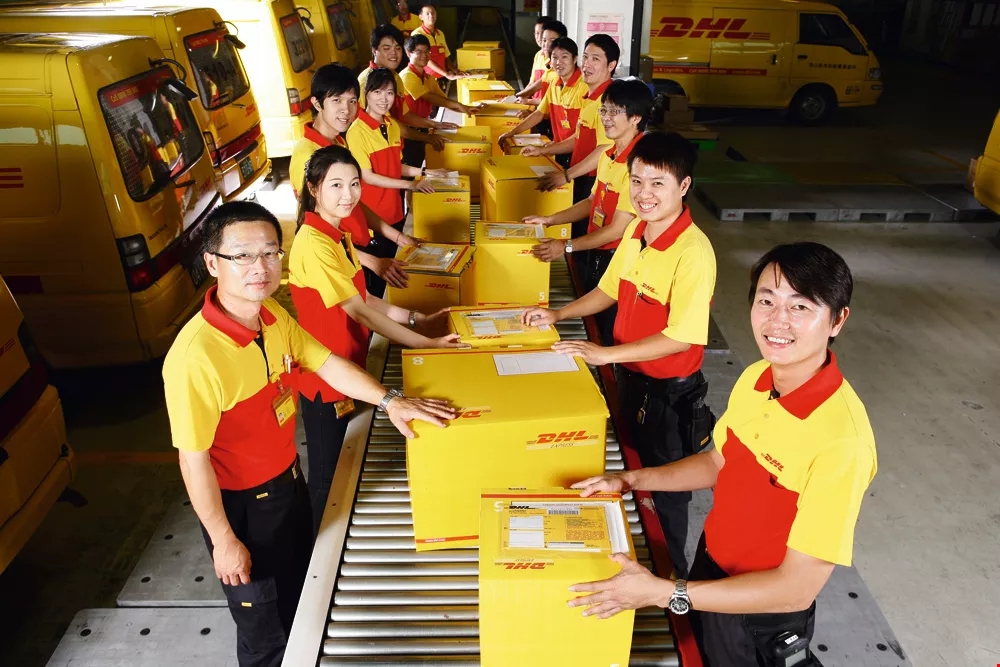
The modern production chain depends heavily on fast and dependable logistics. (courtesy of DHL Express
The German logistics company DHL, which has operations in 220 countries around the world, selected the Taoyuan Airport FEPZ to provide a range of interlinked services that include air transport, warehousing, and overland road transport.
“DHL decided to set up operations here,” explains general manager Chee Yaw Chek, “because it fits perfectly with the three major demands of clients—to be near the airport, to avoid customs duties and procedures, and to have rapid processing to minimize warehouse time.”
He says that goods that arrive by 10 a.m. can, after processing or repair work is completed, be out of the door by 7:30 in the evening, and then will reach anywhere in the Asia–Pacific region or the US the next day. “When it comes to the Asia–Pacific and US markets, we are extremely competitive.”
Chee relates that one client had originally set up a factory in Singapore, but because so many of his suppliers are in Taiwan, he decided to just up and move the Singapore plant to Taoyuan. And Michael Lai, general manager of DHL Supply Chain (Taiwan), says that one German semiconductor company hired DHL to set up a warehouse in the Taoyuan Airport Free Trade Zone to serve as their distribution point within the zone, and as a result resolved many cash flow problems.
Chee Yaw Chek is especially optimistic about Taiwan’s high-end maintenance capability. When combined with international logistics, great things can be expected. “The job of maintenance and repair of high technology is one that particularly suits Taiwan, because there are a lot of high-tech manufacturers in Taiwan and OEM production is done in Taiwan.”
It’s clear from all this that we can look forward to big results from the international logistics industry in the FEPZs. So long as we keep the long run in mind, and speed up the pace of liberalization, Taiwan will have an important part to play in regional integration and in the strategies of global corporations.


@List.JPG?w=522&h=410&mode=crop&format=webp&quality=80)


