"Gangster" Soy Sauce Hot in Southern Taiwan
Lin Hsin-ching / photos Jimmy Lin / tr. by Chris Nelson
March 2010


The Taiwanese idiom "a black bottle filled with soy sauce" is an expression of surprise at something unclear or unfathomable. You may also feel a sense of surprise about the soy sauce made way down south at Pingtung Prison.
Come again? Well, this so happens to be where southern Taiwan's well-known Dingxin Soy Sauce is made. The selling point of this brand, dating back to 1960, is that it's pure, hand-made soy sauce fermented according to age-old methods, made with wholesome ingredients, and boasting a mellow, not overpoweringly salty flavor, fully conforming to modern folk's health needs. Recently, its annual output has surpassed the NT$24 million mark.
Behind this broad-based consumer popularity is the laborious work of many pairs of brawny, tattooed arms. The repute of this "gangster" soy sauce has persisted for years, and is the pride of Taiwan's prison administration.
"Say, Missy, you're doing a soy sauce interview over yonder at Pingtung Prison, eh? I'm no shill for them, but I gotta say their soy sauce is damn good! And a real deal, at under 50 bucks a bottle. We've been buying their sauce for 20 years, and now the other brands just ain't the same to me."
The driver of the cab I hailed randomly from downtown Pingtung sounded like someone giving a testimonial on a shopping channel as we made our way to Zhutian Township, home of Pingtung Prison. The cabbie, a Kaohsiung resident, chattered incessantly about the different flavors of soy sauce available at Pingtung Prison. That such innocuous conversation could evoke a response like this is testament to the popularity of this "gangster" soy sauce.
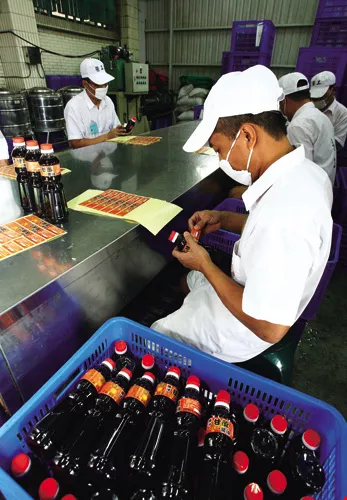
After the manufacturing process is completed, the sauce can be bottled and sold.
Four decades ago, the original goal of developing Dingxin Soy Sauce at Pingtung Prison was to help farmers in Wandan Township and other Pingtung County locales solve soybean overproduction problems. Another reason is that soy sauce on the market at that time was being produced by chemical means, using less wheat and soy, shorter fermentation periods, and added granulated sugar, preservatives and artificial flavorings, which after prolonged consumption can be harmful to your health. With the right location and plenty of time and manpower, Pingtung Prison (with a current inmate population of 2,600) invested in the soy sauce brewing business at the encouragement of academia and the local farming community.
But in the first 30 years, Pingtung Prison saw soy sauce production as just a byproduct of inmate skills training. The sales channels were limited to other prisons and the families of inmates, and there was no will to refine the product, enhance its recognition or sell to the outside world.
But all that changed in 1999. Lan Chun-chieh, then a consultant to Pingtung Prison and an associate professor of food science and technology at Tajen University, proposed that they sell low-salt soy sauce. He believed that Pingtung Prison's wholesome, low-priced, hand-made soy sauce would find a niche in a consumer foods market overrun with artificial additives. With a reduction in salt content, it would conform with modern consumers' preferences for more delicate flavors and meet their health needs, and thus should become popular.
At Lan's recommendation, Pingtung Prison brought in soy sauce guru Hsieh Pao-chuan, a food science professor at National Pingtung University of Science and Technology, as a technical advisor (Hsieh is also the formulator of NPUST's famed low-salt soy sauce). Together, they developed a new flavored low-sodium soy sauce. With its delicate mouthfeel and distinct flavors of soy and wheat, it was an instant hit.
Pingtung Prison worked closely with county farmers' associations to get the product on supermarket shelves in an effort to increase its renown. As word spread, orders started swarming in from other cities and counties.
To adapt to the large demand, Pingtung Prison has added to its soy sauce production facilities over the past decade, now producing 65,000 kilograms a month, up from 10,000 kg, thus helping solve the predicament of excessive orders during the holiday season.
"People like to tell their friends about good things, but in this case we beg our customers to keep the secret to themselves!" jokes Wu Zhaoming, head of the Operation Section at Pingtung Prison, with a hint of pride. Prison, after all, is not a for-profit business, and its space and funding are limited, so it can't expand like private businesses can. "So the better our business, the more problems it causes us!"
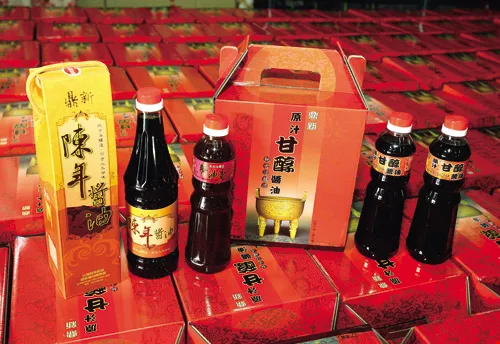
Recently a finely packaged gift box edition of Dingxin Soy Sauce has gone on sale, making superb holiday presents among the people of southern Taiwan.
Currently, Pingtung Prison offers original, original delicate, premium and aged soy sauces. The first three have a fermentation period of over four months; the difference is that for the original style, only the juice from the first pressing is used, retaining the most original flavor. Loyal customers include Pingtung's renowned Hou's Salty Duck as well as Xiong Family Pig's Feet in Wanluan, featured on Formosa TV's prime-time soap Mom's House.
The premium style is made from the second soybean pressing brewed with salt, with a slightly coarser mouthfeel and higher salinity. This version is mostly supplied to prisons around Taiwan and local eateries in the south. The new aged soy sauce is made with soybeans fermented for at least a year, retaining the flavors of the original ingredients, with no artificial colorings added. It's a supreme product among Pingtung Prison's soy sauces.
Wu notes that whether original, premium or aged, they're all aged naturally, following age-old manufacturing processes from steaming the soybeans, toasting the wheat, making koji, to aging in fermentation tanks. Given enough time, the soybeans, wheat, salt and mold (Aspergillus oryzae) become fully married, allowing for the most natural chemical changes.
"Wine improves with age, and the same is true with soy sauce. But many manufacturers prefer speed and low costs, skipping the all-important step of letting time do its magic," says Wu.
After natural fermentation, the beans and wheat become soy mash. The liquid is then bottled and sold after final pressing, filtration and seasoning. Walking around Pingtung Prison's soy sauce factory, the visitor finds the area permeated with an alluring salty-yet-sweet aroma that's not only mouthwatering, but makes one want to go out for some stewed meat on rice!
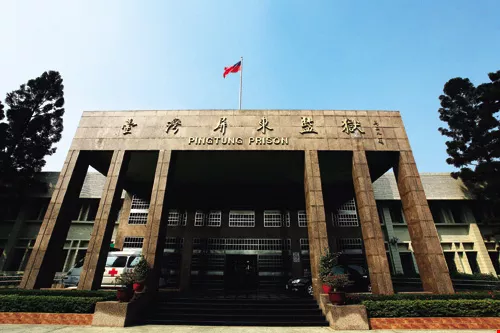
Located in southern Taiwan, with its open spaces and fine weather, Pingtung Prison offers one of the best environments in Taiwan, as prisons go.
"Everyone who tries our soy sauce gets hooked," Xiao Quan (not his real name), a soy sauce factory worker, proudly proclaims. In for the third time on drug charges, he served his last two sentences at Taipei Prison, but his transfer to Pingtung has unexpectedly given him new hope for his future.
Says he, while doing time in Taipei Prison, he was assigned to the clothing rack processing plant. It was dull, tedious work, nothing that made him want to change himself. But coming here has been different: the sense of achievement he derives from seeing soybeans being transformed into flavorful condiments through the hard work of himself and his "classmates," has made him for the first time determined to quit drugs.
With a year and a half left to serve, Xiao Quan is planning to move from Taipei to Pingtung after he gets out. "I'm 43 now; I can't let myself get trapped in a life of crime again. There's good weather down south, and I can be far away from the bad crowd I hung out with. I hope to open a small business here and start afresh."
Perhaps Xiao Quan's change of heart reflects the true meaning of the brand name "Dingxin" (ding means "cauldron" and xin means "new" in Chinese). "Soy sauce is prepared in cauldrons, and we hope that inmates coming here will renew themselves as they labor, finding the power to start over," says warden Hong Zonghuang, filled with expectations.

@List.jpg?w=522&h=410&mode=crop&format=webp&quality=80)

@List.jpg?w=522&h=410&mode=crop&format=webp&quality=80)


