Creeping Cyber-Sickness—Internet Addiction
Lin Hsin-ching / photos Chin Hung-hao / tr. by Geof Aberhart
September 2012


There are many kinds of addiction that are familiar to most people, like drugs, alcohol, and cigarettes. But while these substances have long been known to be harmful, there is one other possible source of addiction far more insidious for its apparent harmlessness: the Internet.
Several long-term studies have shown that in Taiwan, with some 11 million people frequently online, as many as 10 to 20% of students are addicted to the Internet, placing Taiwan second only to South Korea.
How could the Internet, a powerful tool for information and communication in the modern age, also become “digital dope”? What can parents do when their children spend all day wandering the shoulder of the Information Superhighway? And how can we protect against this creeping cyber-sickness?
Open any newspaper or visit any school’s counseling center and you’ll find case after astonishing case of Internet addiction, from parents leaving their children to starve as they immerse themselves in cyberspace to “possessed” children losing themselves to online compulsions and turning on their parents, sometimes violently, when told to log out. Through social-work cases and pleading letters from parents, we see a raft of instances of people so addicted to the Internet that they let their health, family relationships, and friendships deteriorate. These horrifying tales have given rise to concerns about the growing specter of Internet addiction.

Most Internet addicts realize that their behavior is unhealthy, but cannot resist the attraction of going online, and so are unable to help themselves.
With computers, smartphones, and wireless Internet so commonplace in modern society, more and more people are relying on the Net for entertainment, socializing, and work. With heavy users online for eight hours or more a day becoming increasingly common, are such people at a higher risk of becoming cyber-addicts?
The term “addiction” is one subject to a strict definition in the medical world, generally referring to a disorder involving a high level of physical and psychological dependence on a particular substance or behavior; when an addict is cut off from their addiction, they can become irritable and anxious, experience physical symptoms like trembling, and even go into what is known as “withdrawal.”
While drugs like alcohol, nicotine, and heroin cause more physiological dependencies, addictions like Internet addiction tend more toward psychological symptoms. The earliest reference to this disorder was in 1995, when New York psychiatrist Ivan Goldberg wrote a spoof definition of the condition by consulting the fourth edition of the American Psychiatric Association’s Diagnostic and Statistical Manual of Mental Disorders (DSM-IV) and its definition of pathological gambling. Despite Goldberg’s piece being satirical, it struck a chord with many, and sparked serious interest in the then-nascent problem that became known as “Internet Addiction Disorder.”
Although “Internet Addiction Disorder,” or IAD, is a point of heated debate in the global psychiatric community, several in the academic and medical worlds have acknowledged that impulse control problems do exist that can lead to people losing themselves to online games, social networking, or even pornographic or violent online content.
Two schools in Taiwan, China Medical University and Asia University, have joined forces to create the island’s first facility dedicated to IAD, the CMU-AU Internet Addiction Prevention Center. Asia University’s vice president Jenny Ko explains that Internet addicts must generally meet three criteria: “compulsion,” meaning that they are aware that they should curtail their online activity, but find themselves unable to overcome the compulsion to log on; “withdrawal,” meaning that when unable to get online they suffer physical and mental discomfort; and “tolerance,” meaning that their desire for cyber-activity becomes more and more difficult to sate, requiring them to be online for longer and longer periods.

What kind of world are we creating for later generations? As young parents are busy shopping, their mobile devices have become more like mobile babysitters for their young children.
With such tightly defined criteria, one would think that relatively few would fit the classification of “Internet addict,” but statistics tell a different and surprising story.
Studies have indicated that Internet addiction rates are soaring worldwide, with between 6% and 17% of the population in various countries being classified as addicts. Rates are generally higher in countries where video games and broadband Internet access are more common, such as South Korea, well known for its online gaming culture. According to figures published in The New York Times, a 2007 study by South Korea’s Hanyang University showed that some 30% of the country’s under-18s were at risk of Internet addiction, making it the world leader in the category.
In Taiwan, where some 11 million people have ready access to the Internet and over 70% of the population has access via their cellphones, IAD is also becoming a serious problem.
According to studies by Ko, as much as 10–15% of Taiwan’s student population suffers from IAD. National Changhua University of Education’s Department of Guidance and Counseling released even more surprising data this February; based on a sample of almost 4000 students, they found that 18.8% of children in grades three through six, 20.2% of high-schoolers, and 22% of college students were addicted to the Internet, putting Taiwan second only to South Korea.
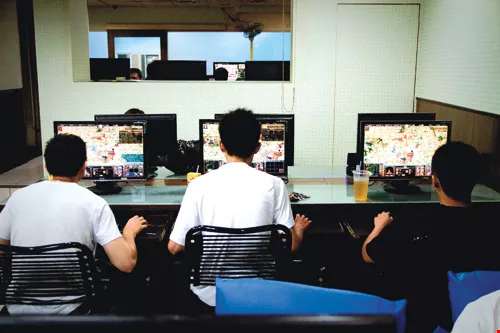
For those addicted to the “digital dope” that is the Internet, life can be a struggle, with it becoming hard to separate virtual and real lives, and real-world interpersonal relationships suffering.
With Taiwan facing a growing problem with IAD, Ko Chih-hung, chairman of psychiatry at Kaohsiung Municipal Hsiao-Kang Hospital, explains that while it may be convenient to pin the blame on external factors like the prevalence of Internet access, we cannot afford to overlook the power of familial and social factors.
“Walk into any Starbucks and you’ll see parents and children sitting together, each with their iPhones or iPads, playing their own games and never saying a word to one another,” says Ko with a wry smile. Parents teach their children by example, and so when they themselves are wrapped up in their own online worlds, or even use computers and smartphones as babysitters, how can we not expect the children to follow their parents’ leads?
This is only compounded by Taiwanese society’s emphasis on academic achievement. As parents coddle their children and restrict their extracurricular activities in an effort to push them higher and higher up the academic ladder, when the children cannot find satisfaction in schoolbooks and can’t build relationships with their peers through extracurricular activities, of course they will turn to the convenience of the Internet as a way to easily and safely vent their emotions.
Once these children gaze too long into the abyss of the Internet, the abyss begins to gaze back; they can begin to lose self-control, and the problems that may arise can be both deep and broad in their impact. Those who are aware that their Internet usage is a problem, but still find themselves unable to free themselves from its depths, may experience strong feelings of guilt and negative emotions, with serious cases at risk of psychiatric illnesses like depression or anxiety.
The long road to healthMore problematic, though, are those who are completely lost to the Internet, so much so that should anyone try and pry them away, they may react violently. School counselors are well familiar with the story: parents unable to bear seeing their children lost to cyberspace all day try to pull the plug, only to have their children turn to violence against themselves or others.
Helping Internet addicts kick the habit is something that needs time and planning. Getting clean, says Jenny Ko, can be a physically and mentally demanding process, no less so than quitting drugs or drinking.
Many impatient parents try to interfere by force, trying to get their children to go cold turkey. But research indicates that teens, being in their rebellious phase, are likely to take such forceful interference badly, becoming more convinced that their friends online are the ones that really understand them, and thus the harder the parents try, the more the children may throw themselves into the depths of the virtual world.
As such, helping kids slip the shackles of Internet addiction should be a more gradual process, starting with in-depth discussions, efforts to build mutual trust, and working to find the underlying causes of their addiction. After that, parents can help put in place ways for the children to monitor and record their time online and reasons for being online, so that the children can in turn gradually cut back the frequency of Internet usage and reduce their psychological dependence on it.
At the same time, parents should help their children develop new models of behavior and interpersonal relations, replacing habitual use of the Internet with things like sports, social activities, or even jobs.
But just as with drug addicts trying to kick the habit, some Internet addicts may find they relapse due to a lack of willpower or a moment of weakness. When this happens, they can experience feelings of disappointment and annoyance with themselves. When faced with someone falling off the wagon, parents and counselors need to be patient and understanding, helping the sufferer get back into positive modes of thinking rather than berating them. Otherwise they may find themselves thinking they’re beyond help and just giving up.
Encouraging responsible useThe path to recovery for Internet addicts can be an extremely long and hard one, and so taking preventive measures is of tremendous importance.
Jenny Ko says that it is important that parents remember to encourage their children to cultivate a wide range of interests from an early age, rather than just plopping them down in front of a computer to while away their free time, so that in the future they will be less likely to let online activity supercede all other activity.
Ko Chih-hung, meanwhile, emphasizes the importance of building good Internet usage habits, with parents setting down clear rules for use as soon as their children start using computers, as well as keeping their home computers in communal spaces like the living room and setting firm rules on how long the children can be online. It is even more important not to relax those rules when the children are on vacation from school.
While we may all appreciate the richness that easy access to the Internet can bring to our lives, we must also be careful not to let ourselves get overly caught up in the digital dimension. Controlled Internet usage is smart Internet usage, not just for children, but for any of us that often find ourselves trawling the Internet at home or on our smartphones.

@List.jpg?w=522&h=410&mode=crop&format=webp&quality=80)

@List.jpg?w=522&h=410&mode=crop&format=webp&quality=80)

@List.jpg?w=522&h=410&mode=crop&format=webp&quality=80)
@List.jpg?w=522&h=410&mode=crop&format=webp&quality=80)

