Investing in Relationships: An Interview with Minister of Economic Affairs Lin Hsin-yi
interview by Eric Lin / photos Ku Chin-tang / tr. by Phil Newell
October 2000


With Taiwan in difficult straits interna-tionally and having few cards to play diplomatically, in recent years the government has come to see Taiwan's economic power and the dexterity of its businessmen as a key assest in foreign relations. The government hopes to create a win-win situation in which the ROC's diplomatic partners gain aid and investment, while Taiwan firms find new business opportunities. However, because most of Taipei's diplomatic partners are half a world away, business people in Taiwan have little understanding of these countries, and economic diplomacy has not yet yielded the desired results.
However, given the trend of globalization of firms, there are growing economic opportunities in ROC diplomatic partner states. New Minister of Economic Affairs Lin Hsin-yi, a successful entrepreneur himself, was a key member of the delegation that accompanied President Chen Shui-bian abroad in mid-August. He devoted particular attention to the local investment climate in each country, and came up with a few suggestions of his own.
Q: In terms of economic diplomacy, what tools does the Ministry of Economic Affairs (MOEA) possess to encourage Taiwan businesses to invest in countries with which Taiwan has formal diplomatic relations? Are there differences in the incentives offered for different areas (such as Latin America, Africa, or the South Pacific)?
A: At present, MOEA measures are mainly based on the "Methods for Encouraging Firms to Invest in Diplomatic Partner States" drawn up by the Ministry of Foreign Affairs (MOFA). These make no distinctions between regions or countries. But, taking into consideration differences in the economic environment across regions, the MOEA has developed different economic promotion and development strategies depending upon the degree of development in various areas. These will strengthen relations with diplomatic partners and help them to develop their economies.
At present, concrete measures include the following:
I. Under the provisions of the MOFA's "Methods," businesses can choose to apply for one of the following three subsidies: (1) Wage subsidy for employment of host-country staff: This covers 20% of such payments, to a cumulative maximum of NT$15 million, for a maximum of five years. (2) Factory rent subsidy: This covers 20% of rent costs, to a cumulative maximum of NT$15 million, for a maximum of five years. (3) Interest subsidy: This covers 30% of a firm's interest payments, to a cumulative maximum of NT$15 million, for a maximum of five years.
In addition, businesses may, in the same investment plan, apply for the following: (1) Investment insurance subsidy: This covers 50% of the insurance premiums for investment insurance, up to NT$500,000 per year, for a maximum of five years. (2) Travel subsidy: This covers the cost of airfare for participation in trips organized by the government (or by private firms commissioned by the MOFA) to investigate the investment climate overseas, with a maximum of one person per firm.
Firms who have already invested at least US$100,000 in a diplomatic partner state can apply to the travel fund to compensate for the original air fares spent when sending personnel to investigate the investment climate, up to a limit of two round trips and NT$35,000 per trip.
Economic diplomacy
II. The MOEA promotes economic diplomacy in coordination with overall foreign policy. Concrete measures include the following: Based on the "Guidelines for Strengthening Economic and Trade Ties with Diplomatic Partner States in Latin America," businesses are assisted in accessing agricultural or industrial raw materials, cheap labor, or land in Latin America, and are assisted in creating an international division of labor with Latin America and in penetrating North and South American markets.
At the same time, the MOEA has signed investment guarantee agreements with 16 diplomatic partners to secure the rights of Taiwan investors. These 16 countries are Nicaragua, Panama, Paraguay, Malawi, Honduras, El Salvador, the Dominican Republic, Senegal, Swaziland, Belize, Burkina Faso, Costa Rica, the Marshall Islands, Macedonia, Liberia, and Guatemala.
In addition, the ROC government routinely sponsors diplomatic-partner investment seminars and provides information on the host-country investment environment to businesses in Taiwan.
Q: In contrast to places where Taiwan businesses are currently investing heavily, such as the US and mainland China, are there really advantages to investing in countries that have formal diplomatic relations with the ROC?
A: Overseas investors from Taiwan usually choose their investments based on factors such as lower costs (e.g. mainland China) or market access (e.g. North America). But to keep in step with the trend of economic globalization, firms could invest in our diplomatic partners depending on the special nature of the firm's industry and the resource conditions in the host country, in order to achieve an integrated international division of labor.
Currently 29 countries have formal diplomatic relations with the ROC. Fourteen of these are in Latin America. Most Latin American countries are at low to medium levels of development, with agriculture still an important sector. The ROC has long assisted them with economic development through technical cooperation, loans, and training of personnel. Types of investment suitable for these countries include garment making, plastics, processing of agricultural products, and textiles.
Risk assessment
Q: Many of Taiwan's diplomatic partners are developing countries, with inadequate infrastructure and political instability. Can Taiwan businesses accept such risks? What does the government do to assist them?
A: Because the ROC economy has developed quickly, on the basis of comparative advantage our firms must move in the direction of internationalization. Because the government's role is limited to guidance, we can only provide the latest economic and political information to assist firms to undertake investment evaluations depending upon the special nature of their industry, competitive trends, and the principle of comparative advantage. In other words, it is up to the firms themselves to select the appropriate investment location.
Firms that invest abroad inevitably face risks from political, legal, market, and currency factors in the host country. Therefore, in order to reduce the risks for investors, the MOEA's Industrial Development and Investment Bureau has published information on the investment climates of 45 separate countries, and provides up-to-the-minute information on the World Wide Web free of charge.
In addition, to ensure objectivity in investment risk evaluations, we also refer to the evaluations made by the Swiss-based firm Business Environment Risk Intelligence S.A., and provide this information to firms from Taiwan.
At the same time, the government tries to sign investment guarantee agreements with countries that have a relatively large amount of overseas investment from Taiwan or with countries that have formal diplomatic ties with us. The purpose is to reduce the risks from non-commercial factors in the host country such as currency controls, confiscation, nationalization, war, rebellion, or civil disorder. As of September 2000, we have signed such agreements with 26 countries, of which 16 are diplomatic partners.
Q: In August President Chen traveled abroad and many leading entrepreneurs from Taiwan accompanied him on the trip. Were there any concrete investments as a result?
A: When president Chen was visiting the Dominican Republic, Nicaragua, and Costa Rica, several government economic officials and industrial leaders participated in investment seminars to further understand the local investment environment and local industrial development, and to exchange ideas with government officials in those countries.
Labor-management disputes
Investments require a great deal of research, evaluation, and consideration, so the entrepreneurs who participated in the seminars said that they would take the information they acquired home for further study before deciding on any investments. We will do our own follow-up work and provide assistance wherever we can.
Q: Recently there was an incident at the Nienhsing textiles plant in Nicaragua involving a protest by a human rights organization. Will this affect future willingness to invest there? Does the MOEA provide any assistance in handling labor disputes in Taiwan firms overseas?
A: Because Nicaragua is a participant in the United States' Caribbean Basin Initiative, textile exports from Nicaragua to the US are exempt from quotas and custom taxes. Given their proximity to the US market, and the abundance of low-cost labor, many textile firms from Taiwan have invested in Nicaragua in recent years to produce textiles for export to the US.
The investment by Nienhsing has run very smoothly, and occupies an important place in global OEM manufacturing of jeans. But because the company has such a large investment in Nicaragua, and employs many local workers, some local labor unions have taken up the complaints of a small minority of workers to provoke labor-management disputes or strikes. Fortunately, Nienhsing follows Nicaragua's labor law carefully, and these problems have been smoothly resolved.
In addition, the media in Nicaragua often carries inflammatory and untrue reports about unreasonable protests by workers in that country, affecting the morale and efficiency of investors. This is really not helpful to that country's long-term goal of attracting foreign investment for economic development. After looking into the matter thoroughly we have made an appropriate response asking the government of that country to improve the situation and to assist in resolving problems as quickly as possible.
Q: Taiwan firms have always been cooperative, and overseas investment has been very helpful to the ROC's diplomatic work. But today the government is putting political considerations first in encouraging Taiwan firms to invest in friendly countries. From an economic point of view, how effective is this?
A win-win strategy
A: First it is necessary to emphasize that economic diplomacy is not the same as foreign aid. Foreign aid is unilateral, whereas economic cooperation should provide benefits to both sides. Many of our diplomatic partners in Latin America, though suffering from inflation and economic stagnation, have rich natural resources and a large supply of low-cost labor, so they are excellent investment locations for companies that cannot maintain competitive advantage in Taiwan. Also there is the fact that Latin America is very close to the North American market, and is eligible for GSP (general system of preferences) and other benefits. I believe that if host-country resources can be adequately utilized, this should be of great assistance to our firms in undertaking an international division of labor and in expanding their market access.
Q: You were yourself a very successful entrepreneur. Can you give Taiwan investors any suggestions based on your personal experience?
A: Of all the wealthy and powerful countries in the world today, there is not one that does not employ overseas investment to maximize the efficiency of factors of production and to develop overseas markets. In so doing, they achieve the dual goals of improving the domestic industrial structure and raising their international economic position. In other words, internationalization is inevitable.
When firms undertake overseas investment, their ability to evaluate and to manage risks will directly affect the success of their investments. Therefore, besides making appropriate use of the resources provided by the government, firms which are thinking of investing abroad must look carefully at the feasibility of their investments, and also strengthen their core resources, and turn them to their advantage in the process of internationalization.
In terms of managing overseas investments, because of differences in background, culture, and economic environment, no single management method applies across the board. This is especially true when firms enter joint ventures overseas, and rely on local partners to handle sales. It is necessary to carefully spell out such things as decision-making power, rights and duties under the joint venture, and labor-management relations. Only then can the overseas subsidiary maintain a positive interactive relationship with the parent company at home.
Today, multinational enterprises are no longer based on simple subsidiary or manufacturing relationships. Today they are highly planned and integrated transnational organizations. An important test for Taiwan firms as they internationalize in the future will be their ability to make plans for and integrate multinational resources.
p.24
Minster of Economic Affairs Lin Hsin-yi was a key member of President Chen's delegation. On the trip, Lin and various business leaders from Taiwan were briefed by local Taiwanese investors.
p.27
Though Taiwan's diplomatic partners in Africa have rich natural resources, industry is still largely at the handicraft stage. There is great potential for Taiwan investors.
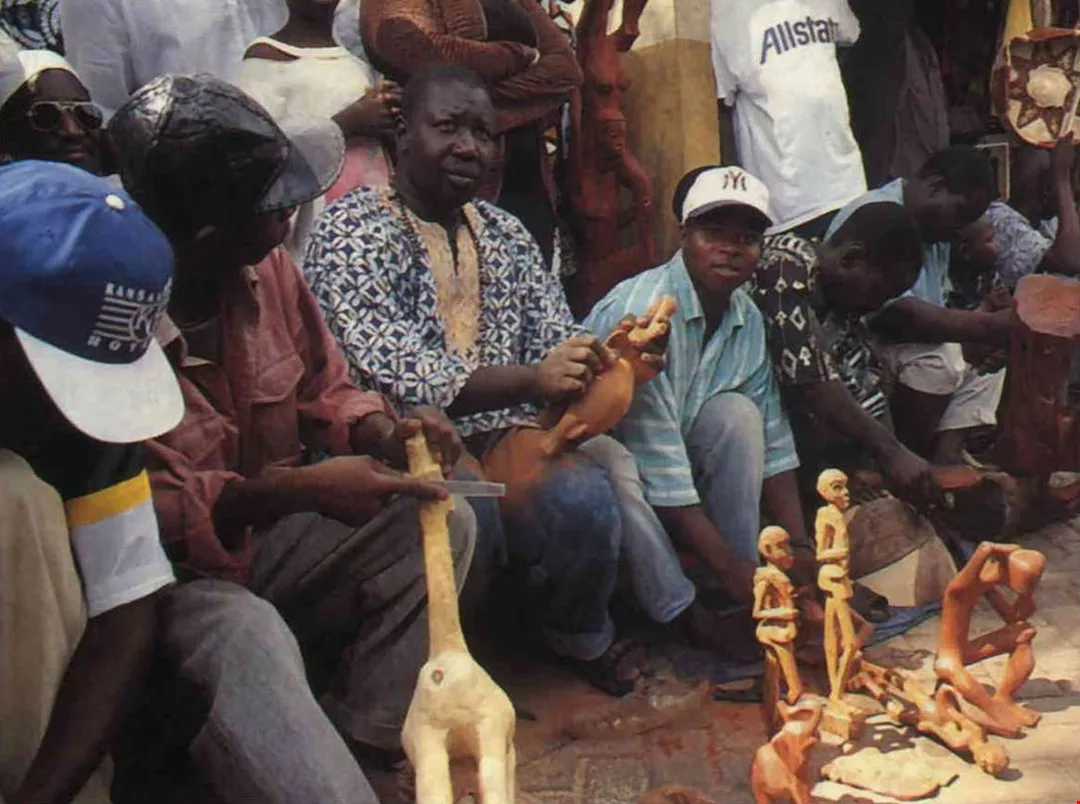
Though Taiwan's diplomatic partners in Africa have rich natural resources, industry is still largely at the handicraft stage. There is great potential for Taiwan investors.

@List.jpg?w=522&h=410&mode=crop&format=webp&quality=80)

@List.jpg?w=522&h=410&mode=crop&format=webp&quality=80)


