New Shoots Arising in Aceh-Tzu Chi's Great Love Villages
Coral Lee / photos Chuang Kung-ju / tr. by Scott Williams
April 2008


The huge tsunami triggered by the Great Sumatra-Andaman earthquake of 26 December 2004 devastated the Indonesian province of Aceh, destroying 130,000 buildings and killing 110,000 people. Rebuilding the province has proved no easy task. Land registration documents have been lost, the local government is ineffective, and international relief teams have had to struggle with linguistic and cultural barriers.
The Tzu Chi Foundation is one of many NGOs operating in the province. However, unlike most of them, Tzu Chi had a presence in Indonesia before the tsunami, enabling it to more readily mobilize the resources necessary to build three Great Love Villages. These communities, one each in Banda Aceh, Aceh Besar, and Meulaboh, have provided 2,700 housing units to the tsunami victims. These new blue-tile-roofed white-walled homes are a magnificent sight from the air, and are a new source of pride for Taiwan.
It is a little cool as we make our way through the Panteriek community in Aceh Province's capital of Banda Aceh in the early morning. The feeling as we walk down the street is almost that of a rural paradise. The air is fresh and clear. The gardens are verdant. Young women in saris talk and laugh as they emerge from their homes. Children with bookbags make their way to school. A vendor sells ice cream from a big tricycle.
Aida Angkasa, the third-generation Chinese-Indonesian and Tzu Chi volunteer who manages the community, is sitting in a breakfast shop chatting with residents over helpings of Indonesian coconut rice.
Aida, who is in her early 40s, lives in Medan Province and flies to Banda Aceh every month to handle the affairs of two Great Love villages. She stays ten to 15 days each time, so that the villages have become her second home.
"We talk about everything," says Aida. "They tell me whose kids are getting married, ask me to mediate disputes between families.... The calls are non-stop, even when I'm back in Medan." Aida tells us in fluent Mandarin that though minor disputes often arise among the 716 families in Panteriek, the community generally gets along well. This in spite of the fact that the community is the most diverse in Aceh, consisting of a mix of Indonesians, Acehnese, ethnic Chinese, government workers, rebel soldiers, Muslims, Protestants, Catholics, and others.
During the conversation, a local resident comes over to donate Rp20,000 (about NT$70) to charity. As a community worker pulls out a notebook to record the amount, Aida explains they receive 30 to 40 such donations every month. Though the amounts are small, she is pleased to see the change in residents' attitudes-instead of having their hands out for help, they are offering help to others.
Aida's voice reveals how proud and pleased she is with the community, and not without reason.
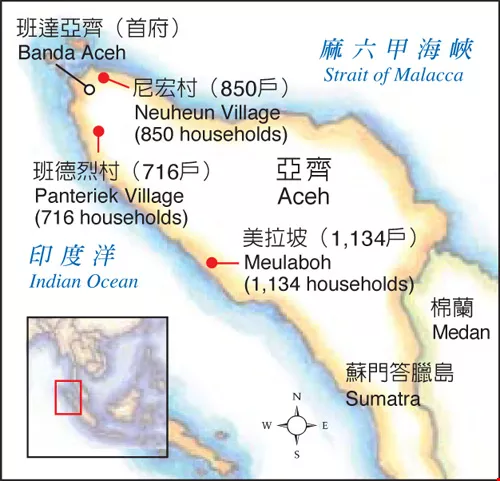
Tzu Chi Foundation aid in Aceh, Indonesia
Before the tsunami, Aceh's ardent pursuit of independence had kept this province in northwestern Sumatra in near constant turmoil. Kept under martial law by the Indonesian government, the province had for many years been something of an enigma to the outside world. Even other Indonesians generally thought of Acehnese as fiercely insular, selfish and untrustworthy.
As of 2005, Aceh had been in a state of civil war for 29 years. Armed conflict between the government's troops and the Free Aceh Movement's guerillas killed more than 15,000 civilians during this period. After the tsunami, the two sides ended the bloodshed with a peace treaty mediated by Finland.
Perhaps the long years of turmoil account for the Acehnese's tendency to look out only for themselves. "They'd even leave their own brothers to their fate!" exclaims Aida. She recalls hearing many stories of people with the means but not the will to help relatives who had lost everything in the tsunami when she was interviewing community residents two years ago.
There was so much to be done after the tsunami, and the people themselves were so standoffish, that Tzu Chi's volunteers were unsure where to begin.
"Master Cheng Yen told us that the safety of the volunteers came first, followed by the construction of a tent city, and then the community," says volunteer Lie Sarpin.
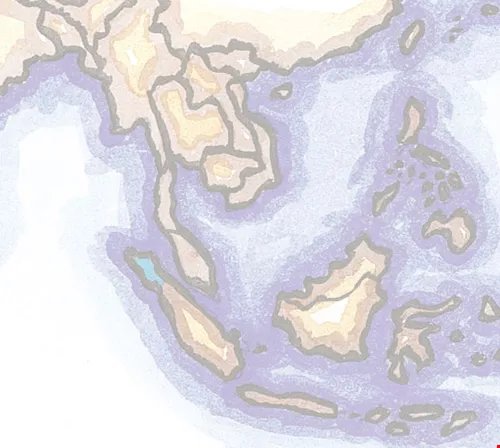
Tzu Chi Foundation aid in Aceh, Indonesia
Following an aftershock three days after the main earthquake, Tzu Chi's Indonesian mission sent a five-person team to Aceh to investigate. They set up bases at the Banda Aceh airport and in Medan. They mobilized 30 people to distribute food, clothing and other urgently needed supplies every day for two months. They also looked for a place to erect a tent city and acquired tents from mainland China. Three months after the tsunami, Tzu Chi had a tent city in place in Jantho, a few dozen kilometers away from Banda Aceh. "Our tents were only intended to provide a temporary refuge," says Lie Sarpin. "But they were large-3.6 meters by 4.8 meters-and were still in good shape after more than a year of use. Our tent city was generally acknowledged to be the best maintained of them all."
Tzu Chi broke ground on the Great Love villages nine months after the tsunami. Lie Sarpin, who oversaw the construction, says that the project encountered one obstacle after another. Nothing, from finding the land and sourcing the materials to actually getting the work done, went smoothly.
Tzu Chi budgeted US$30 million for 3,700 residential units spread over four locations. The group was to handle the construction-modeled on the Cengkareng Great Love Village it had built while restoring the Angke River-on land provided by the Indonesian government. In addition to homes, each community was to include schools, medical clinics, mosques, and meeting halls on sites.
But the plots the government offered were too small, too distant, or too rugged. Tzu Chi searched another six-plus months to find a good site for the Panteriek community. They ultimately found a spot only a ten-minute ride from downtown, making it easier for residents to earn a living. Unfortunately, the new site was only large enough for 540 units, and Tzu Chi had promised more. The foundation therefore spent more than a year filling in a portion of a riverbed to make space for 200 additional homes.
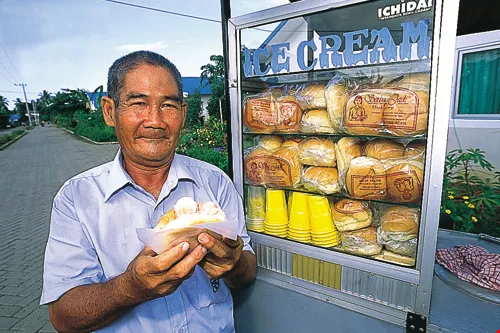
(left) Hsieh Li-lung, an ice-cream vendor, is an ethnic-Chinese Acehnese who had a poor relationship with Aceh's Chinese community. Tzu Chi took him in and hopes to change him.
Building materials were in short supply after the tsunami. Cement, wood, paint, and floor tiles all had to be brought in from outside, and heavy demand drove up prices for materials and transportation. Though the contractors had budgeted for price increases, prices went up faster and more sharply than they had anticipated. Unable to bear their losses, many builders abandoned jobsites before work was complete. Some simply absconded with the money. Others completed the exteriors, but didn't connect the power or water. Delay after delay slowed things further, diminished the quality of the work, and prevented people from moving in.
"Fortunately, our assistant director Sugianto Kusuma works in the construction industry," says Lie Sarpin. "He sought out a large, partially state-owned contractor with which he'd worked for many years, and right off got an agreement that prices for materials shipped from Jakarta would not be increased." Lie says that Tzu Chi signed the agreements for all 3,700 units at the same time, and paid 30% upfront to secure guarantees from the contractor.
Though they took measures to secure the project, some things just weren't foreseeable. For example, locals beat up the workers the builder brought from Jakarta. "They felt the Javanese were stealing jobs that were rightfully theirs," explains Lie. The two regions have a history of conflict, and old enmities broke out afresh. Similar troubles arose at all the Tzu Chi locations, forcing the builder to use Acehnese workers who had less construction site experience than those the builder had originally hired. Tzu Chi had expected to complete the communities in 18 months at the most, but only the Meulaboh community in western Aceh was ultimately finished on schedule. The other two took two full years. The delays and the fact that the government was unable to make sufficient land available also compelled cuts in the total number of units, from 3,700 to 2,700.
Tzu Chi's ethos is to do its best at everything it undertakes. Even though the Great Love villages encountered numerous obstacles on their way to completion, they were very well designed. For example, Tzu Chi built the walls from fiberglass-reinforced concrete, a material not only capable of resisting a magnitude 8 earthquake, but that actually becomes harder when exposed to fire. The communities also provided reliable water supplies. In areas where there was insufficient pressure in the government's water mains, Tzu Chi footed the bill for wells. Streets and alleys are broad-major thoroughfares are five meters wide-and surfaced with easily replaced interlocking bricks.
The communities naturally attracted attention, which gave rise to another challenge-establishing selection criteria for residents.
Most NGOs simply used the list of disaster victims in need of aid provided by the Indonesian government's Rehabilitation and Reconstruction Agency. But Tzu Chi was concerned that Indonesia's endemic "gift" culture might result in units ending up in the hands of people who didn't truly need them. It therefore used a much more time-consuming and unpopular method-it screened the list itself.
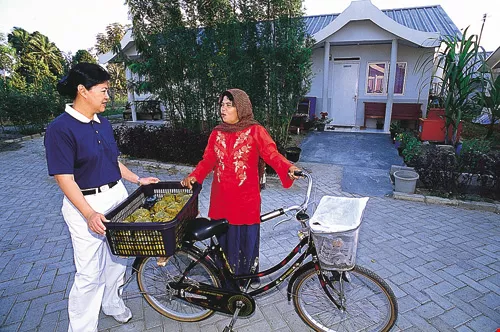
Aida Angkasa (left), a Tzu Chi volunteer from Medan who is raising two children on her own, acts on the principle that it is better to give than receive. Here, she is pulled aside for a chat by a resident of the Panteriek Great Love Village while out on a morning stroll.
"We interviewed people one by one," says Aida, who was involved in the entire vetting process. She recalls that virtually everyone had lost all their documents, and Tzu Chi wasn't sure at first how to go about confirming the identity and status of victims. Lacking other alternatives, she and four local employees developed their own approach: they asked victims about their experiences in the aftermath of the tsunami, and about their work, families, and income. They also examined the ruins themselves. After double-checking potential residents' responses, Tzu Chi asked them to sign agreements stating that they would move out if it were later discovered that they were not in fact victims of the disaster. Over the course of two years, Tzu Chi ended up reviewing some 1,500 applications for just 716 units in the Panteriek community.
"As a matter of principle, Tzu Chi carries out its disaster relief operations without regard for ethnic, religious, political, or socio-economic background of the people it helps," says Aida. "Any who have lost their homes to the tsunami and are without a place to live are eligible." Aida says that the Indonesian government ruled that only victims who owned homes and land were eligible to apply for reconstruction. Tzu Chi, on the other hand, felt that financially strapped renters were in even greater need of assistance. It therefore actively lobbied the government to allow former renters to apply, and became one of a very few NGOs to provide them with free housing.
"The Great Love villages were completed a bit at a time," says Aida, "so we had to establish a means of prioritizing applicants. Families with many young children, families which had lost the husband and breadwinner, and elderly victims were given preference." She recalls having to shrug off lobbying and turn away bribes during the vetting process, and says that Tzu Chi also came under pressure from the ethnic Chinese community.
Tzu Chi's emphasis on ignoring victims' backgrounds even resulted in applications from former rebel soldiers, people of whom the general public had been terrified.
Sayed Husaini, formerly a Free Aceh Movement guerilla, applied for a spot in the Panteriek community two years ago. Friends had told him that he needn't be Buddhist or Chinese to apply, but, having heard many stories of disaster victims being taken advantage of, he was initially reluctant. "I was a rebel soldier and a Muslim," he says. "How could something so good be available to me?" He visited two Great Love villages repeatedly to evaluate the situation for himself before finally taking the plunge. When he later reported back to the leader of his rebel troop, dozens more of his comrades moved in.
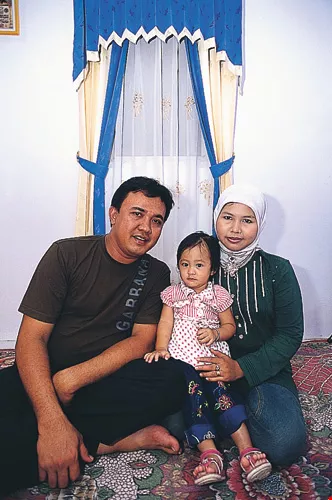
Surazi, a narcotics officer, lost his wife and two children to the tsunami. He now has a new home and family and a fresh start.
"Once approved, residents were matched to units by lot," explains Aida. "We didn't allow them to choose their neighbors or reject neighbors with different backgrounds than themselves." Tzu Chi declared at the outset that everyone would have to set aside their prejudices and get along. Once they moved in, she began telling them about Tzu Chi's good works-its medical relief work, its grants of materials, its construction of Great Love villages around the world, and so on. Her objective was to instill in them Tzu Chi's ethic of selfless giving and to inspire them to work together to maintain their new community.
Occasionally, community members get fed up with one another and have a big argument. When that happens, Aida steps into the fray. "Everyone should be grateful to be alive, not acting divisively again," she tells them heatedly. "The tsunami drove everyone away, regardless of who they were. If we'd ended up in a body bag ourselves, my hands and your feet would all have been in it together. Where would your divisiveness be then?" Many residents find their fondness for the straight-talking Aida tempered with a little fear, but they have come to trust and depend upon her nonetheless.
Surazi, a narcotics officer by trade, had his wife and two young children snatched from his hands by the tsunami. Though he has since remarried, he still thinks about the family he lost. When he's feeling low, or having trouble in his personal or professional life, he often seeks out Aida. Each time he does, Aida opens up a copy of Tzu Chi's Still Thoughts and offers guidance.
"I'm short-tempered by nature, but less so than I used to be," says Surazi. Aida's frequent mentoring on dealing with people and life has inspired Surazi to refer to her as his "godmother."
"I often encourage residents to get back on their feet with the idea that they shouldn't look down on themselves, that people have limitless potential," says Aida. She adds that she is constantly moved and comforted by the sight of victims of the disaster reclaiming their lives.
Take the Jamainurs, for example. The couple ran a prosperous noodle business with three locations about three kilometers from the coast. Then the tsunami stole their two children and washed their shops into the sea. The couple stayed in one of Tzu Chi's tent cities for a time, but were beside themselves with grief. For three months, they searched everywhere, hoping in vain that their kids would turn up. They were despondent and utterly dependent on Tzu Chi's aid to make it from one day to the next.
Everything changed when they moved into the newly completed Panteriek community. Seeing the Tzu Chi personnel working so hard on behalf of strangers was bracing. "Three months later, we wanted to start a business," says Jamainur. He and his wife found further solace in the adorable daughter Allah gave them. They've now settled back into their hardworking routine.
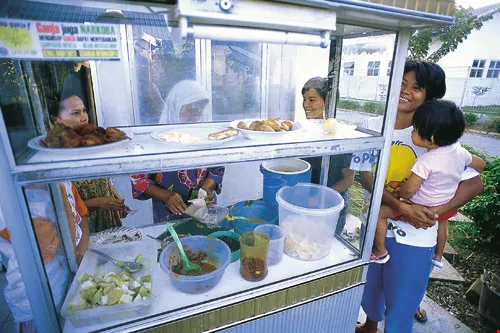
The small food stall these village residents run in front of their home is a good spot for chatting and gossip as well as food.
Tzu Chi's Indonesian mission has no bases or volunteer organizations in Aceh, which is still under martial law. Instead, Aida takes an hour-long flight from Medan to Banda Aceh every month to handle the affairs of two of the Great Love villages. There's a clamor in the office every time she comes back, and the food never stops coming. Someone will bring by some fried noodles, then somebody else will show up with grilled fish and meat. Other people will drop by to chat or ask a question. Everything revolves around her and everyone gets along beautifully.
The tsunami victims have seen for themselves how dedicated and attentive Tzu Chi has been to their needs, and they've been moved by it. As the large, dark and still somewhat menacing Sayed Husaini suddenly added at the end of this interview, "I'd like to ask you to pass something along. If in the future some other area needs donations for disaster relief, I hope people donate to Tzu Chi. We feel they were genuinely fair to us." Husaini cites the housing built in Banda Aceh by another NGO to make his point: He says you had to have connections to get into the units, and many ended up being occupied by friends of officials rather than tsunami victims.
Giving voice to a noble aspiration, Azfili, the lawyer elected to head the Panteriek community's "West Village," says: "It is a point of pride that those of us here are not divided along ethnic, religious, or class lines. Everyone gets along. I hope to bring everyone still closer together, to encourage the wealthy to donate to the poor, and erase the lines that separate us."
The Tzu Chi Foundation believes that it must "help the poor and educate the rich." It aims to inspire the people it aids to help others and to lead everyone to spiritual fulfillment. It appears that in distant Aceh, the Tzu Chi way is taking root.
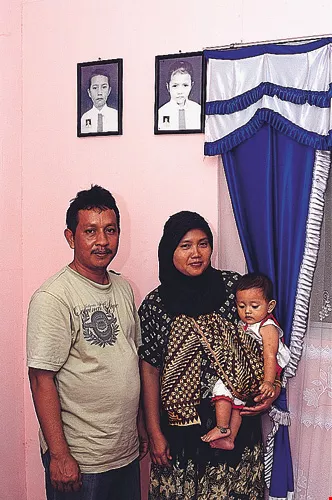
The Jamainurs, who used to own noodle shops, were distraught after losing their children to the tsunami, but have begun to recover. Since moving into the Great Love Village, they have restarted their business and thank Allah for their adorable new daughter.
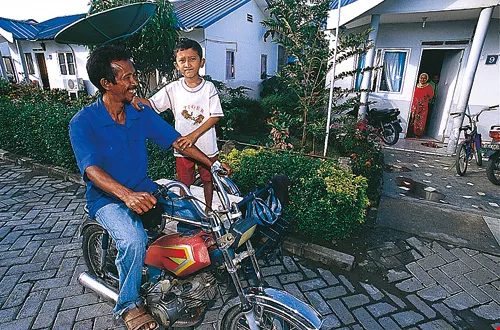
(right) T. Manyak, a casual laborer, has a son with a severe cleft palate. Two trips to Medan with Aida for surgery greatly improved his condition, and now the boy is all smiles.
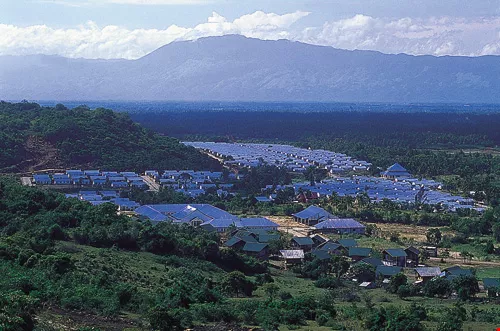
The 800-plus units in Aceh Besar's Neuhuen Great Love Village, set in a lush grove of trees, are now complete.
@List.jpg?w=522&h=410&mode=crop&format=webp&quality=80)

@List.jpg?w=522&h=410&mode=crop&format=webp&quality=80)


@List.jpg?w=522&h=410&mode=crop&format=webp&quality=80)

@List.jpg?w=522&h=410&mode=crop&format=webp&quality=80)
