For the Love of Matsu Folk Religion Builds Bridges Across the TaiwanStrait
Ventine Tsai / photos Hsueh Chi-kuang / tr. by Brent Heinrich
April 1995


On Meizhou Island, a group of village women were drawing up plans to renovate the Mother Temple of Matsu, goddess of the sea. But at the very same time, the military garrison stationed in the area was making preparations to tear the temple down, on the grounds that it was a "superstition which blocks progress and hampers military preparedness." When the Fujian Provincial Party Committee's general secretary posted an official notice proclaiming "Demolition Temporarily Delayed," those simple words commenced a new era for Matsu of Meizhou Island.
Popular religion is on the ascent in mainland China. And among the many folk deities, Matsu, the goddess of sea navigation and patron saint of fishermen, has the single greatest reputation. Particularly prestigious are the Matsu temples of Meizhou Island. Great numbers of Matsu believers from Taiwan have traveled there to worship, competing with each other to contribute cash and bind themselves as bosom kin to the grand old temples. And in terms of her practical value in facilitating good relations between mainland China and Taiwan, Matsu has also become the "Goddess of Cross-Strait Peace," her position truly divine.
In the utter silence and pitch-black night, Xiao Ashi, chairman of the Temple Protection Committee, tracks the inspection troops of Matsu along the road. Relying on the distant sound of gongs and drums and the spray of sparks incessantly drifting in and out of vision, this Meizhou native skillfully picks out a course through the unlit fields. The sound of gongs and drums gets nearer and nearer. We pass through a narrow lane, and a vision suddenly appears before our eyes, reflected in the light of fire--a huge procession of people and horses. Some folks carry incense; others are striking large gongs. Some are bearing little palanquins in which are seated statues of the village gods; they excitedly crowd around Matsu's seat of honor as it moves its way forward.
On either side of the little road, the womenfolk setting rice husks aflame to light the way for Matsu catch a glimpse of the goddess approaching and frantically kneel down en masse, anxiously bowing their heads. It is as if they are placing all of their hopes in this one act of supplication. We come to the home which has been chosen as the quarters where Matsu will rest for the night; the entire house has been wrapped in red cloth, to wipe away all uncleanliness. On a table are laid out offerings, 40 kinds of "reverential beasts of the sea" made of flour.
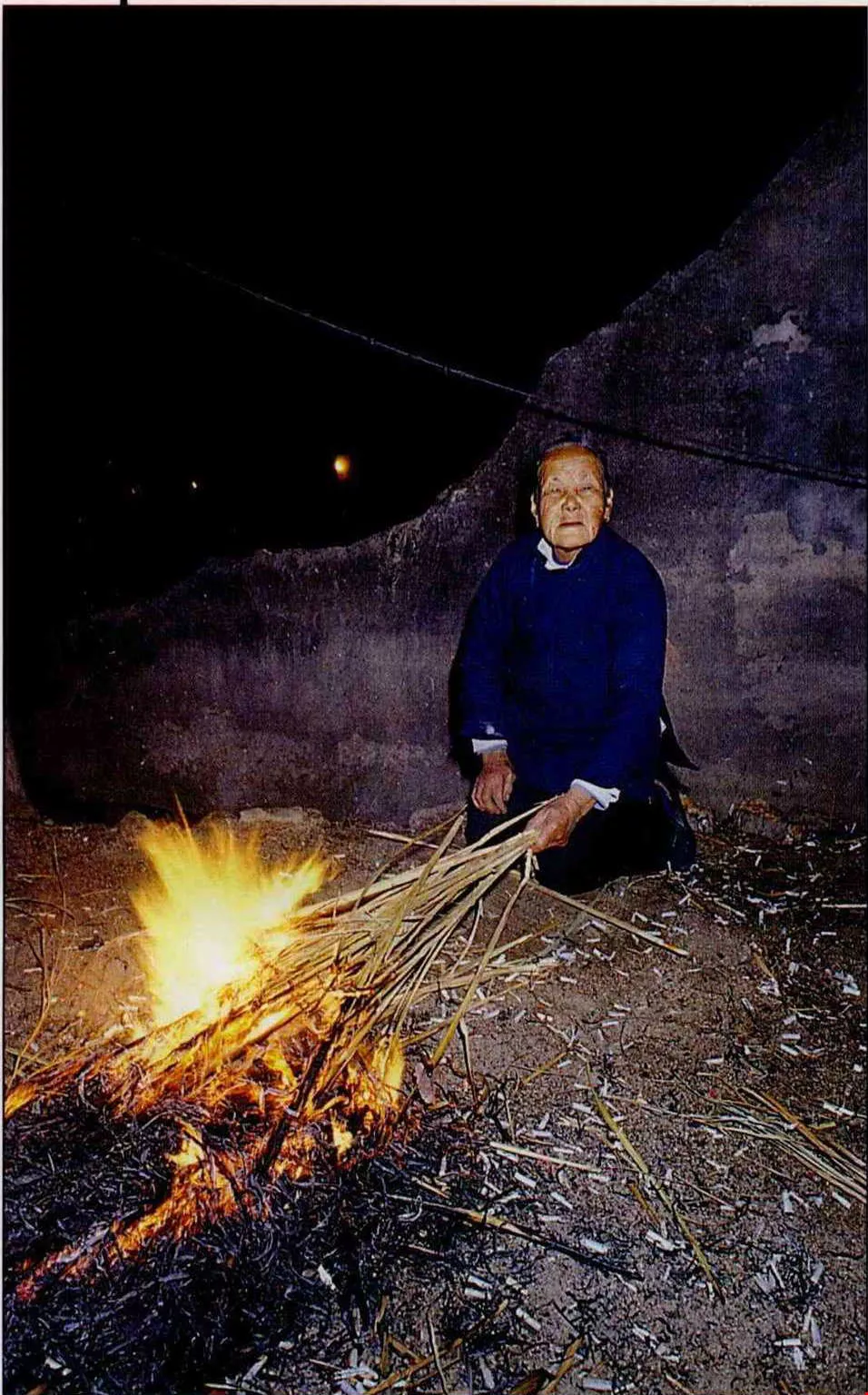
Along the little path that has no street lamps, the womenfolk reverently kneel down, setting rice husks aflame to light the way for Matsu.
We've seen it many times before
In the square in front of the village temple, a huge circle of people has formed. A bonfire has been set in the inner courtyard. As the Taoist priest scatters salt and rice to clear the road of evil forces, two psychic mediums ride in on sedan chairs with knife blades for seats. They stand opposite each other on either side of the fire and leap across, exchanging places. Then placing themselves at opposing edges of the fire, they begin to whirl like dervishes. The villagers who form a circle and look on take a few steps back of their own accord. "They're going to hold a competition of magical powers! They're going to start spinning faster and faster. Be careful," a girl of 15 or 16 warns us.
"They're going to eat the fire blossoms!" Upon this summoning cry, the crowd jostles back to the square, where a tall platform has been constructed. When they see the ten or so enormous sparklers set off simultaneously, the two mediums, their upper bodies bare, lean forward and devour the spouting rain of sparks, as if enjoying a feast. When we ask some of the onlooking girls if they are afraid, they all reply unanimously, "We're not afraid. We've seen it many times before."
On Meizhou, an island of only 14 square kilometers, there are 13 Matsu Temples, including the widely famous Mother Temple. Every Lunar New Year, Matsu (in the person of a statue) starts out from the Mother Temple on her inspection and goes door to door through all the villages and neighborhoods, bestowing good fortune. On the day before Lantern Festival, she returns to the Mother Temple, attended by a crowd of village folk.
When midnight passes on the night of Matsu's return, the women take the flowers from Matsu's head and put them in their own hair. The incense smoke stings so intensely that one cannot open one's eyes. The Matsu idol being carried back is completely covered in notes of RMB 5 and 10. These offerings are not as great as those that Taiwanese pilgrims make, but "the Mother Temple's glory comes from the atmosphere of worship that is stirred up there," notes Academia Sinica researcher Lee Fong-mao, who has visited Meizhou Island.
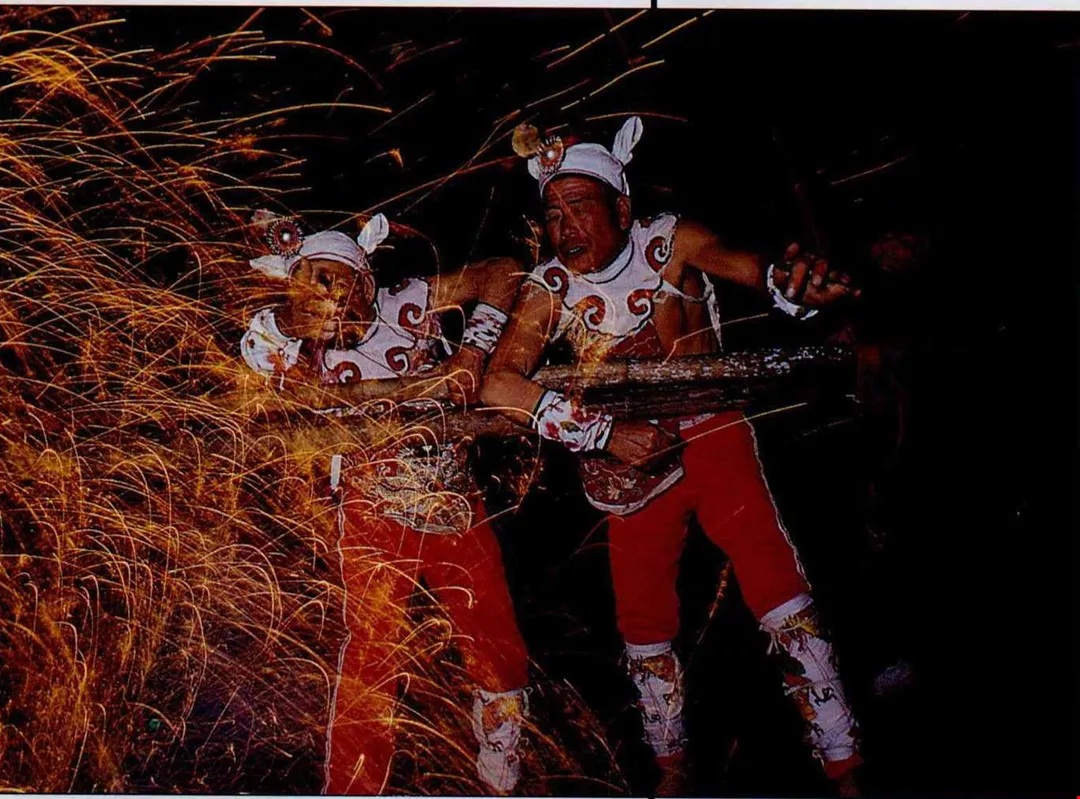
Amidst the voluminous din of gongs and drums, the mediums face ten enormous sparklers, acting out the ritual of "eating the fire blossoms" and bringing the celebrative atmosphere to its apex.
When we began our revolution
Seeing the Matsu Mother Temple, perpetually thronged with worshippers, and the group of temple buildings completed one after another, it is hard to imagine that this was once a deserted wasteland.
During the Cultural Revolution, in order to wipe out "reactionary superstition," monks and nuns were forcibly defrocked, and sacred statues were demolished. Traditional operas were changed into Model Operas. Masters who specialized in making paper possessions to accompany the dead into the afterworld were forced to make dunce caps for the victims of struggle sessions who roamed the streets. Temples were turned into schools or factories.
Scholar Li Yukun, who participated in a preliminary survey tracing the historical roots of Matsu in the PRC, notes that several years ago when they were undertaking their survey, which stretched from Shandong to Hainan Island, most of the temples were still in use. At the rather luxuriant and well-reputed Empress of Heaven Temple of Quanzhou, on the ruins of what was originally Matsu's Adornment Pavilion has been erected a school dormitory. But with no obvious purpose or useful value, the Meizhou Temple was utterly abandoned.
Because of this, after the Cultural Revolution, most people were still extremely nervous about matters pertaining to religious superstition. Nevertheless, in the mountain heights of Meizhou, renovation work on the Mother Temple was already surreptitiously underway. The pioneering spirit in this endeavor was none other than a lady named Ah Bei who had never been to school.
On Meizhou Island women benefit from the glory of Matsu. After they marry into their husband's family, wives of sons are counted as naturally born children in the family. So it was that everyone in her husband's clan got into the habit of referring to Lin Congzhi as "#8" (the eighth child, or in Fujianese, "Ah Bei"). She and two other women, Ah Li ("#2") and Ah La ("#6"), all claim that Matsu visited them in dreams, and this compelled them to go up into the mountains and rebuild the temple. "At the time, to go up the mountain, you had snap off branches from the trees to make your way," says Ah Bei, recalling the extent to which the Mother Temple had fallen into neglect.
A number of middle-aged ladies shared the task of carrying stones and digging. Together they put up a small shrine similar to those dedicated to earth gods. And they went through the preparatory rites for obtaining a sacred Matsu statue. Gradually, more women joined them. They established a society with clearly designated responsibilities and appointment schedules. Then with people taking turns on a daily basis, they put up the first hall of the Meizhou Mother Temple complex. When she relates the tale of the risks they took in constructing the temple, Ah Bei often says with a smile, "At the time when we began our revolution. . . ."
It is also because of Ah Bei's accomplishment in initiating the revolution that she took up the post of executive chairperson of the Meizhou Mother Temple board of directors. She leads 110 employees and manages everything on the mountaintop site. On Matsu's birthday it is she, Ah Li and Ah La who comb Matsu's hair.

RMB bills of 5 and 10 cover the statue of Matsu, clustered like paper flowers. Although the denominations are not large, the gifts serve to express what is in the hearts of the believers.
The Goddess turns red?
Today in mainland China, Buddhism, Taoism and Catholicism are all allowed. But for folk religions such as "Matsuism" which have no doctrines and whose activities are not lacking in unscientific popular beliefs which fall in between ritual and superstition, the mainland policy is basically not to forbid, but not to encourage. Therefore, Matsu temples beyond the provinces of Fujian and Guangdong are mostly obsolete and empty of worshippers. For example, at the Empress of Heaven Temple in Shandong's Yentai, China's northernmost Matsu temple, where the architecture and sculpture are all top notch, renovation has recently been finished. The temple exists, but the goddess is absent. The Putian City Civic Association once suggested that the Yentai Temple be given a Matsu statue, but their request was rejected. "They simply don't want people to return there to worship," explained Zhu Hepu, deputy secretary-general of Putian City's Matsu Research Association. The Meizhou Mother Temple, on the other hand, is quite the opposite.
The preliminary construction of Meizhou's Mother Temple came about thanks to Ah Bei. Nonetheless, Matsu's prestige and position on the mainland is directly related to the interaction between mainland China and Taiwan. "The Meizhou Mother Temple is an absolute exception. Why among so many deities has she obtained the most attention? It's because there is something about her which attracts Taiwanese tourists," enthuses Fujian Normal University Associate Professor Lin Guoping, who researches Fujian's folk religions.
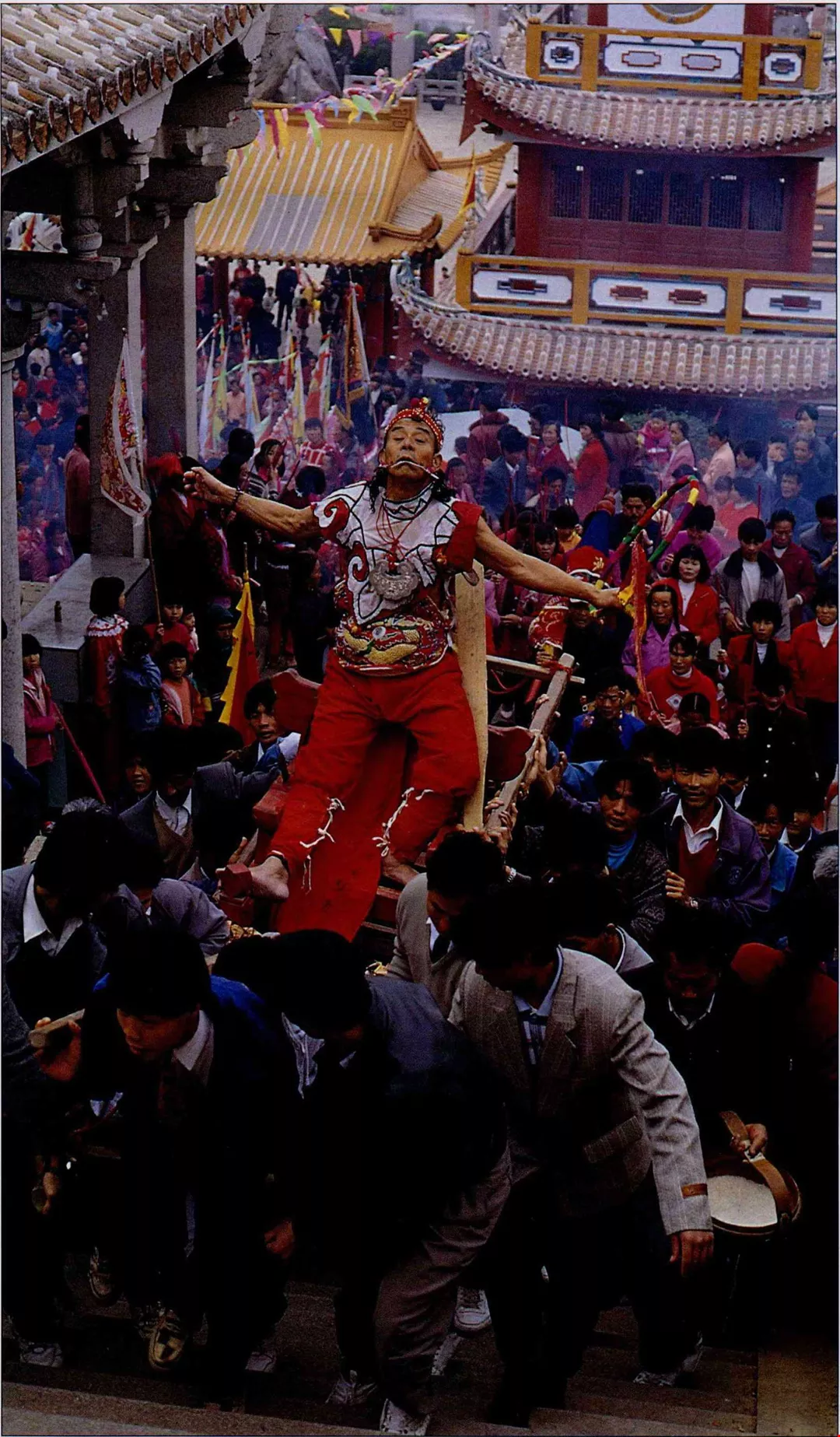
Such a magnificent display is still only the effort of the local citizens of Meizhou Island. If this were Matsu's birthday, when people from all over come to worship, the entire Mother Temple would be enshrouded in a fog of incense smoke.
At the fore of the Formosan front
As a matter of fact, if not for "considerations about Taiwan relations." the reconstructed Mother Temple would have been demolished by the military long ago. While the tensions between mainland China and Taiwan were still considerable, Meizhou was in the frontline of battle preparations. In the mountains where the Mother Temple was located, the frontier force had constructed trenches and criss-crossing underground passageways everywhere.
Seeing that local residents had opened up roads on the mountain and also put up the temple, the frontier force ordered them to raze the temple, on the grounds that it was a "superstition which blocks progress and hampers military preparedness." A dispute erupted between the two sides. Ultimately they resorted to the highest authority of Fujian Province, the general secretary of the Provincial Party Committee. "Under the consideration that the Mother Temple is closest to Taiwan and that it might become the frontline in addressing the Taiwan question, he posted an official notice which proclaimed 'Demolition Temporarily Delayed,' and the Mother Temple was saved," says Zhu Hepu, who had previously interviewed the general secretary, recalling this anecdote of guarding the goddess.
This is actually no great wonder. A glance through the annals of the Matsu religion shows that official advocacy and encouragement were the most important reasons for Matsu's transcendence from a country witch to the Empress of Heaven and her deification as the national guardian spirit of navigation. The governments of various dynasties put an emphasis on Matsu, because of practical necessity in terms of navigation and foreign diplomacy.
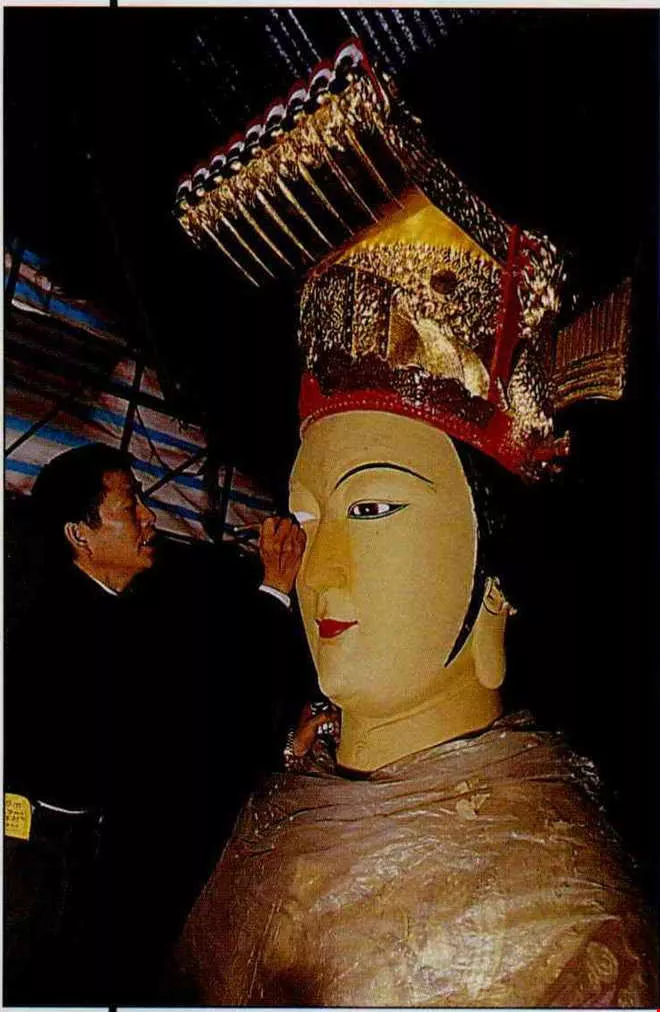
At Quanzhou's Empress of Heaven Temple, workers rush to finish this wood carving of Matsu, destined for Taiwan, where it will become the island's "largest" statue of this kind. Such attitudes which place a premium on size have given rise to the many strange "Matsu phenomena.".
Proletarian heroine
After the Mother Temple was saved, Lin Wenhao, who was Putian City Civic Association chairman ten years ago, and is currently the executive director of the Meizhou Mother Temple, went a further step in bringing the Matsu religion aboveboard. At the time some people accused him of being a godfather of superstition. His answer was, "I don't think I am involved in reactionary superstition, because Matsu is a down-to-earth proletarian. She attends to the illnesses of fishermen, and she salvages shipwrecks. She is a person who has made contributions to history." Thereupon, Matsu, who has shifted from witch to Empress of Heaven, was also transformed from empress to national heroine. At last she marched out from under the shadow of backward superstition.
Then Lin Wenhao organized the Matsu Research Association, which publishes specialized books on Matsu and has organized an international academic seminar to discuss the motivating factors behind Matsu worship. During a National Civic Association seminar focusing on Matsu, one scholar stood up and said, "Matsu is the Lei Feng of the Song Dynasty." (Lei Feng was an ordinary Liberation Army soldier who was exalted as model by Mao Zedong. Before he died, he did countless good deeds.) The scholar won the applause of the conference attendees.
Besides finding a reasonable identity for Matsu, many scholars also mentioned the essential influence Meizhou's Matsu has had in terms of the interaction between the mainland and Taiwan. First of all, Matsu holds powerful magnetism for Taiwan's believers, which has resulted in increased pressure for greater exchanges in terms of commerce, postal services and transportation. In addition, Matsu can call for more investment from Macau, Hong Kong and Taiwan. In this way, Matsu, once maligned as "interfering in frontier defense," has joined the vanguard in addressing the Taiwan question. This reactionary superstition, once categorized as one of the "four olds," turned out to be beneficial to economic development and is helping achieve the "four modernizations."
With such a model, whenever a new Matsu temple is constructed, the faithful will be sure to put up a commemorative plaque which says: "Promoting and glorifying Matsu culture, sharing the passions of the people and quickening the pace of the unification of China." Under the multifaceted perspectives of faith, politics and economy, the Matsu religion has created a special phenomenon on both sides of the Taiwan Strait.

This was once a patch of scorched earth. Today it is the site of the sprawling Mother Temple complex. The Matsu statue which stands upon the mountain top is bound in a mutual gaze with its distant twin sister at the Chaotian Temple in Peikang. (Courtesy ot Meizhou Island Travel Company)
Mecca of the Orient
For the most part, the Chinese of Taiwan originally migrated from Zhangzhou and Quanzhou. In order to safely cross the Taiwan Strait, their ancestors put statues of Matsu, goddess of sea navigation, in the boats they sailed. Up to the present day, it is calculated that two-thirds of Taiwanese are believers in Matsu.
Meizhou is the place where the Matsu religion originated; therefore, Meizhou is to Taiwanese believers what Mecca is to Muslims--the fountainhead of their faith. Early on before the ROC government opened up visits to mainland China, quite a few believers had already violated travel prohibitions and had made clandestine visits to worship Matsu. Later on, 20-odd fishing boats from Nantian Temple in Nanfangao, Ilan, audaciously challenging the longstanding policy forbidding commercial, postal and transport exchanges, sailed directly from Nanfangao to Meizhou to worship Matsu.
The law forbidding visits to the mainland was lifted in November 1987, and the following year, according to estimates by Meizhou's ferry dock ticket office, 37,000 Taiwanese believers arrived. They carried back more than 2600 statues of Matsu. Furthermore, due to the folk custom that sincerity is only demonstrated if pilgrimages are made three years in a row, the average number of people who have gone to Meizhou to pay tribute to the Mother Temple tops 100,000 a year, accounting for a tenth of the total amount of people who visit there. Usually before the tour guide opens her mouth, worshippers will laughingly tell her: "Miss, we've been here many times." The wave of worship tops its crest around Matsu's birthday, the 23rd day of the third month of the lunar calendar.
Around this date, Meizhou Bay is packed with fleets of boats, hoisted flags fluttering on their masts. The seven ferry boats especially assigned to fill the need sail to and fro non-stop. In the Mother Temple, "Matsu noodles" are put on the fire one pot after another. Even with more beds added in the island's hotels, some people still can't find a place to sleep and must return to Putian City for the night. As for worshippers from the mainland, they simply bring out the plastic sheets they prepare in advance and occupy the mountaintop, sleeping in the open. Taiwanese or Mainlander, the respect toward Matsu runs equally high.
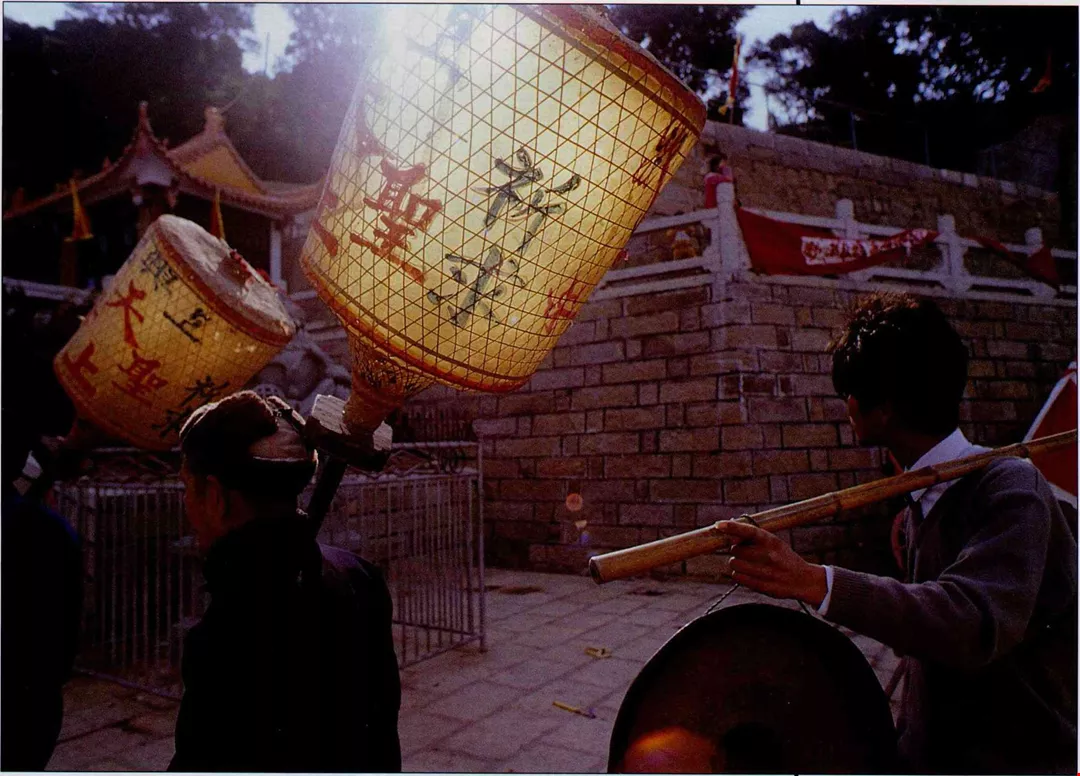
The lanterns are lit, the gongs are sounded. Even if the times are different and lifestyles are changing, the supplications made to Matsu are the same, generation after generation.
Look who has the thickest slice
The walls of Ah Bei's office are jammed full of photos of Ah Bei posing together with the chairpersons of various major Matsu temples in Taiwan.
If you walk on beyond the Mother Temple's main entrance, you might notice that most of the edifices are inscribed with the donors' names. Stepping up 323 stone steps, and looking up, you'll see the towering gate constructed on behalf of Tachia's Chenlan Temple. After passing through the main square, you'll find that the bell and drum pavilions situated on the left and right are dedicated by two business people, a brother and sister from Taiwan surnamed Chen. Turning left from the front hall, you're bound to come across the Adornment Pavilion (used to give the goddess her makeover before processions), which was put up by the collective contributions of the believers of Hsinkang's Fengtian Temple. On the path proceeding upward is the Chaotian Pavilion, situated behind the front hall and provided for by the worshipful donations of Lukang's Empress of Heaven Temple. And the 14-meter-tall pure-white marble Matsu statue which stands at the pinnacle is a gift of the Chaotian Temple in Peikang, where a completely identical marble statue stands gazing toward its twin across the Taiwan Strait.
In order to earn more authority, Matsu temples have long made competing claims to be the first in Taiwan. Nowadays, they compete with each other to tie up kindred knots with the Mother Temple to perpetuate their leading positions. Some temples have even asked the Meizhou Mother Temple to inscribe plaques for them with such titles as "First Matsu in Taiwan" or "Original Matsu." Nevertheless, being concerned not to offend any given temple, the Mother Temple has naturally declined the demand to "clarify their identity."
Where was Matsu Born?
While Taiwan's temples are competing with one another to lavish cash on Meizhou, several managers of the prestigious Matsu temples can't help but feel somewhat out of kilter.
"Meizhou is the sacred place of Matsu's birth, but Quanzhou is the base from which the Matsu faith spread to Taiwan," says chairman of Quanzhou's Empress of Heaven Temple Huang Bingyan. "Not to mention that when Meizhou was in a state of ruin, Taiwan's temples had already been coming to Quanzhou to search for their roots." Comparing the graceful architecture of Quanzhou's Empress of Heaven Temple, with its mix of Song style and Ming structure, to the entirely new constructions of Meizhou's temple complex, Huang Bingyan calls attention to the fact that the Mother Temple was still able to be appointed as a major province-level protected historic site, and with a tone of competitive spite, he adds, "That's just for raising the status of the Mother Temple. It's not very persuasive."
According to the Lin family genealogy, Xianliang Harbor, located on the mainland directly across from Meizhou Island, is the birthplace of Matsu, and both parties have been constantly disputing their claims. "Although long ago there was conflict over which locale was Matsu's birthplace, before the 1980s both the temples were quite at peace, and each had their own followers," states Jiang Weitan of the Putian City Literary and Historical Society.
What's in your heart
In the beginning there was only one Matsu. But within the special milieu of cross-strait politics and economic opportunity, some folks have begun to contend for fame and others to fight for money. In the end, a great deal of disturbance and turmoil has been generated; the Mother Temple is no longer just a simple place of worship. But to the inhabitants of Meizhou Island, it's as if nothing has happened at all.
In the early morning of the 15th day of the first month in the lunar calendar, some old ladies, dressed in Matsu suits, their trousers half black and half red, and their hair done up in "Matsu dos" (modelled after sailboats), were going to the Mother Temple to worship. On the sacrificial table was laid a simple offering of noodles, rice and oranges. One old lady laid down two red eggs. It turns out that she came here to thank the goddess because her wish to have a grandson was fulfilled. This is a big event in mainland China, where the one-child policy prevails.
One woman in her early thirties pulled out a jug of wine and four bowls that held flour gluten, dates and mushrooms. The sacrificial offerings were simple, but the worshipper's manner was entirely solemn and sincere. It happened that her husband and neighbors had bought a new fishing boat. She came here to ask for a talisman for her man to ensure his safety on the sea. It so happened that a Taiwanese pilgrimage group arrived here with mediums. When asked what she thought of the ostentation and extravagance of Taiwanese believers, she gave a simple reply: "It's nothing much. Whether you offer a lot or just a little, it's all to show your respect. lt's just an expression of what's in your heart." Her demeanor was neither humble nor haughty.
One Matsu temple is undergoing renovation in the village on the island. The one in charge collected RMB 10 from each person in every household. He got 50,000 altogether, not even close to the full amount needed. But the villagers did not force themselves to make any unnecessary sacrifices. Laughing, they said if they didn't have enough money, they still could put it up slowly, buying the building materials one batch at a time with the money they had. If the money was not there, there was no way of forcing a big temple into existence! Generation after generation of Meizhou people have been worshipping their Matsu in such an easy manner.
[Picture Caption]
p.86
Since ancient times, the residents of Meizhou Island have devoutly paid homage to their goddess Matsu. No matter how many new titles are given to her, Matsu will always be their most intimate "auntie."
p.88
Along the little path that has no street lamps, the womenfolk reverently kneel down, setting rice husks aflame to light the way for Matsu.
p.89
Amidst the voluminous din of gongs and drums, the mediums face ten enormous sparklers, acting out the ritual of "eating the fire blossoms" and bringing the celebrative atmosphere to its apex.
p.89
RMB bills of 5 and 10 cover the statue of Matsu, clustered like paper flowers. Although the denominations are not large, the gifts serve to express what is in the hearts of the believers.
p.90
Such a magnificent display is still only the effort of the local citizens of Meizhou Island. If this were Matsu's birthday, when people from all over come to worship, the entire Mother Temple would be enshrouded in a fog of incense smoke.
p.91
At Quanzhou's Empress of Heaven Temple, workers rush to finish this wood carving of Matsu, destined for Taiwan, where it will become the island's "largest" statue of this kind. Such attitudes which place a premium on size have given rise to the many strange "Matsu phenomena."
p.93
This was once a patch of scorched earth. Today it is the site of the sprawling Mother Temple complex. The Matsu statue which stands upon the mountain top is bound in a mutual gaze with its distant twin sister at the Chaotian Temple in Peikang. (Courtesy of Meizhou Island Travel Company)
p.95
The lanterns are lit, the gongs are sounded. Even if the times are different and lifestyles are changing, the supplications made to Matsu are the same, generation after generation.

@List.jpg?w=522&h=410&mode=crop&format=webp&quality=80)

@List.jpg?w=522&h=410&mode=crop&format=webp&quality=80)


