Bean Roaster Jacky Lai Brings Home a Coffee Cup
Liu Yingfeng / photos Jimmy Lin / tr. by Phil Newell
January 2015


2014 was a banner year for Taiwan’s coffee community, as competitors from Taiwan made a big splash at a variety of international coffee competitions. In particular, Jacky Lai, a 34-year-old with 13 years of coffee experience, brought home the top prize for bean roasting in the World Coffee Roasting Championship, a feat that really opened the eyes of observers to the surprisingly high skill level among coffee professionals in Taiwan. Driven by what he describes as a “crazy dream,” Lai, for whom roasting is part of a larger java journey, is a force to be reckoned with.
A red congratulatory banner celebrating the top prize at the 2014 World Coffee Roasting Championship hangs gracefully from the green sign of Café Wakeup. As befits the shop’s name, the banner is a real eye-opener.
A couple of decades ago, when the fad for high-grade coffee had yet to arrive in Taiwan, most people’s first experience with the beverage was “three-in-one” packs of instant coffee mixed with powdered creamer and sugar. Lai, though then only a child, says that the combination of bitterness and sickly sweetness still seems to linger on his palate to this day.
In 2001, Lai left his home in Yilan County to study in the Department of Visual Communication Design at TransWorld University, located in Gukeng, Yunlin County— Taiwan’s most important coffee producing area. While in school Lai took a part-time job in a restaurant, where the boss put him in charge of roasting the coffee beans. Though that might sound like a heavy responsibility, in fact at that time it was seen as the easiest job in the joint.
Having thus been introduced into the fragrant coffee cosmos, Lai began to collect books on the subject and to study brewing techniques on his own. The obsession spilled over into his schoolwork, as his projects for classes like marketing and design all were coffee-related. In 2008, when Lai graduated and left Yunlin, he began searching on the Internet for specialists all over the world teaching advanced coffee skills, and his search, ironically enough, took him back to Yilan, where he began learning from George Wang, a well-known and highly respected expert in Taiwan.
During his four-and-a-half years of study, he started from square one: drinking coffee. More specifically, he had to develop his palate to appreciate the subtleties of authentically good coffee. “Just as a chef has to understand how to discern the taste nuances of fine cuisine before he can learn to make it, you have to know what good coffee tastes like before you can produce a high-quality roast,” Lai explains. The experience that Lai gained in these two jobs was all directed at realizing a dream that first came to him as a notion in his student days: opening his own coffee shop.
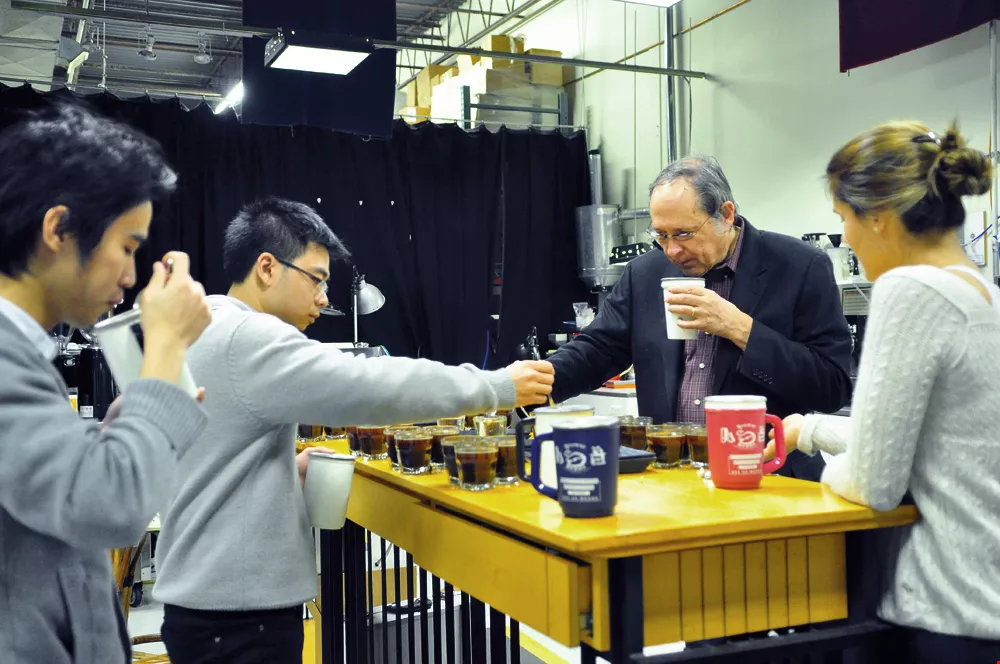
In his pursuit of coffee excellence, Jacky Lai has even traveled abroad to seek advice and instruction from famous coffee masters, leaving no doubt that he takes his vocation very seriously indeed.
In 2012, Lai left the coffee shop where he was working to strike out on his own. Before going into business, however, he first embarked on a java journey to learn from the best. He visited New York, Seattle, Washington DC, and Boston, where he went specifically to pay his respects to a coffee master whom he had long admired named George Howell.
Lai explains that he once tried some coffee made from beans that had been roasted by Howell, and it was awesome. As soon as he took the first sip, his nasal passages and throat were suffused by a blackberry-like fragrance, and a sweet and aromatic sense of roasted sugarcane was left in his mouth. He was also enthralled by the citrus acidity in the aftertaste. On the spot he decided that he would visit the US to learn the secrets of this maestro’s success.
After enormous effort and some help through his friends’ connections, Lai was finally able to meet Howell in person. Thrilled, Lai blurted out “Oh! Coffee Master!” to his idol. Howell, a very affable man, took Lai on a tour of his own coffee roasting plant, where Lai tried out for the first time the highly specialized equipment. This was an enormously enlightening experience for Lai, who had just taken his first steps in the business.
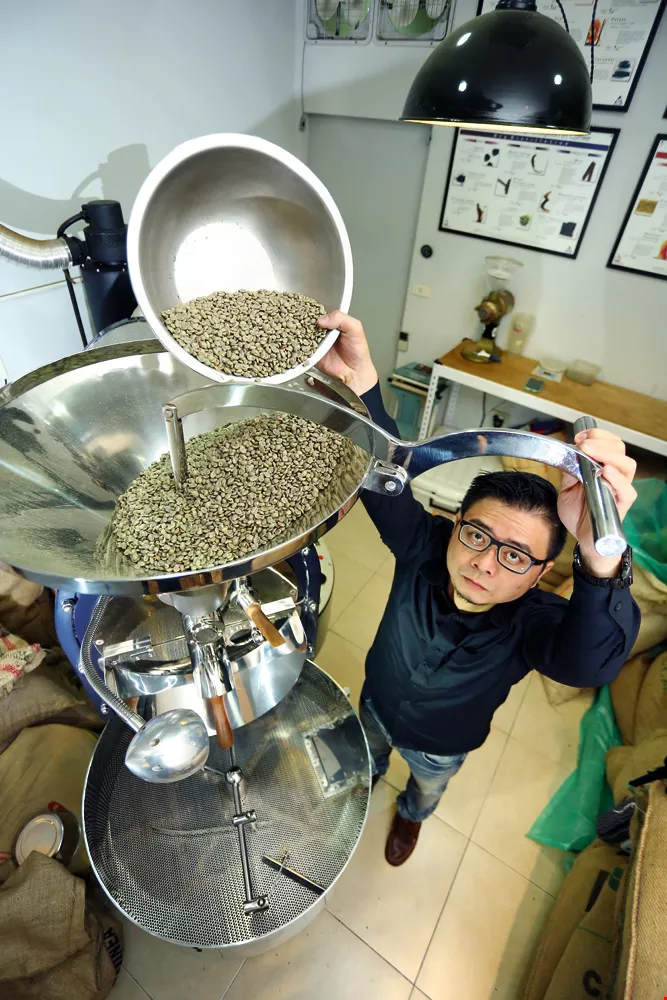
Lai is meticulous about which beans he uses, and once he starts putting them through his equally meticulous roasting process, it’s not long before the delightful aroma of coffee scented with nut and berry flavors permeates the air.
In April of 2012, having completed his month-long coffee tour, Lai returned to Taiwan, his mind filled with things he had learned and new ideas that were inspired by his experiences. With only one small coffee roaster purchased with funds provided by his former employer Qiu Shizong, Lai opened his first shop, Café Wakeup.
However, even as Lai was still sharpening his skills, he immediately had to deal with the pressures that come with managing the business of a coffee shop. Fortunately, after half a year or so, thanks in part to a series of coffee tasting events held by Café Wakeup, Lai had steadily built up a clientele of coffee connoisseurs. The small roaster he had first used was no longer sufficient to meet his needs, so he upgraded to a larger type—costing NT$350,000, and with a roasting capacity of 30 kilograms—to meet the flourishing demand for his java.
Little did he expect that he would immediately hit a wall. Lai relates that the taste of coffee beans is determined by several factors, including the temperature of the air in the roasting barrel and the temperature of the beans themselves. If the controlling factors change, the results will change as well. Lai tried many times to roast beans with his new equipment, but the results didn’t meet his expectations, leaving him vexed, perplexed, and wondering what to do next. “Once I roasted 70 or 80 kilos of beans at one time, but because the flavor was not optimal, I threw the whole batch out.”
The reason that Lai stuck to his high standards is that, for him, the coffee beans he roasts are a manifestation of his own inner self: it is not coffee that he is putting out there, it is Jacky Lai. He says that if sales are poor, you can always blame impersonal factors like lousy materials or a misguided marketing strategy. But the taste of his coffee beans is entirely in his own hands, and depends entirely on his mastery of the art. He says, “If the beans are badly roasted, it proves I just don’t make the grade skill-wise. Who else could I blame for that but myself?”
In 2012 Lai earned his certification as a “coffee cupping” judge from the Specialty Coffee Association of America, and went on to gain specialty certification from the Specialty Coffee Association of Europe (SCAE). In order to upgrade the skill level of his whole team, Lai has provided funding for staff who have worked for him for at least one year to register for the barista certification exam, and he has also invited experts from the SCAE to come to Taiwan to give classes to his employees.
Lai, who benefited so much from George Howell’s selfless sharing of expertise, has adopted the same spirit. Along with some coffee aficionados of diverse backgrounds in biology, physics, and mechanical engineering, he has organized a group which meets regularly to exchange ideas. “In these meetings we have solved a lot of practical problems, from something as small as the ideal setting of the gas flame for roasting to matters involving machinery and facilities,” says Lai.
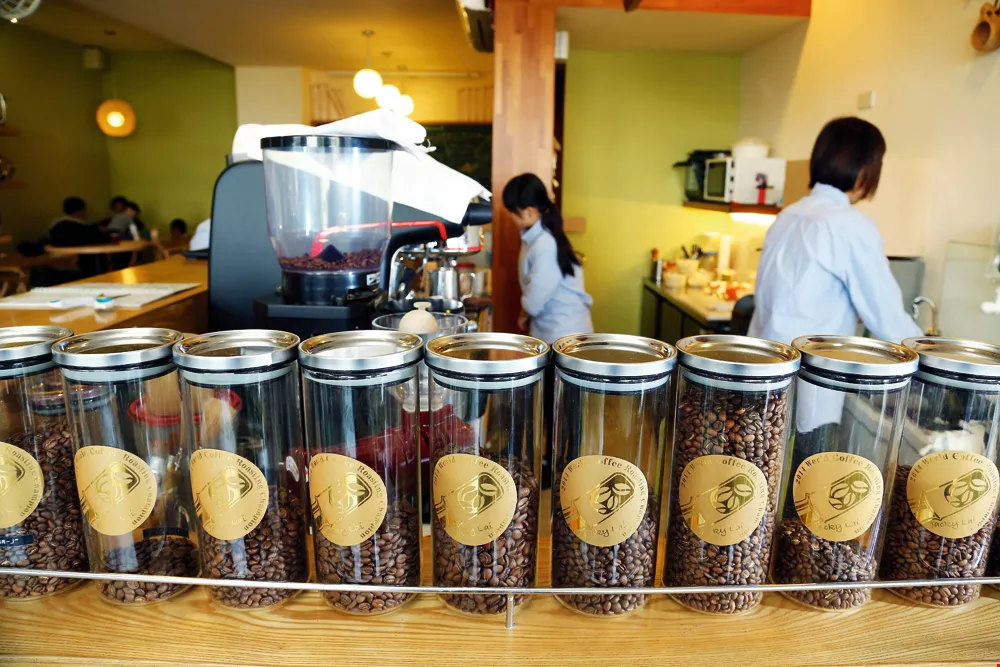
Some have criticized young people for lacking entrepreneurial drive, with small independent coffee shops singled out as examples of limited vision. Jacky Lai is proving that generalization to be dead wrong.
By 2013, Lai had accumulated 12 years of experience with coffee. In an effort to confirm his qualifications, he decided to compete in the WCE World Coffee Roasting Championship—known by insiders as the “Oscars” of coffee-bean cooking. He did not anticipate that his adversaries would be so accomplished that he would finish only 12th in the Taiwan regional round. But he came back again in 2014, and this time was named Taiwan’s roasting champion. Two weeks later, he flew to Italy to represent Taiwan in taking on the finest coffee roasters in the world.
The first day of the competition, Lai discovered that the organizers had elected to use bean roasters made by Giesen, a type of machine rarely found in Taiwan. In contrast to competitors from Japan and Korea, who had practiced on this model prior to the event, Lai could only try to familiarize himself with the machine at the venue, to get it into an optimal state as quickly as possible.
Lai next found himself confronted with a second challenge: The organizers decided that competitors would all have to use the same type of coffee bean for comparison. In the past, participants had been allowed to choose one of three types of approved beans. But in 2014 the rules were changed so that everyone had to use a single type. Lai had originally thought that he could use his expertise in cupping to get an edge on his rivals, but now he had no choice: everything would come down to the roast.
The participants all simultaneously produced their coffee for tasting by the judges. Because the distinctions between them were miniscule, by the end it was difficult for even the competitors to tell which coffee was their own! “These were all top-notch roasters from their respective countries,” Lai explains, “and there was only a nano-difference between the final roasted beans.”
Lai says that his own roast did not come up to his initial expectations, so he thought that his chances of winning were remote. That’s why he was startled when he was declared the 2014 world roasting champion.
Basking in the glory of this honor, Café Wakeup’s business has soared. Currently, in addition to the original Café Wakeup and three “Oh! Café” outlets which specialize in take-out orders, Lai plans to open a multi-functional “coffee factory” near the Kaohsiung Museum of Fine Arts that will be part coffee shop, part bean roastery, and part classroom for specialized training.
After Lai won the title, TransWorld University president Hsu Shu-hsiang specially organized a group to head down to Kaohsiung and present Lai with an award as a “distinguished alumnus,” thereby gracing the small coffee shop of only about 160 square meters with yet another accolade. As we say goodbye, Lai, who describes himself as a kind of “crazy dreamer,” stands before the championship cup that he brought back from the world roasting event, a slight smile on his lips, eyes closed, and inhales the rich fragrance out of the coffee cup in his hands.
@List.jpg?w=522&h=410&mode=crop&format=webp&quality=80)

@List.jpg?w=522&h=410&mode=crop&format=webp&quality=80)
@List.jpg?w=522&h=410&mode=crop&format=webp&quality=80)


