

At the 2009 World Games in Kao- hsiung, 50 "hip-hop Prince Nezha dancers" roared into the opening ceremonies on scooters, from which they dismounted to launch into a uniquely Taiwanese dance routine that featured elements of temple-parade troupe performances combined with an unmistakable air of hip hop. It was all very entertaining for the foreigners in town for the games, and for local Taiwanese it stirred up collective memories of temple fairs. The internationally televised event, moreover, afforded Taiwanese folk beliefs and traditional embroidery a rare appearance on a global stage.
The resulting hip-hop Prince Nezha dancers craze prompted the Temple of the Prince in Xinying City, Tainan County to hold the first-ever national competition for hip-hop Prince Nezha dancers this past February. The hotly contested event was won by a troupe from Puzi City, Chiayi County, who wore imperial robes and armor crafted by Shen Fu Creative Embroidery, a firm that has risen to fame on the strength of the "miniature deity outfits" that it has introduced to the market.
The "miniature deity outfits" derive from the deity outfits worn by temple gods throughout Taiwan. The firms that make them are engaged in a business that is virtually unique to Taiwan, and over the course of a mere 40 years the industry has cycled through its start-up phase, boom times, offshoring, and brand building. Indeed, the specialty stands out as a bright star today in the firmament of Taiwan's cultural and creative industries. Shen Fu Creative Embroidery, one of the leading firms in the industry, got its start in the 1950s in Puzi, and today a third generation of the Zhou family is running the firm.
A special type of embroidery known as Puzi embroidery rose to prominence in Puzi City in the 1950s. As business grew, firms began letting out the work to outside contractors. As the use of electric machines became the norm, suppliers branched out into the making of clothing for theater puppets and Taiwanese Opera performers, and a range of wedding-related embroidery items, including eight-sage embroidered tapestries, curtains, embroidered pillowcases, and the traditional du dou (an undergarment covering the chest and abdomen). At the peak of the embroidering industry boom there were over 20 embroidering firms on or near Kaiyuan Road. Employees there worked away with both machines and hand-held needles on cloth colored in brilliant reds, pinks, and mauves, which lent a markedly festive atmosphere to the entire street. Local makers even exported in the 1960s and 70s to countries throughout the Middle East. Fully half the residents of Puzi worked in the embroidering industry in those days, and the name "Puzi embroidery" commanded nationwide respect.
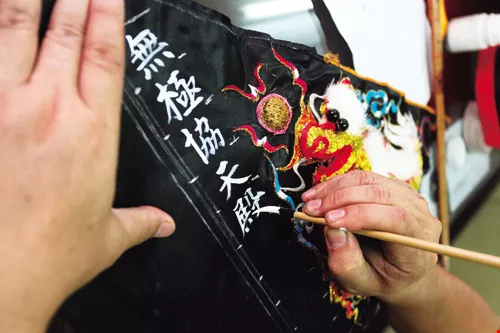
The services of a master craftsmen in Taiwan are expensive, and quality is high, but the occupation is in danger of dying out as few young people now take up this type of work. On the left, an outfit for the Earth God is being made. In the center, an artisan sews decorative thread into her embroidery piece. Oh the right, an artisan uses a brush to paint Chinese characters on a pennant. These characters will later be embroidered into the cloth.
In addition to wedding-related embroidery, the workshops of Puzi also did brisk contract manufacturing business making eight-sage embroidered tapestries and table skirting for brand-name clients in nearby Tainan. Shen Fu's founder, 76-year-old Zhou Guoqin, laid the foundation for success, and recalls how things have changed in his time: "Industrialization really took off in Taiwan in the 1960s. In everything, efficiency became the name of the game. With eight-sage embroidered tapestries, for example, it took a half-month to embroider one in the traditional way, by hand, but you could turn one out in a single day by machine."
As the saying goes, "people need clothes to wear, the gods need clothing for show." In the old days, sculptors would carve the patterns for clothing directly onto the surface of their carvings of divinities, and the most they might do beyond that was apply gold lacquer or gold foil. Prior to the 1960s, the gods in Taiwan were not in the habit of wearing deity outfits over their carved images.
As Taiwan became increasingly wealthy, however, and as the custom of repaying the gods for prayers answered took root in the 1970s, Zhou Guoqin saw a business opportunity and began designing deity outfits, which his wife embroidered. Zhou then took to the road, traveling Taiwan from north to south to market the goods to Buddhist supply shops across the island, or to sell at shops on consignment. Thanks to the fine quality of the designs and workmanship, the deity outfits became a huge hit in northern Taiwan after just a few short years. Orders came pouring in, so the family hired a dozen or more master craftsmen, all experts in hand and machine embroidery, to work in their shop. They also contracted out huge volumes of work to suppliers working out of their homes. At the height of the business, the firm relied on some 200 outside suppliers, and deity outfits emerged as one of the most distinctive local specialty products made in Puzi.
With few competitors, high profit margins, low wages, and high-speed machine embroidery techniques, the business that Zhou and his wife started up grew into a full-blown family enterprise that was eventually joined by eldest son Zhou Zhiyun and his wife Que Shumei. But just as everything was going swimmingly, disaster struck. The firm had come of age at a time and place when a man's word was his bond, and business deals were struck without any written contract. The family got stiffed repeatedly by distributors, and found itself NT$20 million in debt.
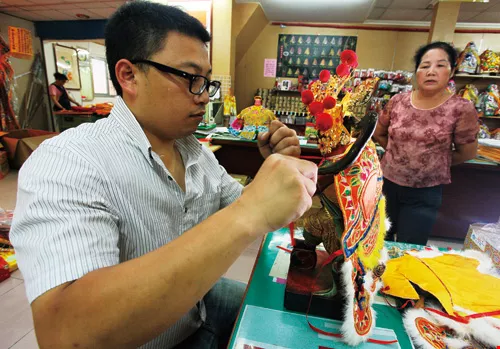
A private individual has prevailed upon a deity to come into the shop and pick out an outfit. Shown at far left is the deity before the change of clothing. Zhou Rangting carefully removes the old deity outfit, revealing the painted-lacquer surface of the statue itself. He cautiously sets the new helmet in place and dresses up Prince Nezha in his new battle robes (below).
Change would come to the business. Wages began climbing rapidly after the Legislative Yuan passed the Labor Standards Act in 1984, and getting a college education became the number-one career option for a new generation of youth in Taiwan. Just a generation before, girls from the countryside would start working in embroidery upon graduation from junior high school, but this source of new blood all but dried up. In 1988, lottery fever swept the island, while exuberant investors in the stock market sent the Taiwan Stock Exchange Weighted Index rocketing past 10,000 points. Outside suppliers vanished as people stopped working and gave themselves over to obsession with stock prices and lottery numbers. The firm found itself frequently unable to meet delivery schedules and product specifications. Mounting debts and production difficulties forced Zhou Zhiyun to make adjustments. In 1990 he set up a factory in Guangdong, changed the company name to "Xin De Workshop," and retained just a few old master craftsmen in Taiwan to carry out R&D work and provide customer service.
When the factory was first set up in mainland China, the company did not have an established local supply chain, so all its thread and cloth had to be sourced in Taiwan, as did the cotton wadding and polystyrene stuffing that they stuffed into the heads and bodies of the dragons. It would be some time before the Guangdong factory was able to procure such materials from mainland-based Taiwanese firms.
Thanks to low wages and cheap raw materials in the mainland, plus the close watch that Zhou Zhiyun kept on R&D and quality control, the company's deity outfits and embroidered goods sold extremely well in Taiwan, and within a few short years the company discharged its debts and claimed a 70% market share.
Some time around 1996, however, stores in Taiwan began importing low-priced goods directly from mainland Chinese suppliers in order to shave a tiny sliver off their prices. Distributors were hit hard, but Xin De Workshop was affected even worse, for there was no way to respond to such price competition. Zhou Zhiyun learned the hard way about the importance of building a brand.
Like most traditional enterprises in Taiwan, Xin De Workshop sold only products, not a brand, and did not even have a storefront sign. Moreover, having always operated as a contract manufacturer, establishing its own brand would bring a rupture of ties with over 1,000 distributors and retailers. They would be sure to try and thwart the plans of Xin De Workshop. The implications were daunting, and Zhou Zhiyun was unable to make up his mind. In the end it was Zhou Rangting, from the family's third generation, who raised holy hell (including knocking over a table during a heated argument) and finally convinced the family to move ahead with its own branding campaign.
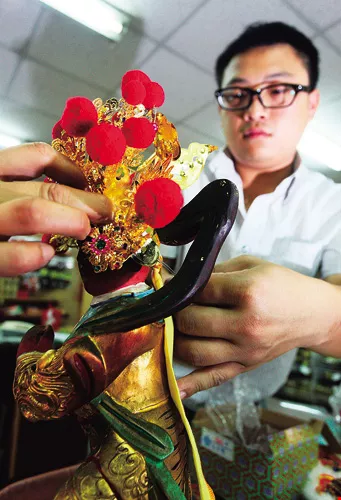
A private individual has prevailed upon a deity to come into the shop and pick out an outfit. Shown at far left is the deity before the change of clothing. Zhou Rangting carefully removes the old deity outfit, revealing the painted-lacquer surface of the statue itself. He cautiously sets the new helmet in place and dresses up Prince Nezha in his new battle robes (below).
Born in 1984, Rangting could never open a book-not even a comic book-without falling asleep. His father hired the best math tutor to be found, and his mother would stay by his side until 2 a.m. the night before tests at school, yet still he came back home once with a score of eight in math. His mother, in the kitchen cooking when the news hit, was so enraged that that she slammed down her chopping knife and stormed out to give him a beating.
Rangting did horribly on his university entrance exams and figured there was no hope for him, but local Toko University offered athletic scholarships. He did well on their test-a 1600-meter run-and gained admission to the school's Department of Leisure Recreation and Travel Management.
"Whenever other students asked me what my father did for a living and I told them that he 'makes shen yi [deity outfits],' they would always misunderstand and think he was a shen yi [a doctor of uncanny skill]. That was always good for a laugh, but after the joking ran its course they'd always ask what the heck deity outfits are." Students at school came from all over Taiwan and would always bring back local specialties from home at the beginning of each school year to share with classmates. As a third-year student, Rangting hit on a unique idea-why not make miniature versions of Dad's deity outfits and give them as gifts?
Rangting's parents would always ask him on weekends to come back to the workshop and help them fix this or adjust that. He would end up designing and sewing a lot of miniature deity outfits, to which he would tie a couple of good luck charms for good measure. When he gave them away, his classmates were always thrilled at the unique gift items.
In 2005, as his father hesitated over whether to establish the firm's own brand, it occurred to Rangting that his miniature deity outfits were such a big hit with friends that they might sell very well on the market. He consulted with teachers at school and actively hit the books to learn about branding. In 2006 he spent NT$200,000 of his own money to hire a professional to design a logo, product catalog, and direct marketing materials. Then he hired someone else to set up a website. To get the necessary money together, he spent his summers working at a hotel, and even did a bit of acting.
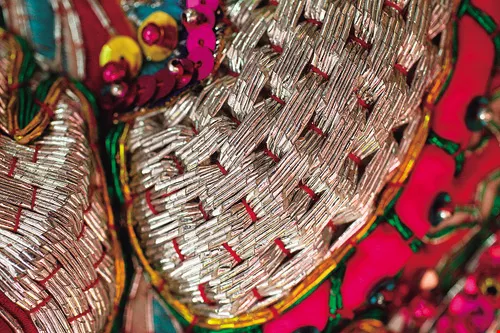
Embroidery is an extremely laborious process. Shown above is a pattern embroidered from silver and gold thread. The outfit at the lower left is studded with crystal diamonds, while the one at the lower right features four-thread float stitches, the highest quality to be found on the market today.
His father kept an eye on his doings without coming out in support until eventually website visitors started phoning in lots of orders. His father then realized that the website was effective. Before that point, however, when father and son were still at odds over the issue of branding, Rangting had made an emotional appeal to his father: "This is your last battle, but it's just the first for me and my two older brothers. If we don't establish a brand, how are we going to compete in the future when cross-strait trade is liberalized and mainland goods start flooding in?"
Rangting stresses that a basic no-frills deity outfit made in Taiwan cost NT$500 a few years ago, but makers in the mainland could quickly make knock-offs and sell them at NT$100, so without brand power there would be no way to survive.
The firm renamed itself Shen Fu Creative Embroidery in 2007, and began promoting the idea of "letting the deities have a frequent change of outfits." It sought to differentiate itself from low-priced mainland Chinese competitors by stressing the fact that Shen Fu embroiders completely by hand and offers made-to-order products based on the customer's own specs. In 2008 Shen Fu started selling via a home shopping channel on television, and the stylishly displayed products attracted customers from as far away as Hong Kong and Singapore.
However, branding is no easy task. Rangting often received threatening phone calls from stores that formerly carried his family's goods, and of over 1,000 distributors and stores that they once worked with, only two still stuck by them.
To stay ahead of the competition, Shen Fu had to be continually creative, and worked hard to make deity outfits that broke free from tradition in interesting new ways. Incorporating fashion design elements, they launched a series of eight new miniature deity outfits, each with a different color theme, including a "romantic pink outfit" for the Mysterious Lady of the Ninth Heaven, and a "wise blue outfit" for the Earth God and Hua Tuo the Healer. In addition, baseball is a very popular sport in Taiwan, and provided Shen Fu with the inspiration for six "baseball outfits" for the goddess Mazu, comprising a du dou undergarment, long-sleeved undershirt, short-sleeved outer shirt, imperial robe, cape, and phoenix hat. All these products are sold online, and have been a big hit among younger buyers.
When the birthday of Mazu was celebrated at Peitian Shrine in Puzi in 2008, Rangting hired a craftsman to sew 1,800 Swarovski crystal diamonds onto the imperial robe of "He Who Sees One Thousand Leagues," and another 1,800 on that of "He Who Hears on the Wind" to make the divine generals all the more eye-catching when they took to the parade route to survey their domains. Onlookers were stunned at the sight, and since then a lot of deep-pocketed buyers have asked specifically for deity outfits studded with crystal diamonds.
Since the third generation took over the family business, oldest brother Zhou Weizhong has been running the factory in the mainland, second brother Zhou Huanzhi has been in charge of business promotion in northern Taiwan, and third brother Zhou Rangting has been handling R&D and business promotion in southern Taiwan. The endlessly creative Rangting came up with the idea of decorating their dragon-shaped embroideries with lace, and the high-class feel it imparts has proven highly popular with female deities. For the past two years, moreover, he has been incorporating LED lights into his deity outfits, which makes the gods and divine generals an especially impressive sight while out on pilgrimages at night time, and adds to the excitement of temple fairs.
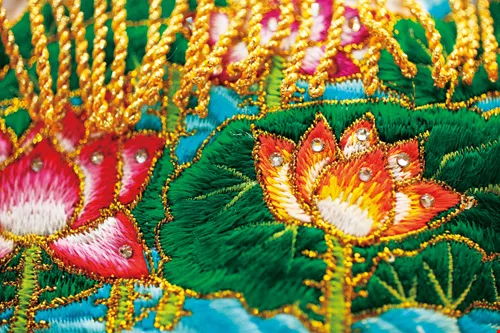
Embroidery is an extremely laborious process. Shown above is a pattern embroidered from silver and gold thread. The outfit at the lower left is studded with crystal diamonds, while the one at the lower right features four-thread float stitches, the highest quality to be found on the market today.
At the Shen Fu retail outlet in Xinzhuang City, Taipei County, deities are lined up in a row in the display window to model the firm's deity outfits. Each one is all decked out in an exquisitely hand-embroidered outfit.
The outlet is run by Zhou Huanzhi, who reports that a spirit medium once entered into the realm of deva vision and "saw" a lot of gods standing in front of his store, probably because they had come to pick out some outfits for themselves before going back to their temples to tell the faithful which ones to buy. "Strangely enough," notes Huanzhi, "the gods are not averse to dickering with us on price!"
Just like humans, in fact, the deities like to look their best, and are picky about what they wear. At most shrines and temples, the deities get new outfits and helmets on their birthdays, when someone wants to repay them for prayers answered, and when it comes time at the end of the year to send off the gods after the offering of sacrifices. And it's not just the stewards of shrines and temples who order new outfits for the deities; a lot of ordinary believers are also very enthusiastic about getting new outfits for the deities in their home altars.
During my interview with Rangting, in fact, a private individual showed up at the shop with a statue of the Third Prince Nezha from their home altar to arrange to get a new outfit for him. Rangting explained that deities from home altars are smaller in size, so people can just bring the statue into the shop and toss some divination blocks to ask the deity which outfit they would prefer. Statues from shrines and temples are larger, however, so the people at the shop have to go directly to the deities to get the job done.
There are all sorts of rules to be followed when measuring a deity for a new outfit. The first step is to throw the divination blocks and ask for the deity's consent to be measured. The blocks must then be thrown again to ask the deity about auspicious dates and times for measuring the outfit, starting to sew, and putting on the outfit. "When you measure the deity," explains Rangting, "you use red threads to block off the dimensions of the statue, then you use a tape to measure the red threads. Taking a tape measure directly to the deity would be extremely disrespectful."
After the dimensions have been measured, the colors chosen, the design completed, and the cloth cut, the customer may have specific requests regarding the exact hour and minute when the sewing is to begin, and who is to do the sewing. Some have been known to ask that all sewing be done by virgin males, or by people of a certain age. No matter what the request, the experts at Shen Fu will honor it punctiliously. After the sewing is done, it is time for the deity to try the outfit on for size, and to make any necessary alterations. And before the deity formally changes clothing, the new outfit must first be purified by thoroughly exposing it inside and out to incense smoke. Rangting confides that he didn't know about such niceties when he was first getting started, and once received an angry tongue-lashing from a temple steward after he forgot to have a new outfit smoked. Finally, after the new outfit has been put on, the divination blocks must be thrown one more time to see whether the deity is satisfied with it. Only then is the transaction complete.
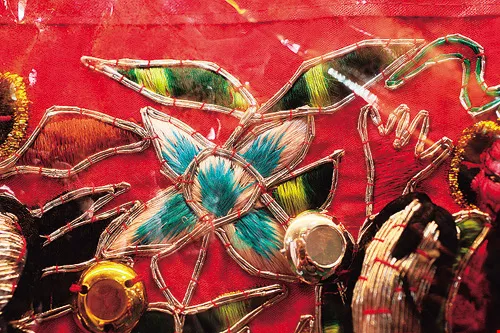
Embroidery is an extremely laborious process. Shown above is a pattern embroidered from silver and gold thread. The outfit at the lower left is studded with crystal diamonds, while the one at the lower right features four-thread float stitches, the highest quality to be found on the market today.
Deity outfits from Shen Fu have been through many changes. First-generation outfits, known as "flower outfits," did not have complex ornamentation, but made use of just three decorative motifs-a dragon shape, flowers, and a wave pattern. The body of the dragon was relatively narrow, and stuffed with cotton wadding. And a lot of float stitches were used.
Float stitches are used to achieve a feeling of raised relief, with bunches of decorative gold or silver weft thread woven across thick yarn strands running in the warp direction. To save time, sometimes quite a few decorative threads pass over a single strand of yarn. Consumers keep getting pickier all the time, however; in the early days, 12 decorative threads would often skip over a strand of yarn, but this number has fallen, first to eight, then six, four, and sometimes three with the most exacting customers. Turning out this level of quality is laborious and prohibitively expensive, so Shen Fu only does it when a specific request is made.
The first-generation "flower outfits" eventually gave way to a second-generation successor, called "pagoda-in-the-center outfits" because they featured two dragons flanking a pagoda, this latter symbolizing the suppression of evil. In the 1980s, polystyrene replaced cotton wadding as the preferred filler for the dragon's body, and resulted in lighter-weight outfits. By 1984, a new method of looming enabled makers to produce what came to be known as "reptilian scale outfits," which accentuated the colors of the dragon's body. The scaly skin of the dragon became the focal point of designs, and it became necessary to embroider the scale pattern onto the cloth before cutting and sewing could commence.
Zhou Zhiyun stresses that cotton wadding and polystyrene each have their good points. It is very time-consuming to stuff cotton wadding by hand because it has to be packed in so tightly that it is practically as hard as a rock, but this method yields a very beautifully curved shape and a strong feeling of 3D relief. The dragon's body is small and very pretty. The advantages of polystyrene, on the other hand, are that it can be quickly cut to the desired shape, it is lightweight, and the dragon's body is stiffer.
How one goes about making a deity outfit depends in part on where the customer is located, says Zhiyun. People living along the coast, for example, work in the fishing industry, are very open and gregarious, and generally worship Wangye, the Lord of the Seas. Because Wangye often travels at sea, his outfit must stand up well to a wet environment. That is why his outfit is made from very stiff materials, which also are very good for expressing the majesty of the lord of the sea.
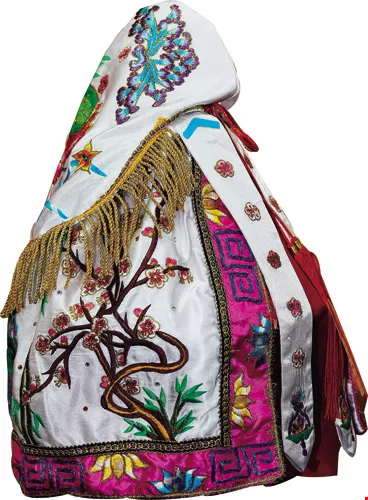
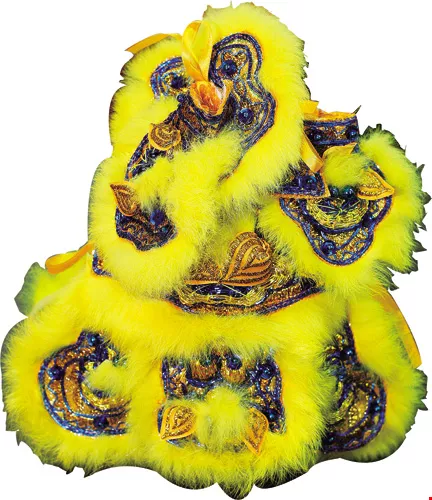
Outfit studded with crystal diamonds.
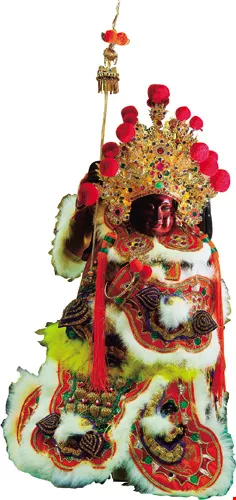
There are detailed historical records that indicate what kind of deity should wear what colors, and what rank of deity should have what sort of patterns embroidered into his outfits. The Jade Emperor, the God of the North Sky, and Mazu all wear golden imperial robes; the merciful bodhisattva Guanyin, savior of the afflicted, wears an outfit with a lotus flower and willow branches embroidered over a simple white foundation; and the Third Prince Nezha wears a suit of armor and flies in the sky riding on the Wind Fire Wheels with a golden hoop in one hand and a fire spear in the other.
The people of Taiwan enjoy freedom of religion, and worship at over 20,000 temples and shrines of all different sizes. Thanks to the firmly ingrained belief that "worshipping the gods will bring protection," many people will worship at any temple they come across. They ask the gods for wealth, peace of mind, success, fame, children, and any number of other things, but most people don't know the symbolism of the design elements in deity outfits. This situation prompted the folks at Shen Fu this past February to set up an exhibit on deity outfits in the cultural park on the grounds of the Taiwan Sugar Corporation's old sugar refinery in Puzi. The exhibit was designed to provide an entertaining but educational look at the origin of deity outfits, how they are made, and the many accessories that come with the outfits. The exhibit features embroidery demonstrations, and visitors can even try on outfits to get an idea of how it feels to be a deity.
Three generations of the Zhou family have journeyed a very long path with their deity outfits, morphing from contract manufacturers into a high-class brand name, becoming a leader among Taiwan's cultural and creative industries, and finally embarking upon the experience economy. The path they've taken just keeps getting broader, and one can't help but look forward with expectation to what they will think of next.
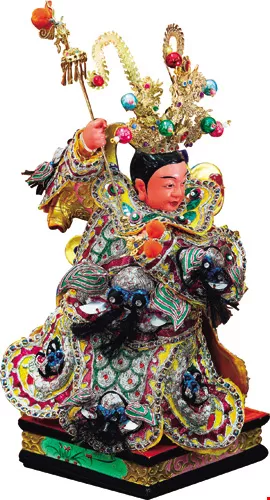
It turns out diamonds are a god's best friend, too! After this deity outfit studded with Swarovski crystal diamonds was created, lots of people began ordering similar outfits.
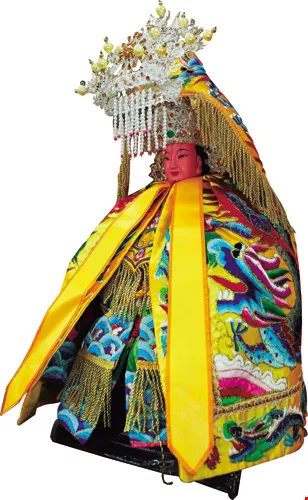
Shen Fu Creative Embroidery began selling its products via a home shopping channel on television in 2008, and the stylishly displayed products attracted customers from abroad.
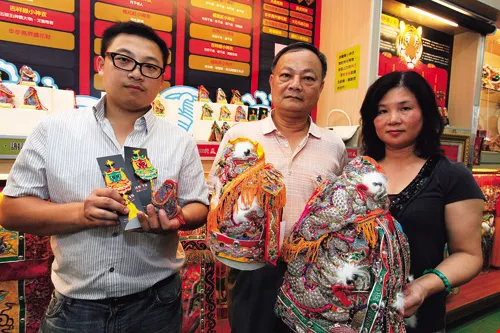
Seventy-six-year-old Zhou Guoqin is the founder of the firm known today as Shen Fu Creative Embroidery, and the inventor of the deity outfit, which now sells like hotcakes throughout Taiwan. He handed the business over to son Zhou Zhiyun (center) and daughter-in-law Que Shumei (right), who carried forward his success, maintaining a 70% market share. Three years ago, at the insistence of third-generation scion Zhou Rangting (left), the firm embarked on a branding campaign and successfully transitioned from a traditional manufacturer into a leader in the field of creative and cultural industry. The firm continues writing a fascinating new chapter in the story of Taiwanese deity outfits today.
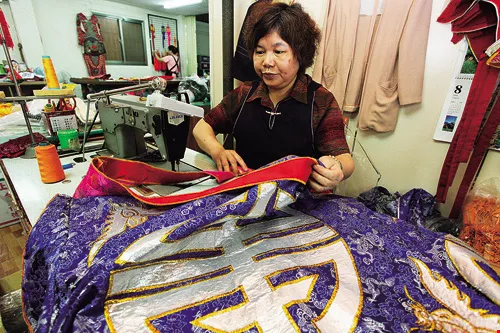
The services of a master craftsmen in Taiwan are expensive, and quality is high, but the occupation is in danger of dying out as few young people now take up this type of work. On the left, an outfit for the Earth God is being made. In the center, an artisan sews decorative thread into her embroidery piece. Oh the right, an artisan uses a brush to paint Chinese characters on a pennant. These characters will later be embroidered into the cloth.
A private individual has prevailed upon a deity to come into the shop and pick out an outfit. Shown at far left is the deity before the change of clothing. Zhou Rangting carefully removes the old deity outfit, revealing the painted-lacquer surface of the statue itself. He cautiously sets the new helmet in place and dresses up Prince Nezha in his new battle robes (below).
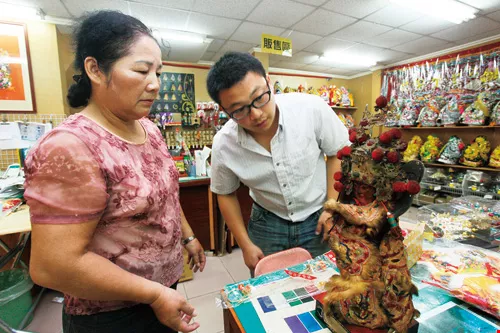
A private individual has prevailed upon a deity to come into the shop and pick out an outfit. Shown at far left is the deity before the change of clothing. Zhou Rangting carefully removes the old deity outfit, revealing the painted-lacquer surface of the statue itself. He cautiously sets the new helmet in place and dresses up Prince Nezha in his new battle robes (below).
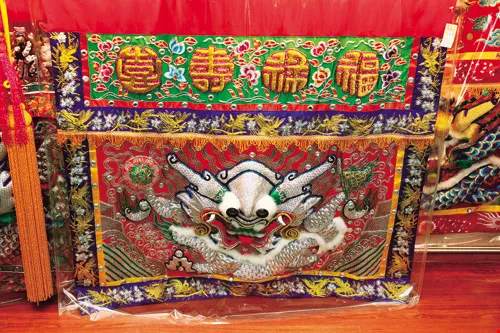
Puzi embroidery has been renowned in Taiwan for a century, and Shen Fu Creative Embroidery is one of its most renowned manufacturers. Table skirting embroidered with auspicious images can be found in almost every home.
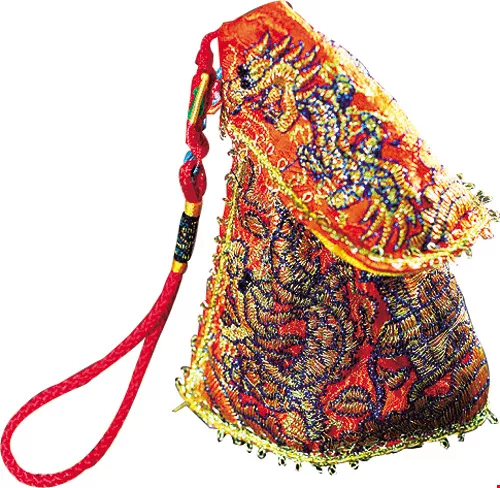
Miniature deity outfits (top) are a pleasure to look at, and also bring the owner good luck. Amulets (center) depicting He Who Sees One Thousand Leagues (left) and He Who Hears on the Wind (right) bring their owners good luck. The fan shown in the bottom photo is used by the goddess Mazu.
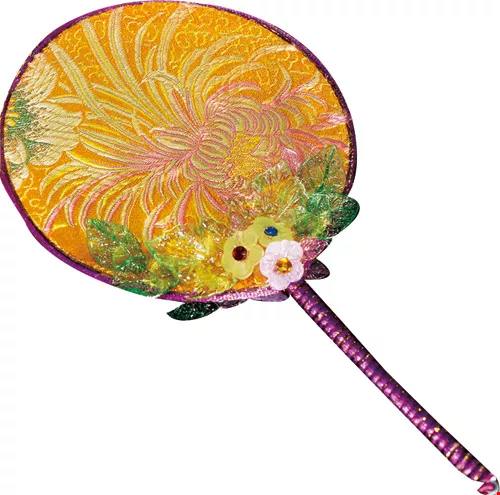
Miniature deity outfits (top) are a pleasure to look at, and also bring the owner good luck. Amulets (center) depicting He Who Sees One Thousand Leagues (left) and He Who Hears on the Wind (right) bring their owners good luck. The fan shown in the bottom photo is used by the goddess Mazu.
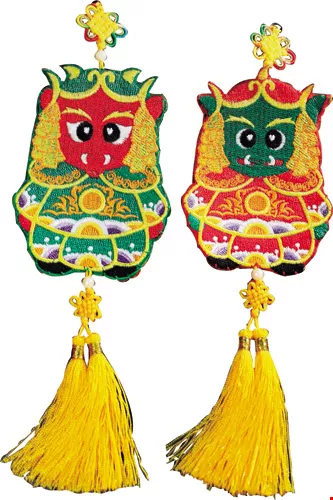
Miniature deity outfits (top) are a pleasure to look at, and also bring the owner good luck. Amulets (center) depicting He Who Sees One Thousand Leagues (left) and He Who Hears on the Wind (right) bring their owners good luck. The fan shown in the bottom photo is used by the goddess Mazu.
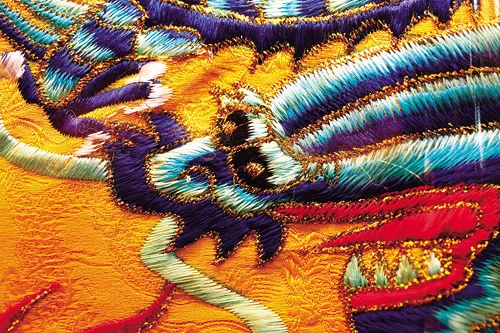
Embroidery is an extremely laborious process. Shown above is a pattern embroidered from silver and gold thread. The outfit at the lower left is studded with crystal diamonds, while the one at the lower right features four-thread float stitches, the highest quality to be found on the market today.
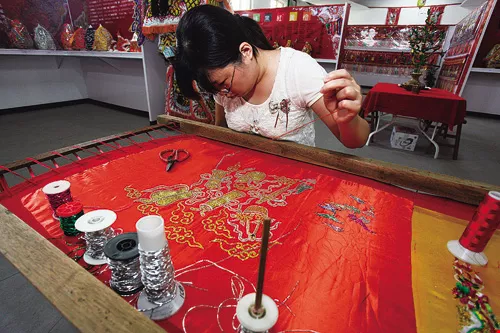
The services of a master craftsmen in Taiwan are expensive, and quality is high, but the occupation is in danger of dying out as few young people now take up this type of work. On the left, an outfit for the Earth God is being made. In the center, an artisan sews decorative thread into her embroidery piece. Oh the right, an artisan uses a brush to paint Chinese characters on a pennant. These characters will later be embroidered into the cloth.
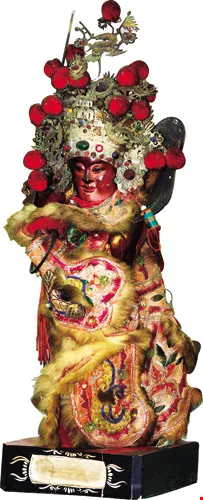
A private individual has prevailed upon a deity to come into the shop and pick out an outfit. Shown at far left is the deity before the change of clothing. Zhou Rangting carefully removes the old deity outfit, revealing the painted-lacquer surface of the statue itself. He cautiously sets the new helmet in place and dresses up Prince Nezha in his new battle robes (below).
Golden battle robes of Prince Nezha.


@List.JPG?w=522&h=410&mode=crop&format=webp&quality=80)


