Where Warmth Has Outlasted War-Matsu's Nangan Community
Pamela Teng / photos Pamela Teng / tr. by Scott Gregory
October 2011


It's the middle of a hot summer, and the whole of the main island of Taiwan is engulfed in strong ultraviolet rays from a cloudless sky. But an early flight out of Songshan Airport to the outlying island of Matsu has been cancelled due to cloud cover. Visibility does not meet safety regulations. The tourists are annoyed, but Nangan locals waiting for the same flight are used to it. A few people from Tieban, Nangan, flip through the standby list at the check-in counter, announcing with certainty which names are from the tour group and which are locals. Nangan is small enough that the locals all know one another's names.
Seats on a flight to Nangan are hard to get. When the airport is closed due to weather conditions, you can travel by boat. But whereas the flight is just 50 minutes, the boat trip takes several hours.
To Matsu locals, home is nearby, but a long trip away. In actuality, "home" has only really belonged to them in the last 20 years....
Because of its special geographical position, Matsu-composed of the two islands Beigan and Nangan-was classified as a "battleground" for more than 40 years, until the government lifted restrictions on it and Kinmen in 1992.
The town of Tieban is located on the southwest tip of Nangan Island. The presence of the provincial government and the military turned this small fishing village surrounded by mountains on three sides into Matsu's business and administrative center. Its strategic importance brought a heavy military presence, and the area was given a new, anti-communist name-Ren'ai ("Benevolence and Love") Village-to reflect traditional Confucian values.
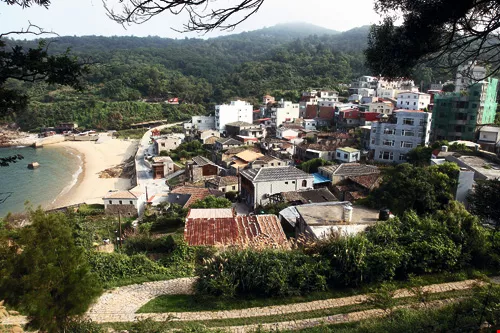
Tieban abuts Nangan Island's tallest peak, Mt. Yuntai, and in the winter the mountain blocks the cold winds from the north. The harbor to the south faces the mouth of the Min River. Its superior geographic position and its climate made it an important early settlement for immigrants to Matsu.
The village developed when the military arrived and declined when it left-and locals had no say in any of it. From the time the military set foot here, developments in cross-strait relations controlled residents' lives completely. It was only when it all became history that Tieban locals' sense of community began to emerge.
Community regeneration in Tieban started with a move to restore the village's original name. The name "Tieban," which means "iron plate," came from a dark-red rock beyond the mouth of the bay that appears when the tide is low. The rock looks like the sort of iron-plate grill used in teppanyaki cooking. To the locals, the rock has become something of an iconic symbol of home.
"After all that time, we were finally delisted as a military-controlled area, but only when the military left did we realize that the Tieban community's economic structure had changed long ago. Over the course of time, locals and the military had become deeply intertwined," says Zhu Jinbao, the current director of the Tieban Community Development Association, which formed in 2002.
Even though freed from the burden of the "battlefield" label, as the saying goes, "You can't go home again." It's not the old fishing village it once was-even the fish and the fishing are gone. For a long time, the economy had been centered around supplying the needs of the military base. From retail, food and drink, and entertainment to other leisure activities and shopping, from local markets, pool halls, dessert stands, and coffeehouses to bathhouses, Tieban's economy dried up immediately when the military pulled out.
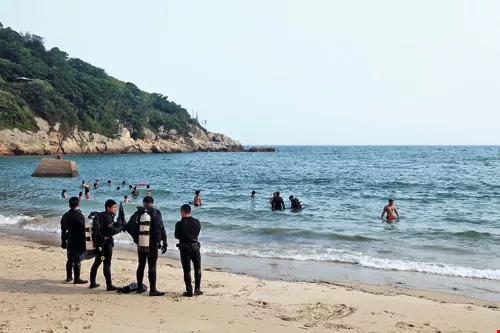
The few troops still stationed in Matsu these days often mix right in with residents on the beautiful beaches.
Nowadays Tieban's main street has just a few shops, so it's hard to imagine it bustling. The empty scene made the locals, who were used to a thriving town environment, realize right away that once the troops had departed, they had lost not only the military's business but also Tieban's way of life.
The silence that set in after the bustle was gone forced Tieban locals to re-examine their hometown and earnestly reflect on its past.
Outward migration was the main force behind Tieban's decline. Running a local business was no source of security for the next generation to base their lives around, and especially for those born in the 1960s and 70s, leaving seemed the only thing to do. Zhu recalls, "The shadow of war and fear had a great influence on the people of Tieban, especially after it was placed under military rule. It was illegal to go to sea at night to fish, drills could happen at any time-residents' lives were limited in many ways. In the days when cross-strait tensions were high and the PRC shelled the ROC's outlying islands every other day, we old-timers from Tieban all had the experience of being awoken in the middle of the night for roll-call or to take cover."
That was the same era that Taiwan's textiles industry was taking off, and factories and processors for export were still flourishing. Tieban locals who had the chance to work on the main island of Taiwan would advise their neighbors back home that moving away was the only way to provide long-term security for a family. As Tieban's population drifted away, buildings sat empty and the village took on an old and dilapidated appearance.
Luckily, the perseverance cultivated in these "children of war" over the years had a strong effect. Through the leadership of the development association and a volunteer association of local mothers, Tieban locals decided that instead of some grandiose plans, they would focus first on putting theirs head down and cleaning up the living environment.
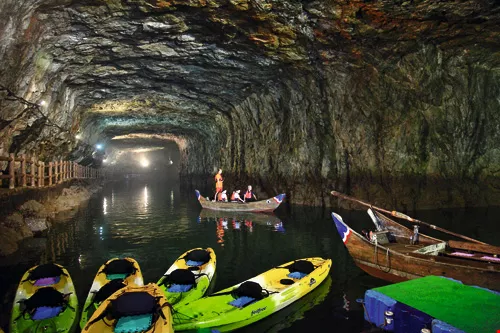
The Beihai Tunnels, one of Matsu's famous military installations, are now open to the public. There are even canoe and sculling tours available-a hit with visitors.
The economic stagnation had made the village a dreary place, but it also meant that the village's traditionally crafted East Fujianese woodwork and stone buildings were never torn down.
During the process of cleaning up the community's empty spaces and disused buildings, the development association worked diligently to get people from Tieban living outside to agree to allow the association to use any unused land to which they held the rights.
At the same time, they sought out resources from the academic world, such as National Taiwan University's Graduate Institute of Building and Planning, and Chung Yuan Christian University's Architecture Department. Teams from these institutions conducted surveys and created plans for Tieban's layout and buildings. Academics also provided expert advice about restoration and reuse of the community's space and buildings.
From cleaning up and disposing of trash and debris to delivering stone and metal building materials, from turning discarded materials into ground cover to planting greenery to make the place more beautiful and environmentally friendly, the development association never requested outside funding for their expenses. They called upon residents to work together, with those experienced in construction and gardening taking the lead. With their efforts, an empty lot covered with trash became a corner park, a dilapidated stone wall became a Japanese-style "borrowed view" landscape, discarded steel became installation art, and lattices were placed in leftover land near the park so residents could grow luffas and vegetables. The changes, which turned the town into a place with a surprise around every corner, left Tieban locals both excited and proud.
With the permission of the original owners, some old houses have been turned into public spaces where locals can get together and hold classes or meetings. Everyone had ideas about how to spruce up and use these buildings. But once the entire village was made over and Tieban's appearance truly lost its old, dilapidated look to recover the glory it once had, residents crowded the streets and got a look at things. It was only then that they began to realize the classic, unadorned dignity that Tieban originally had.

Tieban's 140-year-old Tianhou Temple has retained its Eastern Min architectural style. Here residents practice the traditional temple-fair art of playing the clapper.
Development association leader and Ren'ai Village chief Liu Xianglian and Tianhou Temple committee chair Lin Jinyu were children of the 1950s and 60s. They'd heard their grandfathers' talk of the Tieban fishing industry's glory days, experienced the fear and anxiety of war, and witnessed the rise and fall of Tieban. It was out of a deep sense of duty that they set about rebuilding their hometown.
They never forgot that next to the village was a mountain that could only be seen in the distance but never approached. Though elders had climbed to its summit to dry out fishing nets, it became forbidden for anyone to set foot on it once the military moved in. Even the road up the mountain was cut off.
The imposing and mysterious nature of this mountain, Mt. Guanmao, vanished once the military pulled out, and middle-aged residents began to recall their childhood desires to experience the adventure of climbing it.
Since November, 2002, young and old have headed up Mt. Guanmao every weekend. They've made their own trails through the vegetation and cleared away the garbage left from the decades of military rule. They also transported rocks from the seashore up to the top by foot in order to make steps and paths, and they've labeled the names of the plants. In the abandoned mountain they've uncovered a potential "forest park."
It's worth mentioning that while cleaning up debris, residents dug up more than 200 abandoned artillery shell casings. They didn't want to just throw them away, so they used them at the peak to make Taiwan's only artillery shell stairway.
Liu still frequently heads up the mountain early in the morning to clear away weeds and clean up the pathway. Her husband, Zhang Xiangshou, was once Nangan Township's mayor. His botanical knowledge is strong, and once he retired he became a director of the development association. He spends most of his time surveying Mt. Guanmao's plant life and planting species local to Matsu. He hopes that Mt. Guanmao can become an officially designated forest park.
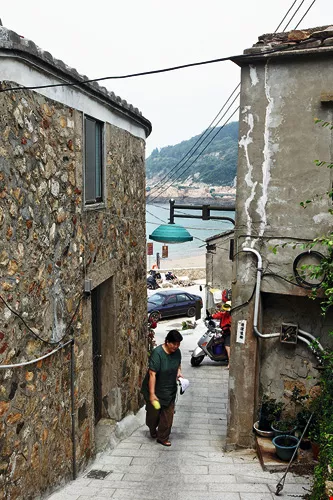
Thanks to the Development Association, Tieban's twisting streets and alleyways have all been beautified and connected to drainage systems. Getting around by foot has become more reliable and safer.
After cleaning up the environment, Tieban locals took a look at the bigger picture. They discovered that the frontline atmosphere that still echoed in the many nearby abandoned military installations was actually a precious resource for Tieban. These include Nangan's most famous sight, the Beihai Tunnels; Dahan Stronghold and the Iron Fort; and a military intelligence base on Nangan's highest peak, Mt. Yuntai. Once these spots were opened up to tourists, they had an irresistible appeal to outsiders.
The waterways of the Beihai Tunnels were made by hand, hacked out of the granite. It took 820 days of round-the-clock working. Originally used for mooring boats, they are now opened to tourists and feature wooden boat and sampan tours. The tunnels are the top tourist draw in Nangan. The three-level Dahan Stronghold tunnels and the important frogman-team sentry post known as the Iron Fort are also must-see stops on a tour of historical sites.
To climb Mt. Yuntai and see both the Matsu islands, still part of the ROC, and the mouth of the Min River, under mainland Chinese control, just across the strait, makes one sigh over the twists and turns in cross-strait relations.
Outsiders coming primarily to see the military sites might not even know that they are in a place called Tieban. But due to the efforts of the development association, people will surely take notice after their tours and be willing to go the extra mile to sample Tieban's warm atmosphere and hike Mt. Guanmao's nature trails.
A village of storiesThe development association occasionally holds clean-up events on the beach here. From the beach, you can see the historic Tianhou Temple, which has kept watch over Tieban for 140 years.
Lin Jinyu says that Tieban's Tianhou Temple isn't the largest temple in Matsu, but its classic architecture is the best preserved. It has never been renovated to give it the look of most other temples. Its wooden Goddess Mazu image is Taiwan's only "young Mazu," depicting the goddess as a fair 16-year-old maiden who has just attained spiritual enlightenment.
Does Tieban offer the visitor anything else to "see"? Or, what can visitors take notice of?
This is the question that Zhu, Liu, and Lin-Tieban's "Iron Triangle"-ponder over and over. Lin says that Tieban still has countless stories to tell, such as tales of pirates, or the time a local grandmother held a knife to her own throat and sat in a doorway to stop soldiers from turning private homes into military offices.
He says, "We won't just talk about the olden days, and we won't immerse ourselves in sad stories. We're clear about it: Our mission is to make Tieban into a place that's suitable to live in."
Tieban locals' consensus is that it isn't necessary to go chasing after every tour group that comes by. They want first to make a nice lifestyle for themselves and then share that with others. This is Tieban's most valuable intangible resource.
In other words, what can people "see" in Tieban?
The answer should be that now the fires of war have gone out, Tieban's tender spirit is its signature asset. Warm but resolute; dedicated and everlasting.
@List.jpg?w=522&h=410&mode=crop&format=webp&quality=80)

@List.jpg?w=522&h=410&mode=crop&format=webp&quality=80)


@List.jpg?w=522&h=410&mode=crop&format=webp&quality=80)
@List.jpg?w=522&h=410&mode=crop&format=webp&quality=80)

