The Hondao Senior Citizens' Welfare Foundation began mulling its "Helping Seniors Write Their Life Stories" project two years ago, inspired by the reminiscences of an elderly volunteer at one of its volunteer stations. Reserved, polite and public-spirited, the unmarried former soldier was always neatly dressed and very welcoming to the station's clients. Much to the dismay of all who knew him, he passed away after being severely injured in a fall at the station.
Believing that we can pass on the tremendous diversity of our experiences, the foundation introduced "Senior Retrospective" classes at five of its volunteer stations. Hondao developed the courses in cooperation with Kuo Tsu-ann, an assistant professor in the Department of Eldercare at Central Taiwan University of Science and Technology who had run a similar program in the US.
Unlike programs that elicit seniors' life stories in one-on-one interviews or through reminiscences on old photographs, Hondao's course seeks to help seniors assimilate their own experiences.
Kuo explains that every life includes losses and regrets, but if these feelings remain buried in old age, they can be detrimental to mental health and impair the development of the adaptability that the aging process requires. Helping seniors address unresolved issues increases their mental capacity and orients them towards dreams for the future.
The technique begins by having volunteers recruit 10-15 seniors without regard to their ethnic or educational background or their physical condition. During the first class, everyone introduces themselves to the group. In the following eight sessions, they establish links to one another, solidify their relationships, and begin to tell their stories under the guidance of a trained, experienced social worker.
Kuo says that most people are reluctant to discuss regrets, believing that "family skeletons are best left in the closet." Men are particularly prone to keeping things to themselves, but once someone begins, the rest all jump in.
In one instance, a group of university students participated in the course and took their turns relating their stories. The first senior to offer his story said that when he was young, he'd failed in business, fled to escape his debts, and had to live on the charity of others. "That I had a tough time doesn't matter. My biggest regret is that my family fell apart during those 10 years. It still pains me to think about it."
At this point, the young man sitting opposite the storyteller began to weep quietly. He explained that the older man's story had reminded him of the panic and sense of being wronged he felt as a child. His parents had also fled debts, and the young man had often been awakened in the middle of the night to move to a new home and a new school. He never could make any friends. "I used to hate them, but your story has given me an inkling of what my father was going through."
This alternation of old and young provided consolation and warmth. "It was like an ensemble performance with everything just pouring out of the participants," recalls Kuo.
These small group courses evolve as they progress. The first few classes are always dominated by seniors complaining about unfilial sons and daughters. By the end of the course, those same seniors say, "I want to chase my dreams, too, to bring a little color into my life." One illiterate elderly woman who spent her life doing menial work and came into the course denigrating herself, came out of the course validating her own life: "The only reason I've deve-loped the courage to deal with problems is because I've suffered and been stepped on since I was a little girl."
Though the social workers running things have to stay exceptionally sharp and alert in every class, attuned to the diverse accents of the seniors and always ready to step in as an interpreter, they find the work very fulfilling. They say hearing these seniors' stories and travails helps them manage the frustrations they experience in their own lives.
Hondao and Kuo plan to expand their training of volunteers and involve more communities next year so that they can offer the course to still more seniors. The books of life stories participants compile in these classes will no doubt become valued family treasures and shared cultural assets.
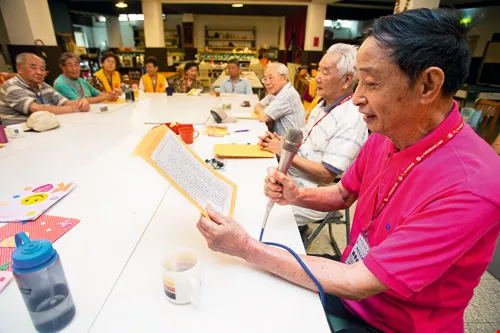
begins 81-year-old Gu Zhaoqin, sharing with his classmates a letter he wrote to his commanding officer decades ago.



@List.jpg?w=522&h=410&mode=crop&format=webp&quality=80)

@List.jpg?w=522&h=410&mode=crop&format=webp&quality=80)


@List.jpg?w=522&h=410&mode=crop&format=webp&quality=80)

@List.jpg?w=522&h=410&mode=crop&format=webp&quality=80)