

Even though 2011 has yet to run its course, the media has already begun trumpeting the domestic film industry's likely eclipse of NT$1.5 billion in box-office gross receipts. As films like The Killer Who Never Kills, Jump Ashin!, You Are the Apple of My Eye, and Seediq Bale shattered all previous records, the beaming countenances of Wei Te-sheng, Lee Lieh, and Giddens Ko have been plastered across all the headlines. In Taiwanese cinema over the years all of the industry accolades and media attention have been generally reserved for directors, but Lee Lieh in her role as producer constitutes a unique exception.
Fresh off of her recognition as Outstanding Taiwanese Filmmaker of the Year at last year's Golden Horse Awards, this year Lee Lieh added a Presidential Culture Award for Innovation to her formidable resume. Just how did a film producer manage to pull off such amazing back-to-back wins?
The General Association of Chinese Culture, which sponsors the Presidential Culture Awards, adduced the following explanation for their decision: "Lee Lieh has established a new operational paradigm for a Taiwanese cinema that had remained essentially static for decades. She doesn't rely exclusively on government funding, emphasizing instead her own innovative and creative operational strategies to breathe new life into Taiwan commercial film. In Monga she successfully implemented a modular approach to production reminiscent of entrepreneurial management, shattering in the process the haphazard production that dominated in decades past. Orz Boyz (2008), Monga (2010), and Jump Ashin! (2011) are three films that, while differing widely from one another in terms of content, all testify to Lee's unique capabilities."
Jump Ashin! is based on the true-life story of the older brother of director Lin Yu-hsien (at left in picture at right). In order to fully inhabit the role of Ashin (the older brother), actor Eddie Peng (facing page) underwent extensive gymnastics training that pushed him to the limit and gave full proof of the actor's astonishing will power and dedication.
Her panoply of career accomplishments is the culmination of 30 years of labor both in and out of the spotlight, as actress, as clothing manufacturer, and as television and film producer, all valuable experiences that were to pave the way for her life's second act.
Along the way she's done her fair share of groveling. She's had to endure hardship in the pursuit of her goals. Every film she's worked on has been a battlefield, but the results always vindicate the effort.
Until August 2008, the prospects for Taiwanese cinema were obscure at best. Ever since A City of Sadness won a Golden Lion award at the Venice Film Festival in 1989, top Taiwanese filmmakers had turned increasingly to art house cinema that alienated mainstream tastes. At the other extreme were cheaply made screwball comedies. Hardly any genre films or mainstream commercial films were made during that time. The domestic film industry seemed to be dying on the vine. Then in 2008 Cape No. 7 pulled off a startling NT$530-million box-office tour de force, and it was suddenly clear that, despite the inhospitable industry climate, there was still a coterie of idealists forging tenaciously ahead.
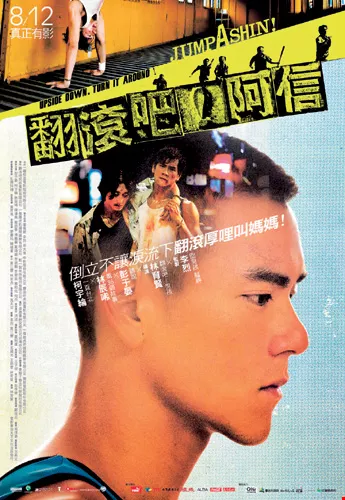
From the whimsical Orz Boyz to the big-budget gangster hit Monga, to the small-budget Jump Ashin!, Lee's uncanny ability to pick out winning scripts has consolidated her standing in the newly emergent Taiwanese cinema. (courtesy of One Production Film (above), Green Day Film (center), and Activator Marketing
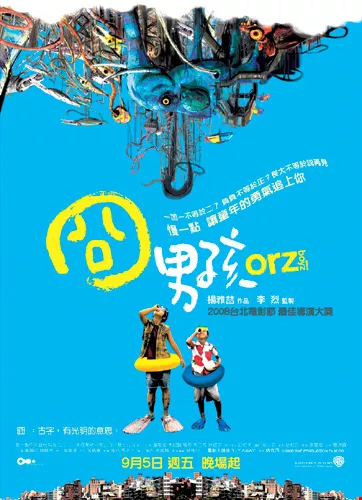
Orz Boys, for which Lee served as executive producer, hit theaters just as Cape No. 7 was beginning its dazzling ascent. Lee's film had a respectable box-office showing thanks to the solid reputation generated by extensive preliminary screenings which reached 6000 people. All in all, they invested a total of NT$14 million including promotion and ended up with NT$36 million.
The astronomical box-office figures that Cape produced were unprecedented in the history of Taiwanese cinema. They are, opined film critic Wen Tien-hsiang, "about as likely to be duplicated as dinosaurs are to reemerge from the ooze."
Cape perhaps really was something of a miracle. Orz Boyz, on the other hand, wasn't a matter of chance. When Orz's youthful director, Yang Ya-che, sought Lee out script in hand in 2007, Lee's producer chops had already been finely honed by years of work in television, including the show that won her four Golden Bell Awards, The Death of Mr .com. She in fact did harbor big-screen aspirations the whole time she was working in television, and, not being the type of person to simply leave her dreams out to dry, she was only waiting for the right opportunity to present itself.
That year the industry's vital signs showed marked improvement. Movies like Island Etude, Eternal Summer, and Spider Lilies all cleared NT$10 million, the sum generally considered to be the threshold of success, with Spider Lilies doing considerably better at NT$50 million. "I sensed that a transformation was taking place," she says, "almost like hearing winter ice beginning to crack apart-I knew that the opportunity I had been waiting for had arrived." The Orz Boys script was in front of her. Reading it made her cry. She decided that she would take the gamble and come aboard as its executive producer, her first foray into filmmaking. "It was a rare opportunity-for all I knew, it could be my last."
Her gamble involved thinking in terms of the worst-case scenario. With the cast still unpicked and no obvious focal point for gossip and buzz, she knew that this movie needed to be handled very carefully or it could easily bomb.
"I thought it over: even if it flops to the point that we don't recoup a cent, that's about NT$10 million. I could keep working and repay the debt within seven or eight years at most. Plus, I knew that it couldn't fail that badly," she recalls.
With the most abject scenario already mapped out in her mind, she was then ready to take the plunge.
The story centered on two mischievous kids who find refuge from loneliness and emotional neglect in their imaginations. Calling on the highly attuned discernment she cultivated over her many years in front of the camera, Lee herself screened child after child in order to find the right kids for the roles of "Liar 1" and "Liar 2." The two youngsters proved to be so natural in front of the camera that in the end their performances carry the film.
Lee's fundraising efforts have since become legendary. After borrowing from all of her friends with the ability and willingness to lend, she had still only raised three-quarters of the capital she needed. But how could she come up with the rest? It seemed difficult without any collateral of her own for such a significant loan, so she turned to her mother for aid, who took out a mortgage on her house.
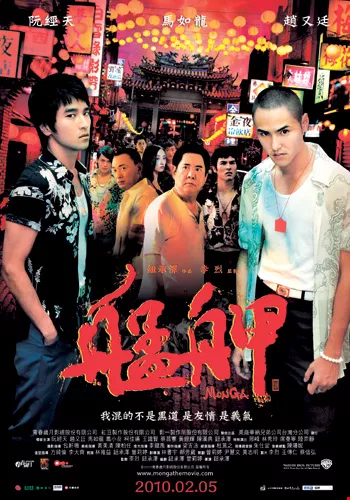
From the whimsical Orz Boyz to the big-budget gangster hit Monga, to the small-budget Jump Ashin!, Lee's uncanny ability to pick out winning scripts has consolidated her standing in the newly emergent Taiwanese cinema. (courtesy of One Production Film (above), Green Day Film (center), and Activator Marketing
Her gamble paid off and the spoils were producer dibs on the upcoming film Monga.
Producing film may have been a novel enterprise, but the work environment couldn't have been more familiar. She knew how to break problems down and whom to ask for assistance. And she knew how she wanted to handle the role.
In Taiwan's inchoate filmmaking industry, directors assumed a centripetal power and authority. Producers, on the other hand, largely scurried about securing funding and thinking of ways to cut costs as well as handling sundry administrative details. It was role that Lee viewed as being entirely too passive.
She envisioned instead a far more encompassing, hands-on approach for the producer involving everything from reviewing and developing the script, casting, and actor training to fundraising, budget control, and marketing strategy. "I need to have a say on every rung of the production ladder," she says. She's willing to do whatever it takes to make the best film possible. More than anything else that means working closely with the director.
Taiwanese cinema had stagnated for so long, Lee felt an imperative to revive it by making films that the public would actually pay to see-it was clear that the director-centric model had failed on that count. Directors are creative, artistic people, and their films are like precious babies that they want to raise all on their own. But their attachment deprives them of perspective; sometimes all it takes is a less biased eye viewing things from a broader angle to eliminate the artistic flaws impeding perfection.
As a hands-on producer, she keeps frequent contact with the director, offering suggestions and proposals until they've attained the best possible results. "Producing requires business acumen, for sure, but it takes more than that: it's even more important to have a sense of the film," she remarks.

Based on Hou Wen-yung's book of the same name, the Public Television Service series Dangerous Mind explored the relationship between parents and adolescents. Lee Lieh portrayed the mother of youthful protagonist Xiao Jie (in the photo holding a megaphone), and Jack Kao (first on the right) played Xiao Jie's father, with both actors deftly handling the emotionally charged roles.
A gangster buddy film set in Taipei's Wanhua district, Monga had hit written all over it. For that to happen, however, a few key provisions needed to be met.
First of all, the story had to be engrossing. In a study done on 10 Hollywood films made between 1999 and 2004 that grossed over US$1 billion, experts compiled a list of nine recurring traits, a so-called "Midas Formula" for commercial success. Among them were child and young-adult protagonists, fairytale-like plotlines, weak or disadvantaged young people overcoming adversity to become mature adults, scenes of intense conflict, happy endings, and actors who had yet to become big stars.
The ending notwithstanding, in all other respects Monga conforms to the "Midas" rubric. Lee took additional pains to try for a coveted Chinese New Year opening slot, the so-called "golden slot" normally reserved in years past for guaranteed cash cows such as films directed by Hong Kong director Steven Chow, of Shaolin Soccer fame.
Warner Brothers Taiwan general manager Eric Shih was willing to offer Lee the New Year's spot, but he clearly spelled out his conditions: "This movie needs to be a real whiz-banger. It has to make people 'ooh and ah.'" Taking Shih's injunction to heart, she measured the dimensions of the film, knowing full well that it needed to be commercially oriented with a cast (Ethan Ruan, Mark Chao, and Ma Ju-lung) that could appeal across a wide age spectrum, and that it would require sophisticated marketing.
Her calculations yielded a production budget of NT$70 million plus an additional NT$20 million for promotion and distribution. Because the investment was already so massive as to preclude the option of failure, she kept the shooting time on a tight leash and had no compunctions about being a thorn in the side of director Doze Niu. She also began priming an audience via the film's official website and whetting the appetite of the media with the occasional tidbit.
In terms of the media campaign, Monga and Orz Boyz could not be further apart. Unlike its predecessor, Monga was only given one token advance screening. In a technique designed to bathe the upcoming film in an alluring mystique, the campaign built up the film by allotting ample coverage to the film shoot even while keeping a tight lid on the specific filmic contents.
The film was a rousing success. It took full advantage of its precious Chinese New Year's berth to post opening day earnings of NT$18 million; by day six it earned the distinction of reaching the NT$100 million mark faster than any other film in Taiwanese cinematic history. By comparison, Cape No. 7 didn't even ascend to box-office champ until the third week of its running. Lee reckoned that Monga was on track to earn a figure just south of NT$300 million with the potential perhaps to even dethrone Cape. But that was before a whirlwind of video piracy hijacked their momentum, bringing things to halt at NT$260 million.
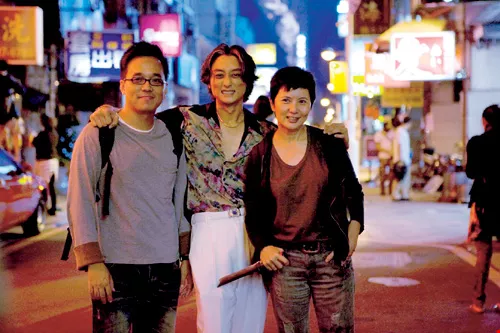
Jump Ashin! is based on the true-life story of the older brother of director Lin Yu-hsien (at left in picture at right). In order to fully inhabit the role of Ashin (the older brother), actor Eddie Peng (facing page) underwent extensive gymnastics training that pushed him to the limit and gave full proof of the actor's astonishing will power and dedication.
In the wake of Monga's box-office triumph, newspapers boldly proclaimed that Lee had "ushered in a new era of domestic film." She began to develop a reputation as a "can-do" figure.
However, unlike Hollywood, which prosecutes a global agenda, in Lee's opinion Taiwanese film isn't likely to attract audiences overseas. "It's not that I'm only interested in presenting films to Taiwanese viewers, it's just that there isn't a market outside of Taiwan, not even in mainland China," she avers.
Faced with this unyielding reality, she's willing to keep her focus on making "pure" Taiwanese movies for domestic audiences. "Monga's success doesn't mean that I'll only focus on big productions-the Taiwanese market can only digest one or two of those per year. To get by, you have to make the middle and small sized flicks, too."
Concentrating on "winning over Taiwanese viewers" means using film to tell Taiwanese stories, and that is precisely what her third film, Jump Ashin!, is all about. When Lee perused Lin Yu-hsien's Ashin script-the 33rd draft, at that-she realized she had found another poignant story.
She asked him about his proposed budget and was surprised when he answered, "NT$20 million." "Why so little?" she wanted to know. Lin explained that he had already been rejected so often that it had made him timid. Investors were always seeking to squash the budget down to NT$18 million or even NT$15 million; Lee was certainly the first individual to suggest expanding it. "What kind of film are you going to make with such a puny budget?" she had demanded. "The money should be equal to the demands of the film. To try to make a NT$30-million-dollar film for NT$20 million-that's just unconscionable!"
All filmmaking involves risk, and one successful outing hardly guarantees the success of the next. Nevertheless, Monga and Cape's strong showings have given Taiwanese filmmakers room to dream and imagine. The days of setting the bar excruciatingly low-of "playing not to win, but only not to lose"-appear to be banished to the past. It now seems totally feasible to make a movie that is both enjoyable and lucrative.
From the whimsical Orz Boyz to the big-budget gangster hit Monga, to the small-budget Jump Ashin!, Lee's uncanny ability to pick out winning scripts has consolidated her standing in the newly emergent Taiwanese cinema. (courtesy of One Production Film (above), Green Day Film (center), and Activator Marketing
Who to cast as Ashin, a youth who turns his life around with gymnastics? Both Lee and director Lin immediately thought of Eddie Peng.
Lee had originally wanted to cast Peng in Monga, but the problem was that he didn't project the melancholy of an Ethan Ruan or the sunniness of a Mark Chao, nor could he convincingly evoke earthiness and local flavor like Rhydian Vaughan. In fact, it became apparent that he was ill suited to portray any of the five members of the "Gang of Princes."
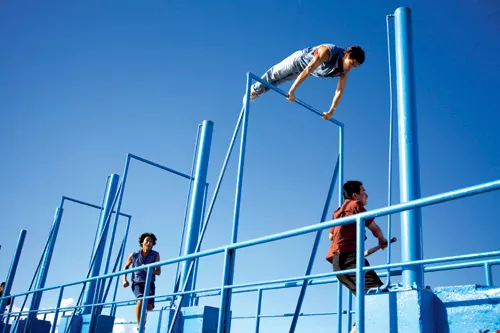
The exigencies of the role of gymnast/protagonist Ashin were formidable, to say the least. Peng underwent a grueling training regimen that began with running and handstands and culminated in honest-to-goodness gymnastic routines such as the high bar, parallel bars, still rings, vault, pommel horse, floor routine, and frontal and back flips. Developing gymnastic competence as well as a gymnast's sculpted upper torso were essential for the story to be visually plausible to audiences.
He trained for three months under the supervision of the real Ashin, reducing his body fat down to a chiseled 6%. He also learned to speak a sprinkling of phrases in Taiwanese with a degree of authenticity that fully concealed his Chinese-Canadian identity, which turned out to be one of the most compelling elements for audiences. Peng's gutsy performance was not lost on the Golden Horse judges, who nominated him for Best Male Actor.
"Taiwan has so many individuals with the all the makings of a star. The problem is that Taiwan doesn't have adequate training grounds to properly groom them for stardom. Those idol dramas are terrible vehicles-half the time, the characters are allowed to mumble their lines," Lee complains. But anyone who acts in one of her films, no matter how popular they may already be, has to take three months of acting lessons.
Cape No. 7 hit a collective nerve in Taiwanese society, offering "chicken soup for the soul." Jump Ashin!, on the other hand, is a parable for all Taiwanese who at one moment or another have lost their way in life.
Everyone deserves a chance to reinvent oneself, and Lee Lieh has seized hers to become Taiwan's boss producer. Moreover, her combination of intellect and daring has helped Taiwanese cinema rediscover its own potency.

@List.jpg?w=522&h=410&mode=crop&format=webp&quality=80)
@List.jpg?w=522&h=410&mode=crop&format=webp&quality=80)


