Putting Sizzle into Language Education: Crosstalk Gets Hot
Jackie Chen / photos Jimmy Lin / tr. by Scott Williams
February 2012


Who really gets classical Chinese? How are students supposed to memorize all that Tang and Song Dynasty poetry? Is there an easier way to learn all the archaic character pronunciations, idioms and aphorisms, partitives, two-part proverbs, and metaphoric terms that carry over into our modern language?
When faced with a boring bit of homework, students of earlier generations might well have thought to themselves how wonderful it would be to have classrooms that resembled movie theaters.
The children of today need not imagine. The Taipei Quyi Troupe has turned the classroom into a performance hall, transforming difficult material into entertaining performances. The troupe’s innovative programs, which focus on elementary- and middle-school language education, offer a new twist on shuochang, China’s traditional “singing and storytelling arts.”
Perhaps the best way to explain the playful language teaching methodology applied by Taipei Quyi Troupe (TQT) is with an example.
“Dingbo Sells a Ghost” is a lesson in a ninth-grade Chinese language textbook. A tale of the supernatural from the Six Dynasties period, the original is more than 300 characters in length and tells of a boy named Song Dingbo who meets a ghost on a trip to the market at Wanshi and deals with him by pretending that he too is a ghost.
Tales of the supernatural appeal to children, but the language of this one, which comes from Cao Pi’s Lieyi Zhuan, dates to the late Eastern Han Dynasty some 1,800 years ago. Though written in the straightforward style of the Six Dynasties era, the story’s classical language is extremely difficult for contemporary students. Students also have difficulty with the substance: they simply have no frame of reference for the market-day experience of our agrarian forebears. The dialogue between ghost and boy is hard for them to grasp, and many children give up before so much as looking at the text.
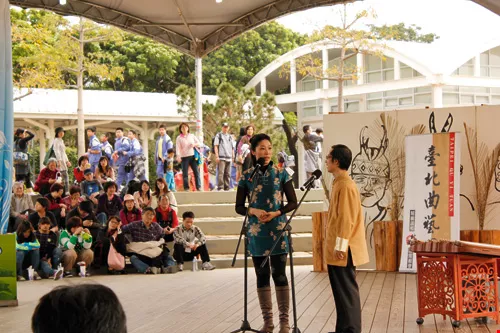
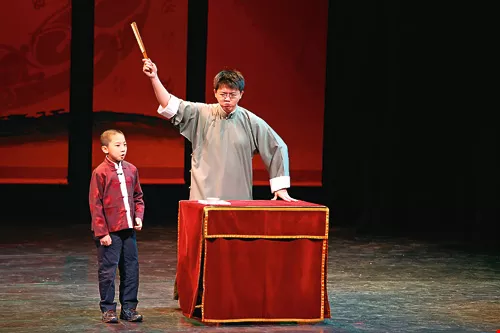
Crosstalk has its roots in life, and its wit makes it a good fit for street performance. The photo is from a TQT show at the Taipei International Flora Expo.
Ye Yijun, an experienced shuochang artist and the executive director of TQT’s education department, has long been interested in the problem of how to increase contemporary interest in her traditional art form. A mother of two who has seen at first hand how much effort children have to invest in language learning, she resolved to spice up traditional language education with shuochang in an effort to make classical Chinese more palatable.
“Dingbo Sells a Ghost” is written in typical classical Chinese. How did she go about shaping it into a shuochang piece that children would enjoy?
She rewrote it, adding details to help children relate. In her version, Dingbo is a stubborn, argumentative procrastinator whose mother has sent him to Wanshi to buy some things. Pressed repeatedly by his mother to get moving, he sulkily responds: “OK, just a minute!” “I know!” “What a pain!” That kind of colloquial language helps draw children in, and exemplifies shuochang’s aptitude for “localizing.”
The core of the story—Dingbo’s encounter with the ghost—takes place after he sets out. Ye casts this as a dialogue between three characters—a storyteller, Dingbo, and the ghost—adding elements that make the characters and story more accessible to contemporary audiences, and filling out the classical text with dramatic scenes crafted to appeal to children.
For example, in the original text, Dingbo fails to recognize the ghost for a time. Ye reworked this, having Dingbo fail to recognize the ghost as a ghost because it isn’t pale. She also has the ghost wondering about Dingbo’s “human scent.” This causes audiences to worry that Dingbo will be found out, to find the ghost funny, and even to pity the ghost for its stupidity.
Though these kinds of performances seem simple, the characters’ lines are rich with emotion. When performing the piece, Ye uses shuochang techniques to switch between the roles of storyteller, Dingbo, and the ghost, an approach that places the performer squarely at the heart of the piece.
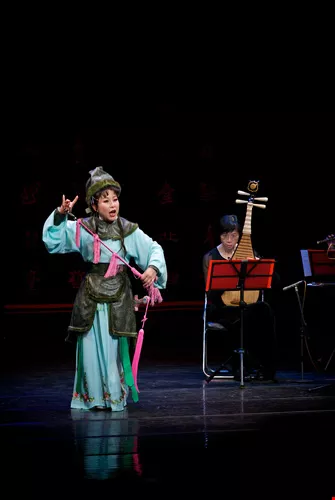
TQT recast “The Ballad of Mulan” as a play, and gave a special performance of it featuring Peking Opera star Li Guangyu.
On the face of it, there’s nothing new about combining shuochang with language education. For example, “crosstalk” (xiangsheng, a style of comic dialogue) routinely includes an enormous amount of wordplay. From the standpoint of language education, crosstalk routines often make excellent use of rhetorical devices ranging from parallelism and proverbs to homophones and puns.
Crosstalk makes frequent use of words that have more than one pronunciation, puns, and abuses of conventional usage for comedic effect.
Crosstalk performers also draw on expressions that repeat a word (e.g. wenzhibinbin “of gentlemanly demeanor” and baibaijingjing “clear complexioned”), expressions built on opposites (e.g. light versus dark, genius versus idiocy), partitives, and idioms (e.g. “rushing to the fore” or “looking out for both sides”) to construct routines.
Like many other traditional arts, shuochang, which rose to popularity in the Song Dynasty, draws on a rich cultural heritage. Crosstalk, storytelling, storytelling with a drum, and other shuochang routines often draw on episodic novels such as The Romance of the Three Kingdoms, The Dream of the Red Chamber, or Water Margin. TQT is typical in this regard, frequently making use of these excellent language resources in its routines.
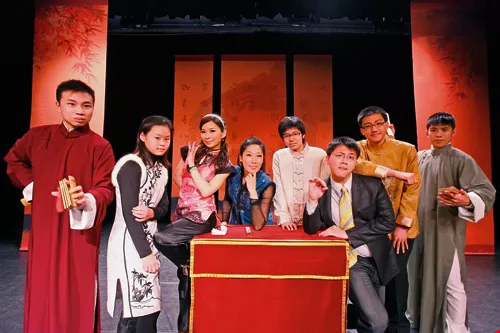
The integration of traditional shuochang with language education has been a key focus of the Taipei Quyi Troupe. Ye Yijun (center, in the blue blouse) and the young performers training in TQT’s practice studio have spent years working on their technique.
Founded in 1993, TQT is one of the many outstanding groups of artists supported by the Council for Cultural Affairs. With Ye at its core, the shuochang troupe has focused on language education.
Ye studied with the renowned crosstalk artist Chen Yi’an before going professional in 1986. After working in crosstalk for more than 20 years under the name Chang Yijun, she traveled to mainland China in 2007 to study with master storyteller Tian Lianyuan, a Shenyang native known for acting the parts of the characters in the stories he tells. A writer, performer, and educator, Ye is one of the few northern-style storytellers in Taiwan.
After leaving shuochang performance for a time in 2005 to have a baby, Ye returned to TQT where she began integrating shuochang into crosstalk programs.
TQT operates a practice studio and a rehearsal hall. The troupe matches teachers with students, training the latter in the fundamentals of shuochang (such as the use of the voice and postures) for three years before providing the children with more specific direction based on their interests and needs. The practice studio attracts many kids with an interest in the art. Troupe members patiently tutor them in hope of passing the torch and in the expectation that young people entering the group will bring a more contemporary perspective to this traditional art form.
The oldest of the kids who were trained in TQT’s practice studio are now in university, and many are able to hold their own on the stage. Over the years, Ye herself has developed numerous educational pieces in which TQT’s young students naturally take roles.
Most of the children studying with TQT are genuinely interested in shuochang, but a few are there for help with issues such as speech impediments, introversion, or hyperactivity.
“We take everyone,” says Ye. Training helps many of the children overcome their speech or behavioral difficulties and even go on to win school crosstalk, public speaking, or recitation contests.
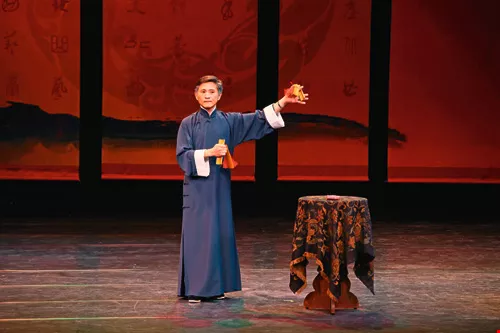
TQT’s Lin Wenbin, known for his bamboo clapper storytelling, has created an updated version of Tang Dynasty author Liu Zongyuan’s famous “The Ass of Guizhou.”
It takes time to pass on a traditional art. Teachers need to be confident, patient, and very passionate.
An accomplished crosstalk professional, Ye went on to become a highly regarded storyteller in shuochang circles in both Taiwan and mainland China. Since stepping out of the limelight, she has spent the bulk of her time with her young students, and writing pieces that don’t adhere to the pointed, satiric pattern of traditional crosstalk. What prompted her change of direction?
“I tend to view life through the lens of crosstalk,” says Ye. She explains that while many people recognize the performative, entertainment, and cultural aspects of shuochang, some peer a little deeper to appreciate the wordplay, riddling and other techniques. When she looked still deeper and realized that shuochang had its origins in life, in experiences such as marriages, births, and travails like failed investments, she concluded that shuochang needed to return to those roots. She thought that if she could combine shuochang with language education and train young performers, she would have a means of connecting her profession to life as lived.
These insights were the fruit of much time spent reflecting, as well as a fortuitous encounter.
When performing in Malaysia in 2003, she met mainland crosstalk star Ma Ji, a student of crosstalk master Hou Baolin. While discussing shuochang with him, she had an epiphany.
Originally developed by people at the bottom of the social ladder as a means to support themselves, early crosstalk often contained vulgar or “dirty” language. Hou, Ma, and the present day TQT have worked to refine it and clean it up, filtering out casual usage and putting new emphasis on rhythm and the elucidation of language.
Ye observes that the language of shouchang, which is filled with references to lines from poems and other quotations from the classics, distills the essence of Chinese culture. She hopes that her compositions will help strengthen and pass on traditional culture.
Bamboo clapper storytelling can also be done with two performers.
There is a body of research suggesting that language determines thought, and even influences the development of personality.
Guo Zhijie, director of TQT, says that the fact that people talk all the time makes it seem as if discourse is a simple matter. But getting up on a stage to tell a story, while enunciating clearly, imbuing the words with feeling, and making the meaning plain, takes comprehensive long-term training. The real fruits of TQT’s years of work combining shuochang programs with language education involve oral training, the cultivation of character, and their integration with elementary and middle-school language materials.
Ye says that children in the Internet era often don’t communicate well with their parents, not because of a lack of vocabulary, but because of a lack of shared cultural understanding. Adults who have been profoundly influenced by traditional culture want their kids to be honest and obedient, but kids who have grown up in virtual spaces are accustomed to equality, role playing, and expressing their individuality. The resultant generation gap causes innumerable problems between parents and children.
“I hope that our shuochang materials can get the cultural ball rolling,” says Ye. Whether an educational crosstalk routine or a reworking of a traditional text (like “Dingbo Sells a Ghost”), Ye says that the language and the performers’ voices draw audiences into the piece, introducing them to crosstalk and storytelling as arts, and passing on traditional culture.
“My children have always loved to talk,” says Jiang Dawei, dropping his twin boys off for a TQT lesson. “But I never imagined that their chattiness would blossom into them learning ‘speaking arts.’ The change in them has been enormous.” Jiang says that his kids used to use language indiscriminately. Now, having studied crosstalk, they understand that you have to choose your words. They are also doing very well in their language courses at school, where they are often selected to take part in performances and anchor programs. They have even been accepted into the National Education Radio anchor contest, received service awards from New Taipei City, and had their worlds broadened by tours with TQT.
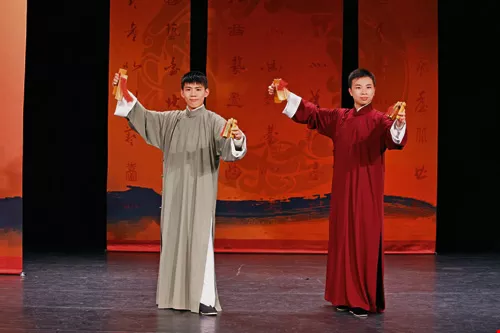
Bamboo clapper storytelling can also be done with two performers.
Middle-school students today are still required to memorize “The Ballad of Mulan,” which tells the story of the young heroine who became a soldier in her father’s stead.
Ye’s middle-school-aged son was astonished to hear his mother reciting the poem to herself. As the two took turns reciting lines, a light went on in Ye’s head.
“Who would have thought that the Mulan ballad had such linguistic force in the 21st century? It seemed to me that I must have passed my cultural gene on to my son and I fretted that few such genes were left.” Ye says that her desire to “sow seeds” with a language education troupe for the last several years arose from the desire to perpetuate these genes.
“Chirp chirp and again chirp chirp / Mulan weaves by the door / [A passerby] can’t hear the sound of the loom / Only the woman’s sighs….” TQT’s version of “The Ballad of Mulan” sounds great and makes wonderful use of traditional theatrical imagery, weaving traditional culture and language education together, and passing them on to the next generation.
@List.jpg?w=522&h=410&mode=crop&format=webp&quality=80)

@List.jpg?w=522&h=410&mode=crop&format=webp&quality=80)


@List.jpg?w=522&h=410&mode=crop&format=webp&quality=80)

@List.jpg?w=522&h=410&mode=crop&format=webp&quality=80)
