
On 21 September the United Nations General Assembly began its latest session. At the same time, New York, where the Assembly meets, has become strategic location to be battled over by Taiwan and mainland China. From the R.O.C., Liu Sung-pan, President of the Legislative Yuan, Jason Hu, Director-General of the Government Information Office, Huang Hsin-chieh, former Chairman of the Democratic Progressive Party, and many officials and legislators from the ruling and opposition parties are currently making their separate ways to America to lobby for support in various ways. Although there is no chance that the question of admitting the Republic of China to the Assembly will be discussed during this year's session, at least they have the opportunity to publicize the situation and aspirations of the more than 20 million people in Taiwan before the gaze of the international media.
In late July this year, Foreign Minister Frederick Chien attended a meeting in Central America. Shortly afterwards, on 6 August, Guatemala, Nicaragua and five other countries with diplomatic relations with the R.O.C. wrote to United Nations Secretary-General Boutros Boutros Ghali, proposing that the agenda for the 48th UN General Assembly this September include a discussion on establishing a "Special Committee" to resolve the issue of representation for "The Republic of China on Taiwan." This marked the first tentative step towards R.O.C. participation in the United Nations, and provoked an enormous response within the R.O.C. itself.
There is no doubt that the R.O.C.'s initiative is worrying to the Chinese Communists. At the end of August, the mainland's State Council issued a harshly-worded policy white paper in seven languages entitled The Taiwan Question and the Reunification of China, which clearly stated that the R.O.C.'s attempt to participate in the United Nations was unacceptable. It is interesting that on this occasion the Chinese Communists, who have always proclaimed that cross-strait matters are "the Chinese people's own affair," and avoided internationalization of the cross-strait issue, have this time adopted a different posture, by urgently expressing their position to the international community in written form. Even this point alone represents an impressive victory for Taipei.
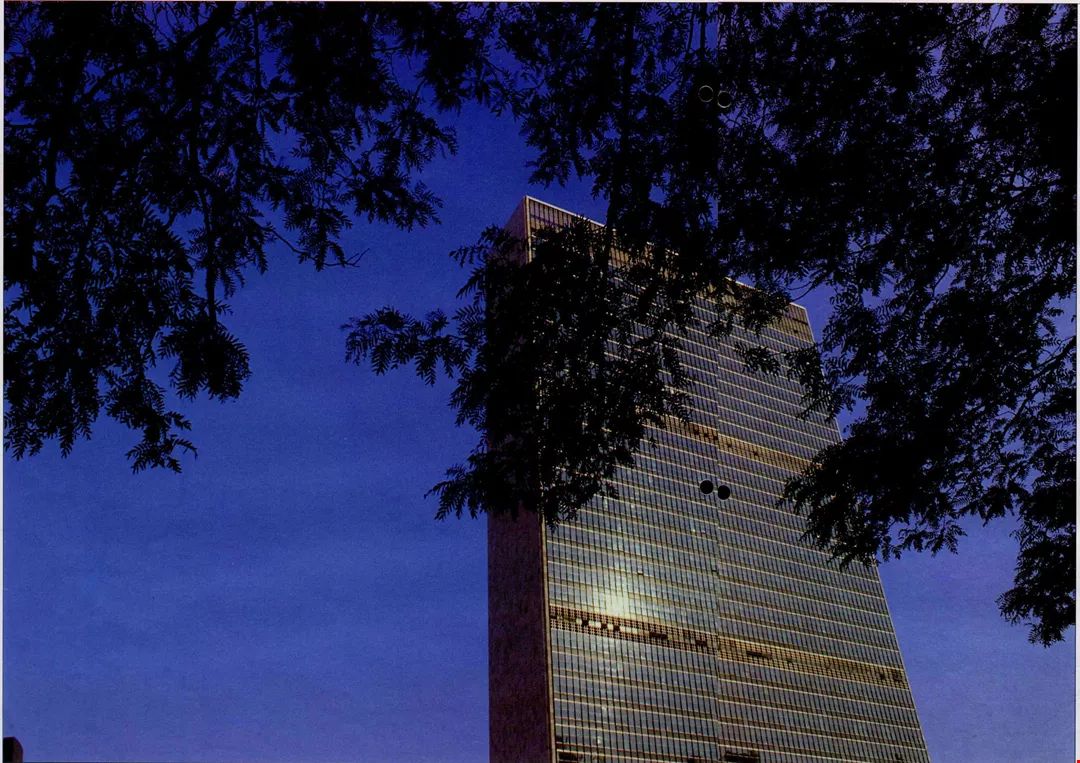
The way the UN works may arouse controversy, but in the new post-Cold War order, it still plays an important role. (photo courtesy of Cosmorama magazine)
Throwing off isolation and returning to the international community:
Today's appeal by the R.O.C. to participate in the UN is a bold step, calling for justice to be reestablished after 22 years of its citizens suffering isolation and discrimination.
Back in September 1971, when the UN General Assembly passed Draft Resolution 2758 excluding the R.O.C. and admitting Communist China, people in the R.O.C. were saddened and angered, and bitterly denounced the other nations for abandoning an ally; but this could not change the brutal reality of the international trend of the time. After the R.O.C. lost its UN seat, its international position gradually became more and more shadowy, as one country after another broke off diplomatic relations, navigational rights were rescinded, the R.O.C. was forced to withdraw from international organizations, and R.O.C. passport holders faced obstacles wherever they went. It was a cold and bitter time.
But times and fortunes change, and those things which previously we were loath to remember and dared not dream of recovering, we can now openly and forcefully demand. To return to the United Nations is the most important but also the most difficult of these objectives.
"In the last few years, the situation has changed enormously. We can look at this from three angles: internationally; within the R.O.C.; and from the point of view of cross-strait relations," observes Dr. Chao Chun-shan, Deputy Director of the Institute of International Relations at National Chengchi University.
Firstly, with the collapse of the Soviet Union, the situation of two large opposing blocs, capitalist and communist, no longer exists. It is no longer the case that the Western camp wishes to use the Chinese Communists to contain the Soviet Union, and therefore goes out of its way to ingratiate itself with them and is afraid of offending them. What is more, in the post-cold-war era the world is filled with an atmosphere of reconciliation, and it is a time for setting aside enmity and for co-existing peacefully. The states of the former Soviet Union have all declared their independence, the two Germanies are united, the two Koreas simultaneously entered the UN the year before last, and even Israel and the Palestinians have just come to an agreement despite deep-rooted hatred. For Taiwan to take advantage of this conciliatory atmosphere to voice its own aspirations should be something which the international community can understand and support.
As far as relations with mainland China are concerned, since political restrictions in the R.O.C. were removed with the lifting of martial law and the ending of the "Period of Mobilization for Suppression of the Communist Rebellion," the ruling Kuomintang (KMT) party has been able to adopt a more pragmatic attitude with which to approach the R.O.C.'s position and cross-strait relations. The former highest principle of "no compromise with the rebels" has now been replaced by "mutual coexistence and mutual prosperity" with the mainland; and although the "Koo-Wang Talks" between the R.O.C.'s Straits Exchange Foundation and the mainland's Association for Relations Across the Taiwan Straits did not go entirely smoothly, they were undoubtedly an important step forward in advancing relations with the mainland.
The establishment of channels for cross-strait dialogue, the contacts and interaction between the people of Taiwan and the mainland, and the involvement of Taiwanese business people in the mainland's economic development, "show that in the present phase, mutual co-existence, mutual prosperity, and well-intentioned contacts, in order to prepare the way for future unification when the time is ripe, are surely in line with the hopes of the vast majority of Chinese people," says Cheyne Chiu, Secretary-General of the Straits Exchange Foundation with great confidence.
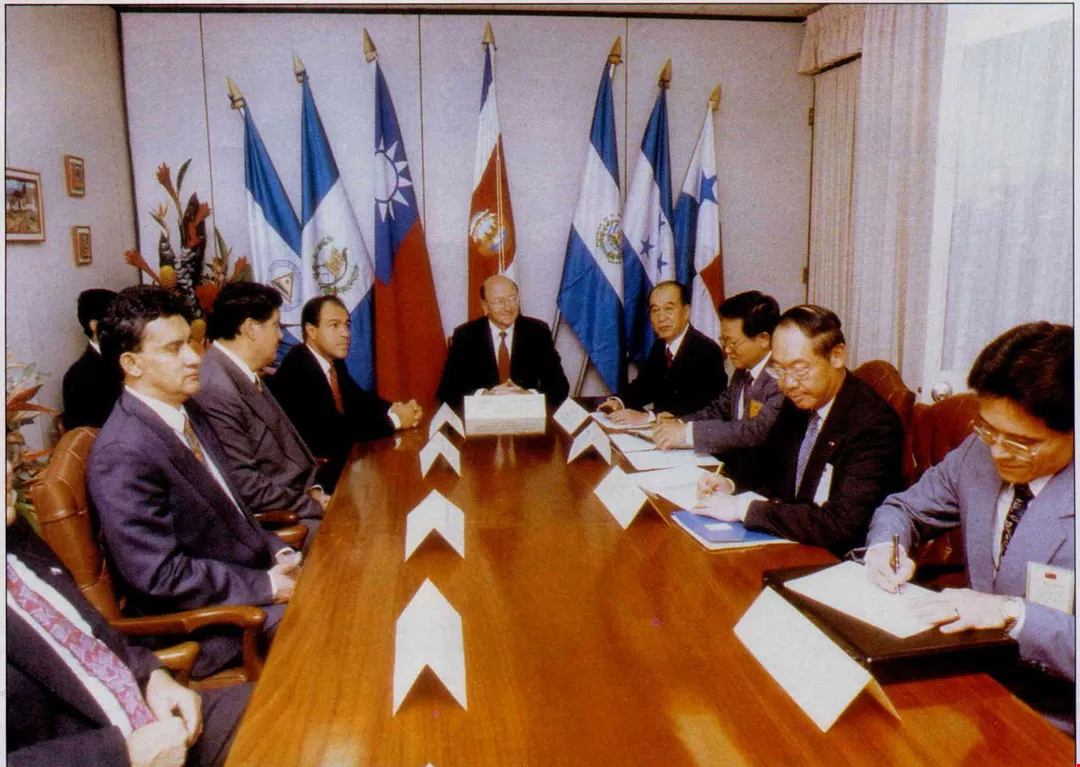
The strong support expressed by our Central American allies for R.O.C. participation in the UN is of great help in breaking away from the diplomatic status quo. Pictured are R.O.C. Vice-President Li Yuan-zu and Foreign Minister Frederick Chien on an official visit to Central America in 1991. (photo courtesy of the Government Information Office)
Who took away the R.O.C.'s right to speak?!
Of course, it is the changes within Taiwan itself which are the main reason for wishing to return to the United Nations.
"Taiwan is now too big to ignore!" was the headline over a leading article three years ago in the New York Times: the 14th largest trading nation in the world; the world's biggest foreign exchange reserves at US$84 billion; and a per capitanational income approaching US$10,000, ranking 25th in the world. Even Taiwan's population, now counting 21 million people, is enough to put it among the top third of the current 184 member states of the United Nations. Furthermore, the UN, in an effort to be as representative as possible, applies the principle of "universal membership," so that even the exiled Palestine Liberation Organization is able to have UN observer status. It goes without saying that Taiwan meets the criteria for membership.
And because the UN aims to enable every country to exercise its right to speak on the world's stage in order to protect its interests, it is not reasonable for the international community, under pressure from Beijing, to have deprived the people of the Republic of China of this right for so long. Premier Lien Chan's call for the world to "correct past mistakes and treat us justly again" very much expresses the aspirations of R.O.C. citizens.
Chao Chun-shan emphasizes that in the 1990's, the topics of world importance are no longer limited to peace and security, but instead include complex issues relating to such areas as environmental protection, economics and trade, and even human rights. All these global topics require nations to express their position and to exchange and pool information in international organizations. If the R.O.C. cannot gain admission to such organizations, it will be obstructed at every turn, and this will greatly hinder national development.
For instance, to protect the rapidly thinning ozone layer, the United Nations Environmental Program is encouraging countries to sign the Montreal Protocol. Under the terms of the Protocol, all signatories agree to reduce their use of chlorofluorocarbons, and any nations not willing to sign may be subject to economic sanctions. But the R.O.C. is in the unique and embarrassing position of having "an extremely strong desire to sign the Protocol and adhere to its regulations, but having the door slammed in its face." If the R.O.C.'s environmental protection authorities had not taken the initiative by personally attending the meetings and taking every opportunity inside and outside the venues to lobby and express their position, Taiwan might really have been unfairly subjected to punishment.
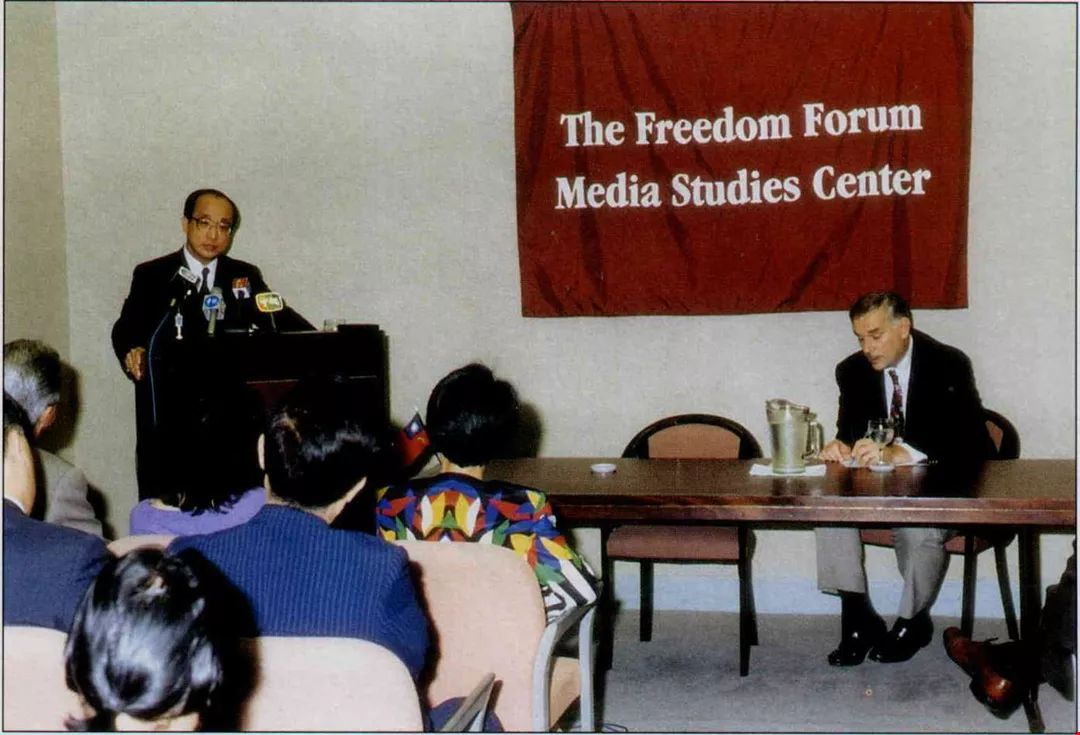
To support the cause of R.O.C. participation in the UN, many groups of ruling and opposition party legislators and government officials have recently visited the U.S.A. to express the aspirations of their compatriots in Taiwan to the outside world. Picture d here is Jason Hu, Director-General of the R.O.C. Government Information Office, giving a lecture as a guest of New York's Columbia University. (photo courtesy of the Government Information Office)
Giving back to the international community, seeking acceptance:
Of course, as the R.O.C. has emerged as an economic power, it has increasingly received both praise and criticism in the international arena. On the good side, there are many aspects of the "Taiwan experience"--in agronomics, land reform, health and safety, education, family planning and even the process of democratization over recent years--which can serve as a reference for third world countries; but on the other hand Taiwan's record on product counterfeiting, environmental protection and other areas has attracted a good deal of international criticism.
R.O.C. government officials have repeatedly stressed that we are happy to provide information about the benefits of the Taiwan experience, and funding, to other countries; as for existing shortcomings, the government is also willing to accept international regulation and improve step by step. It may be difficult for people outside Taiwan to appreciate the great desire here, suppressed for so many years, to return to active membership in the international community, but for the 21 million compatriots here it is very real.
Apart from the desire for interaction with the international community, the evolution in the political situation inside the R.O.C. also adds to the pressure to participate in the United Nations.
"In the past, with the doctrine of the inseparability of China, to speak of Taiwan being its own master or gaining its own sovereignty was treason and heresy, but now our democracy has reached a degree of maturity, and demands like these appear completely natural," says DPP legislator Parris Chang.
Chang takes the view that although the DPP's party program expresses the hope of establishing an independent state, as far as entry into the United Nations is concerned, even if the name Republic of China continues to be used, "So long as we can get in, we can accept that." Going further, he says that if Taiwan's 21 million inhabitants can obtain the respect and rights of a sovereign nation without changing the country's name, then the question of Taiwan's independence would become secondary.
Of course, the DPP wishes to use this issue to cast doubt on whether "the R.O.C. government on Taiwan can really win the respect and rights of a sovereign nation for the people of this island." And the ruling party, taking advantage of the favorable situation, is responding to these doubts with concrete, active measures.
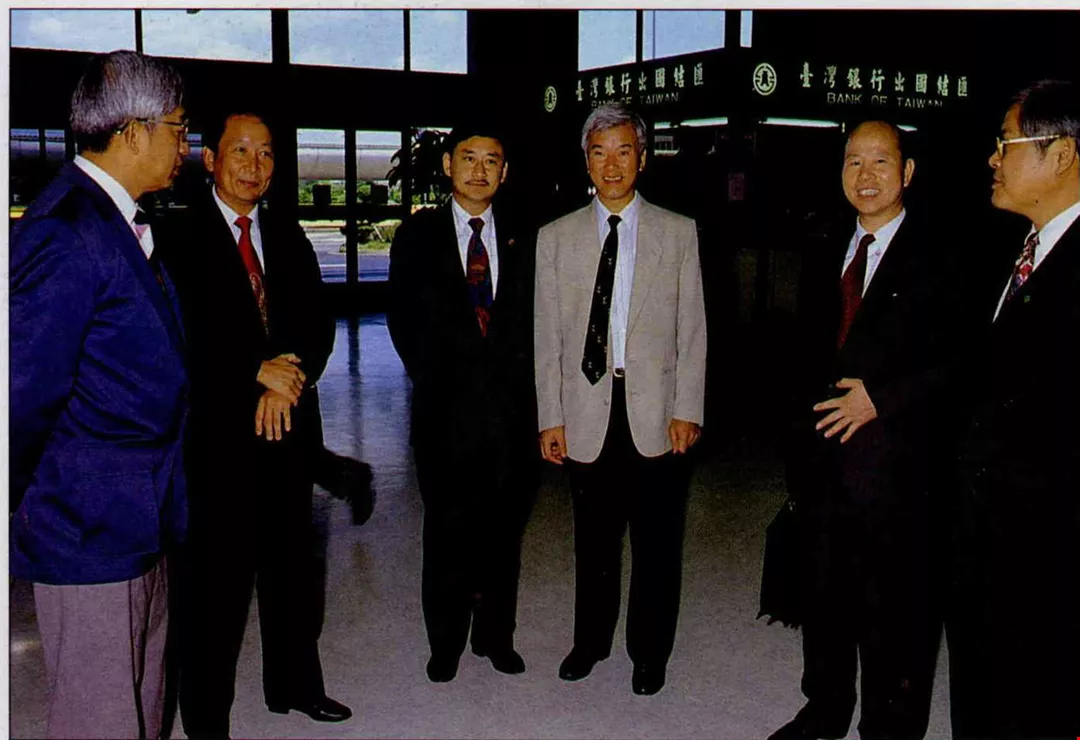
The Democratic Progressive party has declared "joining the UN" as its prime diplomatic objective, and recently the party's former chairman Huang Hsin-chieh and current chairman Hsu Hsin-liang led groups to America and Europe to lobby for support. Pictured here is the DPP delegation at the airport before their departure. (photo by Hsueh Chi-kuang)
Knocking on the UN's door:
For the R.O.C. to resume participation in the United Nations is the natural result of trends internationally, within the R.O. C. and in cross-strait relations. But although these trends exist, the difficulties and obstacles are no less than before. Most fundamentally, what course of action must be taken for these aspirations to become reality?
Currently many formulae have been proposed by which the R.O.C. could participate in the UN, including "resuming" its seat, applying to join, parallel representation with "one country, two seats"; or the roundabout route of first joining the UN's peripheral organizations. Many possibilities exist, but all are fraught with difficulties.
Foreign Minister Frederick Chien points out that a move for the R.O.C. to "resume" its seat at the UN in place of the Chinese Communists would be most unlikely to gain enough supporting votes, while an application to join as a "new independent country" would not get past the Chinese Communists' veto on the Security Council. Neither of these approaches is realistic.
By comparison, the "two parallel seats" approach seems more feasible to most scholars. Two parallel seats means that while stressing the principle that China will eventually be reunited, the "political entities" on the two sides of the Taiwan Straits could both take their seats at the United Nations independently and with equal status, each separately exercising its functions. If the opportunity can be grasped, with each side showing sincerity and goodwill, then this transitional arrangement of "one country, two seats" would be advantageous for future peaceful unification. The reunification of the two Germanies is the best example supporting this assertion.
However, the difference between China and the two Germanies is that Germany's separation was not the result of a civil war, and there was not the enmity, distrust and fear between them which a civil war generates. Furthermore, the two Germanies had each recognized the other as an independent sovereign state, unlike the Chinese Communists who have always claimed sovereignty over Taiwan. This is the real cause of the logjam.
Ironically, back in 1971 when the R.O.C. was still recognized as the legitimate government of China and the Chinese Communists were unable to gain entry to the UN try as they might, "two seats with parallel representation" was the expedient by which the international community once hoped the issue of representation for China might be resolved. But with the uncompromising attitudes of the time, with each side wishing to gain "sole" legitimate status, both vehemently attacked such suggestions as absolutely unacceptable.
However, times have changed, and today, although we are still in the weaker position, with hard work perhaps this goal can be achieved. More importantly, as GIO Director-General Jason Hu stresses, "parallel representation for a country under divided rule" is both fair and reasonable, and Beijing really should try to accept our ideas and demands. "If they can't even do that much, then any talk of national unification is meaningless and unattainable," says Hu.
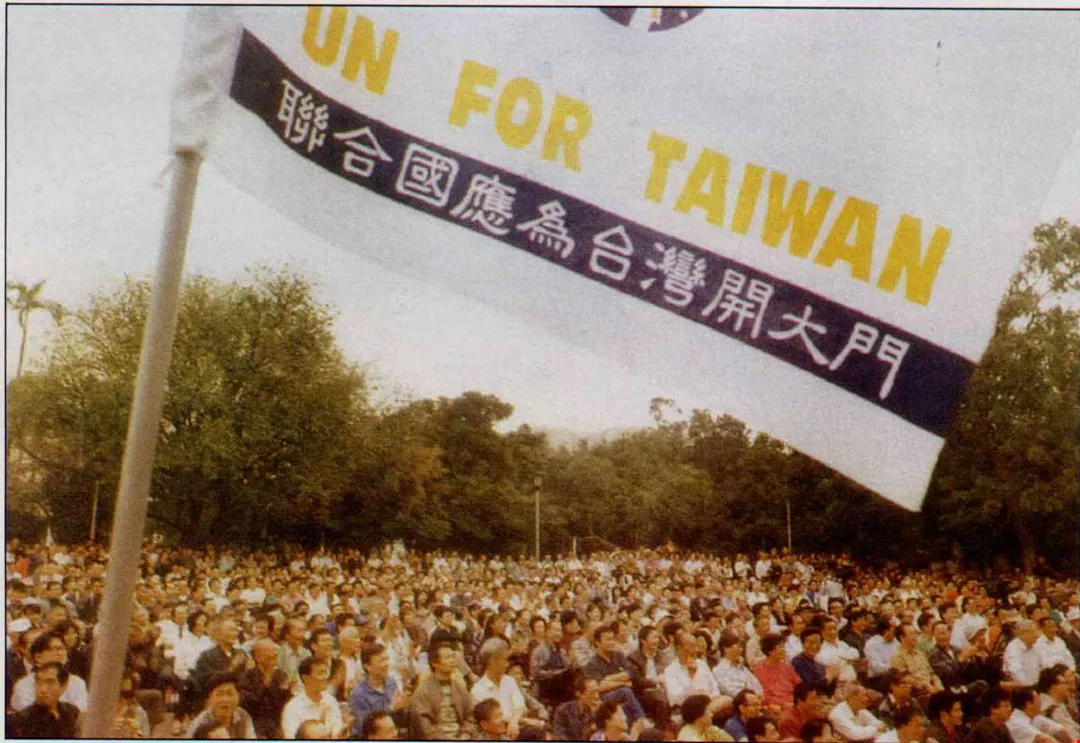
In an increasingly pluralistic and democratic society, the public can fr eely express opinions of any kind. This meeting demanding "UN membership for Taiwan," organized by the DPP in February of this year, brought out thousands of supporters. (photo courtesy of Agence France Presse)
Slow and steady--a test of patience:
Of course, re-establishing participation in the United Nations is not something that can be rushed. After the Communists gained political power on the mainland, it took them 22 years to get into the UN. The fact that at this time the R.O.C. government is asking for "participation" in the UN rather than speaking of "returning to" or "joining" the UN indicates the R.O.C.'s willingness to play any role in the UN which is open to it.
In view of the above, some scholars suggest that the R.O.C. should first become a member of international organizations and UN peripheral organizations such as the World Bank and the International Monetary Fund, and then wait for the right opportunity to get the UN to accept Taiwan as a member "by the back door."
Cheyne Chiu, who has been at the front line of negotiations with the Chinese Communists, believes that this approach, though circuitous, is the most reliable. He points out that from the R.O.C.'s and the Chinese Communists' simultaneous entry into organizations such as APEC and the GATT, it would appear that the Communists have already recognized the R.O.C.as an economic entity. Thus the two sides might do well to learn to co-exist and communicate in international economic organizations of a non-sensitive nature which are in line with their mutual needs and which do not touch on the dispute over sovereignty. Then, once a mutual basis of trust has been established, the two sides could go on to gradually clarify political relations across the Straits.
"We should not think of the Chinese Communists as perverse and unreasonable. In fact, they have been continuously revising their policy on Taiwan," says Cheyne Chiu.
Furthermore, "the UN is a political organization, and if at a time when cross-straits talks have not yet touched on political issues we unilaterally raise political demands with the international community, this will inevitably meet with enormous resistance from the Chinese Communists, causing great difficulties," says Chiu, putting his finger on the nub of the problem. However, to steer clear of the UN and to start with economic organizations is a tortuous route beset with difficulties and requiring great patience; in the face of the strength of people's aspirations and the doubts raised by the DPP, this would be a test of another kind.
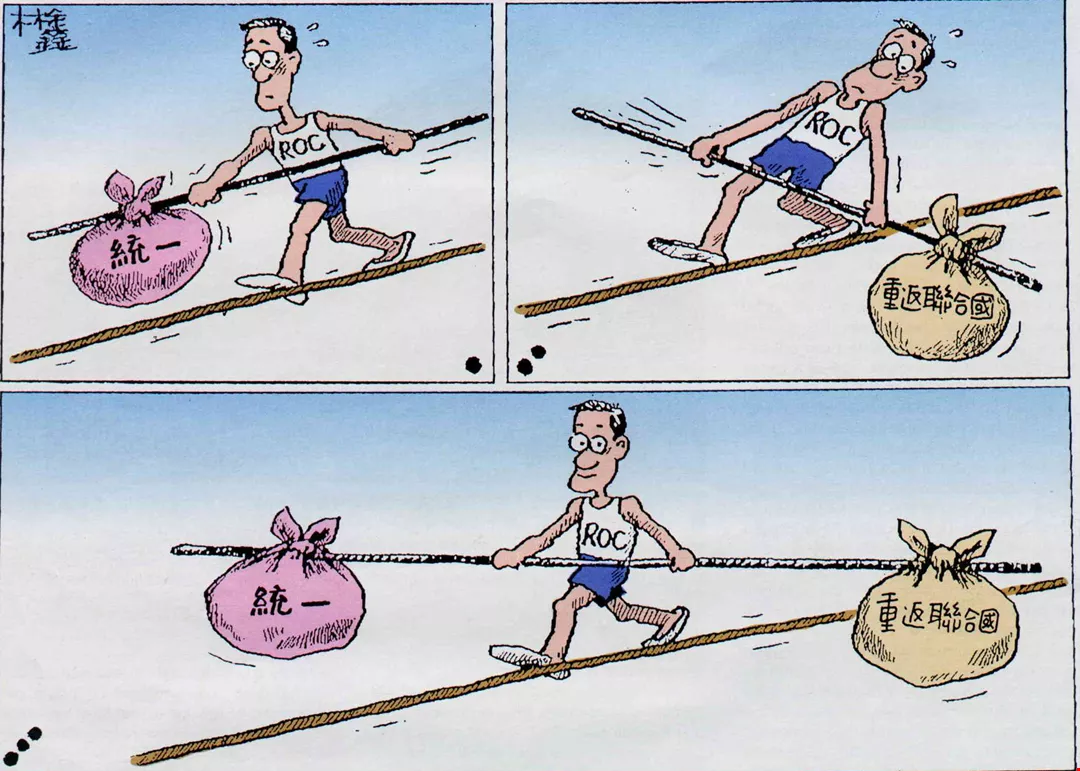
Overcoming the theoretical and pragmatic constraints of pursuing UN participation with the status of a sovereign state while not violating the principle of "Chinese unification" requires common purpose and united effort between government and people. (The bag on the left-hand end of Lee's balancing pole is marked "Unification," and the one on the right "Rejoin the UN.") (cartoon by Lin Hsin)
A triple conundrum:
Just as opinions differ on the choice of strategy, the choice of name is also highly problematic. The current official name of "The Republic of China," because of its inherent implication of a sovereignty which includes the Chinese mainland, and the fact that in terms of international familiarity it has been replaced by the other side's "People's Republic of China," would cause confusion and overlap in the definition of sovereignty. A survey made recently by the Independence Evening Post among various countries' delegations to the United Nations showed that people in many countries are unclear about the distinction between the R.O.C. and the P.R.C.. But to change the country's name in order to gain entry to the UN would be too great a price to pay, and would also inevitably unleash conflict between supporters of reunification and supporters of Taiwanese independence. The storm this would arouse both in Taiwan and across the Straits would be too dangerous. In an interview in the US with CNN and other news media, Government Information Office Director-General Jason Hu has also said that it is too early to discuss under what name the R.O.C. might enter the UN, as this still requires consultation between many parties. He also said that what the R.O.C. is asking for at the moment is a matter of principle, and also represents a protest against its unreasonable treatment by the international community, which should come to an end. As for under what name and by what formula it might participate, these are technical questions. "We should not obscu7re our demands on issues of principle by constantly bickering about technical questions," said Hu.
For most countries, UN participation is purely a diplomatic activity. By careful planning and bold action, the R.O.C.'s Ministry of Foreign Affairs has gained some impressive successes. But given the present complex situation, isn't there a risk that success in gaining international support will stir up conflict within the country between supporters of unification and of independence, and lead to entrenchment and hardening of positions across the Straits? Many scholars have expressed such fears.
"For us to enter the UN requires us to seek international support, to seek consensus between unificationist and separatist elements within the R.O.C., and to seek peaceful co-existence in crosss-trait relations. These three aspects must be tackled together if we are to avoid the risk of reversal," stresses Chao Chun-shan. To progress simultaneously on three fronts and enlist support from all sides is the only quick path for the R.O.C. to enter the UN. But what is most worrying is that both within the R.O.C. and across the Straits, the basis of mutual trust is very weak.
In terms of cross-strait relations, both President Lee and Premier Lien have solemnly declared on many occasions that Taiwan's participation in the UN can only benefit national reunification, but the Chinese Communists still obtusely insist that it is an expression of Taiwan's intention to gain independence. On the other hand, people within the R.O.C. feel that Communist China's overbearing attitude and its readiness to threaten the much smaller Taiwan with armed force mean that Taiwan is bound to come off worse if it enters into negotiations hastily.
By the same token, those people who hope that the government can start political discussions on this subject with the Chinese Communists as soon as possible are apt to be accused of demeaning themselves and strengthening the enemy's hand, while those who propose ignoring the Chinese Communists and appealing directly for international support are accused of wishful thinking and blindness to reality, or of opportunistically seeking Taiwanese independence . . . . With each sticking to their own opinion, it is hard to reach a consensus.
Perhaps the reason why doubts and suspicions are so easily aroused is that as political cartoonist Lin Hsin has described, the government's attempt to pursue both "national reunification" and "UN participation" really is "walking a tightrope"; Cheyne Chiu also acknowledges that it is indeed hard to reconcile the government's wish to maintain a policy of "one China" with its stress on the independent sovereignty of "the Republic of China on Taiwan."
Jason Hu's comment on this is that although it is true that as yet the various factions within the R.O.C. have not reached any consensus, during the present phase of seeking international support we really shouldn't be seizing on points of disagreement over which to attack each other. We can only succeed if we "seek broad agreement and set aside minor differences."
But on the other hand, long years of striving for the best possible advantage in the restricted space available to it has given the R.O.C. the strength and resilience it has today. There is no denying that achieving participation in the UN is a formidable task, but the government's resolute determination to do its utmost to attain this goal has won respect from all sides. If the people place their trust in the government and on this basis build mutual trust and consensus, surely this will be an even more significant achievement than entry to the UN itself.
[Picture Caption]
p.72
The way the UN works may arouse controversy, but in the new post-Cold War order, it still plays an important role. (photo courtesy of Cosmorama magazine)
p.74
The strong support expressed by our Central American allies for R.O.C. participation in the UN is of great help in breaking away from the diplomatic status quo. Pictured are R.O.C. Vice-President Li Yuan-zu and Foreign Minister Frederick Chien on an official visit to Central America in 1991. (photo courtesy of the Government Information Office)
p.75
To support the cause of R.O.C. participation in the UN, many groups of ruling and opposition party legislators and government officials have recently visited the U.S.A. to express the aspirations of their compatriots in Taiwan to the outside world. Picture d here is Jason Hu, Director-General of the R.O.C. Government Information Office, giving a lecture as a guest of New York's Columbia University. (photo courtesy of the Government Information Office)
p.76
The Democratic Progressive party has declared "joining the UN" as its prime diplomatic objective, and recently the party's former chairman Huang Hsin-chieh and current chairman Hsu Hsin-liang led groups to America and Europe to lobby for support. Pictured here is the DPP delegation at the airport before their departure. (photo by Hsueh Chi-kuang)
p.77
In an increasingly pluralistic and democratic society, the public can fr eely express opinions of any kind. This meeting demanding "UN membership for Taiwan," organized by the DPP in February of this year, brought out thousands of supporters. (photo courtesy of Agence France Presse)
p.78
Overcoming the theoretical and pragmatic constraints of pursuing UN participation with the status of a sovereign state while not violating the principle of "Chinese unification" requires common purpose and united effort between government and people. (The bag on the left-hand end of Lee's balancing pole is marked "Unification," and the one on the right "Rejoin the UN.") (cartoon by Lin Hsin)
@List.jpg?w=522&h=410&mode=crop&format=webp&quality=80)

@List.jpg?w=522&h=410&mode=crop&format=webp&quality=80)


@List.jpg?w=522&h=410&mode=crop&format=webp&quality=80)

@List.jpg?w=522&h=410&mode=crop&format=webp&quality=80)
