The Golden Horse Awards at 50
A Celebration of Chinese-Language Cinema
Teng Sue-feng / tr. by Phil Newell
December 2013


For the 50th year of the Golden Horse Awards, many of the kings and queens of the silver screen from over the years came together for a grand reunion, which culminated when world-renowned directors Hou Hsiao-hsien and Ang Lee jointly announced the winner of best feature film: the Singapore production Ilo Ilo.
This was the first time ever that a movie from Singapore took the Golden Horse for best feature film, further consolidating the position of the Golden Horse Awards as a platform where all the world’s Chinese-language filmmakers can come together.
After assessments by 17 judges and four rounds of voting, Ilo Ilo, a Singaporean production made with a budget of only NT$15 million, took the 2013 Golden Horse for best feature film. A “dark horse” had turned to gold.
Director Ang Lee, who headed this year’s awards jury, had mixed feelings about the performance of Taiwan films for 2013. He said that the advantage of making films in Taiwan is creative freedom, but “production is on a small scale, technical values are not up to standard, and many films just fall flat.” While Tsai Ming-liang’s Stray Dogs compensated somewhat, no other Taiwanese films came up to its weight class. “You can’t generalize about the quality of Taiwan cinema just from Tsai Ming-liang’s films, any more than you can say that Hayao Miyazaki’s movies ‘represent’ Japanese cinema.”

Stray Dogs tells the story of an unemployed, homeless, middle-aged single father who lives a nomadic existence with his son and daughter. A deliberate film with a very unique style, it took the Grand Jury Prize at the 2013 Venice Film Festival, and has now earned the 2013 Golden Horses for best director and best actor for Tsai Ming-liang (top photo, left) and his long-time collaborator Lee Kang-sheng (right).
In any case, Tsai did win his second “best director” prize for Stray Dogs.
Tsai, whose Vive l’Amour won a Golden Lion at the 1994 Venice Film Festival, and who was named best director at that year’s Golden Horse Awards, is a highly revered filmmaker. But there is a lot in his works that is difficult for outsiders to understand.
His 1997 film The River, which included homosexual love and sex, created a huge controversy at the Golden Horse judges’ conference, with opinion divided into two sharply opposed camps. After that experience, Tsai decided not to submit any more films to the awards. It was only when Hou Hsiao-hsien became chairman of the Golden Horse executive committee in 2009 that he returned to the competition with Face.
In his remarks, Tsai emotionally described his feelings about the Golden Horse Awards as “a love–hate relationship.” But this year he was obviously feeling upbeat: “I’m a Malaysian Overseas Chinese, and I’ve had my conflicts with the Golden Horse Awards, but now I’m able to come here again and receive this award…. This could only happen in Taiwan.” He said that the Golden Horse Awards finally slowed down to wait for him, and he thanked the jury for giving him the encouragement to keep going.
Tsai has in his work continually explored different forms that films can take. The rhythm of Stray Dogs is very slow, the plot is fragmented, and characters suddenly appear and then disappear never to return. The movie resembles a series of still life paintings.
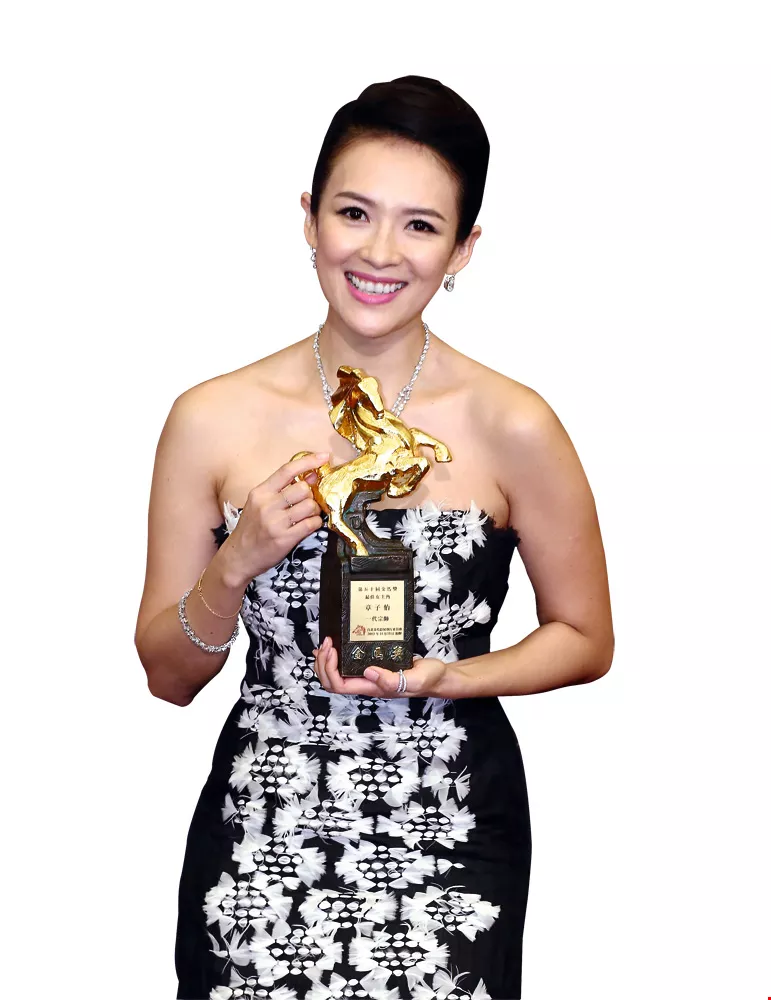
Mainland Chinese star Zhang Ziyi made her screen debut at age 19, and honed her skills under directors such as Zhang Yimou and Ang Lee. Her portrayal of Gong Er in The Grandmaster makes her a worthy recipient of the 2013 Golden Horse for best leading actress.
Stray Dogs tells the story of a single father who makes a living by standing at intersections holding up advertising placards. He has no fixed abode, and takes his two children with him in his wanderings, mainly living in abandoned construction sites in the city.
Tsai has said, “Lee Kang-sheng’s face, that’s my film.” There is one scene where Lee, playing the lead role, stands outdoors in a storm, protected only by a cheap thin plastic raincoat, holding up a placard advertising luxury housing, a placard that in the wind makes it hard for him to even stand. The whole scene is a close-up of his face as tears roll down his cheeks and he sings quietly to himself, “In anger my hair stands on end….” Though his anguish is painful to watch, the camera stays relentlessly focused on Lee’s face throughout the long scene. Said Ang Lee: “That shot alone made this the best film.”
Lee’s performance—described by Ang Lee as “bringing to life for everyone to see, the hardest, bitterest ways that some people have to live in Taiwan”—was rewarded with the best actor award, keeping that title in Taiwan.

Stray Dogs tells the story of an unemployed, homeless, middle-aged single father who lives a nomadic existence with his son and daughter. A deliberate film with a very unique style, it took the Grand Jury Prize at the 2013 Venice Film Festival, and has now earned the 2013 Golden Horses for best director and best actor for Tsai Ming-liang (top photo, left) and his long-time collaborator Lee Kang-sheng (right).
Tsai Ming-liang, who comes from Malaysia but attended university in Taiwan, represents the generation of directors who have taken films in Taiwan to a high artistic plane. The new Singaporean director Anthony Chen has taken a great deal of his inspiration and “nourishment” from Taiwanese New Wave films of the 1980s and 1990s.
“Without Taiwanese New Wave film, there would be no Ilo Ilo,” said Chen. He thanked the Golden Horse judges for drawing the attention of the Chinese-language world to Singaporean cinema, and for turning a new page for Singaporean film.
As Ang Lee noted, Ilo Ilo won over the judges by being refreshing, unpretentious, and touching. But besides recognizing the film for its inherent quality, the awarding of the Golden Horse for best film to a Singapore production in the 50th year of the event has a larger significance in showing the continuity and interactivity of the Chinese-speaking film world.

The red carpet at the entrance to the Golden Horse Awards ceremony was graced with countless celebrities and lined on both sides by fans and paparazzi. Among the ladies were Brigitte Lin, in an elegant red evening gown; Maggie Cheung, in a blue dress featuring transparent lace; Gwei Lun-mei, in a bejewelled white gown; and Shu Qi, in a low-cut Chinese-style outfit that showed her figure to full effect. On the men's side, when idols like Andy Lau or Tony Leung appeared, they were instantly bathed in the light of photographers’ flashguns.

The red carpet at the entrance to the Golden Horse Awards ceremony was graced with countless celebrities and lined on both sides by fans and paparazzi. Among the ladies were Brigitte Lin, in an elegant red evening gown; Maggie Cheung, in a blue dress featuring transparent lace; Gwei Lun-mei, in a bejewelled white gown; and Shu Qi, in a low-cut Chinese-style outfit that showed her figure to full effect. On the men's side, when idols like Andy Lau or Tony Leung appeared, they were instantly bathed in the light of photographers’ flashguns.

The red carpet at the entrance to the Golden Horse Awards ceremony was graced with countless celebrities and lined on both sides by fans and paparazzi. Among the ladies were Brigitte Lin, in an elegant red evening gown; Maggie Cheung, in a blue dress featuring transparent lace; Gwei Lun-mei, in a bejewelled white gown; and Shu Qi, in a low-cut Chinese-style outfit that showed her figure to full effect. On the men's side, when idols like Andy Lau or Tony Leung appeared, they were instantly bathed in the light of photographers’ flashguns.

Many of the kings and queens of Chinese-language cinema were on hand for the 50th Golden Horse Awards in 2013. The best feature film prize was presented by two world-renowned directors, Hou Hsiao-hsien and Ang Lee.

Ilo Ilo, named best feature film at the 2013 Golden Horse Awards, is a story of a Singaporean family with two working parents, in which the child and the Filipino maid gradually go from mutual dislike to mutual acceptance. This was the first time ever that this award went to a Singaporean production.

The red carpet at the entrance to the Golden Horse Awards ceremony was graced with countless celebrities and lined on both sides by fans and paparazzi. Among the ladies were Brigitte Lin, in an elegant red evening gown; Maggie Cheung, in a blue dress featuring transparent lace; Gwei Lun-mei, in a bejewelled white gown; and Shu Qi, in a low-cut Chinese-style outfit that showed her figure to full effect. On the men's side, when idols like Andy Lau or Tony Leung appeared, they were instantly bathed in the light of photographers’ flashguns.

The red carpet at the entrance to the Golden Horse Awards ceremony was graced with countless celebrities and lined on both sides by fans and paparazzi. Among the ladies were Brigitte Lin, in an elegant red evening gown; Maggie Cheung, in a blue dress featuring transparent lace; Gwei Lun-mei, in a bejewelled white gown; and Shu Qi, in a low-cut Chinese-style outfit that showed her figure to full effect. On the men's side, when idols like Andy Lau or Tony Leung appeared, they were instantly bathed in the light of photographers’ flashguns.
@List.jpg?w=522&h=410&mode=crop&format=webp&quality=80)

@List.jpg?w=522&h=410&mode=crop&format=webp&quality=80)


@List.jpg?w=522&h=410&mode=crop&format=webp&quality=80)

@List.jpg?w=522&h=410&mode=crop&format=webp&quality=80)
