City Life vs. Living in the City: Lessons from the Shida Shopping Area Controversy
Chen Hsin-yi / photos Chuang Kung-ju / tr. by Phil Newell
October 2012


It is very common in the big cities of Taiwan to see shangquan (literally “shopping circles”) with “mixed residential and commercial uses” of space. The mixed-use shangquan is indeed a very defining characteristic of Taiwan, and many a quaint neighborhood has been transformed as large numbers of small owner-operated shops have opened for business in first-floor spaces of residential apartment buildings.
At first the shops and restaurants make life convenient for residents, and—being small and initially cheap—often nurture alternative and creative lifestyles, becoming a source of charm and character for the city. But as outsiders hear about these hip neighborhoods, they pour in, generating trash, noise, and traffic, and in turn attract ever more businesses to spill over into once-quiet adjoining lanes and alleys, creating a vicious cycle of increasing crowds and increasing numbers of shops.
Last year controversy broke out over the shangquan around National Taiwan Normal University, known as the “Shida shopping area.” On the surface, the problem appears to arise from the conflict of interest between residents and shop owners over quality of life versus profits. But the root of the problem runs much deeper than that, to the very question of what kind of city and urban life we want, and what the long-term vision should be for urban planning in Taiwan.
One of the most memorable scenes in the film Au Revoir, Taipei, is when the male and female leads duck into the back alleys of the Shida shopping area, which become brighter and more electrifying the later the hour. As they rub shoulders in the densely packed crowd, around them the glittering store signs and veritable fog of steamy aromas from restaurants and food stalls weave a magical urban night scene. This night market, embedded in a culturally robust district of the city, could very well be a showcase of Taiwan’s urban creativity and vitality, and indeed is precisely the kind of area towards which the tourism authorities point visitors.
But there is a less romantic version to this story, one that only came to public attention in 2011, when local residents took their complaints to the city government: The stores and restaurants stay open until the wee hours every single night of the week, making it impossible for residents on the higher floors to get to sleep. Local traffic is constantly in a knot, and on weekends or holidays one can do little more than take baby steps through the dense crowds. Newly opening shops are continually redoing the first floor storefronts they move into, not only creating pounding noise, but raising safety concerns by knocking out building pillars or beams willy-nilly in order to redecorate.
An estimated 10–20,000 people flow into this neighborhood on weekdays, rising to between 30,000 and 40,000 on weekends and holidays. The total resident population of the three wards that host the Shida shopping area is only about 16,000. The fact that shoppers and diners far outnumber the locals creates numerous nuisances that have increasingly irked residents.
In the early days, the Shida shopping area was little more than a few streetside food stalls along Shida Rd. In the late 1980s, the city government began implementing an urban renewal policy here, including constructing a green belt now known as Shida Park and banning streetside food stalls on Shida Rd. itself. Some of the vendors responded by moving their operations into the small lanes and alleys that run off of Shida Rd.
That was the beginning. Then funkier restaurants and shops (at first generally catering to the university crowd) moved into the neighborhood, and these in turn attracted novelty hunters from outside. The ever growing crowds of diners began to draw in hip hole-in-the-wall shops selling clothing and accessories. At first all this was legal. But the snowball of shoppers attracting shops attracting shoppers attracting shops has become an avalanche, spilling over into every lane and alley in the district.
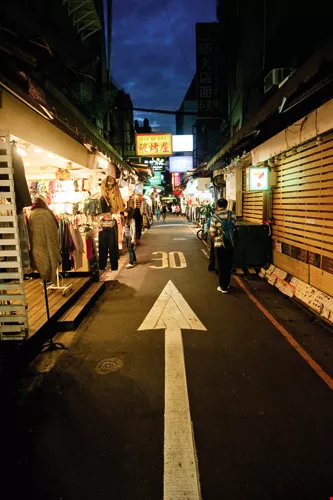
The biggest winners in the Blob-like growth of the Shida shopping area have been owners of first-floor properties and real estate agents. People living on the second floor or higher have, on the contrary, seen their lives disrupted and the resale value of their homes drop. (facing page, middle and bottom) The Shida shopping area boasts a huge variety of cool foods, and has attracted a large number of hip young entrepreneurs looking for relatively inexpensive space.
Today, the shopping area is centered around two main trunk streets, Shida Rd. and Longquan St., and occupies about 18.5 hectares bordered by Heping E. Rd. to the north, Pucheng St. to the west, Taishun St. to the east, and Roosevelt Rd. to the south. In the map below, it is the area in red plus the area in yellow. However, only one hectare, marked in red, is actually zoned for “commercial use.” (The orange is National Taiwan Normal University, known as “Shida,” which gives the shopping area its name.)
Under the law that provides the basis for Taipei’s land use system, except for that one hectare, the remainder of the area around Shida Rd. is zoned as a “Type 3 residential area.” It is by no means completely illegal to open a place of business in an area of this category, but there are limiting conditions. Specifically, if the road onto which a property faces is eight meters wide or more, it is legal to open a restaurant, coffee shop, clothing store, convenience store, and the like. Along roads six to eight meters wide, it is legal to open a shop providing basic services for daily life (such as hair cutting or shoe repair) so long as the premises are smaller than 150 square meters. Theoretically, no commercial activity of any kind is permitted in lanes narrower than six meters.
Statistics from the Taipei City Office of Commerce show that in 2009 there were between 400 and 500 registered stores in the Shida shopping area. By early 2012 this number had grown to almost 700, some of which were located in the one hectare zoned for “commercial use,” and others of which conformed to the requirements for Type 3 residential areas, but over 350 of which were in violation of zoning regulations. In other words, at that time, already more than half of all the businesses in the area were illegal.
How is it that the Shida shopping area grew so rapidly?
Lin Chien-yuan, a former vice-mayor of Taipei City and now a professor in the Graduate Institute of Building and Planning at National Taiwan University, notes that the shop owners are simply responding to the presence of shoppers—demand—in the neighborhood. Any neighborhood that is currently attracting shoppers will inevitably attract more businesses. Secondly, the Shida shopping area is also a night market, and in urban areas people increasingly move their leisure behavior from the daytime later and later into the night, meaning night markets are likely to have an ever-larger consumer base. Third, the expansion of the MRT system has also made it easy for people who live outside of the downtown area to stay there after work, or to come in from the suburbs, for food, shopping, and leisure. Finally, central and local government tourism bureaus have been promoting night markets and cultural zones to tourists (both terms apply to the Shida shopping area), further stimulating growth in such neighborhoods.
It is nothing new to Taiwanese to have convenience-chain outlets, mom-and-pop stores, bakeries, and the like little more than a short walk from their front doors. Almost all neighborhoods in Taiwanese cities are “mixed” districts in this sense. The Taiwanese lifestyle built around mixed zoning has provided fertile ground for the rise of shangquan, including the Shida shopping area. But this factor alone cannot explain how businesses have saturated every lane and alley in entire neighborhoods.
The regulatory regime has also been permissive. The Ministry of Economic Affairs used to have a unified system for issuing a permit to open a profit-making enterprise, under which the owner of a shop would first have to get approval in the areas of urban planning, architectural coherence, fire safety, and so on, before permission would be granted. However, because this was seen as too complicated and time-consuming and therefore a hindrance to economic development, in 2009 the Legislative Yuan revised the law to separate the registration of businesses from government oversight, so that shop owners could simply register as a company, rent a space, and go into operation without any official personage ever setting eyes on the place of business.
This reform measure created a window of opportunity for entrepreneurs. If it turns out that the space for a new shop is not zoned for commercial purposes, the shop owners simply ignore the law and open for business. In their minds, what other choice do they have? Many of them are young creative types with few resources—they couldn’t survive except in a situation like this.
In late 2011, seeing the need to rein in the Blob-like expansion of the Shida shopping area, the city government created a one-stop window where citizens could find out whether a given business location conformed to zoning regulations. But this did not resolve the problem for businesses that were already open.
The contradictions to be found in the Shida shopping area can be traced not only to a lack of consistency in the government’s regulatory policies, but also to the fact that capital flows in recent years have driven up the price of real estate, bringing changes to the types of businesses operating in shopping areas.
“Rent for first floor space is about NT$10,000 per ping [3.3 square meters]—it’s really at the point of being out of control,” observes Chen Junhong, manager at the Shida–Yongkang branch of Sinyi Real Estate. This has produced various effects. For one thing, many of the traditional shops serving the local residents and university community—like bookshops and cheap restaurants—have been forced to move out because they lack high profit margins. They have been replaced by boutiques and other stores with higher profit margins that will attract more outside shoppers. Where once the neighborhood had a “university town” feel, it now feels more like a bazaar. The new stores also have to stay open as late as possible to make enough money to pay the rent.
To make the situation more complex, these shops are not necessarily illegal. The city government manages zoning based on a simple list of categories of stores that are allowed in Type 3 residential neighborhoods. Clothing stores are on the list, so are legal. The problem is that the rules governing Type 3 neighborhoods are supposed to serve the interests of residents, and were drafted with the idea that only one or two shops of each category would open on each street. The rules were not intended to legalize the transformation of every first floor space in an entire residential district into boutiques selling fashions and accessories! The problem, then, is not that zoning laws do not in principle separate commercial and residential districts, but that there is no overall regulation or implementation of the intent of the laws on a neighborhood scale.
The controversy over the Shida shopping area has brought to the surface many problems that had long remained hidden. It is symptomatic of the kinds of challenges faced when people’s actual behavior no longer fits easily within city planning rules. Many of Taipei City’s best known shopping neighborhoods, including Yongkang St., Zhongxiao E. Rd. Sec. 4 (the “East District”), the area around Zhongshan MRT Station, and Tonghua St., are likewise Type 3 residential areas. So what can be done now?
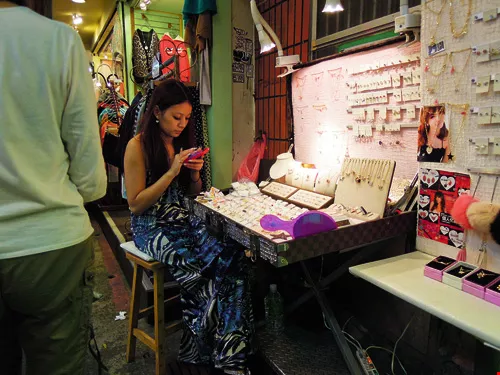
The biggest winners in the Blob-like growth of the Shida shopping area have been owners of first-floor properties and real estate agents. People living on the second floor or higher have, on the contrary, seen their lives disrupted and the resale value of their homes drop. (facing page, middle and bottom) The Shida shopping area boasts a huge variety of cool foods, and has attracted a large number of hip young entrepreneurs looking for relatively inexpensive space.
Lin Chien-yuan says that a more farsighted approach would be for the city government to adopt appropriate incentives to attract economic activities from Shida into nearby night leisure spaces, such as the Riverside Park near Gongguan, Treasure Hill Artists Village, or the Hakka Cultural Park.
Hsia Chu-joe, a former professor in the Graduate Institute of Building and Planning at NTU, believes the problem cannot be solved simply by having the city government come in and close down all the illegal shops. He advises the city government to commission a third party that can mediate between residents and shop owners, one street and one neighborhood at a time. For example, shop owners could promise to reduce their operating hours and keep the environment clean, while residents would have to show flexibility and good intentions, leaving the city government to merely handle public issues like trash removal and traffic control. A whole new model of urban management could emerge from such a process.
Wu Cheng-chong, an associate professor in the Department of Geography at NTNU, has written that the Shida shopping area—which boasts numerous hip or cutting-edge shops—provides a terrific bridge linking up local life in Taiwan with world culture, providing a mirror to reflect the past and a window to explore the future. It is essential that the problem not be considered merely from the point of view of the residents of this or that street, but should instead be looked at from the macro point of view of urban and cultural life in Taiwan. The status and fate of the Shida shopping area should be evaluated in this larger context.
Wu also hopes that NTNU, just adjacent to the shopping area, can provide refuge to high-quality shops that reflect university culture, like bookshops. The university could even take the initiative to turn some of its historic structures, such as Wenhui Hall or the former residence of Liang Shih-chiu, into commercially operated bookstores, teahouses, or avant-garde theaters, providing an oasis where culture can thrive in the commercial district.
There have been efforts in recent years to relieve population and price pressures on downtown areas by redistricting land on the margins of the city for new residential construction, or by building entirely new planned satellite towns. However these new towns, many built on former farmland, have not attracted enough shops and restaurants to make life convenient or enjoyable for residents. In the end, the people still return to the urban core for their recreational and shopping activities.
What kind of urban lifestyle do we want? The only way to find a solution to the Shida shopping area controversy that leaves everyone a winner is to start with this most basic of questions.

The presence of some commercial shops in virtually every residential neighborhood is a defining feature of Taiwan, making daily life remarkably convenient. The city government should seize on the Shida controversy as an opportunity to come up with a completely new vision for the future of the city as a whole.
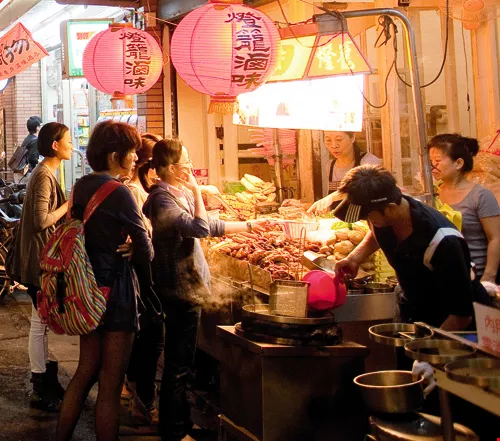
The biggest winners in the Blob-like growth of the Shida shopping area have been owners of first-floor properties and real estate agents. People living on the second floor or higher have, on the contrary, seen their lives disrupted and the resale value of their homes drop. (facing page, middle and bottom) The Shida shopping area boasts a huge variety of cool foods, and has attracted a large number of hip young entrepreneurs looking for relatively inexpensive space.
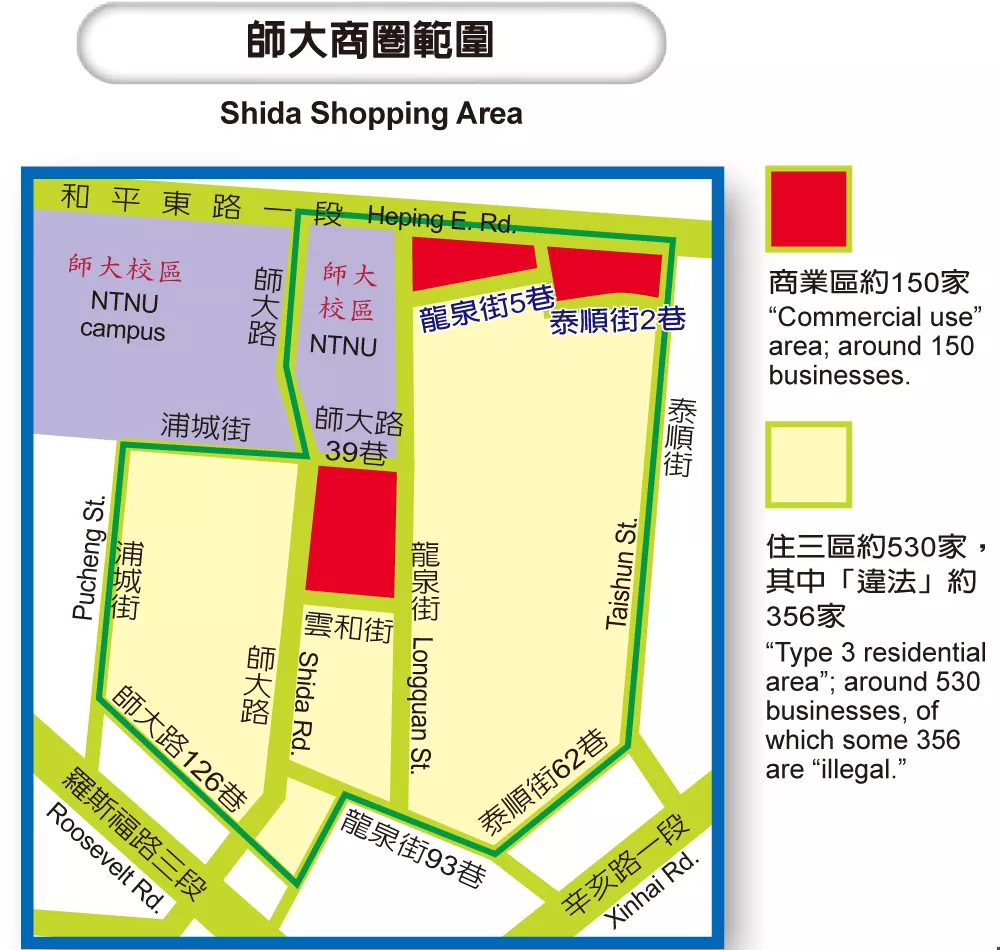
The area around National Taiwan Normal University was once defined by cultural enterprises (like bookstores) and small shops and restaurants serving the needs of residents and the university community. But in recent years funky boutiques and exotic eateries aimed at non-residents have filled the first floor spaces along every lane and alley, causing a sharp deterioration in the quality of life for people who live above and around them.

@List.jpg?w=522&h=410&mode=crop&format=webp&quality=80)
@List.jpg?w=522&h=410&mode=crop&format=webp&quality=80)


