The Encyclopedia of Buddhist Arts
Fo Guang Shan’s Magnum Opus
Jackie Chen / photos courtesy of the editors of the Encyclopedia of Buddhist Arts / tr. by Chris Nelson
July 2013


The 20-volume Encyclopedia of Buddhist Arts is the first great modern-day compendium of the world’s Buddhist arts.
This set of volumes, which took Fo Guang Shan’s headquarters in Kaohsiung a dozen years to complete, fills a gap in Taiwanese publications on Buddhist arts.
It’s no exaggeration to say that Taiwan is a storehouse of Buddhist artifacts. Taiwan is home to many private museums housing Buddhist objets d’art, and many collectors have collections of over 10,000 pieces each. Some of these collectors have generously donated their lifelong collections to public museums.
But to compile a Buddhist arts encyclopedia requires more than just money and effort: it also requires will. The Encyclopedia of Buddhist Arts, published in March 2013 by Fo Guang Shan, is just such an opus.
This set of books comprises four volumes on Buddhist architecture, five on grottoes, four on Buddhist sculpture, three on painting, one on crafts, one on calligraphy and seals, and one on personages, plus an index: 20 volumes in all. The complete work contains almost 3.8 million Chinese characters of text and more than 15,000 pictures. It’s essentially a picture dictionary: images are primary; text is secondary.
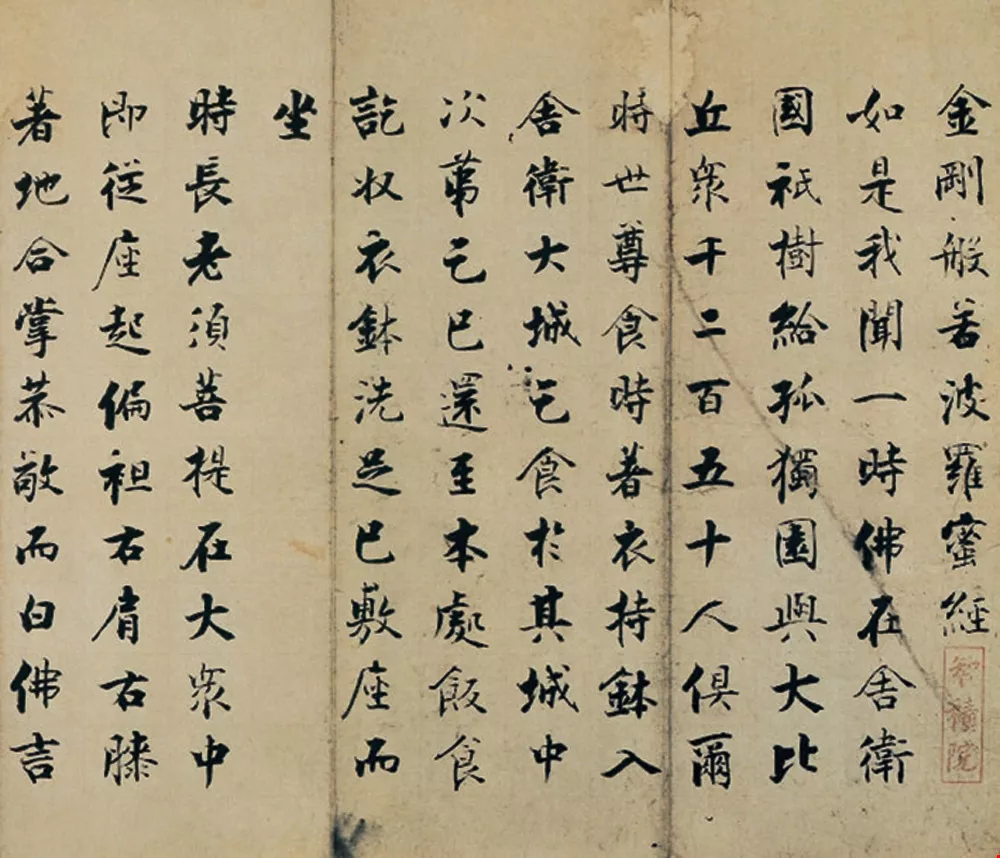
The Diamond Sutra scrolls of Zhang Jizhi of the Southern Song Dynasty are now in the collection of the Chishaku-in Temple in Kyoto, Japan.
Notes Lin Pao-Yao, professor of fine arts at Taipei National University of the Arts, the preservation of Buddhist arts has had a grueling history. Between 1890 and 1915, the great world powers of Britain, France, Germany, Japan and Russia launched numerous archaeological and exploratory expeditions in search of Buddhist artifacts. Back then when they visited the poor, backward Far East, they saw a great variety of exquisite Buddhist art, which surprised them greatly. They went on to scour the Orient, seizing precious works of Buddhist art and bringing them back to their countries.
Afterwards, research into Buddhist art developed strongly in the West, leading to the authority to interpret this Eastern artform falling into the hands of the Western world. It wasn’t until the 1980s, with the joint publication between mainland China and Japan of the 17-volume Chinese Cave Temples, that this interpretive authority gradually began to move back.
During this time, the three-volume The Art of Central Asia: The Stein Collection in the British Museum (1982) was published by Japanese publisher Kodansha in collaboration with the museum; and the Musée Guimet in France published the two-volume The Arts of Central Asia: The Pelliot Collection in the Musée Guimet (1984). In 2012, the National Museum in New Delhi, which houses an extensive collection of Buddhist artifacts appropriated from Dunhuang by British archaeologist Marc Aurel Stein, published Buddhist Paintings of Tun-Huang. But Taiwan didn’t play any part in this tide of publications.
“Now, this compendium of Buddhist arts by Fo Guang Shan has finally made up for Taiwan’s absence from the scene,” says Lin.
Publications on Buddhist arts originated in the Tang Dynasty. Lin tells us that the Taizong Emperor sent Wang Xuance to India four times, starting in 641 CE, to view and record Buddhist statuary and painting in India, central Asia and Khotan. He brought his illustrations back to China and published them in the Records of the Western Region, comprising 60 volumes of text and a further 40 volumes of illustrations. This 100-volume opus is the earliest compendium of Buddhist art.
“Seeing the Encyclopedia of Buddhist Arts today, it’s as if the grand event of the Tang Dynasty’s publication of Records of the Western Region were recurring in modern-day Taiwan,” says Lin.
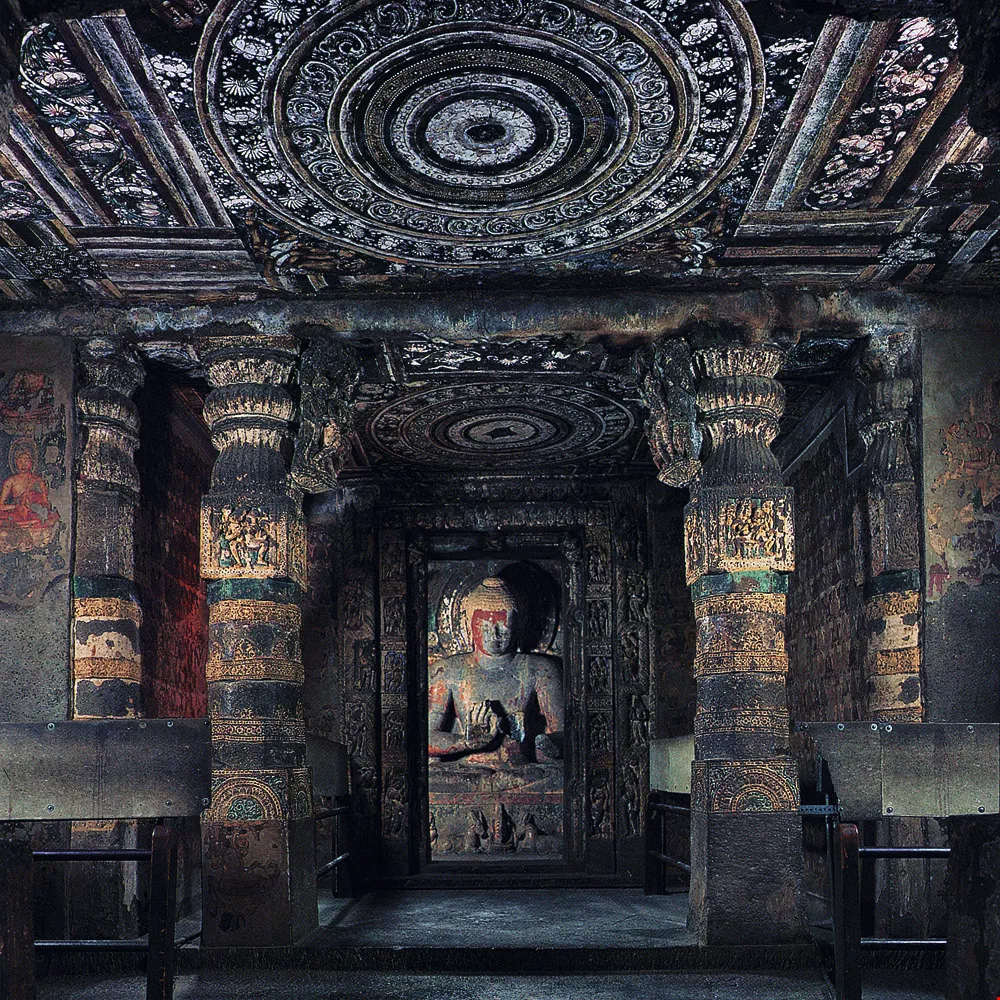
The Ajanta Caves of Aurangabad, Maharashtra, India, are filled with spectacular hallways and niches.
Editing a voluminous arts encyclopedia requires vast amounts of effort and funding, so why did Fo Guang Shan come up with this idea?
Fung Ming-chu, director of the National Palace Museum (NPM) in Taipei, has taken part in the editing of many great works in her nearly 30 years at the museum, such as the Siku Quanshu (“Complete Library in Four Branches of Literature”) and the Tibetan Dragon Sutra. The original copies of these tomes can be referenced, but there are few authoritative works available for reference on the Buddhist arts. Fo Guang Shan’s attitude of “If we don’t do it, who will?” is admirable indeed.
Fo Guang Shan founder Venerable Master Hsing Yun, who has upheld his philosophy of “propagating the Dharma through culture” for over 70 years, visited Dunhuang and the Yungang Grottoes in China, Borobudur in Java, and the Shwedagon Pagoda in Rangoon, Myanmar, in his younger years. From this he gained a profound appreciation of the contributions of Buddhist culture in world civilization. Hoping to spread the word, he long ago came up with the idea of compiling a Buddhist arts dictionary.
Master Hsing Yun’s disciple Dharma Master Ju Chang completed her studies at Fo Guang University’s Graduate Institute of Art in 2001. Thereupon Master Hsing Yun asked her, “What do you wish to do in the future?” She replied, “I would like to compile a Buddhist arts encyclopedia.” Eventually, the simple aspiration of this art-trained nun, plus some karma, saw the completion of the encyclopedia.
In 2004, the work of editing the encyclopedia faced a major hurdle. Due to differing academic viewpoints over such issues as the dating of various works of Buddhist architecture and the definitions of important terminology, some people even suggested that Fo Guang Shan should abandon the project. But later, with the help and participation of Luo Shiping, art history professor of the China Central Academy of Fine Arts in Beijing, as well as many mainland Chinese graduate students, professors and experts in art history who joined in the writing and review process, the editorial difficulties were gradually resolved.
Says NPM director Fung, in art history, numerous soul-stirring works of art were conceived and accomplished because of religious zeal. Buddhism is one of the best religions when it comes to expressing religious ideas through art. The content of the books covers Buddhism’s origins in India, its spread throughout Asia, and its different manifestations developed through intermixing with local cultures, such as Chinese Buddhism and Tibetan Buddhism. Its breadth and depth make it a full introduction to Buddhist art.
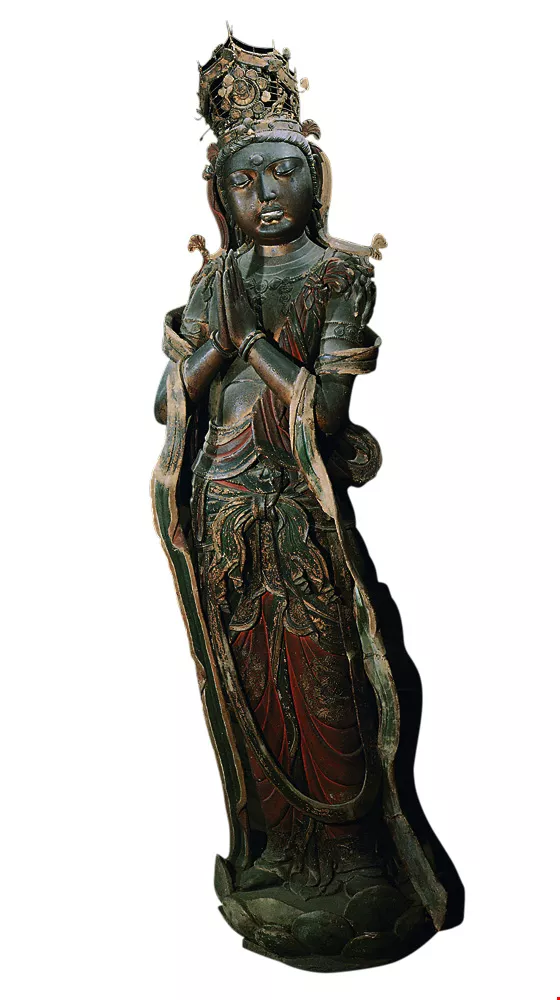
This statue of a bodhisattva at Huayan Temple in Datong, Shanxi Province, is 365 centimeters tall and 975 years old.
This set of books isn’t just for academic use. It can also serve as a reference for anyone who wishes to elevate their knowledge of Buddhism.
Wang Meizhi, one of the editors of the encyclopedia’s Chinese edition, illustrates this point through architecture. The descriptions of the architectural features of Buddhist temples from 2000 BCE to the present day make the encyclopedia an excellent explanatory guidebook for tour operators. For instance, the exterior form of the Four Noble Truths Stupa at Fo Guang Shan’s Buddha Memorial Center is inspired by the Mahabodhi Temple in India, and its spire is modeled after those of Nepalese temples. The book helps us clearly understand the contexts of Buddhist architecture.
The information in the encyclopedia also includes some of the latest developments in the Buddhist arts world. For instance, for the Bamiyan Caves in Afghanistan, where the Taliban regime destroyed the renowned Buddha statues, the encyclopedia displays the appearances both before and after the destruction. And the Buddhas unearthed near Handan, China, in 2012 are also included in the encyclopedia’s sculpture section; this is information so recent that it has yet to be published in academic journals.
Dharma Master Ju Chang points out that the personnel and volunteers taking part in the compilation and editing of the encyclopedia feel that this endeavor is a way of accumulating wisdom and blessings. In the editing process, Fo Guang Shan also designed open courses such as “The Best of the World’s Buddhist Art” and “A Journey to the World’s Buddhist Temples,” introducing the splendor of Buddhist architecture and sculpture to learners in a systematic way.
As the saying goes, “with sincerity and perseverance, nothing is impossible.” The publication of the Encyclopedia of Buddhist Arts proves that you can achieve whatever you put your mind to, and that the soft power of Taiwan’s culture can be found within any person willing to pursue it.
@List.jpg?w=522&h=410&mode=crop&format=webp&quality=80)

@List.jpg?w=522&h=410&mode=crop&format=webp&quality=80)
@List.jpg?w=522&h=410&mode=crop&format=webp&quality=80)


@List.jpg?w=522&h=410&mode=crop&format=webp&quality=80)
