The Resurgence of Fine Porcelain in Taiwan: Henry Shen Pushes the Limits
Kuo Li-chuan / photos Jimmy Lin / tr. by Geoff Hegarty and Sophia Chen
January 2011


If a fine, fragile piece of white porcelain artwork were crafted without a base or any other visible means of support, then what posture would it adopt? Taiwanese ceramicist Henry Shen is the creator of his own brand, 1300 Only Porcelain, and in September 2010 he introduced the company's new line of products, "720 Degrees: Three-Dimensional Sculpture in the Round," for display at Maison & Objet Paris 2010, a home decor exhibition. His fantastically translucent three-dimensional works, which display little apparent means of support, challenge the limits of ceramic design. They have gained enormous admiration, attracting the attention of buyers from the USA, Britain and Russia, who are talking about franchise agreements. The company has drawn further international attention to Taiwan's booming ceramics scene after the success of Franz Collection Inc., another local company with an international reputation as a producer of fine porcelain
This 3D Sculpture in the Round porcelain is unique. It pushes the limits of the traditional ceramic structure to create a multidimensional 720-degree perspective: front and back, top and bottom, left and right, allowing the work to extend freely in all directions. A key characteristic of the technique is its ability to portray a huge variety of shapes, presenting perfectly executed S-shaped curves and transverse arches. Diverse viewing perspectives reveal the delicacy of the techniques involved in these exquisite works.
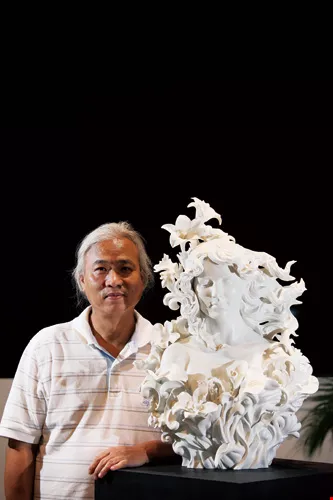
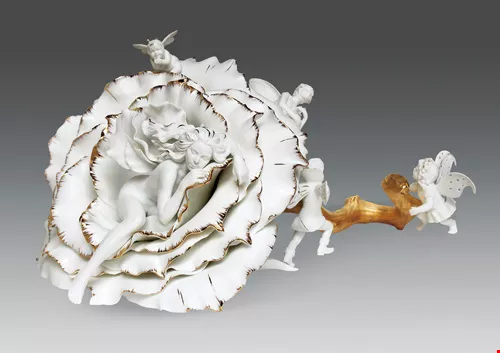
(facing page) Taiwanese contemporary ceramicist Henry Shen is the creator of his own brand, 1300 Only Porcelain. In September 2010, he introduced a new line of products, "720 Degrees: Three-Dimensional Sculpture in the Round," reintroducing Taiwanese ceramics to the international community. The picture shows the work Spring from the Venus Dream Series, consisting of 70 separate pieces created in more than 400 molds. Six craftsmen took a week to assemble the parts into the final design, which was then fired in a kiln. Success ran at only 20% in the initial stages.
The Dream of Hibiscuses, 35 centimeters long, 10 cm wide and 15 cm high, for example, with the girl's elegant flowing hair at the front and hibiscus petals blossoming behind, uses only three tiny points from her hair and petals to support the entire structure. Constraints on the design were obviated by doing away with a flat base so that the delicacy of the detail could be clearly displayed. Each hibiscus blossom is different: changes in the light highlight variations in the depth of folds and waves in each petal. The buds, as thin as pine needles, celebrate the joy of life in the open air. The delicate hibiscus girl may be quietly basking in the fragrances borne on the wind: one feels almost overcome by faint aromas on a summer afternoon's breeze.
In Shen's studio located in Dashu Township, Kao-hsiung County, one realizes that the hibiscus petals, each of which is individually fashioned, are actually created in delicately-shaped molds. The complexities of such craftsmanship are revealed by the division of tasks in the studio. To convert a creation imagined without limits into a complex series of physically limited molds involves skills beyond the range of the average artisan.
Shen founded his own brand in 2005. In an effort to create an individual style, in 2007 he decided to reach beyond the traditional techniques of fine Western porcelain which generally feature a base supporting a vertical figure, to create works that support themselves through their own design-with no base. For his initial work The Dream of Narcissus, he rejected 18 draft designs before making a choice. Several mold manufacturers were stumped by the unprecedented S-shaped figure and refused the work, so Shen, at some expense, ended up employing his own master mold-maker.
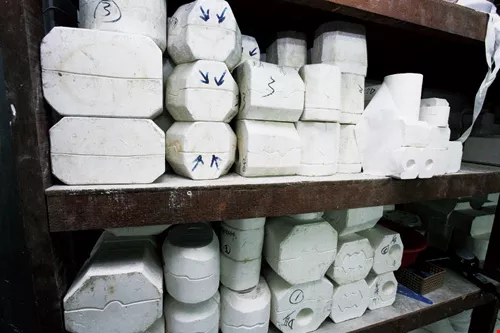
The modern fine porcelain industry requires not only creative ingenuity-a precise and organized division of labor is also important. The pictures show the production process. From top to bottom: (1) Sculpting (2) Designing different types of molds (3) Assembling the complete piece. When completely dry, it is fired in a kiln, a critical process that generally determines success or failure. (4) Painting.
"An S-shaped figure is incredibly difficult to remove from a mold-even creating a basic mold in the shape of curling flower-petals is very hard." The Dream of Narcissus had to be postponed for over a year because of the difficulties in completing the mold work, and with this setback, the entire work was delayed. Still in its infancy, Shen's company was suffering serious growing pains. Fortunately, by way of an introduction, a senior mold master who had been waiting for just such an opportunity to bring his skills into full play accepted the challenge, and was able to solve many of the most difficult problems.
Fortunately with few financial or time constraints, Shen led the nearly 70 members of his creative team into fresh fields. Two years and several hundred million NT dollars later, after countless setbacks and the firing of more than 10 tons of clay, trial production commenced in November 2009. In July 2010, Shen publicly announced his new enterprise-1300 Only Porcelain, a new line of fine ceramics.
"The essence of art is to continually innovate and push the limits," says Shen.
Although the history of creating fine objets d'art from porcelain stretches over a thousand years or more, the untrammeled lines and perfect curves that Shen wanted to capture had never been tried. The technique finally developed for producing a series of molds for his three-dimensional pieces was not only a technical breakthrough, but in fact represented a major innovation in the field.
A degree of vitrescence and clear layering are key elements for fine porcelain, a major challenge whose secret lies in how to remove the porcelain from the mold. Shen's creative team finally developed a technique that works like Russian dolls. The clay body is created in a series of layers, and the piece is removed with an oblique movement, techniques that together overcome the limitations of traditional techniques. This novel method immediately obviates a number of restrictions on porcelain design.
The "1300" of the 1300 Only Porcelain brand is not merely a number, but also the best temperature to fire porcelain in a kiln (1300°C). It also represents the number of years since the peak of China's Tang Dynasty when fine porcelain was becoming widespread. In subsequent centuries the product was counted equal in value to gold in European society, with royalty and wealthy businessmen proud to possess a piece of Chinese porcelain. By 200 years ago, however, European porcelain techniques had gradually matured, and with the emergence of British Royal Crown Derby and other famous manufacturers, the quality of Western porcelain came to surpass that of the East. The beauty of "china" no longer belonged to the country from which it had taken its name-but Shen is hoping that, after 1300 years, Taiwanese fine porcelain will win back this glory.
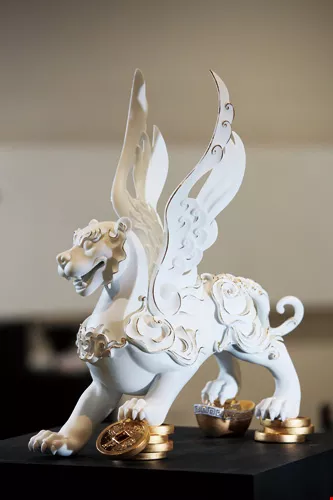
The work Ru Hu Tian Yi from the Auspicious Oriental Animals series shows a new stylized animal.
Looking back on the difficulties of artistic creation and the need for technical innovation, modifying the firing process for the three-dimensional pieces was no less troublesome.
"Kaolin, or china clay, is a silicon-alumina compound. The silica expands by around 6% as a porcelain body is fired in a kiln, but when the temperature reaches 550-600°C, it contracts by 15%. So the tensions created by this expansion and shrinkage amount to a total resulting from a 21% change." As an example, a fine porcelain wall-hanging, Formosan Blue Magpie, with a 3D relief structure, was designed with a height of 110 centimeters, but contracted to around 90 cm after firing.
To help porcelain bear the high temperatures and stresses of the firing process after design and sculpturing, molds are made for the most fragile parts of the structure. These are then filled with clay and fired in a kiln, and later these parts form a bisque, a solid foundational structure to support the more fragile parts during firing. With Formosan Blue Magpie, for example, the extended tailpiece would have been at risk of cracking without this protection.
The most challenging work for the team has been Spring from the "Venus Dream" series. This large vitreous white porcelain bust represents Venus' expression as she wakes in early spring with flowers blooming all around. The work actually consists of 70 separate pieces which were made in more than 400 molds. After the parts were completed, six craftsmen took a week to assemble the parts to form the body. After the formed body had fully dried, it was ready to fire. Because Venus' hair was so wavy and the flower buds so small and delicate, there was fear that during the firing process any part unable to bear the heat might shatter or deform, thereby leading to the destruction of three months' effort. Success ran at only 20% in the initial stages.
Pure-white porcelain using no colored glazes but with a design traced out in gold is another major characteristic of 1300 Only Porcelain. The works are fired in a kiln at 900°C, then 1300°C until the work becomes translucent. Next it is coated with a layer of transparent glaze and heated to 1220°C. In this final stage, the design is traced out in 22K liquid gold, and the piece is again heated to the lower temperature of 810°C.
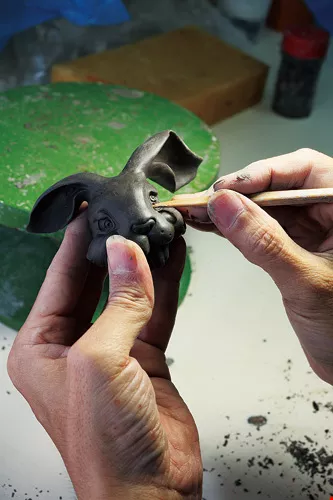
The modern fine porcelain industry requires not only creative ingenuity-a precise and organized division of labor is also important. The pictures show the production process. From top to bottom: (1) Sculpting (2) Designing different types of molds (3) Assembling the complete piece. When completely dry, it is fired in a kiln, a critical process that generally determines success or failure. (4) Painting.
Shen stresses that with more than a decade back in his native land, fostering the development of Taiwan's creative artists is the one thing of which he is most proud. Although cultural and creative industries generally emphasize teamwork above individual effort, he encourages every individual member of his team to find their unique personal passion. They may specialize in design, sculpture, mold making, hand painting, firing or finishing.
The reason for Shen's stress on individual ability is that in his youth, he himself experienced a great deal of personal uncertainty and lack of direction.
Shen was born in the Qijin District of Kaohsiung in 1958. In his final semester studying electrical engineering at Kun Shan Technology College (now Kun Shan University), he experienced the great sadness of a classmate's sudden death due to a road accident. At first, he couldn't believe that it had really happened. With this sudden realization of the impermanence of life, he also pondered questions of the self: why are we born at all into such a world?
Says Shen: "Electrical engineering was my parents' choice; it was quite common for Taiwanese kids at that time to do what their parents wanted-but what did I really want?"
Looking back on the process of growing up, Taiwan had been confronting a number of extreme political and social difficulties, including breaking off diplomatic relations with Japan in 1972, the Zhongli Incident in 1977, the loss of diplomatic relations with the US in 1978, the Formosa Incident and the adulterated alcohol problem in 1979, and the PCB-contaminated cooking oil issue in 1980. The volatile international situation and unstable domestic political circumstances with people crying for an end to martial law, a business community hell-bent on profit with no apparent sense of morality-events such as these had an enormous impact on Shen's developing personality. He felt little hope for the future.
Just after the diplomatic break between Taiwan and the US, one of his relatives migrated to that country to run a restaurant. Wages in the US were much better than in Taiwan, so after he finished his military service in 1981, Shen decided to travel alone to the US. Working in his family's restaurant as a dish washer and later a waiter, after only three or four years of hard work he was able to open his own restaurant.
"Mainstream American society emphasizes individualism: to be yourself. With this philosophy, I was quite happy being a dish washer or waiter because I could dream about a future where anything was possible. Once I had a clear goal, I was able to endure any hardship."
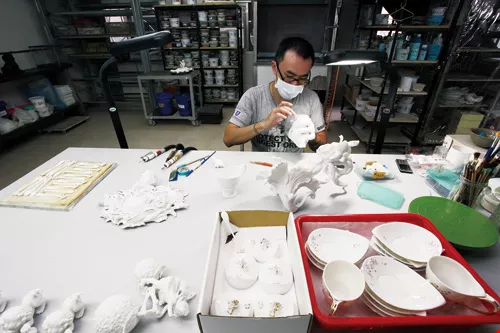
After firing, the pieces are subject to strict quality assurance before they leave the workshop.
After Shen had been living in the US for six years, he learned that his father was suffering from stomach cancer, so as the eldest son he closed the restaurant and returned to Taiwan. With his father's condition stable after eight months of care, Shen decided to remain in Taiwan and look for a job, but without much success initially. His previous optimism for the future had dissipated: the feelings of personal uncertainty and lack of direction prevalent in his youth reemerged with a force, so not knowing what else to do he started thinking about further study. In 1989, he returned to the US to study design at Parsons design school in New York, Hunter College of the City University of New York, New York State College of Ceramics at Alfred University, and the Art School at the University of Hartford in Connecticut, where he was a graduate student.
One may wonder at Shen's dramatic change of direction from engineering to ceramic art. He explains that during his military service in Linkou, he often spent his leave strolling around the ceramics shops in the old part of Yingge. Looking at the many ceramics brought him great pleasure, so he started to collect pieces that took his fancy. In fact, two weeks before he went to the US to study, he enrolled in a ceramics class. The molding of the clay to create a variety of shapes seemed to make sense of his confused thoughts; he was especially captivated by uncertainty and challenges of the firing process.
Because of these impressions, he changed his major in the US from studying product design, a practical skill, to mastering installation art and ceramics. At one time he served as an assistant for his ceramics professor, and in order to control the color variations of the glaze, he often experimented with different types of glaze test pieces in his spare time. He came to understand the differences and unique characteristics of different firing states through experimentation, experiences which contributed enormously to his own future creative work.
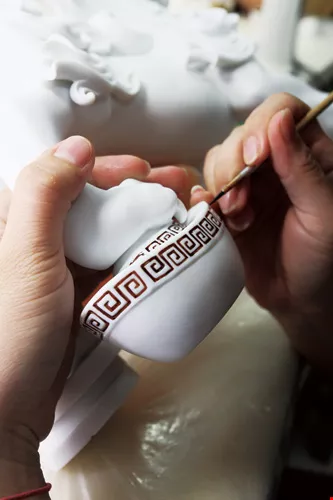
The modern fine porcelain industry requires not only creative ingenuity-a precise and organized division of labor is also important. The pictures show the production process. From top to bottom: (1) Sculpting (2) Designing different types of molds (3) Assembling the complete piece. When completely dry, it is fired in a kiln, a critical process that generally determines success or failure. (4) Painting.
In 1996, Shen returned to Taiwan, bringing back the knowledge and skills he had learned in the US. He lectured in the Arts Institute of National Cheng Kung University for a short period, and then he moved to a community college. In 1997, he led a group of young people who loved simply learning about ceramics, to establish a studio in his birthplace, the Qijin District of Kao-hsiung. This became known as Qijin Kiln.
"In order to learn ceramics, the students took the 8 a.m. ferry to Qijin every morning, worked very hard all day, and rushed to catch the last ferry at midnight back to downtown Kaohsiung." Because his students showed such enthusiasm and passion, Shen actually gave up his stable teaching position to lead them in their creative endeavors. Thus, Qijin Kiln became a unique creative space, and was later opened up to the public.
In the studio, apart from a display of many unadorned but lovely pots and kit-chen-ware, there were beautiful ceramic reliefs and tiles, and even the stairs were in-laid with ceramics. The studio became a cultural center in the district, with tourists who had always been attracted by the ocean views and delicious seafood going on to Qijin Kiln to appreciate the ceramics and enjoy the creative thrill of making their own.
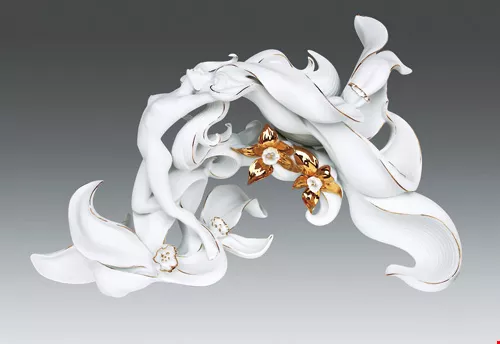
The "Venus Dream" series, with its Western classical theme, highlights the beauty of women and the soft warmth of flowers. The female figures are interlaced with plants, representing the vigor of life, their forms revealing a style somewhere between realism and abstract. From left to right, The Dream of Hibiscus (35 × 10 × 15 cm), The Dream of Rose (50 × 30 × 23 cm), and The Dream of Narcissus (47 × 22 × 27 cm).
Having resided in the US for many years, Shen realizes that most of the superior porcelains currently available on the international market are European. The Taiwanese product not only has a low market share, but the amount of porcelain being created is also far behind that of Europe. However, Shen insists: "Taiwanese porcelain is on a par with the best in the world."
Shen says that Taiwanese creativity and technological innovation have attracted steady international attention for a long time: Sun Chao's crystalline glaze in the early years and Franz more recently, for example. But only if Taiwan can establish more of its own quality brand names will it be able to escape the fate of being merely a contract manufacturer. When the entire process-design and manufacturing-can be Taiwan based, then fine porcelain art will take root and grow.
Shen has created an apprenticeship scheme quite unlike traditional ones where trainees begin by cleaning up and making the coffee. Shen's disciples learn by doing. They participate in all parts of the production process including design, mold making and painting. Then according to their performance and aptitude, they specialize in an area of their own interest in order to bring their expertise into full play and gain enjoyment from their work.
Shen stresses that if we want to create another "Made in Taiwan" miracle in the cultural and creative industries, we need both the passion and the resources to create a complete industrial chain and produce large enough quantities to hold our own in the market.
In 2005 when he decided to go all out to break into the international market, Shen realized that it would be the ultimate challenge to compete with the world's best. This was a test of his confidence, and also an extremely expensive venture. However, he had accumulated a raft of the most valuable, though intangible, assets during his 15 years in the US. He had won the ability to solve his own problems and a degree of perseverance which has meant that he never gives up without a fight. As he has witnessed 1300 Only Porcelain gradually increasing in popularity, reluctantly he has had to close the Qijin Kiln operation in order to devote all his energy to the brand.
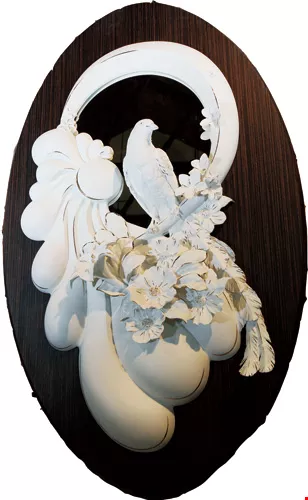
Formosan Blue Magpie from the Taiwan Fauna and Flora Series is a three-dimensional fine porcelain wall hanging.
1300 Only Porcelain held an exhibition in September 2010-"The Resurgence of New Classical Art"-at the Pier 2 Art Center in Kaohsiung. The exhibition introduced two new series of porcelain works, the "Oriental" and the "Western." The former presents a new style of auspicious Oriental animals, while the latter follows the Western themes of angels and flowers, celebrating the pure and aesthetic nature of art.
The work Soaring Giant Tiger, three meters long, three high, and 80 centimeters wide standing at the center of the exhibition has attracted enormous admiration. Standing with its soaring wings at an angle of around 15 degrees from the vertical, the work overturns all limitations on traditional forms of porcelain art. This masterpiece took the team 100 days to complete.
In October 2010, Shen won the Kaohsiung Award. At the ceremony, a play called Smash, Redo recreated Shen's artistic journey, faithfully conveying his creative ideals of continual innovation, uniqueness and passing on his inheritance to a new generation and his insistence on keeping his roots in Taiwan.
A piece of clay, through a process of shaping, glazing, and firing, may eventually become a fine pure-white work of art. Whether you merely examine its beauty with your eyes, or touch it with a hand, the life force of the artists who created it and of Nature itself is a part of the work, and is waiting to touch you.
The "Venus Dream" series, with its Western classical theme, highlights the beauty of women and the soft warmth of flowers. The female figures are interlaced with plants, representing the vigor of life, their forms revealing a style somewhere between realism and abstract. From left to right, The Dream of Hibiscus (35 × 10 × 15 cm), The Dream of Rose (50 × 30 × 23 cm), and The Dream of Narcissus (47 × 22 × 27 cm).
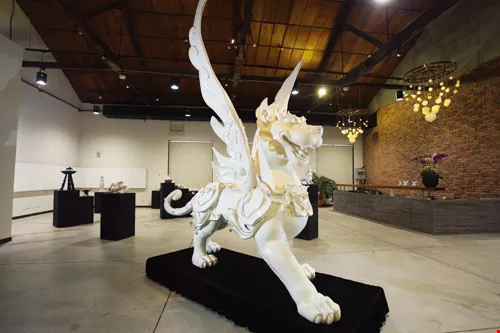
The work, Soaring Giant Tiger, three meters long, three high, and 80 centimeters wide, with wings held high at an angle of 15 degrees from the vertical, breaks through all limitations on traditional porcelain art.
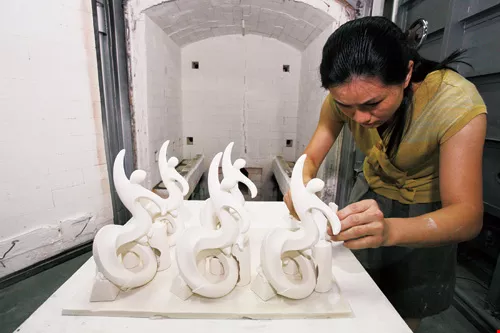
The modern fine porcelain industry requires not only creative ingenuity-a precise and organized division of labor is also important. The pictures show the production process. From top to bottom: (1) Sculpting (2) Designing different types of molds (3) Assembling the complete piece. When completely dry, it is fired in a kiln, a critical process that generally determines success or failure. (4) Painting.
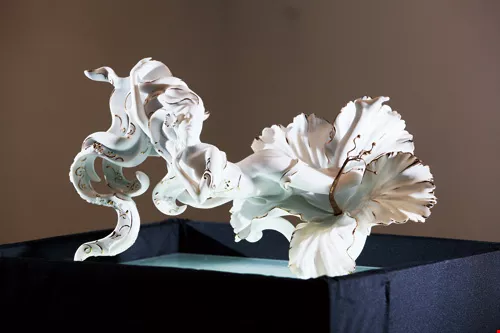
The "Venus Dream" series, with its Western classical theme, highlights the beauty of women and the soft warmth of flowers. The female figures are interlaced with plants, representing the vigor of life, their forms revealing a style somewhere between realism and abstract. From left to right, The Dream of Hibiscus (35 × 10 × 15 cm), The Dream of Rose (50 × 30 × 23 cm), and The Dream of Narcissus (47 × 22 × 27 cm).
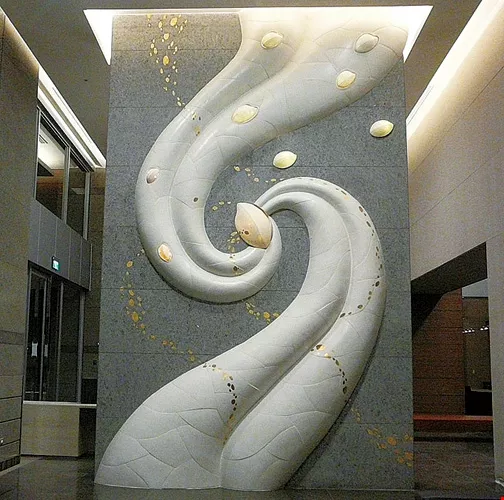
Breeding, a two-story high ceramic mural, is based on the qualities of the Chinese staple food, rice, symbolizing not only harvest and rebirth, buat also the nurturing of present and future life.

@List.jpg?w=522&h=410&mode=crop&format=webp&quality=80)
@List.jpg?w=522&h=410&mode=crop&format=webp&quality=80)


