Heavenly Music Comes to Taipei:Sistine Chapel Choir to Perform in September
Sam Ju / photos courtesy of the Taipei Philharmonic Foundation for Culture and Education / tr. by Scott Williams
September 2014


The Sistine Chapel Choir, the Pope’s own choir and one of the oldest religious choirs in the world, will make its first visit to Taiwan in September. The visit will be the first—and possibly only—chance for people in Taiwan to hear its heavenly sounds in person.
The Vatican’s Sistine Chapel Choir will make its debut in Taiwan on September 23 performing a program of sacred music at the National Concert Hall.
Although the 1,400-year-old choir is named after the Sistine Chapel, in fact it predates the church by some 900 years.
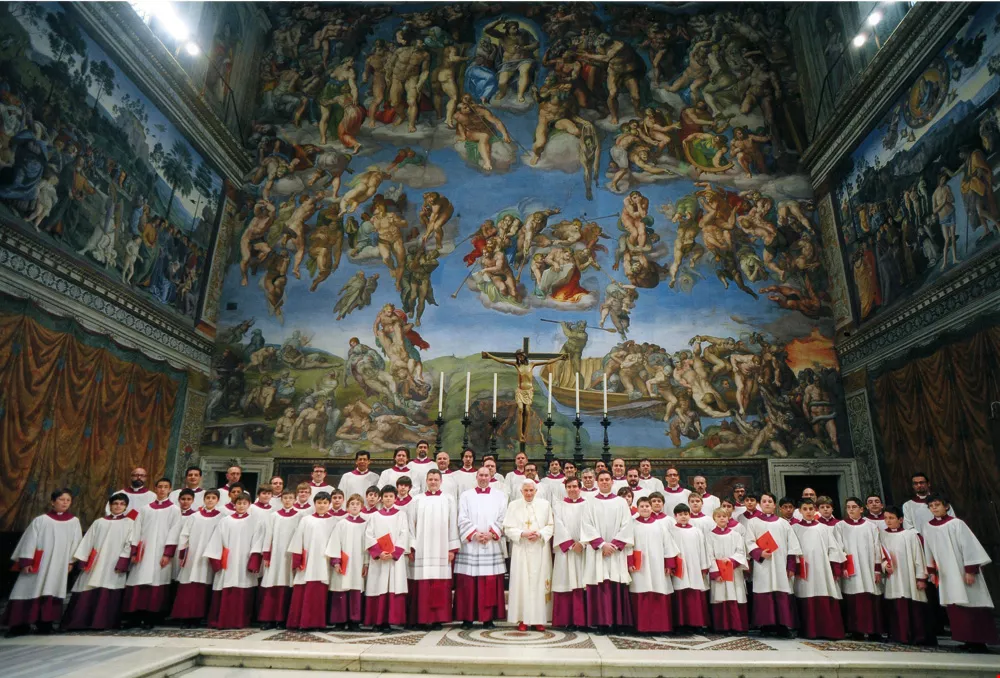
The Sistine Chapel preserves incomparable examples of Italian Renaissance fresco painting. In the photo, Pope Benedict XVI and members of the chapel choir stand beneath Michelangelo’s The Last Judgment.
Preserving a tradition
Choirs have been performing sacred music at Roman Catholic religious ceremonies since the 4th century CE. Pope Gregory I (Gregory the Great) established what would eventually become the Sistine Chapel Choir in the 6th century, when he reformed and made permanent the company of pontifical singers. Gregory also broadened its membership to include boys, monks, and secular clergy, and established the tradition of limiting its performances to only those ceremonies hosted by the Pope himself.
Pope Sixtus IV (d. 1484) moved the company to the Sistine Chapel after consecrating the latter in 1483.
Located in the Apostolic Palace, the chapel is renowned for three things. It hosts the Papal Conclave, which chooses the Pope and famously announces its selection with a stream of white smoke from the chapel chimney.
The chapel also preserves incomparable examples of Renaissance Italian fresco painting, not least of all Michelangelo’s The Creation and The Last Judgment.
And then there is the Sistine Chapel Choir, which performs sacred music in the chapel for the Pope.
The Pope’s choir
Interestingly, it’s rare for chapel visitors to hear the choir perform.
“The Sistine Chapel Choir serves the Pope exclusively and performs only at masses over which the Pope personally officiates. According to Rev. Fr. Otfried Chan, secretary general of the Chinese Regional Bishops’ Conference, this also means that the Pope must personally approve the choir’s participation in cultural exchanges with other nations.
In other words, the choir’s September concert tour of the Greater China region, which consists of performances in Macao, Hong Kong, and Taipei, has been arranged with Pope Francis’ express permission. These Asian concerts follow a series of late May performances in Moscow.
The Rev. Dr. Chan Kim-kwong, executive secretary of the Hong Kong Christian Council, helped arrange the Greater China tour. He reveals that the negotiations for the Russian performances dragged on for six years before finally being wrapped up in 2013. In contrast, discussions of the Greater China concerts began just last year and were concluded in June of 2014. “It was clearly important to the Pope.”
Chan adds that the original plans included a performance in Beijing, but that confirmations from Beijing were delayed too long for the necessary arrangements to be made.
A “memorable” feat
Many important musicians and composers have created music for the chapel choir over the years, among them Giovanni Pierluigi da Palestrina, who served for many years as the musical director of the Julian Chapel. The Sistine Chapel Choir will perform the “Credo” from Palestrina’s Missa Papae Marcelli at its Taipei concert. Palestrina composed the piece to honor the recently deceased Pope Marcellus II, who had passed away in 1555 just three weeks into his pontificate.
The Italian composer Gregorio Allegri’s 17th-century Miserere was also produced expressly for the chapel choir. So expressly, in fact, that the Vatican both barred its performance in any venue other than the chapel, and banned its transcription. Those edicts remained in place until undone by a 14-year-old Mozart some 140 years later. On hearing the Miserere performed in the Sistine Chapel, the young prodigy was so moved that he immediately transcribed it from memory. The publication of his transcription introduced the composition to the general public. Interestingly, the Pope at the time not only chose not to punish the young Mozart for his “theft” of the chapel’s intellectual property, but also knighted him for his feat.
Mgr. Massimo Palombella, appointed choirmaster of the Sistine Chapel Choir in 2010 by Pope Benedict XVI, visited Taiwan in July to check out the National Concert Hall’s acoustics in advance of the choir’s performance.
Palombella says that the choir performs sacred music in the traditional manner, and will provide Taiwanese audiences an authentic sampling. He added that the program will also include a composition for organ by Bach played on the hall’s organ. To help set the proper mood for the pieces, each will be introduced with a brief explanation of its meaning, and a Chinese translation of its lyrics will be projected onto a screen during its performance.
The heavenliest of choirs
Many people may wonder whether the choir’s performance to a lay audience in Taipei will feel different from one offered to the Pope.
Palombella says that because performances for the Pope in the Sistine Chapel are synchronized with the Mass, they require very precise timing, which makes for anxious performances. The atmosphere at concerts is more relaxed, but that shouldn’t suggest there’s anything casual about the performances. Such shows are presented at the command of the Pope, and the choristers strive to help audiences grasp the religious and cultural significance of the pieces performed.
The Sistine Chapel Choir currently has 60-some members, including 30-odd boys who sing what would nowadays typically be women’s parts. (Boys leave the choir once their voices change.) The men’s parts are performed by trained choral singers who are on the Vatican staff.
Roughly 600 schoolboys from the third grade up audition in Rome every year, seeking to join the choir. The fact that only ten to 12 succeed in becoming members indicates just how daunting the task is. “The keys to being selected are having a clear voice and good pitch,” says Palombella.
For the large majority of us who will never be able to attend a Papal Mass in the Vatican, the Sistine Chapel Choir’s September 23 Taipei concert brings the gorgeous sounds of this heavenly choir within reach.

@List.jpg?w=522&h=410&mode=crop&format=webp&quality=80)

@List.jpg?w=522&h=410&mode=crop&format=webp&quality=80)


