

Social enterprises that combine profit-making with charity have been popping up everywhere in recent years. These enterprises attempt to give equal weight to benefiting society, the environment, and their own finances, and their spread is leading many businesses and charities to rethink their operations. With businesses mulling how to help society as well as themselves, and charities looking into becoming self-supporting, the line between these formerly distinct endeavors is blurring. The government is getting in on the act as well by seeking to create an entrepreneurial environment more conducive to the formation of social enterprises.
On a summer’s day in July 2014, a NET clothing store in Douliu Township, Yunlin County, closed its doors to paying customers in order to serve to a group of invitation-only VIPs. Selected by the Yunlin County branch of the Taiwan Fund for Children and Families, these special guests consisted of 200 underprivileged children and teens, each of whom had been given a voucher enabling them to obtain the clothing of their choice at no charge.
Grandma Wu’s grandson was among those with a voucher. The boy, a middle-school student, was getting new clothing for the first time in his life. As she says: “How do you buy new clothes when you don’t have enough money for a full meal?”
Huang Wenzhen, NET’s chairperson, is himself a Yunlin native (from Dongshi Township) and has a history of charitable giving. But after donating tens of thousands of pieces of clothing to victims of the Jiji Earthquake and Typhoon Morakot, he realized that clothing choices are too personal for donors to be selecting clothes for those who receive them.
NET therefore changed tactics this time around, providing NT$500,000 in gift cards (NT$2,000 per Yunlin County recipient and NT$4,000 per Dongshi Township recipient) rather than preselected items of clothing. The idea was to make disadvantaged kids a little more confident in themselves by letting them choose their own clothes.
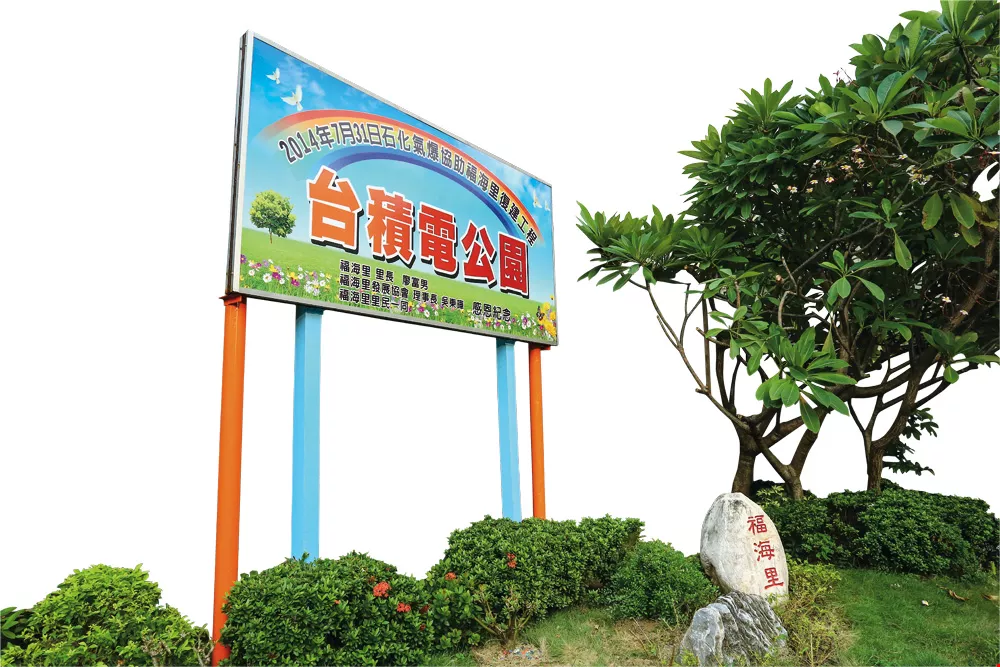
Taiwan Semiconductor Manufacturing Company chose to take an active role in the reconstruction of a Kaohsiung neighborhood ravaged by a pipeline explosion. Its involvement earned praise from local residents, who hung banners thanking TSMC for its help and even proposed renaming a local park in its honor.
Adam Smith, the godfather of economics, wrote in The Theory of Moral Sentiments that sympathy and morality were forces for social progress. He argued further that the “invisible hand” was important not only to the market, but to morality.
Hu Jersan, a professor with the Social Enterprise Research Center at Fu Jen Catholic University, makes a similar argument. “There should be no distinction between helping oneself and helping others,” says Hu. He believes that the ascendency of a capitalism focused on personal gain has resulted in severe income inequality and many other social ills, and suggests that the solution is to return to Smith’s vision of combining personal benefit with benefits to others.
Hu cites the fashion industry as an example, noting that we wear clothing not just for protection from the elements, but also to adorn and express ourselves. He sees the move from donating clothing to donating vouchers as an important step forward in that it meets a psychological as well as a functional need. He stresses that businesses don’t exist solely to make profits, and suggests that such charitable acts bring them closer to their original purpose. “The true spirit of entrepreneurship is generating a profit by satisfying a social need.”
Social enterprises are formed specifically to benefit from benefiting others, but there’s nothing stopping ordinary for-profit businesses from acting in a similar fashion. In fact, they can build value by doing so.
According to Carousel30, an American digital marketing agency, charitable acts can influence the buying decisions of up to 73% of consumers. Fieldwork by Michael J. Hiscox, a professor at Harvard University, has similarly shown that “fair labor standards” certification labels enable products to outsell their unlabeled peers by 20% even when the certified products cost as much as 10% more.
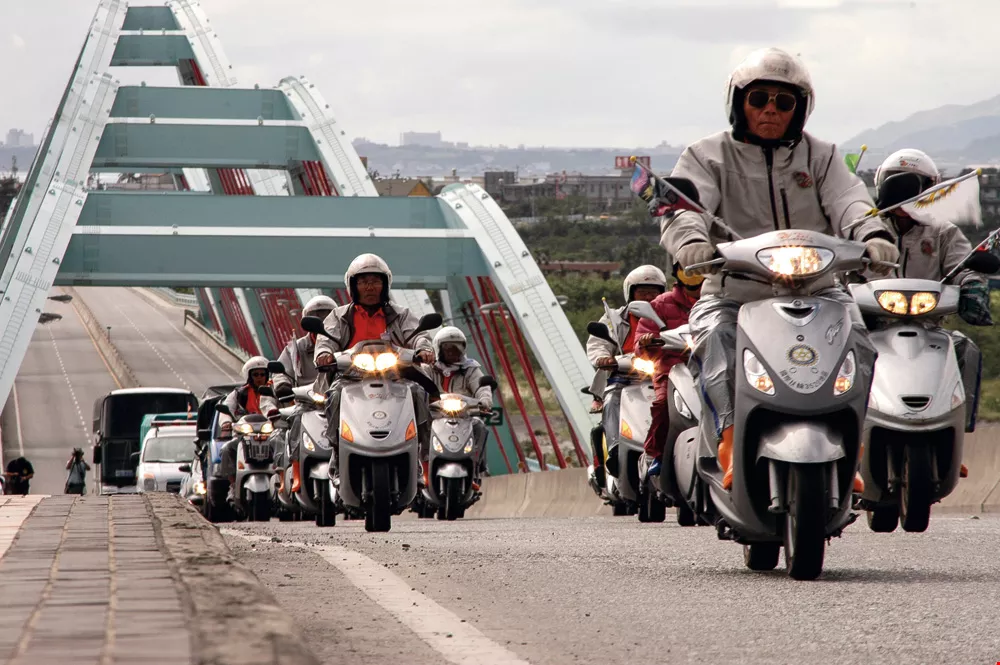
Hondao Senior Citizens’ Welfare Foundation’s documentary Go Grandriders follows a group of seniors making a motorcycle trip around Taiwan. The popular and touching film also highlights the foundation’s work.
Businesses have been working with charitable organizations on “cause marketing” promotions since the 1990s. In a typical case, businesses agree to donate a given percentage of each sale of a designated product or service to charity.
The partnership between China Trust Bank and the Tzu Chi Foundation is perhaps Taiwan’s most famous example. Under the arrangement, China Trust donates 0.25–0.50% of its enrolled credit-card customers’ purchases to Tzu Chi. The program has been a phenomenal success, resulting in 300,000 card applications for the bank, and generating NT$450 million in contributions to the foundation over the last 20 years.
Taiwanese online retailer Sunfar Computer has gone even further, transforming itself into a “charitable enterprise.” Since 2010, the company has donated 20% of its after-tax earnings to charities that help economically disadvantaged children receive tutoring. The program has contributed more than NT$130 million to education since its inception. Though company chair Wu Jingchang is himself relatively low key, he plays up the contributions to ensure that consumers differentiate his brand from its peers.
Employees and shareholders may struggle with charitable giving, but Hu finds the data on the social influence of various brands persuasive.
“Viewing deeds in dollar terms may be crude, but it makes [their benefits] easy to grasp.” Hu cites tutoring programs for underprivileged children as an example. He says the cost of such programs amounts to the tutors’ wages and the rental expenses for the location, but points out that children who don’t receive such tutoring are more likely to end up needing government subsidies and may even take up crime. Charitable activities create value by reducing such potential consequences. When you account for their positive effects, you find that many seemingly costly charitable actions actually save or even “make” money down the road, making charity “good business.”
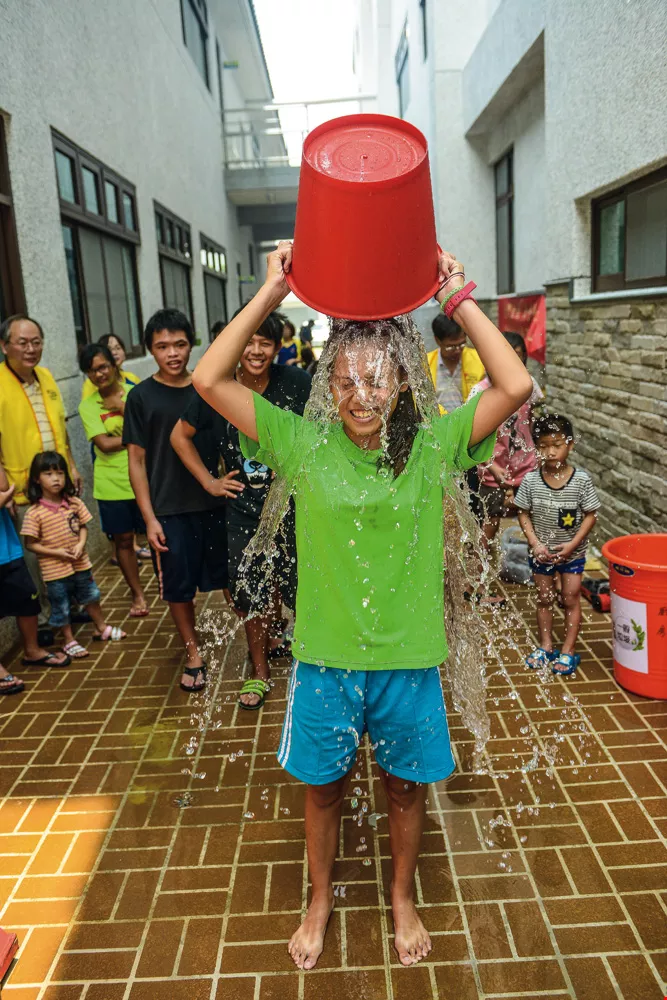
The Ice Bucket Challenge that is sweeping the globe has been spread by celebrities and ordinary folks happily sharing video of their participation.
While companies struggle to persuade their shareholders of the benefits of doing charitable work, non-profits struggle to make a “profit.” According to Hu, “Step one for fixing social problems is ensuring your organization doesn’t become one itself.”
Tom Wang, founder of Dream School, admits that it can be challenging keeping revenues flowing while also doing charitable work, but suggests that some simple techniques can be surprisingly effective. He cites as an example the US’s Lunchbox Fund, which has found a way to link donations, consumption, and profits. When users of the fund’s mobile app buy a meal in a designated restaurant and post a picture of it to Facebook, the restaurant donates money to aid disadvantaged teens in Africa.
“Doing good works doesn’t always depend on individuals acting selflessly; you don’t always have to appeal to people’s higher sentiments.” Wang says that balancing charity with commerce enables anyone to do good deeds, and argues that such an approach is crucial to the long-term sustainability of charitable groups.
Charities often struggle for years before finally gaining recognition and support. Wang believes they could achieve much more with a little bit of creativity and marketing savvy.
In 2012, the Hondao Senior Citizens’ Welfare Foundation released Go Grandriders, a humorous and touching documentary about a group of senior citizens’ motorcycle tour of Taiwan. A hit in Taiwan, the film entertained audiences, engendered greater compassion for the elderly, generated NT$30 million in ticket sales, and resulted in an increase of nearly NT$20 million in donations to Hondao in 2012.

Taiwan Semiconductor Manufacturing Company chose to take an active role in the reconstruction of a Kaohsiung neighborhood ravaged by a pipeline explosion. Its involvement earned praise from local residents, who hung banners thanking TSMC for its help and even proposed renaming a local park in its honor.
The “Ice Bucket Challenge” that swept the world this past summer has been one of the most successful examples to date of innovative marketing by a charity. Participation was incredibly high and fundraising totals set records. In Taiwan, the challenge enabled the Taiwan Motor Neuron Disease Association to raise NT$38.5 million over the three-week period from August 17 to September 10, a figure greater than the organization’s NT$30 million fundraising total for all of 2013. In the US, it helped the ALS Association raise nearly US$100 million from more than 2 million new donors.
The enormous reach of social networks makes them indispensable to charitable marketing efforts. The Ice Bucket Challenge, for example, spread from the US to the entire world, its influence extended by the ease with which participants were able to post videos of themselves taking the challenge.
“Giving money is painful,” says Hu, adding that people naturally hope to receive something for their “pain.” When their donations don’t deliver immediate, tangible results, they are less willing to make them. The Ice Bucket Challenge circumvented this problem by having participants post videos online. Some donors even went so far as to post images of the receipts for their donations. Hu says that having the ability to make others aware of their good deed gave value to participants’ “pain.”
The Ice Bucket Challenge also benefited from the participation of celebrities. The involvement of the likes of Bill Gates and Mark Zuckerberg and later Andy Lau and Takeshi Kaneshiro heightened public interest, in part because it differed from a typical celebrity endorsement. “People designated by celebrities felt some of that fame conferred upon themselves,” says Hu, calling it a kind of halo effect that made people feel honored and happy to participate.
The fact that the challenge made celebrities look silly further aided its marketing. “People love to see celebrities embarrassed,” says Wang, arguing that we’d much rather see celebs have ice water dumped on their heads than watch them make a speech.
Letting people knowThe Ice Bucket Challenge has not only heightened people’s awareness of amyotrophic lateral sclerosis (ALS), but also shown charities the value of innovation and expertise.
NPOst, a charity portal established less than a year ago, is a rarity for Taiwan: an informational website for non-profit organizations (NPOs). The site seeks to help charities develop a better grasp of management by sharing information on the operational, marketing and oversight mechanisms used by NPOs both in Taiwan and abroad.
“Taiwan’s smaller NPOs have been slow to exploit social networks and mobile devices” explains NPOst founder Portnoy Zheng. He says that NPOst contacts and reports on NPOs, then posts these reports on its site, where other NPOs can read and learn from them.
NPOst hopes to change the widespread perception that charitable groups are volunteer-based organizations offering free services. “Large NPOs can receive tens to hundreds of millions of NT dollars in donations every year. Volunteers don’t have the capability to manage this kind of money and produce the detailed financial reports associated with it. It requires professional accountants and managers,” says Zheng. He adds that NPO’s personnel and administrative expenses are also paid by donors. Keeping those expenses in an appropriate range is crucial. NPOst’s goals include increasing the public’s understanding of NPO operations and using discussions and exchanges to enhance NPO efficiency and ensure that donations aren’t wasted.
A number of companies have been remarkably successful at using charitable acts to enhance their reputations. Taiwan Semiconductor Manufacturing Company was widely praised for its actions in the wake of the August 2014 pipeline explosions in Kaohsiung. Where most companies simply donated money, TSMC sent company volunteers to the area to aid engineering teams from Da Cin Construction and Fu Tsu Construction. The volunteers put their expertise to use helping repair and rebuild more than 400 homes, and earned high marks from victims for their efforts.
In addition to fixing buildings, the TSMC team provided the city government with rescue equipment and materials, and erected security fencing on both sides of damaged streets to keep people from falling into the chasms the explosions had created. Over the course of a month, the team made more than 2,000 person-visits and poured roughly NT$10 million into the area, leading local citizens to remark that Taiwan’s “most profitable company also excels at disaster recovery!”
Taiwan is becoming more advanced. That progress is beginning to break down the distinctions between profit-seeking corporations and selfless charitable organizations and allowing the outlines of a new and more ideal society to begin to emerge.

@List.jpg?w=522&h=410&mode=crop&format=webp&quality=80)

@List.jpg?w=522&h=410&mode=crop&format=webp&quality=80)


