The Science of Magic Meets the Magic of Science
Lin Hsin-ching / photos Chuang Kung-ju / tr. by Geof Aberhart
April 2010


Sawing his beautiful assistant in half, before making her lower body disappear as he jokes around; turning a handful of colorful scarves into soaring doves in the blink of an eye.... As we watch dumbstruck, the masterly performance of a magician can leave us all wondering, "How on Earth did he do that?"
Actually, underneath the seeming mystery of these tricks lies a thick foundation of scientific principle, and in the National Taiwan Science Education Center's exhibition on magic, visitors can look through the veil of mystery that surrounds magic and finally understand the tricks that have had them so fooled.
On April 8th 1983, iconic American magician David Copperfield unveiled a stunning piece of magic-in front of the watchful gaze of his audience, he made the 93-meter-tall Statue of Liberty vanish! Broadcast live around the world, the trick left millions dumbstruck in front of their televisions, with some so shocked they unconsciously crossed themselves for comfort.
Was it witchcraft? Superpowers? Or just an illusion? Those in attendance and watching on television around the world were left wondering about this and more. The real answer, though, is "None of the above." The statue never left its pedestal; Copperfield was simply using mechanics and physiology to fool the audience into temporarily not being able to see it.
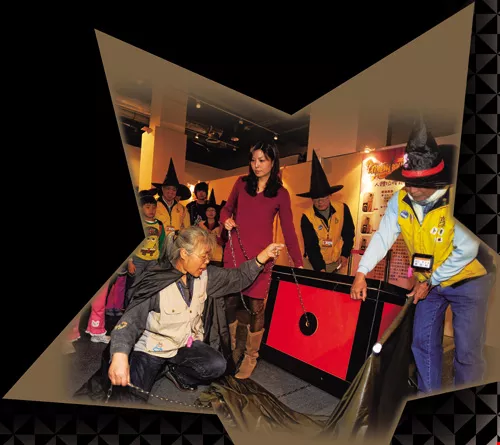
How can a magician's assistant, locked up in chains, go from standing outside a box to suddenly being inside it, still chained? In fact, there is a trick lock on the chains, and as soon as the curtain is raised over her, she opens the lock, climbs into the box, and locks herself up again, creating this seeming feat of teleportation.
Firstly, the audience in attendance that night was seated on an outdoor stage-a stage specially made to rotate. When the show began, Copperfield started off with spotlights, searchlights, and a helicopter to confirm to everyone that the statue was in fact there. Then as they raised the curtain in front of the statue, went to commercial, and followed that with Copperfield telling the audience about the history of the Statue of Liberty, while their attention was elsewhere the stage slowly turned, the helicopter overhead turning with them. After a few minutes had passed, the curtain was lowered, and, not aware of their having turned around, the audience naturally couldn't see the statue anymore. At the same time, searchlights and spotlights set up at the second site, where the audience would be looking, "proved" that the "miraculous" disappearance had occurred.
Amidst the gasps and applause, Copperfield again raised the curtain and in moments the statue was once again standing in front of the audience, completing possibly the greatest feat of illusion of the 20th century.
"The success of that trick was all about the best possible combination of time, geography, people, and scientific principles," says Zhuo Juanxiu, a senior guide at the National Taiwan Science Education Center (NTSEC). Many may be curious how the audience couldn't feel that they were turning-in fact, the Earth is always rotating (at the equator, the speed of the planet's rotation is approximately 465 meters per second), but humans' sense of motion relies on the relative positions of themselves and other physical objects in their vicinity for verification, and so since everything on Earth moves along with the Earth, people usually have no real sense that they are actually moving.
The masterful Copperfield used the same principle in the rotation of the stage. Additionally, the skyline behind the statue doesn't vary especially much, thus providing an excellent smokescreen. He also secured the cooperation of local residents, getting them to turn off their lights, while also using the ultra-bright spotlights and searchlights to further obscure the vision of the audience, making it difficult for the audience to make out any of the details of their surroundings. Already expecting to see something, the audience unconsciously bought into this combination of elements, becoming witnesses to a supposed miracle.
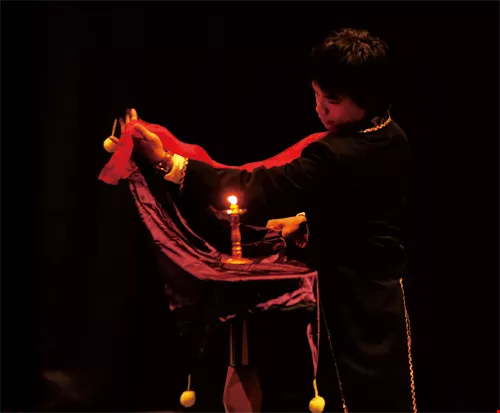
This floating stand is actually made of lightweight polystyrene, and the cloth the magician is holding it by has inside it a number of extremely fine wires, enabling him to "raise" the stand into the air, letting it dance around in the air to suspenseful music.
Other more common magic tricks are similarly grounded in the application of scientific principles, but audiences are generally so caught up in the entertainment on stage that they overlook their educational value.
And so, with their special exhibition "Magic and Science" NTSEC hopes to help people learn through the enjoyment of several popular magic tricks, subverting the stereotype of science as being dry and boring, while inspiring in children an interest in learning and a drive to learn.
The exhibition is divided into sections on well-known illusions, the science behind magic, and a stage for performances. Not only does the center have well-known Taiwanese magicians performing for and educating audiences, but the popular illusions area also has on display several common magic props, which together with the explanations of professional guides offer the chance for visitors to analyze the reality behind the facade.
Take for instance the perennial trick of sawing a woman in half-once the assistant has stepped into the box, the magician ruthlessly "dissects" her with metal "blades." Just as everyone watching is concerned for the wellbeing of the assistant, in a flash she steps out of the box unharmed, leaving the audience to wonder if she's actually clad in Kevlar underthings.
Of course that isn't the case-the reality of the trick is actually to be found in the box.
In one form of this trick, the inside of the box is lined with foam rubber, letting the assistant curl up inside the box, pressing up tightly against the walls and end of the box. This way no matter how the pieces of the box are rearranged after she has been "cut," she remains in the same position, making the illusion of her body being in multiple separate parts a relatively easy matter.
Another variant, known as the "Indian Basket Trick," involves a combination of exquisite box design and physical suppleness on the part of the assistant. After the assistant steps into the box, she curls up inside it, leaving a gap above her head of about 15 to 20 centimeters. This way, when the magician inserts a sword from the top, the assistant can guide it down with her hands, while ones coming in at angles completely miss her.
"As well as the tricks in the apparatus," says Zhuo, "magicians also have a trick to picking assistants-particularly slim, lithe young woman who have done yoga training are best, because they can more easily contort themselves in such small spaces."
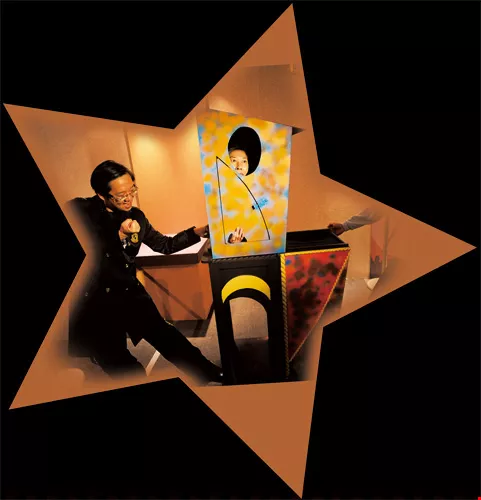
In this trick, the box has a hidden plastic panel which means that when the box at the top is moved, the assistant-seemingly "trapped" in the box-only has to lean her upper body to follow it while keeping her legs and feet still, creating an astonishing visual effect.
Another common trick that leaves audiences astonished and searching for an explanation involves the magician, with a wave of his cape, making the lower half of his body disappear. How does he pull that one off?
Actually it's not all that difficult to figure out. Just look closely and you'll see, behind the magician, a dark-colored background covered in complex geometrical designs, in front of which stand two chest-height mirrors facing outward at a 270-degree angle. When the magician steps between these two mirrors, they hide the lower half of his body, but the reflection on them is still of the same complex-patterned background, and the patterns join perfectly, giving the audience the impression of the magician becoming little more than a floating head.
Other tricks, like the always well received "quick change," use bright flashes of light to leave a temporary "silhouette" of the magician in the vision of the audience-part of how human vision works is the temporary preservation of images, so that for between 0.1 and 0.5 seconds after an object moves, an image of it lingers; this is the main principle behind animation. By using an extremely quick motion to pull off his first outfit to reveal the one being worn underneath, this "time lapse" effect leaves those watching with the impression that the magician "transformed" before their very eyes.
There are all kinds of little scientific tricks like these lying hidden in magic just awaiting discovery by keen eyes. The most obvious example is the traditional black cape and top hat worn by stage magicians, always accompanied by bright white gloves. This is all because black more readily absorbs light, making it easier for the magician to conceal balloons, scarves, doves, or any other prop on his body, while the constant movement of the bright white gloves draws the attention of the audience and keeps them distracted. Between the two of them, they can make it difficult for the audience to see through virtually any trick.
Science, skill, and stagecraft
A lot of once-mysterious magic, once science has explained it, loses its mystique, so will an exhibition like this end up lowering public interest in magic, and maybe even affect magicians' livelihoods?
"A good magic show is a combination of scientific principles, thoroughly honed technique, and the personal charisma of the magician. Each one of these elements is essential," explains well-known Taiwanese magician and exhibition performer "Magic Jack."
He goes on to explain that a magic show is usually composed of three stages. The first of these is when the magician builds up the atmosphere with colorful, fun tricks with rabbits, doves, balloons, scarves and the like, getting the audience to suspend their disbelief while stunning them with his apparent abilities. The second stage is when the magician moves on to more "static" tricks like escapes and quick changes, or tricks with more audience participation like card tricks. This gives the audience a chance to catch their breath, relax, and drop their guards.
Finally comes the main event, the big, suspenseful tricks that often involve major pieces of apparatus, such as the aforementioned sawing a woman in half. By keeping the audience on tenterhooks, the magician creates the high point of the show, ending the performance with a bang and to rapturous applause.
Magic Jack explains that this is just the basic concept, and that magicians can adapt their shows in any number of ways to fit their own personal style.
"The top priority in a show is entertainment, and so magicians have to constantly practice their body language and techniques, creating a stage presence that can build suspense and can draw in and amaze the audience. They even have to practice bringing that together with narration, music, costumes, and their assistant, all of which takes time and effort to get just right. That's something that all the knowledge of formulas and principles can never teach you," he says confidently.
Jiang Zhongcun, head of the exhibition group at the NTSEC, also notes that science is all about the search for truth, while magic is more a demonstration of cultural creativity. The two may seem diametrically opposed in concept, but they are actually very complementary. Through this exhibition, the public get a glimpse behind the veil and investigate the connections between science and magic, while magicians can use it to inspire creative ideas and design new and unimaginable tricks.
Magic is as adaptable as the people who perform it. Even though people soon figured out the tricks behind David Copperfield's disappearance of the Statue of Liberty, this did little to dampen the sense of marvel the trick created. For those who love magic, whether as simple entertainment or as a puzzle to solve, there is a lot to get from a performance. And even though the magicians putting on the dazzling displays aren't superheroes or wizards dispatched from a galaxy far, far away, they are missionaries of the miraculous that can turn frowns upside down, and even inspire a desire to learn.
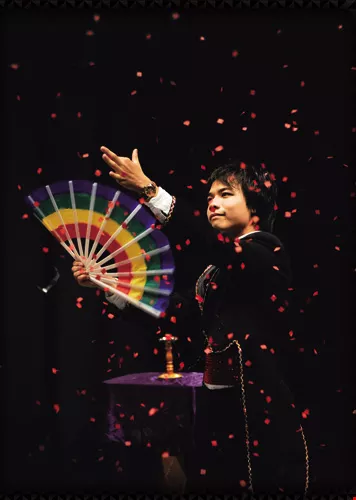
During on-stage performances, magicians often use a variety of eye-catching techniques to create surprise by disturbing the audience's line of sight and distracting from the props on the magician's person.
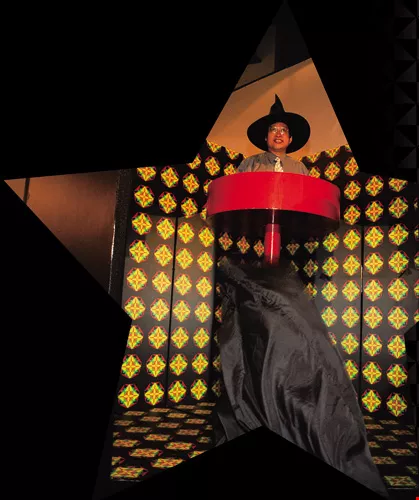
Disappearance tricks have long relied on the use of dual mirrors which the magician stands behind before the start of the performance. Using his cape to obscure his lower body, as the performance begins he sweeps his cape open to reveal his "invisibility"-an effect created by the patterns reflected in the mirrors joining up perfectly with their reflections.
@List.jpg?w=522&h=410&mode=crop&format=webp&quality=80)

@List.jpg?w=522&h=410&mode=crop&format=webp&quality=80)


@List.jpg?w=522&h=410&mode=crop&format=webp&quality=80)

@List.jpg?w=522&h=410&mode=crop&format=webp&quality=80)
