Chugging into Modernity:
The Railway Department Park
Lynn Su / photos by Lin Min-hsuan
September 2025
The demolition of the Beimen Overpass in downtown Taipei City in 2016 gave visual access to the Railway Department Park opposite the iconic building of the Beimen Post Office.
With its characteristic red brick walls and white faux stonework, the European-looking main edifice of the park used to be the headquarters of the Japanese precursor to the Taiwan Railway Corporation. Now under the management of the National Taiwan Museum, the renovated site unveiled its splendors to the public in 2020, telling the story of the vital role played by railways in Taiwan’s march toward modernization.
People in Taiwan have long been used to traveling by train. Since the beginning of the Japanese colonial era (1895-1945), the headquarters of the institutions responsible for the island’s railways have been successively housed in three different places. The Japanese took over the site of the Machinery Bureau established by Liu Mingchuan (1836-1896), the first Qing-Dynasty governor of Taiwan. The premises came to be used by the colonial government’s Railway Department. In 1920, the Railway Department moved into a new edifice designed by Japanese architect Matsunosuke Moriyama (1869-1949). After World War II, with the capital’s railway lines beginning to move underground in the 1980s, the Taiwan Railways Administration (now the Taiwan Railway Corporation) relocated to Taipei Main Station in 1993.
The Railway Department Park is not only the Taiwan Railway Corporation’s ancestral home, but also an important site that has witnessed the modernization of Taiwan.

photo by Chen Mei-ling
An architecture textbook
For many years the group of buildings in the park stood unoccupied, though numerous audiovisual productions were graced by their classical beauty, such as Coco Lee’s music video Di Da Di (1998), Edward Yang’s coming-of-age crime film A Brighter Summer Day (1991), the TV drama Police et Vous (2008), and Leste Chen’s horror film The Heirloom (2005).
Amidst a growing trend of cultural heritage restorations, the site was designated a national monument in 2007. It encompasses the main office building, a canteen, an octagonal building, a power room, the engineers’ offices, a wartime command center, and the eastern wall of the Qing-Dynasty Machinery Bureau on the periphery of the site.
Feng Chia-fu, a research assistant in the Exhibition and Planning Department at the National Taiwan Museum, says, “This place feels like an architecture textbook”—not quite encyclopedic, but not far off.
Since the newly restored park reopened to the public in 2020, the rich diversity of architectural styles and features here has been capturing the attention of tourists from far and near.
.jpg?w=1080&mode=crop&format=webp&quality=80)
Western style, local motifs: Stucco decorations
Elaborate stucco decorations can be found on the ceilings of the main building on the first and second floors, including not only Western-style flora and insignia but also local produce such as pineapples and grapes.
.jpg?w=1080&mode=crop&format=webp&quality=80)
A secret roof space: Timber trusses
The structural design of the main building features bricks below and timber above. The third floor offers views of the roof trusses, built of high-grade Alishan cypress. Interlaced with maintenance walkways, electrical wires, and pipelines, these intricate structures look magnificent.
.jpg?w=1080&mode=crop&format=webp&quality=80)
The most fashionable restroom: The Octagon
Originally intended as a men’s restroom, the eye-catching Octagon has a hollow octagonal pillar in its center, whose top meets the radial roof beams. These are all made of reinforced concrete, a cutting-edge building method at the time. Each side of the pillar had a urinal built into it.
.jpg?w=1080&mode=crop&format=webp&quality=80)
Remembering a turbulent age: The Wartime Command Center
World War II left its mark on the Railway Department Park. Rail transport being crucial to the war effort, the Japanese built an air-raid shelter on the site. After the war, the Taiwan Railways Administration expanded the granary-shaped building and renamed it the Wartime Command Center in 1957.
A railscape that resonates with all
Why did the Japanese choose to set up the Railway Department here? The decision had a lot to do with Taipei’s urban development. The Qing-era Machinery Bureau, the cradle of advanced technology in Taiwan, was located here, while vibrant commercial hubs clustered around Wanhua and Dihua Street in the western part of the city. In 1920 Beimen was at the very heart of Taipei. Institutions such as the Railway Department and the Beimen Post Office were situated here.
The Railway Culture Exhibition in the park shows us passenger carriages of different classes, station platforms, rail and road traffic signals and signage, tickets, ticket clippers, token lock devices, and even train operation diagrams.
A major highlight on the second floor of the exhibition is a large model railway crafted in fine detail at a 1:80 scale.
The model brings us back to the close of the era of steam locomotives, representing the transition to diesel and then electric trains. “We seek to tell a different story in each section of it,” says Hung Wei-chien, an assistant researcher at the Railway Department Park who took part in planning the model railway.
The model embraces the entire cityscape surrounding Taipei Main Station in the twentieth century. In addition to Taiwan’s first railway roundhouse and the enormous bus terminal in front of the station, it shows Zhonghua Market and its pedestrian overpass. These miniature versions of historical sites promise to bring a smile to the faces of Taipei old-timers.
.jpg?w=1080&mode=crop&format=webp&quality=80)
The Railway Culture Exhibition at the Railway Department Park displays all sorts of railway signals and signage.
.jpg?w=1080&mode=crop&format=webp&quality=80)
Railway Department Park researchers Feng Chia-fu (left) and Hung Wei-chien (right).
.jpg?w=1080&mode=crop&format=webp&quality=80)
Tickets showing the auspicious names of certain railway stations were once very popular. With the phasing out of printed tickets, these have been consigned to history.
.jpg?w=1080&mode=crop&format=webp&quality=80)
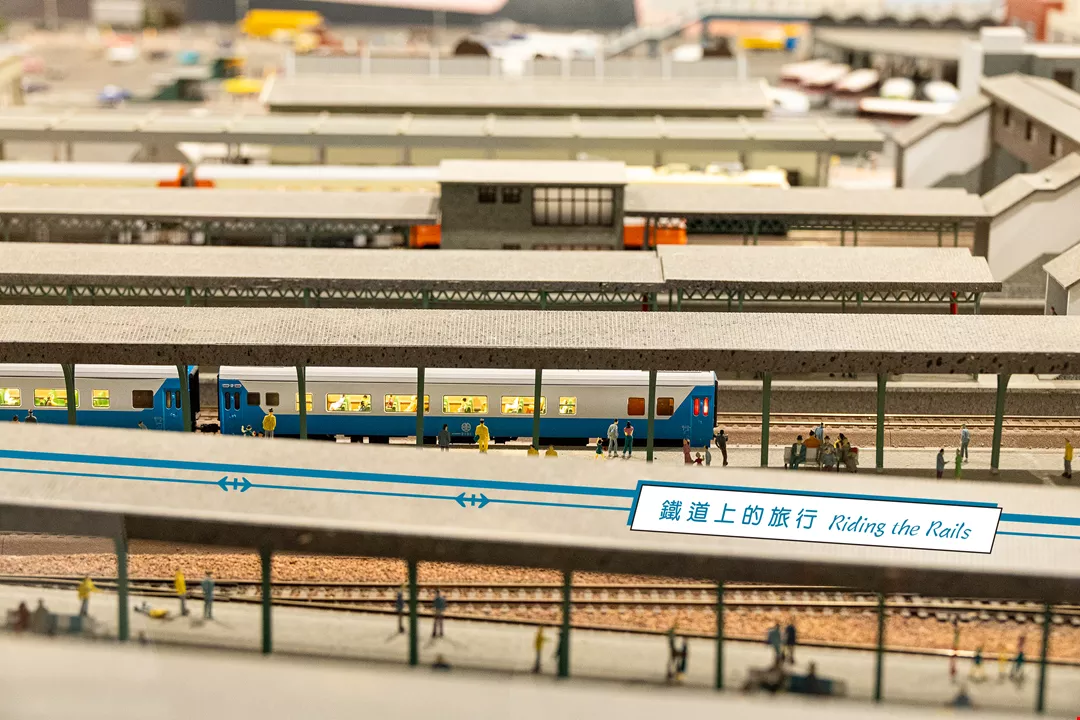
With miniature trains shuttling back and forth, the enormous model railway at the Railway Department Park features historical sites in Taipei, such as the railway roundhouse and Zhonghua Market, recreating scenes surrounding Taipei Main Station in the last century.

