Taiwanese Agricultural Assistance in Africa
Cheng Sheng / photos Cheng Sheng / tr. by Christopher J. Findler
February 2006


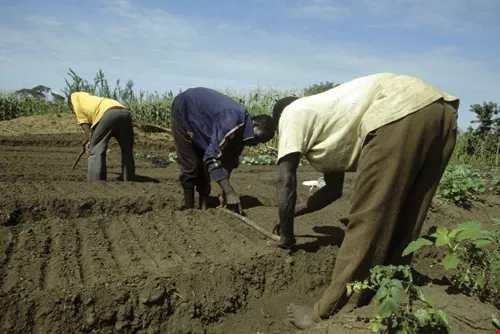
Malawi, 1998
Rice
In the mid-1990s, Taichung #10 long-grained, nonglutinous rice began to be brought along as technical missions from Taiwan traveled to far-off lands, including Africa. Mission members work side by side with locals as they open up irrigation canals and plant the golden stalks of rice in every corner of this land, formerly known as the "Dark Continent."
After the land has been cleared for cultivation, tribal chiefs parcel it out to the people. Those who work hard benefit and watch their incomes steadily increase. Those who don't, don't. After a while, the industrious ones buy the rice paddies belonging to the less diligent and after a few years they build new homes with their hard-earned money.
Paddy rice differs from traditional African upland rice in that it has a better mouth feel and the grains are plumper and don't break as easily. Furthermore, paddy rice crops that are patiently cared for, weeded, and fertilized have a higher economic value. In West Africa, farmers use direct deepwater seeding to prevent damage from salt, birds, and weeds. Farmers in southern Africa benefit further from paddy rice crops in that two crops can be harvested annually, compared to only one of upland rice.
Technical missions to Africa train locals to cultivate and the scale of farmland in some regions is quite impressive. In Wovue, a northern district of Malawi, for example, a total of 224 hectares of land have been converted into paddies. Based on the idea of "teaching to fish, rather than giving a fish," missions turn land brought under cultivation over in stages to local agricultural organizations or governmental agricultural agencies for management.
Unfortunately, the people of Africa aren't as hard-working as their Taiwanese counterparts. Also, due to cultural differences, after a few years, lack of upkeep in farmland areas results in blocked irrigation canals and worn out and damaged farming equipment. In the end, large expanses of arable lands shrink for lack of anyone to care for them. It truly is heartbreaking to watch.
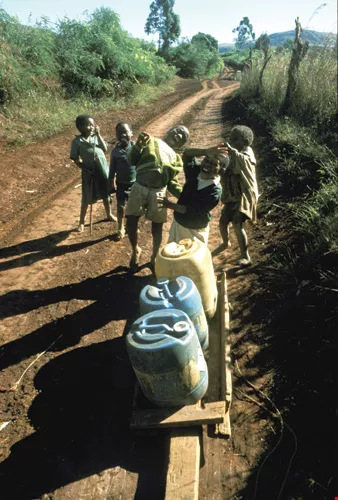
Swaziland, 1997
Corn
Corn (maize) is the staple food in the diet of many Africans, but many areas of the continent lack fertile land and money to fertilize it. As a result, planting is a much less refined art. They don't fertilize, irrigate, or weed, which leads to lower production, frequent food shortages, and reliance on aid from advanced nations.
The approach used by Taiwan's technical mission to Malawi is to select suitable areas with the help of agricultural agencies of the Malawi government. First, it organizes local farmers and provides them with education, counseling, and assistance in production and marketing. A certain percentage of income from the first harvest is set aside into a revolving fund to be used the next year to purchase seed and equipment. The mission also reduces the amount of money it provides in the form of subsidies. A sound cycle of economic practice like this gradually allows local farmers to continue producing and stand on their own two feet.
This Program to Increase Production of Small-Scale Corn Farmers succeeded in helping farmers in remote areas to augment production. Over a period of four years, almost 8,000 families were trained and more than 3,000 hectares of corn developed as average per-hectare production more than tripled, swelling from 1,200 to 5,000 kilograms per hectare.
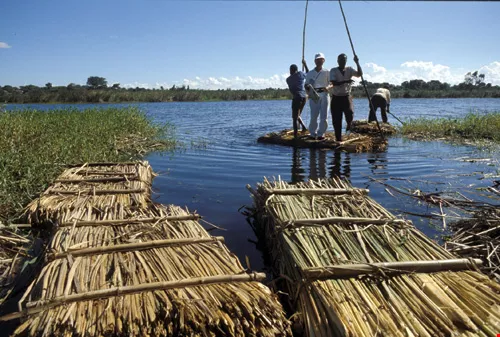
Malawi, 1999
Cultivation
It's no secret that Taiwan commands highly advanced agricultural technology. Mission members must be able to be take charge of a number of programs in their assigned area. In order to blend in with local society, they study the local language, familiarize themselves with local practices and cultural background, and strive to befriend the people they are training.
Farmers in Swaziland used to till their land with a single ox and plow. While there is nothing wrong with this, one ox is not strong enough to break up the hard soil and this affects overall efficiency and results in poor yield. Missions taught the farmers to use two or more oxen on each plow and designed ox plows and yokes better suited to local conditions, thereby improving soil preparation.
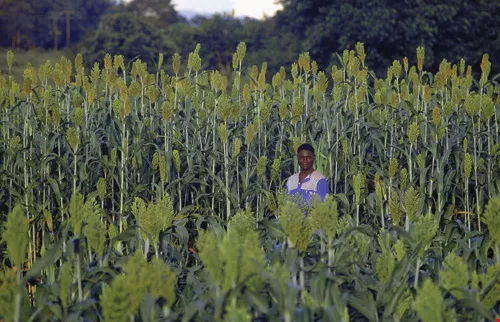
Malawi, 1999
Water resources
Water is the source of life. With the exception of areas blessed with sufficient amounts of rain at appropriate times, all farmland requires auxiliary water sources. Water from drilled wells is the most economical way to irrigate crops during dry seasons. Water is pumped into cisterns for storage and later use in irrigation.
In the high plains of eastern Africa, sinking wells is no easy matter and wells are not necessarily located in villages. Roundtrips of an hour are common for residents carrying water back to villages. The women, who are responsible for carrying the water, are skilled at carrying containers full of water on their head.
Water is especially valuable in drought-stricken areas and conserving it is a matter of survival. It's hard for people from areas blessed with plentiful water to imagine that an entire family can subsist on a bucket of water a day. Lack of water makes regular bathing impossible and individuals that work with locals must learn to tolerate the smell.
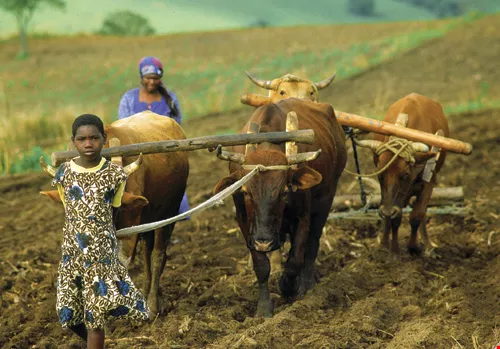
Swaziland, 1998
Food grains
In addition to major crops, the cultivation of other grains and cash crops can be promoted in Africa.
Tea leaves are a major export for Malawi. Although production lacks any real scale, it is an important source of foreign exchange. Most unprocessed leaves are shipped to Britain to produce black tea. Enshrouded in fog year round, Malawi's southern plateaus produce smooth, aromatic black teas that maintain their unique fragrance even when used to make milk tea. Tea production in Malawi differs from that in Taiwan in that mainly males pick the leaves.
As Malawi lacks a developed livestock industry, fish is a major source of protein. In addition to tilipia, a fish indigenous to Lake Malawi, smaller amounts of other types of seafood are caught in lakes and rivers nearby. Despite mission efforts, environmental and technical limitations have unfortunately prevented the realization of aquaculture around Lake Malawi.
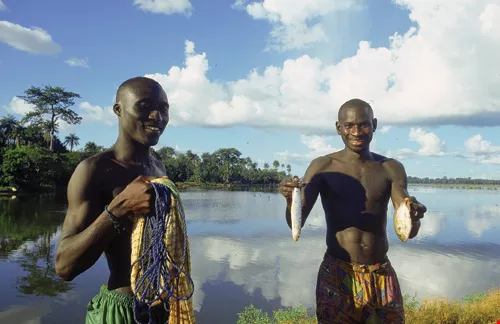
Gambia, 1998
定稿-1@List.jpg?w=522&h=410&mode=crop&format=webp&quality=80)
@List.jpg?w=522&h=410&mode=crop&format=webp&quality=80)


