Half a Century of Love for Taiwan--Doris Brougham
Teng Sue-feng / photos courtesy of Doris Brougham / tr. by Scott Williams
July 2002


Virtually everyone educated in Tai-wan knows the name of Doris Brougham. Perhaps that's not so surprising when you consider that Brougham has lived in Taiwan much longer than in her native Seattle. Brougham first left the US in her early twenties bearing with her a desire to spread the Gospel. After a personal encounter with China's civil war, she ended up in Taiwan, where she quite inadvertently became Taiwan's earliest, most famous and most caring foreign teacher of English.
To this day, the 76-year old Brougham retains the bright smile of her youth. Her Studio Classroom, meanwhile, is Taiwan's largest English-language teaching enterprise. And, after more than 50 years in Taiwan, Brougham was finally granted permanent residency on June 10.
These days, the 76-year-old Doris Brougham, founder of Studio Classroom, is all smiles. On April 9, President Chen Shui-bian presented Brougham with the Order of the Brilliant Star with Violet Grand Cordon as a measure of the great esteem in which Taiwan's 23 million citizens hold her.
Meanwhile, her Studio Classroom, which produces instructional English-language radio programs for Taiwanese listeners, also celebrated its 40th birthday on April 26 with a banquet at the Taipei International Convention Center attended by a number of notable longtime listeners, including Taipei mayor Ma Ying-jeou, former premier Hau Pei-tsun and former director-general of the National Police Administration Yen Shih-hsi.
In addition, on May 13 the Legislative Yuan passed the third reading of revisions to the Immigration Law, which finally gave persons such as Brougham the right to apply for permanent residency in Taiwan.
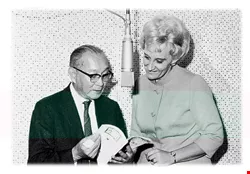
When the famed linguist Lin Yu-tang heard Brougham's program on the radio, he was much impressed with her enunciation. He asked her to record a set of tapes to accompany a series of middle-school English texts, and the two of them became friends.
Where the heart is
Asked about the law, Brougham, who mixes English and fluent Chinese in conversation, remarks, "Actually, the old law had little effect on my life. But I hear that the revisions will allow several hundred people to get permanent residency, and I'm very happy for them."
Brougham, who is both the founder of Studio Classroom and the president of its parent company, Overseas Radio and Television, often travels overseas for meetings and occasionally returns to the United States for visits. In spite of these frequent trips, she never considered the possibility of being unable to return to Taiwan. In fact, the only time it occurred to her that she wasn't a Taiwan resident was when writing her permanent address on entry documents on reentering Taiwan.
"I'm American, but I'm not a US resident because I don't live there." She says she's lived in Taiwan for 50 years, but seeing Studio Classroom's summer hires getting the same visa that she used to have made her feel that Taiwan still thought of her as a "guest."
But she says, "Actually, I'm a citizen of God's kingdom."
To Brougham, in this age of the global village, home is where her friends are. She says that many of the good friends she made in Hualien when she first arrived there 50 years ago now live in North America. Her visits to Los Angeles, Seattle and Canada therefore provide her with the opportunity to see many old friends. When she traveled to Brazil last year, Brougham even got to eat lychees grown by a Taiwanese friend who had immigrated there. "My feeling is that we shouldn't live in the past, shouldn't have this idea that 'I wish I had lived in some place.' At my age, I want to live in the present."
Under Brougham's leadership, Studio Classroom has grown into an English-teaching enterprise that employs more than 200 people. (photo by Pu Hua-chih)
The call of the East
Brougham was born in Seattle to a Christian family of German stock and was one of nine children. When she was 11 years old, she attended a summer camp at which Chi Chih-wen, an evangelical minister from China, spoke about his ancient land. On hearing Chi's lecture, Brougham decided that when she grew up, she was going to go to China as a missionary.
In 1948, the 21-year-old Brougham gave up her dream of becoming a trumpet player and her scholarship to New York's Eastman School of Music. Choosing instead to become a missionary, she boarded a ship for the six-week journey to China, passing through Tokyo, Pusan, Manila and Hong Kong before arriving in war-torn Shanghai. China's civil war forced her to flee to Chongqing, Lanzhou and Hong Kong, before finally coming to Taiwan with her church.
When Brougham arrived here, she noted that there were few people on the east coast and many towns without churches. She therefore decided to set up her mission in Hualien.
She began teaching music at Yushan Theological College (YTC) in Hualien County's Meilun Township in 1951and was also responsible for training the school's Sunday school teachers. She had soon also established a small church and put together her own small Sunday school class. Brougham began teaching her Sunday-school students about the Christian faith, simultaneously picking up some of the language of the aborigines of the area. Whenever the children invited her to their homes, she made a point of putting her just-acquired language skills to use, in spite of her odd accent. The families at first thought it strange to hear her greet them in their own language, but in the end her efforts brought smiles to their faces.
Brougham fell in love with scuba diving when she was 56. Her enthusiasm for the sport inspired her staff to make her a birthday card with a picture of her diving on the front of it.
Lilies of the valleys
Brougham's students at YTC included members of Taiwan's Bunun, Atayal and Amis tribes, and most came from homes deep in the mountains. In those days, the government strictly controlled access to the interior mountains. Ethnic Chinese were not allowed into the mountains without a permit. Those permits were extremely difficult to get, but Brougham was willing to go to whatever lengths were necessary to acquire the pass that would allow her unfettered legal access to the mountain districts.
In an effort to reach greater numbers of people with the Gospel, Brougham applied to the Broadcasting Corporation of China (BCC) for assistance. With BCC's help, she began broadcasting a bible-study program on a Hualien station. When the Far East Broadcasting Company heard about what Brougham was doing, it asked her to produce a children's program for children. Brougham agreed and made the children's choir from her Sunday-school class the star of her new show. To fill out the program, she also brought in three children as broadcasters.
All those who work with Brougham find themselves attracted by her simple and somewhat shy smile. Her aboriginal friends were no exception. Brougham's natural charm coupled with the aborigines' own warmth and simplicity drew them to one another. Her aboriginal friends even gave her an aboriginal name, Rebekah, which means a blossoming bouquet of the lilies that grow in the valleys of Hualien.
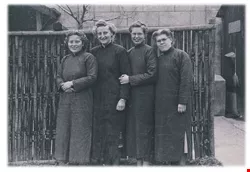
Brougham (second from left in the bottom photo) traveled to mainland China with her church in 1948, arriving first in Anhui where she studied Chinese.
A pioneer in English education
Brougham's church, her broadcasting and her duties at YTC kept her delightfully busy, but there were problems, too. The recording studio she was using was insufficient to her needs, and she also often found herself bringing friends down from Taipei to add more meat to her program.
Brougham decided to move to Taichung, where the provincial government was headquartered, to facilitate the further development of her radio program and to provide easier access to Taipei. She made a trip back to the US to raise funds to purchase better recording equipment, then quickly established Team Radio in Taichung.
Around this time, Taiwan started putting together its first television station. Recognizing that TV would eventually become a more important broadcast medium than radio, Brougham began thinking about another move. She decided to rent a two-story building on Section 2 of Taipei's Chungshan North Road where she began producing a 30-minute radio program for weekly broadcast on nine radio stations around the island. Six months later, her program was being broadcast daily. In those days, Brougham and her 14 comrades-in-arms lived together, and many of them also worked outside the studio as tutors and temporary janitors. They used their earnings from these odd jobs to buy recording equipment, pay broadcasting costs and cover the rent. What money was left over paid their living expenses.
Time passed, and Brougham's group outgrew the Chungshan North Road building. They decided to buy a piece of land and build their own building on it. They found what they were looking for in Tachih, which in those days was all rice paddies. The owner of the property was asking NT$800 per ping (about 3.3 square meters), and Brougham and her friends found themselves about US$1,000 short of his price. Brougham decided to return to the US to raise funds once again, and, introvert that she was, steeled herself to approach several business magnates, including Time magazine founder Henry Luce. Her efforts paid off, and Brougham came back to Taiwan with US$5,000 for her cause.
In 1962, the Voice of Salvation radio program hit the airwaves. Brougham's group originally produced eight hours of programming a day for the show. By the second year, they had expanded to 18 hours of programming a day broadcast simultaneously in Mandarin, Taiwanese, Cantonese and English. That same year, the Ministry of Education commissioned the Fu Hsing Broadcasting Company to produce an English-language education program. The company sought out Brougham, who in addition to being a native speaker also had a great deal of broadcasting experience, to work with it on the program. On August 1, Studio Classroom was heard for the first time. Brougham excerpted the content of the program from articles printed in well-known American magazines, explaining and discussing them on the air.

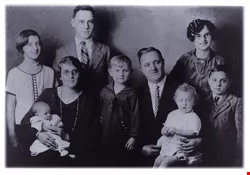
Brougham's family were ethnic-German Christians. In the upper of the two photos at the bottom of this page, the young Brougham is sitting on her father's knee.
Interactive education
With her new program, the innovative Brougham had turned a recording studio into a classroom. She incorporated interactive dialogues into her show and even brought listeners on to give her audience a greater sense of participation. Not surprisingly, the program received rave reviews. Listeners wrote in asking that the show's dialogues be printed to make it easier to follow along with the program. The producers agreed and began printing a two-page supplement without a cover that they sold for NT$1 per copy.
Around this time, the well-known linguist Lin Yu-tang returned to Taiwan from the United States. Kai-ming Publishing asked Lin to put together a series of English teaching materials for middle-school students, and wanted to produce a set of tapes to go along with the texts. Lin had heard Brougham's radio program and was much impressed with her voice. He immediately recommended that Kai-ming bring in Brougham to produce their tapes. Working together on the project, Lin and Brougham became good friends, and Lin compli-mented Brougham as the best of English teachers.
To ensure that she had enough materials for her radio show, Brougham read an average of ten magazines a month, incorporating new information of all kinds into her articles. In fact, Studio Classroom introduced the microwave oven and the concept of the global village to Taiwan 20 years ago. In 1974, Studio Classroom became a full-blown magazine, and made the switch to color in 1977.
In 1981, Brougham also began publishing Let's Talk in English and producing a radio program to accompany it, with reading and listening materials appropriate for middle-school students. Today, the two magazines have a circulation of about 500,000 between them, making them Taiwan's most popular English-language publications. In addition, another two million people take in Studio Classroom content every day on the radio, TV or the Internet. Studio Classroom has broken even for the last ten years without the assistance of donations. However, the company must spend more than NT$1 million a month to buy time on local radio stations to ensure that its programming reaches listeners in the more isolated parts of Taiwan. Three years ago, once again with the goal of spreading the Gospel through English, Brougham began selling Studio Classroom in China, making it the first Taiwanese English teaching publication to be distributed there.

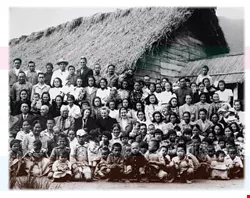
In 1951, the young Brougham went to Hualien as a missionary. There she became involved with the local aboriginal communities, who gave her an aboriginal name meaning "a blossoming bouquet of the lilies that grow in the valleys of Hualien."
Serendipity
Although she rose to fame as an English educator, Brougham says that this was completely inadvertent. "I didn't come to Taiwan to teach English; I was originally a music teacher. But Lin Yu-tang and Wu Ping-chung kept pushing me to teach English because there was a need for English teachers in Taiwan."
Although Brougham is already 76, she has no interest in retiring.
"If I had worked in a factory, I would have retired a long time ago. But I've been involved in education, in which you are forever sharing with other people." Lately, Brougham has been reading the latest books on management from the States, writing abstracts of each and translating those abstracts into Chinese for her colleagues.
In 1997, Brougham traveled to Kazakhstan in Central Asia to visit the Uighurs there and was tempted to stay. She says, "They really loved me too. When I see someone in need, I want to help them."
According to Simon Hung, Studio Classroom's president, "She's a very curious person by nature; that curiosity has driven her personal growth her whole life." For example, Hung says that when Brougham goes out with her colleagues, she always takes a different route on the way back; she loves visiting unfamiliar places and learning new things.
Brougham, who also loves cats and spaghetti, learned to scuba dive at the age of 56, and it quickly became her favorite hobby. She still goes diving in Malaysia once or twice a year when she can get away. Brougham is also a big fan of Jackie Chan, and a colleague of hers once even used a computer to make a poster showing her in hand-to-hand combat with him.
Brougham says of her admiration for Chan, "Jackie Chan came through the school of hard knocks, which is no easy task. And his movies are funny."
A life of sharing
Brougham has sacrificed a great deal to her vocation. As a youngster, she gave up her study of music to travel overseas as a missionary. She lost both her parents while abroad, and has also declined several proposals of marriage. But Brougham continued to pursue her dream, working still harder at spreading the Gospel and teaching English in Taiwan, even after the ROC's international position began to deteriorate following its withdrawal from the United Nations and the end of formal relations with the US.
Following the Chichi Earthquake, Brougham's Overseas Radio and Television donated one million NT dollars to disaster relief funds and even sent foreign teaching staff and other employees to Puli and Tungshih to help with rescue efforts and post-disaster reconstruction.
For 50 long years, Brougham has lived in a foreign land without kith or kin, but she has no regrets because people thank her every day for her efforts.
"Of course there are times when I'm lonely, especially at Christmas. But I don't think that marriage would have made things any better; my view is that you shouldn't rely on other people for your happiness. All people have times when they are low. Maybe you feel lonely today, but the sun will come out tomorrow. Don't fret the bad days too much." Without doubt, Brougham will continue to give of herself to those places and people who need her.


