

Some say, "anxious youth," what have you got to be anxious about? Study? Love? The future? All these problems seem easy to solve compared to the sensitive topic of sex.
For fresh and virginal youth, what does it matter what they know about sex? What if they don't know?
Recently, sex education has become a hot topic, especially since the broadcasting of "The Origin of Man" on public television.
After the program, focused on sex education, was broadcast, many parents called to ask whether or not the program could introduce changes in the psychology of the young, for "we really don't know how to talk about these problems with our children. . . ." Many feared the program was unsuitable for small children, but Cheng Chung of the Committee on Public Television noted the program was for general viewing and that it would be even better if parents could discuss it with their children after the program. A schoolteacher from Taoyuan called on schools to instruct students to watch the program and to supplement it with classroom materials and discussion.
The program was widely welcomed. "Bringing this topic into the living room is a major breakthrough," said Chang Yu, Assistant Professor of Public Health at National Taiwan University.
This small step is a giant one for Chinese. In traditional thought, sex was for procreation, not for personal expression or for emotional fulfillment. Children who asked "where do babies come from?" were likely to be told either that such matters were not appropriate for children or to be fed myths like "they come from stones."
In fact, sex is also a way to help a person satisfy their need for close interpersonal relations, but traditional thought does not recognize this aspect.
And as for education, it is joked that when teachers get to "Chapter 14" in health education (the chapter on sex) they look up at the ceiling or down at the floor, but dare not turn around to look at the board. In fact, many schools just skip over chapter 14 altogether.
Because of these reasons, according to statistics, the vast majority of young people learn about sex from their friends or from the mass media; only ten percent acquire their knowledge in school.
And these sources are none too helpful. One teacher specializing in psychological guidance points out that watching sex films has recently become a popular pastime for the young. But these provide no details, and from them "the only thing you can learn is 'sexual positions' and not real knowledge about sex." And the mass media focus on sex crimes, prostitution, or sexually transmitted diseases.
The Excellent Company, producers of "The Origin of Man" program, surveyed 1400 young people from 13 to 35 in Taipei and Chia-yi. Respondents answered "don't know" to 31 percent of the questions, indicating the inadequacy of sexual knowledge among the young.
The price of ignorance "can be seen most clearly in the hospital," says Dr. Hsieh Ying-hua, where one finds unwed mothers, abortions, and victims of venereal diseases. Other clear examples come from the print media, where exaggerated advertisements display miracle cures for impotence or other sexual problems.
It's no wonder then that some criticize this era of "too little sexual knowledge, too conservative sexual thinking, and open sexual activity."
Criminal psychologist Hwang Fu-yuan is concerned about the 15 percent increase in the rate of sexual crimes over the last three years. He notes that especially junior high school students have a great curiosity about sex, and "if they are not given correct guidance at this time, they must explore other channels to the end." Generally speaking, boys reach sexual maturity at about 14, girls about 12.
While some fear that greater knowledge will lead to the side effect of greater activity, the experiences of other nations tell us that sex education has benefits. In Sweden, sex education is compulsory, but its implementation did not lead to any increase in the rate of sexual crimes.
The minimum purpose of sex education is to avoid the problems of ignorance. But its more active purpose is to "extol human sexuality, support a wholesome and satisfying family life, and create a sense of responsibility toward oneself," says Yen Han-wen, professor at the National Taiwan Normal University.
But when is the best time to start? Children become curious about their sex organs by four years old, about where babies come from at five to eight, and conscious of sex differentiation at eight to twelve. Many experts thus suggest that sex education should start at about ten years old.
What should be taught in sex education? The U.S. in 1980 issued guidelines for graduated curricula going from simple understanding of bodily functions (five to nine years old) through physiological changes like menstruation (ten to twelve) to self-understanding and questions of male-female relations and birth control (thirteen to fifteen) to dating behavior, parenting, and family planning (fifteen to eighteen).
A survey done in the R.O.C. in 1980 revealed that young men want to learn about ejaculation, sexual behavior, sexual films and books, venereal diseases, and virginity, while girls wanted to know about virginity, sexual maturation, sexual harassment, birth control, and falling in love. It is clear from this that their questions go beyond simple physiology.
Chinese specialists suggest a wide variety of subjects to be taught. Yen Han-wen stresses that sex also needs understanding, respect, and responsibility, and means love, caring, and communication. Sex education should include family life and marriage.
Hwang Hsiang, author of a column on male-female relationships, advises that sex education include dating practices and the physiological fact that boys' sexual interest peaks at eighteen or so, while women's peaks at around thirty. Chang Yu says that it is especially important that relations between the sexes and sex role differentiation be stressed since Chinese society has traditionally favored males.
"Sex education requires interdisciplinary, comprehensive work," National Taiwan University Professor of Psychology Hwang Jung-tsun wrote in an article. It includes physiology, law, psychology, sociology, and more, and is related to a society's entire cultural and educational systems. This comprehensiveness is by no means easy to attain.
Currently, in its first season, the series "The Origin of Man" has been scholarly--some would say bland--focusing on the reproductive systems, childbirth and pregnancy, and so on. The second season will include units on sexual problems, menstruation, sexual psychology, and other topics.
Besides TV, there are other ways to undertake sex education. In Hong Kong they use comic books available on the street; in West Germany and elsewhere cartoons are one vehicle; in Japan, a series of sex education movies has been produced for children and adults.
In the R.O.C., public television's first step has met an enthusiastic response. Whatever direction sex education takes, at least we are "on the road."
[Picture Caption]
The airing of the series "The Origins of Man" caused a tremendous reaction among viewers.
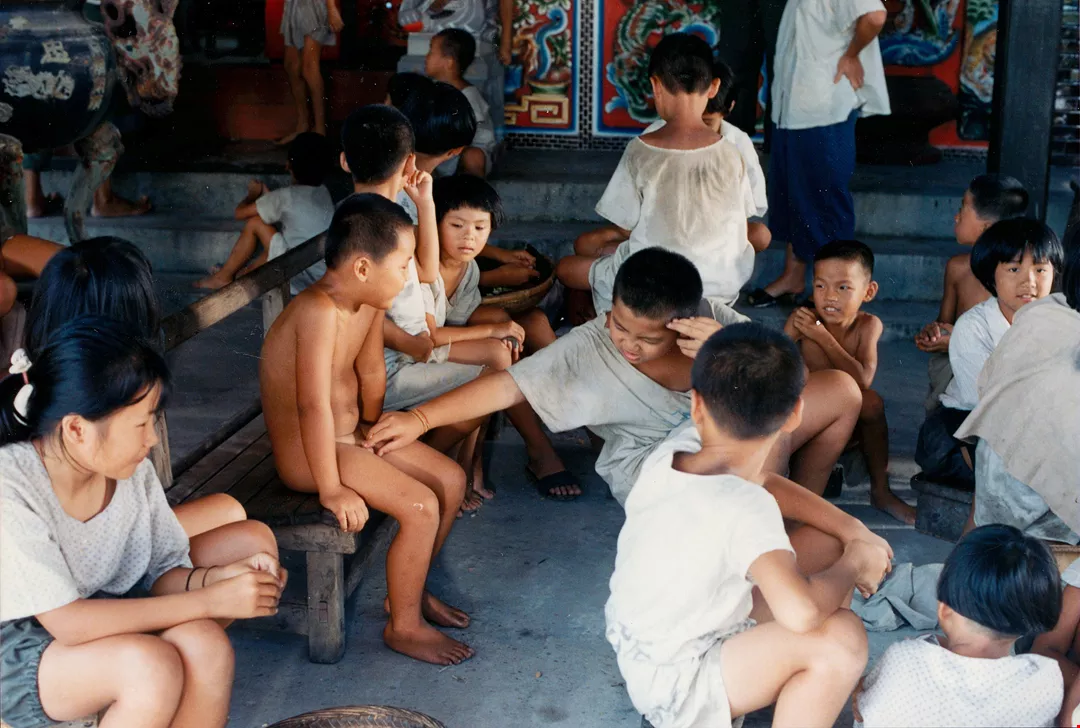
Curiosity about the reproductive organs is a natural part of the process of growing up. (photo courtesy of Wan Lung Motion Pictures)
Admiring young idols--where haven't young people gone through that?
"Walk slowly on the road of love." Sex education teaches not only about physiology, but about psychology and society as well, and should be closely connected to the topics of love and marriage.
Since the lifting of restrictions on dancing, there are a lot more opportunities to meet and learn about the opposite sex. (photo by Vincent Chang)
Exaggerated ads promising miracle cures for sexually related problems can mislead unaware young people.
Maintaining a happy family is the most important goal of sex education.
Curiosity about the reproductive organs is a natural part of the process of growing up. (photo courtesy of Wan Lung Motion Pictures)

Admiring young idols--where haven't young people gone through that?

"Walk slowly on the road of love." Sex education teaches not only about physiology, but about psychology and society as well, and should be closely connected to the topics of love and marriage.

Since the lifting of restrictions on dancing, there are a lot more opportunities to meet and learn about the opposite sex. (photo by Vincent Chang)

Exaggerated ads promising miracle cures for sexually related problems can mislead unaware young people.

Maintaining a happy family is the most important goal of sex education.


@List.jpg?w=522&h=410&mode=crop&format=webp&quality=80)
