

The dog's place in human society is vastly different from that of a wild animal facing extinction. The dog is just about man's most commonly raised pet, and the canine-human relationship provides the clearest portrait of man's love for a fellow creature--but also the sharpest images of his cruelty to animals.
Although dogs abandoned to roam the streets are just one aspect of how people in Taiwan treat dogs, Westerners are given to generalize as regards Chinese behavior toward animals. After all, don't the Chinese, who put rhino horns and tiger bones into medicine, think that eating dog meat invigorates the body during the chill months of winter? But in reality is there much difference between the way Chinese and Westerners treat dogs?
In Germany in April of this year, rumors that Chinese restaurants were selling "sweet and sour dog" caused some Germans to boycott Chinese restaurants, making business drop by 30%.
When it was later proven that the reports about dog dishes were groundless, the Berlin Labor Bureau, which had made the charges, issued a formal apology to Chinese restaurants. Many attributed the ultimate cause of "the dog meat incident" to latent German racism. Still, many Westerners hold to the stereotype that the Chinese do eat dog meat for nourishment. Especially now, after a series of international incidents involving rhino horns and tiger bones, the Chinese have acquired a reputation as bloody-handed barbarians, who can often be seen biting at hunks of dog meat or gnawing on rhino horns.
The impassioned reaction of the Germans regarding the "dog meat incident" is of course related to the emphasis that Europeans put on protecting animals. There, many dog owners love their dogs, treating them like members of the family. How the Chinese could kill Spot or Rover and serve up his remains at the dinner table is hard for dog lovers to comprehend.
But think about it in more detail: Westerners are not by any means the only people with a tradition of treating their dogs as darling pets. Nor is occasionally offering up dog meat for a sumptuous meal an exclusively Chinese custom.
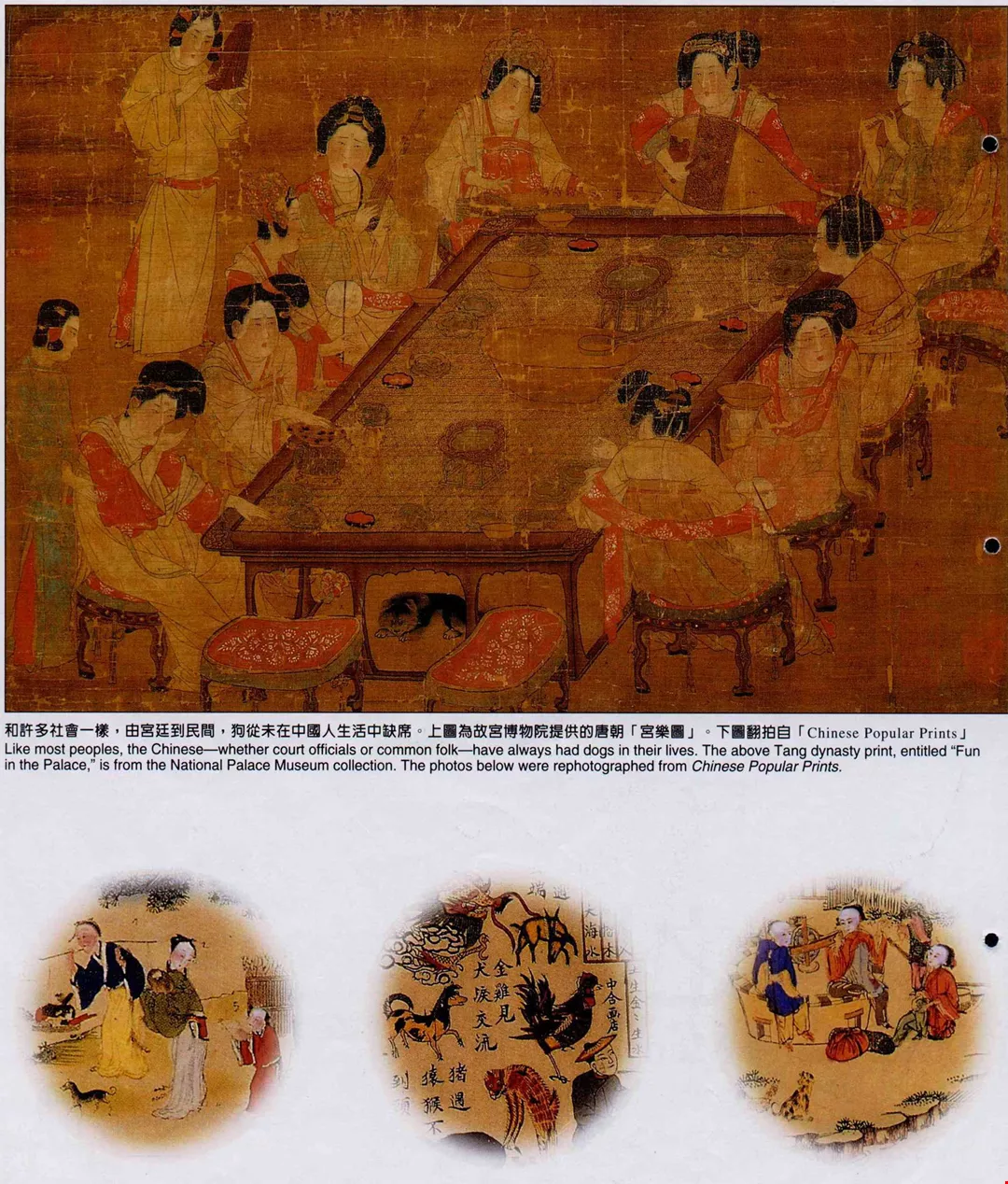
Like most peoples, the Chinese--whether court officials or common folk-- have always had dogs in their lives. The above Tang dynasty print, entitled "Fun in the Palace," is from the National Palace Museum collection. The photo s below were rephotographed from Chinese Popular Prints.
Loving dogs, eating dogs
It is not only in the Orient that dogs have had the misfortune to end up at the butcher's. There are records of dog meat being sold in Greece and Rome, the fountainheads of Western civilization. And there are still groups in Europe and the Americas who go in for eating dog. In Veterinary Medicine and Hu-man Health, C.W. Schwabe mentions that an outbreak of trichinosis in one area of the Swiss countryside was blamed on the local fondness for dog meat. Which begs the question: Where are dogs better off, East or West? The wild dogs that run rampant on the streets of Taipei often shame those Taiwanese who have visited America or Europe, but don't be under the mistaken impression that the reason you see no stray dogs on Western streets is because Westerners treat their dogs with love and affection. The reality? According to statistics from Britain's Royal Society for the Prevention for Cruelty to Animals, British streets support about 500,000 stray dogs a year. And in Chicago alone more than one million strays are caught and killed every year, giving it a reputation as the world's worst failure in canine population control.
Europe industrialized and urbanized in the 18th century, at which time urban stray dogs became a major problem. For a long time, people used the easiest and quickest way of dealing with strays, which was to catch and slaughter them, treating them as garbage to be processed.
In Taiwan, where the number of stray dogs grows by the day, many cities and towns don't have dog-catching squads. One member of the Council of Agriculture believes that if only people and dogs could get along, there wouldn't be any need to catch stray dogs. And it wasn't until very recently, when the problem of strays became very serious, that environmental agencies began strengthening their dog catching functions. With domestic dog lovers raising angry cries, conservation groups here are saying that dog-catching as it is now practiced is cruel, and they have invited foreign animal protection groups to teach sanitation personnel "how to catch dogs humanely."
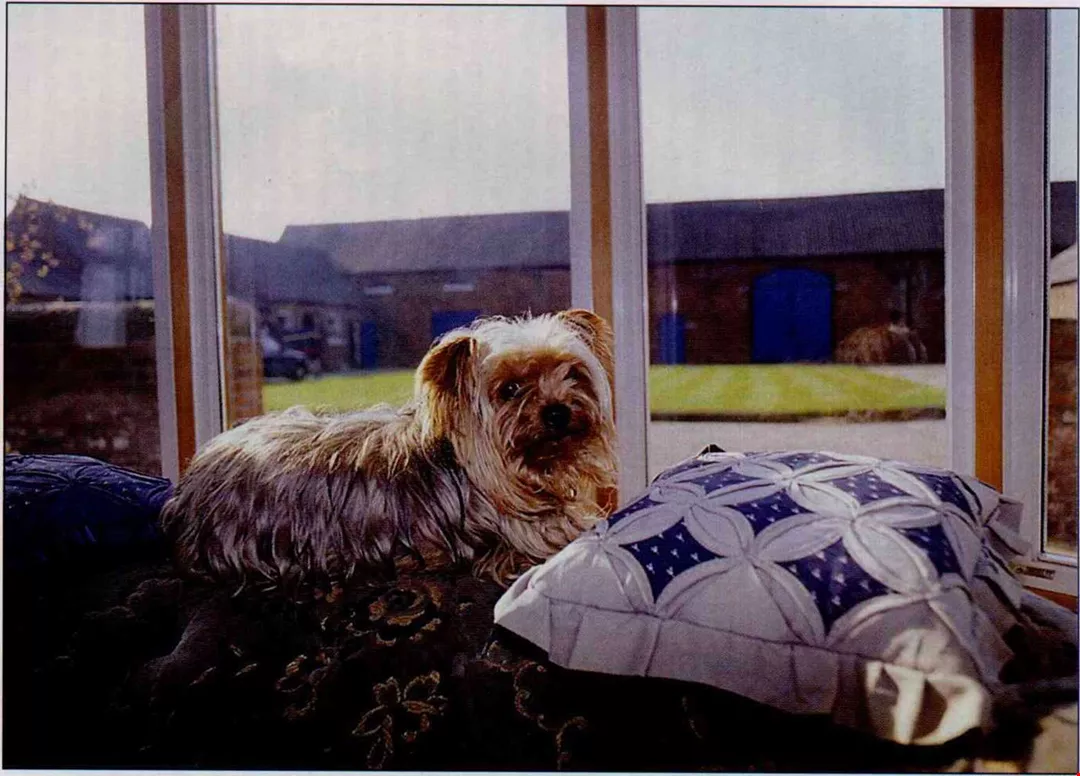
Napping on a soft-as-velvet sofa--what a life! Many dogs in Europe are regarded as the family's coddled daughter. (photo by Vincent Chang)
A stone-age pact
In reality, it's very difficult to determine which ethnic group loves dogs most. Because the dog was the first animal to enter human society, most cultures have a long history of affection for the dog, which is unmatched by feelings for any other animal.
Way back in the stone age, when man looked out across the wilderness, the dog was already his trusted companion.
Zoologists believe that dogs were perhaps first domesticated in South Central Asia, but as people wandered across the continents, dogs entered all cultures and played important roles in them. The canine-human bond may vary from group to group, but it is a complicated relationship among them all, one full of "contradictions." In this respect, the Chinese are no exception.
In Huaiyang County in Henan Province, Fuxishi, the mythic progenitor of the Chinese who taught man to fish and raise livestock, had the face of a man and the body of a dog. The character fu (伏) has the radical for man on the left and the radical for dog on the right. In Huaiyang today, they give children toys made out of clay, which are called "nini gou"--or clay dogs, the earliest form of which is said to have been the half-man, half-dog Fuxishi. Mainland Chinese scholars believe that clay dogs are a valuable resource in research that probes the roots of Chinese culture, and should be protected as national treasures.
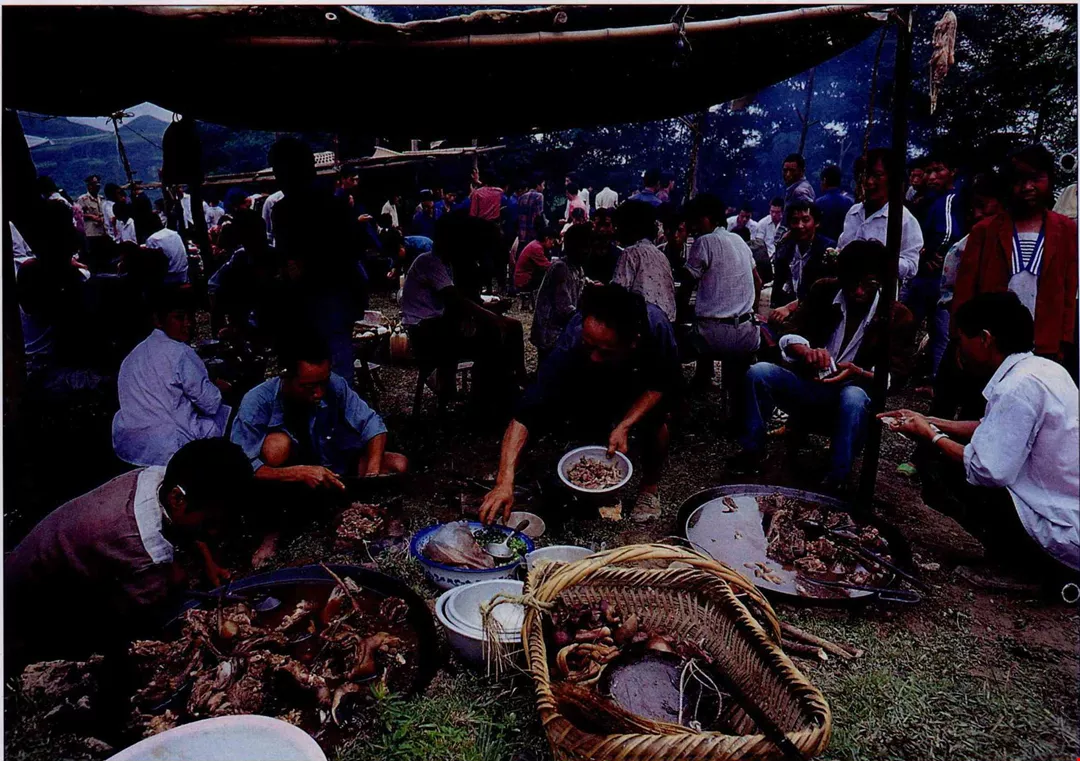
Culinary habits are long in changing. Many Asian ethnic groups today still eat dog meat. The photo shows the "Dog Meat Festival" celebrated by the Buyi people of Guizhou on the sixth day of the sixth lunar month, when Buyi gather to feast. (photo by Lin Tien-fu)
Fuxishi: half dog, half man
That the Chinese progenitor Fuxishi was half dog, half man is related to the dog's status in a primitive age of hunting. The anthropologist Jang Chang-juei believes that surviving in the wilderness without dogs would have been like trying to survive there blind. In such an environment people naturally came to view the dog with great respect, the equal of man.
In many hunting societies, dogs were given proper burials. The American Indians have a legend that a human progenitor and a dog together created the world. Long ago, in Taiwanese aboriginal hunting tribes, dogs were regarded as more valuable than cows.
Out of necessity, every ethnic group that went through a hunting phase accepted, tamed and raised dogs. But when human tools progressed, and agricultural societies became more and more dominant, the cow and ox began to be more essential for man than the dog, and the dog's status began to fall dramatically to where it merely kept watch. Mean while, the ox, out there helping to till the fields, saw its own status leap. And today, many Taiwanese farmers still refuse to eat beef.
The dog may no longer be a major tool for human survival, and it has lost the religious import it had during the age of hunting. But the dog still frequently appears in Chinese derogatory expressions, such as "dog thing" (meaning bastard), "dogs eyes looking down on people" (meaning a low-life who looks down on others for no good cause) or "dog relying on master's power" (referring to cowardly and well-connected bullies). "A dog who barks by a well" (until he falls in) refers to someone hurt by his own ignorance and stubbornness.
According to historical records, dogs were originally man's most important aid in catching rats. Later, their place was taken by light and nimble cats. There is even a derogatory idiom that runs, "the dog who tries to catch mice isn't minding its own business."
In Hsiehshengwang Temple in Chiayi, Taiwan, the worshippers must present offerings of dog meat, because the deity of the temple is a thief who was chased by biting and barking dogs as a man. In Chinese society, good guys and thieves all pray for peace of spirit. And it's only fitting that worshippers at the temple of the "thief king" will offer dog meat.
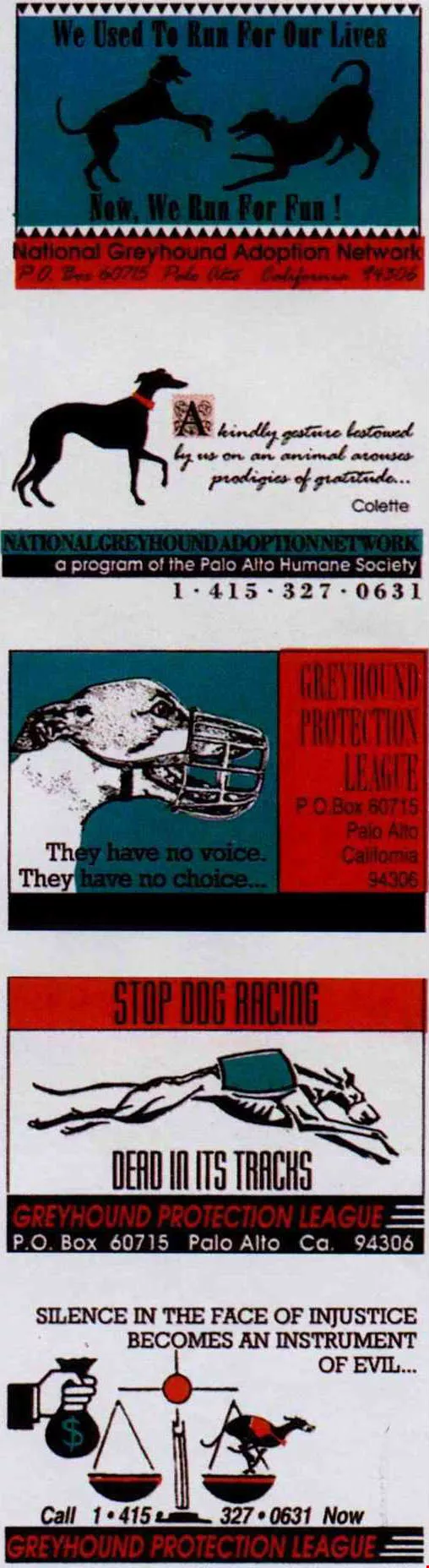
Dog racing is very popular in Europe and America, and a frequent target of international conservation group attacks. (courtesy of the Life Conservationist Association)
Bullied by man
In the West, the dog has encountered just about the same treatment. As man has grown more powerful himself, the dog's status has gradually declined. Americans curse each other with the term "son of a bitch"--which takes canine degradation to the extreme. At the beginning of the Republican era, on a park gate in a foreign concession in mainland China were the words "No Dogs or Chinese Allowed." They didn't mean to compliment dogs by grouping them with the Chinese.
The symbolic import of dogs relates to their actual status. And their ultimate fate in Eastern and Western society proves that as humanity has grown ever cleverer, dogs have been reduced to relying on people to survive. When people can treat dogs however they want, the ways people do treat them grow ever more varied.
In The Rites of Zhou, it is written there are three kinds of dogs: "field dogs, watch dogs and eaten dogs." The above-mentioned "eaten dogs" were the full-bodied ones, plump and full of meat. During the Han dynasty, dog liver was one of the eight culinary treasures.
In the past, when techniques for raising and breeding livestock weren't nearly so advanced as they are today, people would put anything down their throats as long as it would sate their hunger. Hence, it would hardly be surprising to find dog meat on the dinner table back then. Culinary traditions aren't made overnight.
The Chinese put much emphasis on creating a harmony between the human body and nature, and so Chinese medicine has developed an elaborate system within which dishes are classified as "cold and fortifying" or "hot and fortifying." In this jargon, dog meat is "hot and fortifying." And the organs of the dog can also be used in medicines.
In maintaining feelings of affection over a long time, people are no match for dogs. In many dog-eating societies people would only eat dogs raised in special, separate compounds, so as to reduce any potential qualms. In the Bencao Gangmu (Compendium of Materia Medica), Li Shi-zheng repeatedly exhorts that dog meat used to provide fortification in the winter months must only come from dogs raised to be eaten, and not from beloved family pets.
In some areas of Asia and in the southern Sahara Desert in Africa, people still eat dog. In South Ko-rean markets you can find stalls specializing in dog meat.
While Chinese still eat dog, the areas where they do are actually very limited. Guangdong (Canton) is most famous for it. Because most overseas Chinese are Cantonese, its cuisine has the most international exposure, and the habit of eating dog has occasionally been brought by Cantonese immigrants to their adopted lands, giving people the mistaken impression that all Chinese often eat dog meat.
But just as cultures differ, people's taboos and moral views also vary. From a dog lover's perspective, eating dog is incomprehensible. But from the perspective of elderly Taiwanese who don't eat beef, those who hold dogs close to their hearts and then go to a steak house might well be considered evil barbarians who ought to burn in hell.
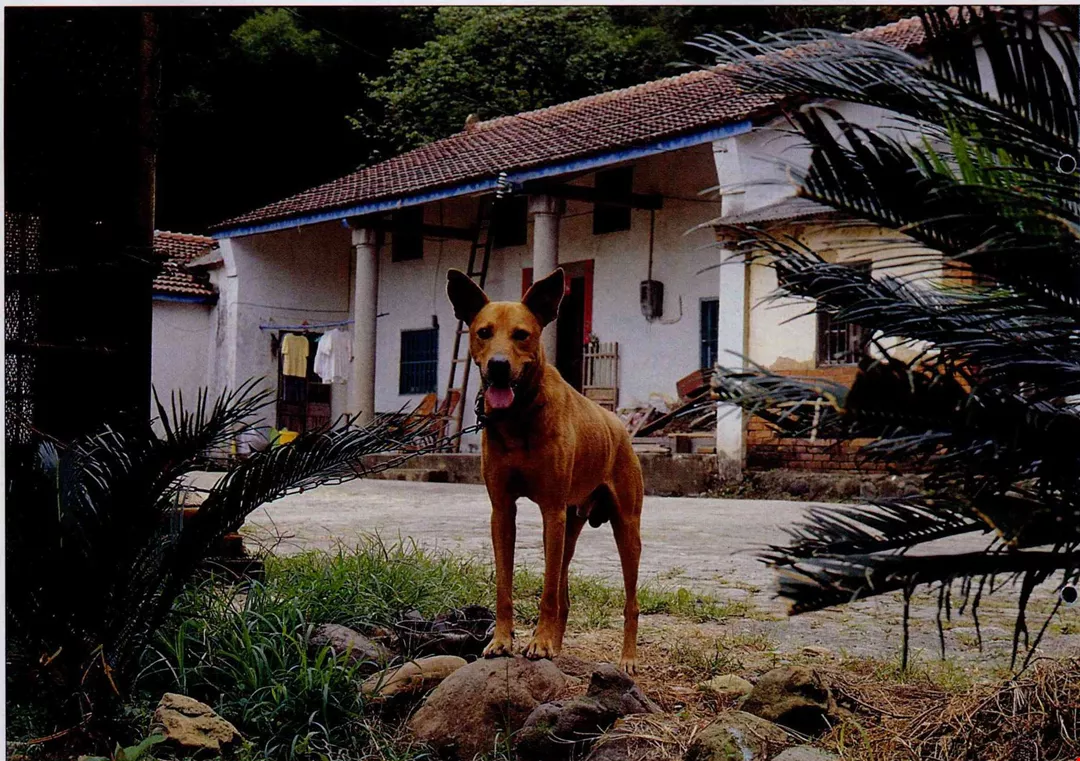
Dogs are man's trusted helpers. They can help guard the house and serve as partners in the hunt, and emotionally they provide their owners with great tenderness. (photo by Vincent Chang)
You eat dogs, I race them
The uses for dogs in the West are even more numerous. There they used to categorize dogs as hunting dogs, sheep dogs, war dogs, fighting dogs, and watchdogs. In the 16th century, when Spain conquered what are now Mexico and Argentina, they trained dogs to attack and kill the natives. Today, in Europe and America, there are dog races held for the purposes of entertainment and gambling. In comparison, the traditional Chinese uses of dogs for meat and medicine seem more moral.
According to the Encyclopedia Britannica, large-scale and systematic dog racing was developed in the West in the 19th century. It's still booming today. According to the statistics of the American Humane Society, every year nearly 50,000 greyhounds die in the dog racing industry--because to the industry, dogs are just racing machines. Only one-eighth of greyhounds bred to race live to see their fourth birthday. Now many conservation groups are shouting for the governments of Europe and America to ban this immoral activity.
In February of this year, the Life Conservationist Association invited the World Society for the Protection of Animals to visit Taiwan. The society's adviser-director Princess Elizabeth De Croy from France was surprised that Taiwan had banned dog racing, and said that this had changed her stereotyped impression that Taiwanese don't love dogs.
In truth, people everywhere are alike at heart, and many kinds of behavior exist in a variety of different cultural circles. Differences are just a matter of degree. There are, for instance, some Western groups that still eat dog meat. Nor can it be said that the Chinese have never gambled on dogs. In the Han dynasty, the sons of wealthy families "fought cocks and raced dogs and bet on the outcome." Today many Taiwanese want to turn back the clock and are asking the government to legalize horse and dog racing.
Jang Chang-juei, who is preparing to write a book entitled Animals and Ethnic Customs, says, "Because people from different socio-economic levels have different attitudes and make different demands on resources," a hundred different kinds of people will raise 100 different kinds of dogs. Dogs have many different fates.
And so simply looking at utility and economics to determine the meaning of dogs' existence in human society slights the relationship between the ancients and dogs and gives short shrift to the multifaceted nature of the relationship between man and dog even today.
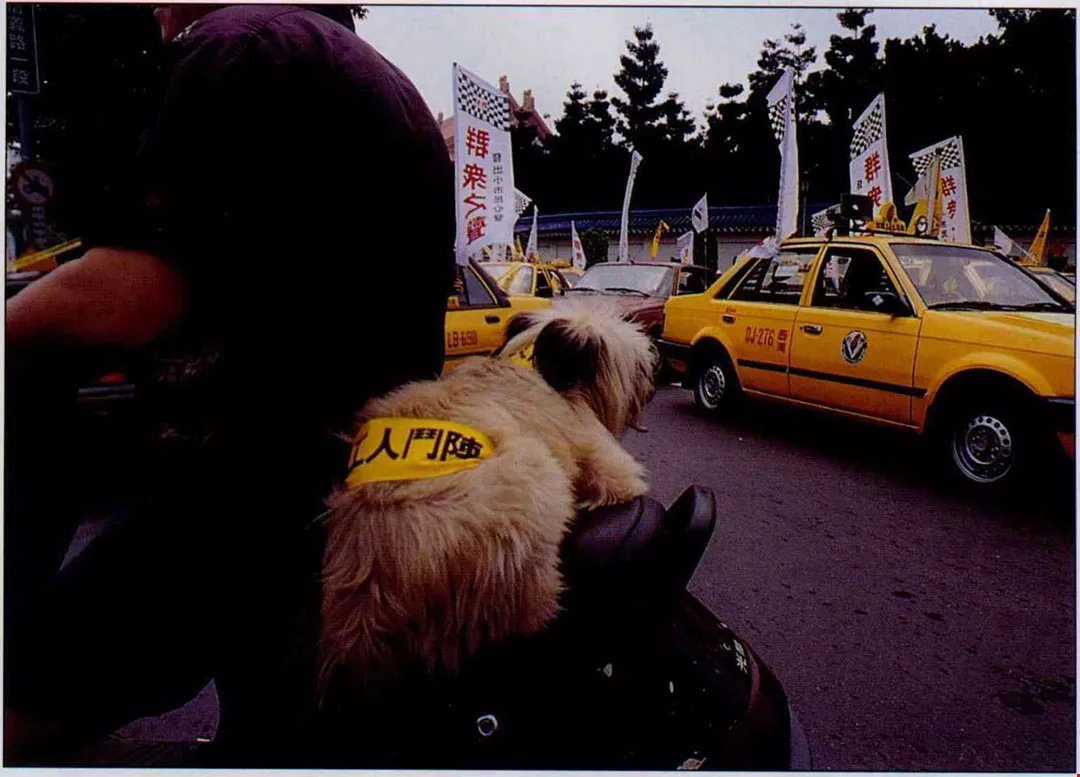
Today dogs can even have a cloth band tied around their bellies and hit the streets to accompany their owners at protest demonstrations.
Rather a dog at peace than man at war
Although the care and affection that people give to dogs can never be realistically compared to what dogs give back, in most cultures the dog is still the animal for which people have the deepest feelings.
The dog's nature is ultimately very different from such domesticated species as the cow, the sheep or the pig. When a dog looks at a you, he can turn your heart to mush, making it impossible for you to refuse him. And so in a society that can support pets, this four-legged family companion is never far from man's side.
Excavated ceramic Han dogs have short legs and long bodies, like coddled miniature poodles or Pekingese. During the Tang dynasty, dogs in even greater numbers entered palaces as treasured pets. The great poet Du Fu describes the society ladies of Chang-an: "The weather turns on the third day of the third moon/ And on the river banks the women gather, fair and boon. . . . In the late spring sun their embroidered robes shine/ With peacocks and unicorns needled in gold or silver line." It's just too bad that Du Fu didn't mention the dogs running around at the feet of the beautiful women. These canine companions might have been wearing red silk handkerchiefs or their entire bodies might even have been dyed the same color as their mistresses' clothes. Dog and mistress wearing matching clothes like lovers--how much notice it must have attracted! In today's Taipei one can also see beautiful women out on the streets with exquisitely attired dogs. Modern people who do this occasionally are typically regarded as pulling some strange stunt to draw attention to themselves. But the truth is they fall far short of how the ancients used to behave with their dogs. Tang beauties, the plump and the svelte, were the first to dress up their dogs. Today, people shouldn't seem so shocked--they're just making a mountain out of a molehill.
The painting "Ladies Wearing Flowers" by the Tang dynasty court painter Zhou Fang depicts five wealthy young women playing with two Pekingese dogs who'd been dyed various colors. Long before the baroque vanity of 16th century Europe, Tang dynasty women had presided over a period of material grandeur when even the dogs were showered in their masters' luxury.
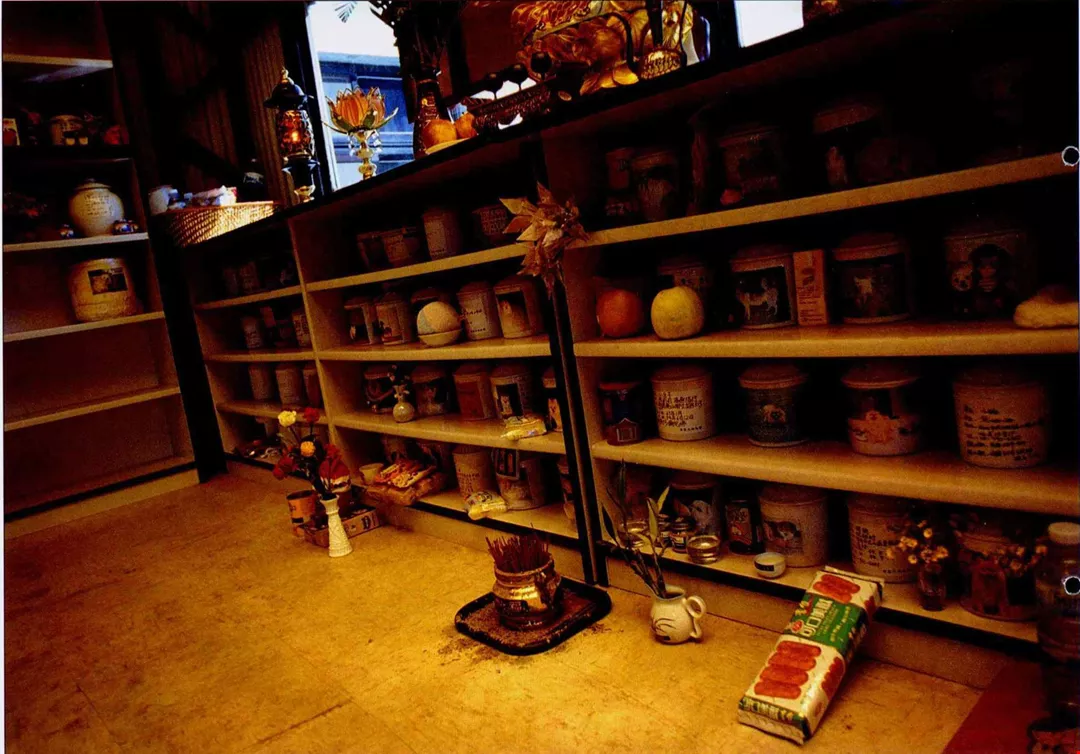
In canine funeral rites, biscuits, fresh flowers and toys are placed beside the deceased's mortal remains. Up in Heaven, does he know of his owner's heartfelt sentiments?
Confucius loved dogs
After his dog died, the great sage and teacher Confucius instructed his student Zhegong to arrange a burial. He said that because his family was poor, they couldn't afford a casket for a proper funeral, but they could at least wrap him in a woven straw mat to keep his body from being exposed. The Book of Poetry, an even earlier text, describes an ancient who had his dog carried in a cart so as to conserve its energy.
The Yanshi Jiashun (Family Instructions of Mr. Yan) mentions a Zhu Zhan who lived in Jiangling. A good scholar with no money, he didn't eat for many days, until it got to the point where he was eating paper. He wouldn't slaughter his dog to relieve his own hunger, and because it was winter and he lacked blankets, he and the dog cuddled together for warmth when they slept.
In affluent areas where Chinese live today, there are also cases where people spoil dogs like their favorite daughters. Take Taiwan, where a beloved pet need not lack for food or clothing, and there even exist restaurants, beauty parlors, photo studios and funeral parlors that cater exclusively to pets. How complete a range of services! In Taipei's Municipal Sixth Changli Cemetery one can even see scattered small tombs upon which are written, "Beloved Blackie's Final Resting Place" or "Little Flower enjoyed seven years of life."
After liberalization in the mainland, Taiwan residents couldn't buy any Pekingese dogs because all of them were being exported for sale in Beijing. In the past, those who could raise pets were members of the decadent moneyed class deserving of denunciation. Today, when one dog can go for as much as RMB$100,000, dogs are rare and precious goods and difficult to obtain. Of course, at these prices, dogs are not for eating, they're for spoiling.
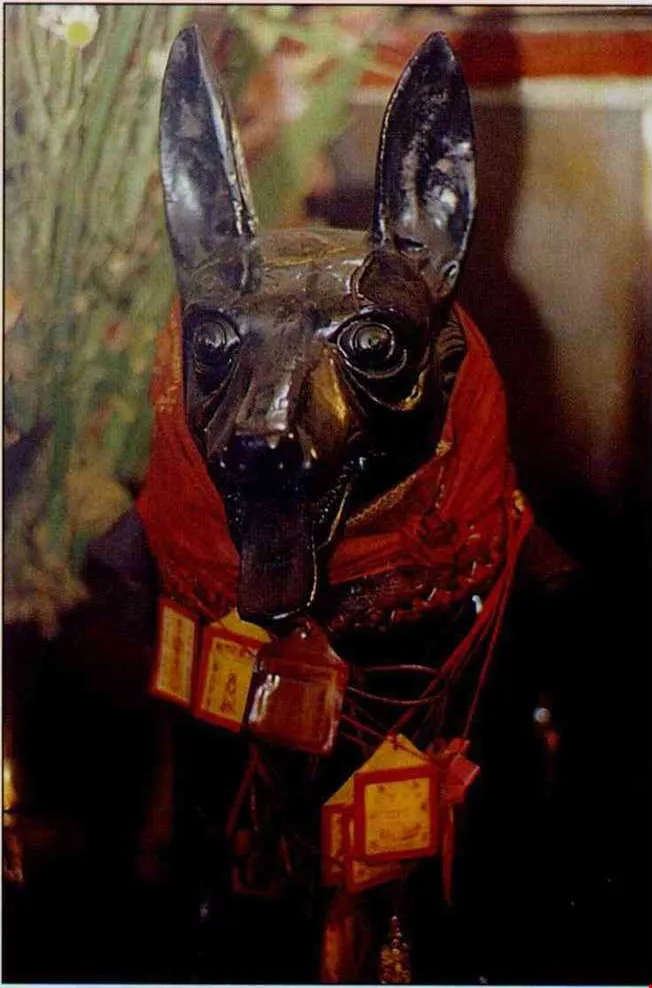
At Taipei County's Shihpa Wangkung Temple, offerings are made to a dog which, refusing to the bitter end to leave his master, was buried with him.
Dogs are also Buddha-like
Dogs that show remarkable loyalty and save their masters often become Taoist deities. The receivers of Chinese offerings. The Chinese worship loyal dogs for their moral rectitude. In this social value system, if men aren't loyal, they aren't even as good as dogs. When representatives for the World Society for the Protection of Animals came to Taiwan they wanted to visit the Shipa Wangkung Temple because no dogs in the West are so exalted.
A folk belief holds that dog's blood will ward off evil and keep away bad spirits. It is said to be much more effective than the blood of other animals because dogs have more spirit. It's similar to how the ancient Chinese thought that the turtle had supernatural powers of prophecy. As a result, they made divination blocks out of turtle shells, and carved half of the ancient oracle bone scriptures on them as well.
The Buddhist teachings of "protecting life" and "freeing life" have had a big impact on the Chinese, which is why academics hold that it is more difficult to control stray dogs in Taiwan than in the West.
In the six tracks of reincarnation, man and animals are neighbors, on the third and fourth tracks respectively. Hence, dogs can be reincarnated as people and people can become dogs. Because people and all animals including dogs alike have desires, alike suffer pain, and alike are self-centered, their wisdom and wants are very similar, and there is no basic difference in their natures. From this has derived the idea that freeing animals is good, causing stray dogs to appear in Chinese cities very early on.
In the Song dynasty, business and commerce prospered but city sanitation controls were not as strictly enforced as they had been in the Sui and Tang dynasty capitals of Changgan and Luoyang when the central government had more power. In the painting, "The Shang River on Tomb Sweeping Day," dogs are found in twos and threes amid the hustle and bustle of the Song capital of Bianjing, serving as a decorative counterpoint to the urban prosperity. Except during the massive campaigns to kill dogs in the mainland after 1949, over the course of history the dogs and cats that Chinese couldn't afford to raise were rarely killed.
It's just now that the urban scale is even bigger, the living environment more crowded, and roads ever busier with traffic, city living isn't suitable for stray dogs. The life of a dog roaming about the city is a frustrating one, and the Buddhist teaching of "freeing life" is a poor excuse for abandoning dogs to the streets, because stray dogs lead a life that seems worse than death. Today the problem has come to a point where it requires strict controls. People can no longer fool themselves about this problem by saying that "to live in misery is better than to die in peace."
From tool of production to trusted friend
The growing numbers of strays make clear how dogs have moved toward awkward extremes of status in modern society.
With the rise of industrial society, the dog took on new meaning for humanity. In a prosperous and busy society where relations between people are nervous and distant, the dog for most people is no longer a "useful" tool. It has shed its functionality and along with other pets taken the role of psychological trustee, providing for people's spiritual needs and serving as a "social lubricant."
The dog has once again taken a precious place in people's lives, like it had in hunting societies. Now that Taiwan is developed, the number of children per family is declining, to the point where some couples aren't even having children. And the children and grandchildren people do have are often anxious to flap their wings and leave the nest. Dogs, who aren't very particular about their masters, make ideal companions for many people.
Great numbers of dogs are pets, serving as spiritual companions. People are beginning to give their dogs birthday parties and enjoy the happiness of a family life with them. Some people are even leaving large inheritances to their beloved little pooches. In England, 8% of dog owners have insurance for their dogs.
On the other hand, there are more and more diseased strays roaming the urban landscape and rummaging through garbage to find food, prolonging their lives only temporarily in the streets and alleys.
Chuang Po-he, an ethnologist, believes that although dogs' relationships with the ancients were based on their utility, because people treasured and protected their resources, they would often hold a deep affection for their dogs; whereas today, dogs have become consumer goods whose value people manipulate. The market for dogs is highly speculative: The new hot breeds fall from favor as quickly as they rise, and values can soar or plummet. With breeders adopting herd-like instincts, dogs are propagating in profusion, so that supply often exceeds demand. Or sometimes dogs' masters no longer find their pets any fun. Either circumstance can lead to dogs being abandoned. Modern people have extended the concept of disposability to their pets, resulting in various bizarre phenomena.
Over the last few years, akitas have been bred to an overabundance and their value has plummeted. On college campuses, on Yangming Mountain, even on mountain slopes with an elevation of 1000 meters or more, you can find stray akitas. Wang Li-ling, the head of the Stray Animal Home, says, "Whatever breed is in fashion today will be roaming the streets in great numbers two years from now."
As the market for large dogs has crashed, dog sellers have pulled something new from their bag of tricks: They've imported growth suppression injections, to keep the puppies of large-breed dogs small forever, turning great danes into puny danes. And because dogs so injected take up less space and are cuter and more compliant, they fetch a higher price too.
In need of laws
Dogs are different from wild animals that constantly face the crisis of keeping the species going. Dogs, though free from fears about their species dying out, have to deal every day with human crises.
Animal lovers speaking on the dog's behalf can't use the same arguments that they use for animals facing extinction. But today, when there is a greater emphasis on morality and humane treatment of other living beings, many countries are hard at work creating animal protection laws in the hope that in addition to wild animals, the pets with whom people have ever closer relationships, livestock and other animals that serve economic functions can also have legal protection. Humans will never stop eating and using animals, but some of the pain and hardship can be eliminated from how they use them. Such laws could also prevent unnecessary abuse.
While animal lovers today have no way to ban dog races in Western societies, the laws governing such racing should grow stricter as opposition to racing grows. They could, for instance, prohibit the use of injections to force already injured dogs to race.
As for dog meat, Huang Hui-pi, an associate professor of veterinary medicine at National Taiwan University, says that there is no way to ban the eating of dogs outright, but as long as people are raising dogs to be butchered, the law can at least prevent the process from being too cruel.
A fierce look and a gentle heart
The I Ching says that "dogs have fierce exteriors that can stop intruders, but gentle hearts."
The dog isn't man's slave but rather his compliant and gladly servile friend, wagging his tail whichever way his master wanders, showing man limitless love and loyalty.
It is a virtually unchallenged axiom in both the Orient and the Occident that the dog, who has walked beside man through history, is "man's best friend." Yet since man walked through the wilderness hunting game, it seems that not a single society has been a wholehearted friend of the dog. Does the tragedy stem from the dog picking the wrong companion way back when?
[Picture Caption]
p.6
Dogs are loved by men and women both East and West. What a cool image one cuts taking doggie for a joy ride in a moment of leisure! (photo by Vincent Chang)
p.8
Like most peoples, the Chinese--whether court officials or common folk-- have always had dogs in their lives. The above Tang dynasty print, entitled "Fun in the Palace," is from the National Palace Museum collection. The photos below were rephotographed from Chinese Popular Prints.
p.9
Napping on a soft-as-velvet sofa--what a life! Many dogs in Europe are regarded as the family's coddled daughter. (photo by Vincent Chang)
p.10
Culinary habits are long in changing. Many Asian ethnic groups today still eat dog meat. The photo shows the "Dog Meat Festival" celebrated by the Buyi people of Guizhou on the sixth day of the sixth lunar month, when Buyi gather to feast. (photo by Lin Tien-fu)
p.11
Dog racing is very popular in Europe and America, and a frequent target of international conservation group attacks. (courtesy of the Life Conservationist Association)
p.12
Dogs are man's trusted helpers. They can help guard the house and serve as partners in the hunt, and emotionally they provide their owners with great tenderness. (photo by Vincent Chang)
p.13
Today dogs can even have a cloth band tied around their bellies and hit the streets to accompany their owners at protest demonstrations.
p.14
In canine funeral rites, biscuits, fresh flowers and toys are placed beside the deceased's mortal remains. Up in Heaven, does he know of his owner's heartfelt sentiments?
p.15
At Taipei County's Shihpa Wangkung Temple, offerings are made to a dog which, refusing to the bitter end to leave his master, was buried with him.


@List.jpg?w=522&h=410&mode=crop&format=webp&quality=80)
