No Shortage of Prophets Here:The Economics of Fortune Telling
Eric Lin / photos Yang Chien / tr. by Chris Findler
July 2003


Fortune-telling stalls surround in-cense-choked temples like Taipei's Lungshan and Panchiao's Tzuyou. Divination books that abound in bookstores are targeting ever-younger readers. Psychics and astrologers packaged like pop stars have become television's hottest hosts. Recognizing the great potential and high profit margins of the psychic business, Internet and mobile phone companies are beating a path to the doors of soothsayers.
Global economic woes, wars, and epidemics have produced uncertainty and anxiety. People long to know what lies ahead. In this century of burgeoning science, the ancient profession of guiding people away from bad luck and toward good luck is being boosted to new heights with the help of the television, mobile phone, and Internet industries.
Lately, National Taiwan University Chinese Department graduate and translator Lin An-hsin finds himself at a loss when thinks of the monthly get-togethers with his classmates, many of whom have changed their names at the urging of fortune tellers who insist that saying the new names aloud often enough unlocks the powers contained within. His classmates greet each other warmly during these gatherings, but Lin, the only holdout, cannot get used to it and feels out of place.
"It's like having friends that you've known for years suddenly 'come out of the closet' only to reveal that they are, in fact, extraterrestrials," grumbles Lin. "It's really disconcerting." Worse yet, he continues, are the new names themselves-they sound like characters in a Harlequin Romance novel. It is like being trapped in the middle of some cheesy film.
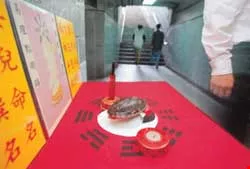
Tortoise shells and copper coins (right), birds and bamboo fortune sticks (left). Weighed down with anxieties, people today are inclined to place their faith in the mystical arts of divination, but will the guidance they receive lead them out of the darkness and into the light?
What's in a name?
Just how far has Taiwan's name-changing craze gone since materializing a couple years back? Let's take a look at Taipei City. According to municipal government household registry data, last year alone, more than 2300 individuals applied to change their names-a five-year high. With a population of under one million, Yunlin County in Central Taiwan reported some 6500 applications. Applicants line up outside the household registry agencies of many towns before the doors even open up in the mornings.
Su Ting-feng, who specializes in the art of naming, explains that the sluggish economy and escalating unemployment make the little guy feel impotent. He is looking desperately for someone to advise him, to steer him in through the maze of good and bad fortune. Minglixue-the field of knowledge covering fortune-telling, auspicious symbolism, numerology, astrology and the like-offers many traditional means to redirect fortune, from religious rituals in temples, burning of "eternal peace lights," wearing good-luck charms, and changing names to using fengshui to adjust the yin and yang around us. Changing names is the simplest and quickest approach. That, coupled with the fact that the Ministry of the Interior's Department of Census Administration revised the "Regulations and Bylaws for Names" in October two years ago, relaxing regulations to allow individuals to change their names twice, has led to more name changing.
"The household registry data only gives us an idea of what is happening out there," Su points out. "The number of people actually changing their names is possibly many times that, because, traditionally, intellectuals select alternative names and nicknames in addition to their given names and many people get new names without telling the authorities.
While other industries in Taiwan struggle, the name-change trend reflects the stellar performance of the numerology business. Just how big is Taiwan's market?
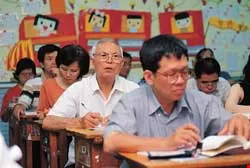
Many people that believe in fortune telling hope to get a glimpse of the mysterious patterns of the universe, but the tuition for most privately taught classes are prohibitively expensive. Students, young and old alike, have flocked to take Professor Lan Ming-ho's class on the arts of fortune held at Shihlin Community College.
Billions and billions
According to a survey taken by the Internet business assessment firm NetValue, Taiwan's psychic industry saw a turnover of more than NT$5 billion last year. In addition to traditional forms of minglixue, like Chinese astrology, geomancy, divination using tortoise shells and milfoil leaves, and name changing, new online versions are raking in some NT$300 million.
Turning to consumer behavior, a John Tung Foundation survey entitled "Levels of Depression and Habits in Seeking Medical Attention in the Greater Kaohsiung Area" sheds light on the role that fortune telling plays in the lives of the general public. It states that approximately 13% of the populace has serious problems with depression, but that only 7.2% of those afflicted actually seek medical assistance. Almost 65% of depressed individuals opt to seek help from psychics, divination by the eight trigrams (bagua), changing their luck (through changing one's name or dress, getting a new seal carved, or splashing on some holy water), or consolation through religion.
And, of course, the number of shamans offering their services has increased in proportion to the number of people seeking them. Kuo Chien-hung, a 34-year-old fortune teller with a BS degree, points out that people in this line of work do not necessarily hang out a shingle or register with the government. Many physiognomists work from their places of residence to keep costs down, consequently, there are no hard and fast numbers on just how many people are in the business. Estimates from within the trade, however, suggest that numbers have swelled by at least 30% over the last two or three years.
Both prophets and profits are increasing. Explains Kuo: "Media reports have helped improve the image of the minglixue industry in the eye of the public. What's more, it is a relatively easy field to get into-a couple years training and you are set to launch your own practice. Highly educated, middle-aged individuals are flocking to the field." Equipped with knowledge passed on to him by practicing family members and life experience accumulated in the workplace, Kuo, who became a sage a couple of years back, feels that he "got a feel for this line of business right away and has a pretty good reputation on the market."

Mystical studies might be baffling, but fengshui is the epitome of the wisdom passed down to us by our ancestors and encompasses many spatial concepts, including science and visual effects. Placing an aquarium or vase in your home or office is not only pleasing to the eye, it can open the way for the unimpeded flow of good fortune.
Making a fortune
Kuo set up shop in the makeshift marketplace on Hsishanshui Street next to the Lungshan Temple along with 30 or 40 other fortunetellers who are cramped together under a few dozen meters of sheet metal structure. Over the past three years, waves of "fortune seekers" have patronized the fortune-telling stalls and amulet vendors that sprout up each weekend amid the hubbub that engulfs Lungshan Temple. On rainy days, visitors pack the benches and jostle each other in the passageways next to these narrow booths.
Miss Chen performs a baibai (burns joss sticks in reverence to ancestors and gods) and draws bamboo sticks (foot-long slivers with fortunes carved on them) regularly each month at Lungshan Temple. While there, she often takes side trips over to the Hsishanshui Street market to have her fortune divined. It helps her "out of her funk."
"They seem to know what they're talking about-sometimes. In any case, it only costs NT$300 a shot," she says. "If a master exhorts me to beware of such-and-such, I do so as it gives me some peace of mind." Miss Chen explains that because of the flaccid economy and a market seemingly gone haywire, her business has been getting smaller and more dismal over the past two years-from two tea houses, to one coffee shop, and, finally, to a hole-in-the-wall place that she opened this year. Were it not for the smidgeon of hope that religion and seers give her, she doesn't know how she would make it.
"I've had my fortune told at almost every one of the booths around Lungshan Temple," says Chen, who compares the various psychics-their specialties, their strengths, their weaknesses. She points out candidly that she is addicted to fortune telling and that she has tried them all. It seems that she frequents astrology, palm reading, and physiognomy booths as often as her own kitchen.
After construction on an underground commercial area near Lungshan Temple is completed next year, fortune-telling stalls are expected to become an integral part of the local tourist industry there just as those in the underground passageway near the Hsingtien Temple have. Psychic stands have also been popping up around other temples over the past two years.
"Most of these people are weighed down by their troubles or they wouldn't come to baibai in temples in the first place," says Kuo. "Those who don't like the fortunes carved on the bamboo sticks they draw come over to us for divination or to have their fortunes told. We fortune tellers tend to dwell less on doom and more on positive things."
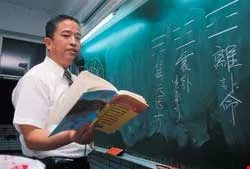
Many people that believe in fortune telling hope to get a glimpse of the mysterious patterns of the universe, but the tuition for most privately taught classes are prohibitively expensive. Students, young and old alike, have flocked to take Professor Lan Ming-ho's class on the arts of fortune held at Shihlin Community College.
Fortunes in the stars
Something interesting about the current fortune-telling craze is the fact that the media has helped to create numerous "psychic stars."
Psychic guests on such popular television programs as Lucky Strike and Fun with Fortune Telling frequently become sizzling celebrities. They print the names of the shows on which they have appeared on their business cards as a means to promote themselves. Jumping on the bandwagon, mobile phone and Internet companies are offering celebrity seer services. Far Eastern Telecom's I-style "515 Psychic Service," for instance, offers fortunes for romance, career, and wealth, as well as dress recommendations for improving your luck transmitted via short messaging at NT$20 a pop. Taiwan Cellular provides recordings by Tang Li-chi's Tarot Readings, Vivian's Astrology, and Hsu Shao-Hua's Naming for Fortune to their mobile-phone customers.
Pay psychic services on larger portal sites and psychic websites with "real human services" are catching the fortune telling wave. Boasting its own batch of celebrities, Live3p.com, founded last April, has organized large minglixue exhibitions held in conjunction with major department stores.
Live3p.com president Wu Yung-yu points out that at first, they require that their gurus be skilled in a variety of fortune-telling methods, including not only traditional Chinese arts like the four pillars of destiny and naming, but also Western astrology. However, the market still shows a preference for traditional Chinese forms. Interestingly enough, since the advent of the Internet has made the idea of space a moot point, one-third of their clientele is located abroad. Moreover, Hong Kong's psychic websites are popular with Taiwan's Internet users.
"Our figures show that females make up two-thirds of the visitors to psychic sites," says Wu. "Concentrated between 25 and 30 years of age, their questions deal mainly with romance, because, we assume, they feel pressure to get married." Wu explains that for most people, love is the most difficult thing in life to get a handle on and the most likely to cause distress, so their company asks their psychics to provide more positive guidance.
The policy of "real human psychics" is the key to Live3p.com's success, but it also limits company growth. Profits are lower because flesh-and-blood soothsayers can only handle so many cases. Computers, on the other hand, are fast and the NT$100-per-consultation price tag is inexpensive enough that users won't shy away from them, so major websites are working hard to develop more accurate fortune-telling software as a small profit, large volume sales strategy.
Showing students the door
Divination by the eight trigrams costs between NT$300 and NT$800 a session, and ziwei astrology goes for between one and several thousand New Taiwan dollars. Name changing is even more expensive. Wu Tsung-tai, who works in high tech and has studied fortune telling, feels that, "Instead of paying somebody big bucks to tell your fortune, you can study the arts yourself. Not only can you get a peek into the mysteries of fortune telling, if you become good enough, it can be a second vocation. If things work out, you can even start your own business." Many study fortune telling with the same ideas in mind, but after they actually start their studies, they realize that these courses only scratch the surface and that the teachers tend to hold back some of the more important trade secrets. The fine points of minglixue and the teacher's experience are available only to true disciples willing to fork out hundreds of thousands of NT dollars for the privilege.
Lan Ming-ho, who lectures on minglixue at Shihlin Community College, explains that in minglixue, the adherents to the Ziping School are skilled at the quick and easy form of bazi fortune telling, which is good for foreseeing luck, whether good or bad, and is particularly accurate in forecasting wealth. The Ziwei School employs ziwei doushu, the study of shifts in the constellations, and although not as good at predicting wealth, it is excellent for auguring romance and disasters. Members of the Jianghu School, who focus on body language and what the client says, offer suggestions based the auras they exude.
Lan explains that to excel at fortune telling, you have to learn under many masters and blend the fortes of their various schools. Their combined tuitions, however, could amount to millions of NT dollars. As most people are only interested in dabbling, it just does not make economic sense to pay six-digit figures just to be accepted by a teacher. As an alternative, community colleges around Taiwan are now offering fine beginning and intermediate level courses in various forms of minglixue.
A Chinese proverb says: Teachers can only show students the door; students have to open it. If you are interested and willing to put time into your studies, there is no need for high-budget courses; many students at inexpensive community college have become "masters" in their own right after only one or two years of study.
The students beginning minglixue class at Shihlin Community College this semester come from all walks of life and average around 40 and 50 years of age. The students, the most conspicuous being a mother and son duo, are merely seeking a path to peace in their lives.
Rely on yourself for success
Cheng Tung-you, a fourth-year student in Fu Jen University's Economics Department, comes to class with his mother so that after class he can explain things she does not understand. He says that the teacher is very interesting. He adds that when they get home, he helps his mother rearrange the house in accordance with the principles proffered by the prof and this has helped mother and son grow closer.
"The problem is, it doesn't seem to work all that well. I still did poorly on my midterms even after adjusting the fengshui in our house." After thinking about it for a moment, Cheng points out that maybe he simply does not know enough yet. After ten classes, he feels that fortune telling and fengshui might be useful on a personal level, but as a student of economics, he does not feel that minglixue can be used to do things like predict the stock market.
His mother, who does not concern herself so much with scientific method, says that understanding minglixue has helped her relieve stress and has served as a sort of psychiatric therapy. When things go wrong, she can step back and try to determine the source of the problem: Did she not put enough effort into the task or was it simply bad luck? "You could say that it gives you a positive philosophy on life." She points out that her son is quite gifted in minglixue and she would not at all be against it if, in the future, he decided to make a career of it.
Times are changing. Fortune telling, considered vulgar in the past, has become very fashionable. But Lan Ming-ho exhorts novices that hard work is still the most important factor to success. This holds true in fortune telling as it does in any line of work.


